



Day 1: Depart from Kunming to Puzhehei, Stroll along Lotus Avenue + Stay in Xianindong Village (3.5h drive, arrive before 3:00 PM)
I left Kunming South Station at 8:30 AM, specifically choosing a window seat—watching the karst mountains outside slowly recede until they became distant shadows. The high-speed train departed on time at 9:00 AM. I held a cup of freshly brewed rose porridge bought earlier (from a breakfast stall at the station entrance, 5 yuan per bowl, sweet but not cloying) and scrolled through my phone while waiting to arrive. At 11:40 AM, the “Puzhehei Station” notification popped up. The wind at the exit carried a scent of green grass and was 3 degrees cooler than the city center, instantly refreshing me.
There weren’t many touts at the station, so I went straight to the “Carpooling Area”—I had added a driver’s WeChat in a local guesthouse group yesterday. He was holding a sign with my name, wearing a faded blue T-shirt, and spoke with a slight Qiubei accent: “Sorry to keep you waiting, miss. This car just finished dropping off guests; we’ll be in Xianindong in 15 minutes.” Sure enough, the car drove along an asphalt road lined with phoenix trees, passing vast paddy fields. The rice was just beginning to head, the tips tinged with pale yellow, and as the wind blew, the rice leaves rustled against the car window. Before 12:00 PM, the car turned into the alley of Xianindong Village. On both sides of the bluestone road were aunties carrying bamboo baskets selling lotus seed pods for 5 yuan each. I bought one and peeled it; the lotus seeds were so tender they melted in my mouth, leaving a hint of pleasant bitterness.
The guesthouse, “Hefeng Xiaozhu,” was booked two weeks in advance. The owner, A-Qiang, met me at the door holding a string of copper bells: “You’re here! Your room is at the far end of the second floor, with a balcony facing the lotus pond.” Opening the door, the room was filled with a bamboo fragrance—the furniture was made of local cedar, the bed was covered in soft cotton-linen sheets, and a dried mugwort sachet was placed by the pillow. There was a rattan chair on the balcony. I put down my luggage and sat on it, just in time to see the layers of lotus leaves in the pond. Pink and white lotus flowers peeked out from the green umbrellas, and as the wind blew, petals fell onto the water, startling small fish. A-Qiang brought a cup of Pu’er tea: “If you’re going to Lotus Avenue this afternoon, bring some insect repellent—the grass is thick there, and the mosquitoes are quite aggressive.”
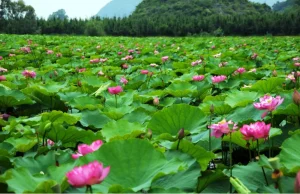
At 2:30 PM, I headed out with my repellent and phone, walking 10 minutes to Lotus Avenue—it’s actually at the west end of the village, with a wooden boardwalk built along the lotus pond. It wasn’t crowded when I first entered, and it grew quieter as I walked deeper, with only the “rustle” of the wind blowing through the lotus leaves. 80% of the lotuses were in bloom—pink like water-soaked clouds, white like fallen frost. Some flower stems bent down until the petals almost touched the water, tinting the reflection pink. I squatted at a corner of the boardwalk to take photos—switching my phone to “Portrait Mode” and using a low angle to focus on a half-bloomed lotus. A red dragonfly happened to land on the tip, its wings so transparent you could see the veins. I took a close-up; later, when I posted it on social media, friends asked if I had “hired a professional photographer,” but it was just luck.
On the way, I met an elderly lady picking lotus pods, wrapped in a blue cloth headscarf. Seeing me staring at her basket, she handed one over: “Freshly picked. Look for the ones where the stem is slightly curved; the seeds inside are tender.” I peeled one and put it in my mouth; it was indeed sweeter than those sold outside. The lady smiled and said: “If you like them, come back in the evening. The dew on the lotuses hasn’t dried then, and they look brighter in photos.”
At 5:00 PM, back in the village, I felt a bit hungry. A-Qiang peeked out from the living room: “Come on, I’ll take you to eat the sour soup tilapia my wife made.” The restaurant was diagonally across from the guesthouse, with a bamboo-woven lantern hanging at the entrance. Opening the door, the aroma of sour soup hit me—the soup was fermented from home-grown cherry tomatoes. The orange-red surface was topped with coriander, hiding two tilapias, tender tofu, and bean sprouts. I took a piece of tofu that had soaked up the soup; it burst with juice in my mouth—sour enough to make me squint, but I couldn’t stop. I ended up drinking half a bowl of the soup. A-Qiang’s wife smiled: “This fish was just caught from the lake this morning; it’s very fresh.”
At 7:00 PM, I wandered to the night market in the village center. The streetlights were imitation antique paper lanterns, casting a warm glow on the bluestone road. A crowd had gathered in front of an auntie selling roasted Rubing (milk fans). I squeezed in: “I want a sweet one, with extra peanuts.” Wearing cotton gloves, the auntie rolled the milk fan into a cylinder, roasted it golden over charcoal, brushed it with a layer of honey, and sprinkled crushed peanuts. One bite, and the fragrance of the milk fan mixed with the crunch of the peanuts—sweet but not greasy, like melted milk candy. At a nearby stall selling handmade silver jewelry, the owner showed me a silver bracelet: “This was made by the Mosuo people, engraved with lotus patterns to ward off evil.” I didn’t buy it, but we chatted for a bit. He said, “Puzhehei is most comfortable during the rainy season; the lotuses are in bloom, and even the wind is cool.”
On the way back to the guesthouse, the scent of home-cooked meals drifted through the alleys—the smell of sour bamboo shoots, chicken soup, and osmanthus. Standing under the phoenix tree at the guesthouse entrance, smelling the lotuses and the food, I felt that the summer heat had long been left behind in Kunming—I realized that escaping the heat isn’t about hiding in an air-conditioned room, but about walking into a lotus pond, eating sour soup fish, and listening to a grandmother’s tips on picking lotus pods while a cool breeze blows in your ear.
Small Tip: The UV rays at Lotus Avenue are still quite strong after 3:00 PM, so it’s best to wear a wide-brimmed hat (I brought a straw hat, which works as both sun protection and a prop); the boardwalk can be slippery in some places, so wear non-slip sneakers instead of flip-flops; if you want photos of “yourself among the flowers,” walk deep into the lotus pond where there are fewer people and a cleaner background.
| Item | Details |
|---|---|
| Transport | Kunming South → Puzhehei High-speed Train (2h40m, 137 yuan/person), carpool from station to Xianindong Village (15m, 30 yuan/person) |
| Accommodation | Hefeng Xiaozhu (Lakeside guesthouse, 280 yuan/night, balcony lotus view, owner A-Qiang is hospitable and provides repellent) |
| Food | Sour Soup Tilapia (58 yuan/fish, cherry tomato fermented soup, tofu absorbs the juice), Roasted Milk Fan (10 yuan/skewer, sweet style) |
| Attractions | Lotus Avenue (West end of village, wooden boardwalk, recommended 2-5 PM to avoid crowds, bring repellent) |
| Avoiding Pitfalls | Don’t rent bikes with canopies (blocks the view); thick grass by the pond, wear long pants; don’t buy dried lotus pods at the entrance (expensive and not fresh) |
Day 2: Take a Willow Leaf Boat on the Lake + Climb Qinglong Mountain for the Panorama, Stay in Xianindong Village (Boat at 9:00 AM, climb at 3:00 PM)
I woke up at 6:30 AM—the window faced the lotus pond, and the morning mist carried the lotus fragrance into the room. The lotuses looked like they were soaked in light milk, and even the veins of the leaves felt soft. Putting on yesterday’s cotton-linen shirt, I grabbed my phone and ran downstairs. A-Qiang was boiling soy milk in the living room, the bamboo bucket covered with thick cotton cloth. He handed me a cup: “Sweet style, with osmanthus. Line your stomach before going to the pier.”
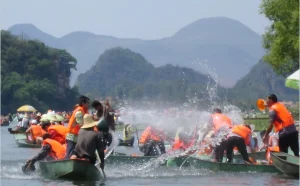
The road to Pucaotang Pier is paved with bluestone, and foxtail grass brushed against my calves, making me laugh. At 7:50 AM, a few tourists were already waiting. I hurried to the innermost willow leaf boat—the gunwale was studded with copper nails, and the dark brown hull was stained with lake water. The boatman, A-Qiang (same name as the guesthouse owner, turned out to be cousins), wore a navy cloth shirt and a worn straw hat, crouching at the stern to tie the rope. “Miss, you want this one?” He patted the wooden plank at the stern, “Sit here for less bumping; your photos will be clearer.” I sat down quickly and connected my phone to a power bank—I checked yesterday; the boat trip takes about 1 hour and 40 minutes, so I needed to save battery for videos.
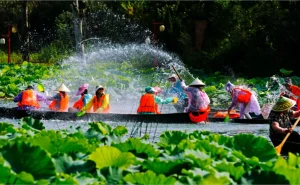
At 9:00 AM, the oars broke the water surface, and ten thousand acres of lotus fields suddenly spread before me—the lotus leaves were taller than I am, round leaves covered in dew. When the wind blew, the dew “pattered” into the water, creating small ripples. In the distance, several egrets flew close to the leaves, their wingtips touching the water like scattered silver. The uncle’s rowing rhythm was slow, and he hummed a low Yi melody, sounding like he was chatting with the lake. I tried propping my phone on my leg to film the oar’s wake with time-lapse; it looked like circles of silver ripples, a segment I later used in my vlog, which friends said “looked like a movie.”
When the boat reached the stilted buildings of Xianindong Village, the uncle stopped for a while: “These houses were built during the Ming and Qing dynasties. The pillars are cedar, which isn’t afraid of moisture.” I looked up at the upturned eaves and ivy-covered walls. An elderly person sitting on a bamboo chair below was peeling soy beans and smiled at me: “Little girl, take photos! These buildings are older than you!”
At 11:40 AM, the boat docked. I walked back to the guesthouse, my arms feeling a bit warm from the sun—A-Qiang had already placed my cotton-linen slippers at the door, which were soft as clouds. After a quick rinse and changing into sneakers, he handed me a wide-brimmed hat: “The path up Qinglong Mountain is slippery. This hat is for sun protection; don’t forget it.”
At 2:30 PM, I headed out with a small cross-body bag—Qinglong Mountain is behind Xianindong Village. I walked up a dirt path lined with plantain and wild chrysanthemums, the dew on the leaves dampening my pant legs. After ten minutes, I met a grandfather carrying a bamboo basket with a bunch of wild chrysanthemums in his hand. He told me in dialect: “Little girl, the slope ahead is steep, take it slow.” Then he walked off with his cane, his figure disappearing into the tree shadows.
Twenty minutes later, I reached the summit. The wooden railing of the viewing platform was a bit rough. I held onto it and looked down—the entire Puzhehei lake group looked like silver scattered on the ground. The light blue lake water mixed with deep blue shadows like crumpled silk. The surrounding mountains were dark green with clouds drifting at the peaks. The distant village roofs were covered in blue tiles with wisps of smoke rising. The wind blew the scent of lotuses and pine needles, pressing my T-shirt against my back and making me shiver with the cold; I quickly tightened my hat.
At 5:00 PM, I came down the mountain. My legs were a bit sore, but my throat was full of the pleasant bitterness of pine needles. Back in the village, A-Qiang was calling from the guesthouse entrance: “Come on, let’s go to my restaurant for Qiguo Chicken (Steam Pot Chicken)!” The restaurant was next door with a bamboo-woven lantern. The owner was a bearded middle-aged man who wiped the table with a smile: “This chicken was just killed this morning—local free-range chicken, with Sanqi roots added. It’s been slow-simmered for three hours, try it.”
The Sanqi Steam Pot Chicken arrived steaming, with Sanqi leaves floating on top, the whole chicken buried underneath with red dates and goji berries. I took a piece of meat; it fell off the bone and had no gamey smell. I took a sip of the soup—fresh with a hint of bitterness, like drinking mountain spring water but with a sweet aftertaste. The owner handed me a bowl of rice: “Eat it with these pickles; they’re sour and spicy, good for cutting the richness.” I mixed the pickles with the rice and finished two large bowls, even drinking most of a cup of soup.
Back at the guesthouse, A-Qiang handed me a cup of honey water: “Climbing the mountain was tiring, right? You’re going to Lugu Lake tomorrow, go to bed early.” I sat on the rattan chair on the balcony, smelling the lotuses and food, listening to the lake—the temperature in the wind had dropped, and even my breath felt cool. In the distant lotus pond, frogs were croaking and fireflies were flying with their small lanterns. I thought of the photos I took at the stern this morning, the dew on the lotuses, the boatman’s melody, and the wind at the summit—I realized that escaping the heat isn’t about avoiding it, but about putting yourself into nature’s cool, where every pore breathes comfortably.
Small Tip: Arrive at the pier 10 minutes early to snag a seat; the stern is best for photos. The path on Qinglong Mountain will be more slippery after rain, so definitely wear non-slip sneakers. Drink the Sanqi Steam Pot Chicken while it’s hot; it might have a slight gamey smell once cold. Most boatmen at Pucaotang Pier speak the Yi language; try chatting with them, and they’ll share many stories about the lotus fields.
Day 3: Puzhehei to Lugu Lake, Photo Ops at Roadside Viewpoints + Arrive at Daluoshui Village (6.5h drive, arrive at 5:00 PM)
At 6:50 AM, the driver’s Wuling Hongguang was already at the guesthouse entrance—he was wearing a faded navy T-shirt, and on the passenger seat were two boxes of freshly steamed buckwheat cakes: “Eat something; we’ll be on mountain roads for an hour, you can’t be hungry.” I took a cake and bit into it; the buckwheat aroma was wrapped in a bit of sweetness, a fermented dough taste that felt much more substantial than convenience store bread. The car wound up the Puzhehei mountain road. The morning mist hadn’t dispersed, and the distant mountain tops looked like they were soaked in milk, with occasional peaks showing a touch of emerald green like a paint-dipped brush.
At 7:50 AM, we arrived at Baoziqing Viewpoint. The driver parked and pointed to the wooden boardwalk ahead: “Walk up for ten minutes, that’s the best view.” I climbed up holding my phone; the dew on the grass along the boardwalk dampened the edges of my sneakers. At the top, the wind suddenly picked up, blowing my hair across my face—the Puzhehei alpine meadow spread out before me like a freshly ironed green velvet blanket, dotted with tiny blue flowers. The lakes at the edge of the meadow looked like crushed glass, shimmering with pale blue light. I stood at the end of the boardwalk, propped my phone on a rock, and used the wide-angle lens for a panorama: the sun pierced through the mist, tinting the meadow pale gold, while the blue of the lake and the blue of the sky layered together more naturally than any filter. The driver came over with his camera: “Stand here, miss, I’ll take a photo of you—meadow and lake in the background, look back at the lens, and give a soft smile.” I later set this photo as my lock screen; friends said “they could smell the grass.”
At 10:30 AM, we continued. The driver turned on the radio, playing Yi folk songs with a slow melody that felt like it was chatting with the mountain road. At 12:30 PM, we arrived at Qiubei County. The driver parked in front of “Lao Chu Jia”: “This black goat hotpot is authentic; I eat here often.” The restaurant was a converted old wooden house with a string of dried chilies hanging in the hall. The owner was a bald man who shouted when he saw us: “Xiao Yang (the driver’s name), the usual?” I quickly interjected: “The black goat pot, with mint!” When the pot arrived, the surface had a layer of golden goat oil with fresh mint leaves floating on top. The goat meat was thinly sliced and cooked quickly, with no gamey smell but a hint of milky fragrance—the owner said, “These goats are free-range on the mountains, raised on a hundred types of grass.” I dipped a piece of goat meat in mint; the coolness of the mint cut through the richness of the oil. I even drank half a bowl of soup, paired with the sour and crunchy pickled radish provided by the owner.
At 2:00 PM, the car headed towards Lugu Lake. Passing Shede Grassland, the driver suddenly slowed down: “Stop for ten minutes, get out and walk around; it’s more comfortable than sitting.” I pushed open the car door, and the scent of grass rushed in with the wind—the grass was knee-deep and soft as clouds. Distant cattle walked slowly, the copper bells around their necks tinkling. I squatted down to touch the grass; the tips had tiny fuzz and felt warm from the sun. The driver leaned against the door smoking: “This grassland is very cool in summer, you need a thin quilt at night. It snows in winter, looking like it’s covered in white sugar.” Ten minutes later I got back in the car; my pant legs had a few blades of grass stuck to them, but I couldn’t bear to brush them off—they were a souvenir of the grassland.
At 5:00 PM, we finally reached Daluoshui Village. The driver helped me with my luggage: “You’re staying at ‘The Home by Lugu Lake,’ walk forward fifty meters and turn right.” The guesthouse entrance was made of logs with a shell wind chime. The owner, A-Mei, greeted me with a smile: “You’re here! Your room is on the second floor, lake view, I’ll get you a kettle.” Opening the door, the room was filled with the scent of pine needles—the bed was covered in cloth hand-woven by the Mosuo people. The windows were floor-to-ceiling glass. Just as I put down my backpack, I saw the waves of Lugu Lake hitting the pier, the spray carrying the blue of the lake like scattered diamonds. Outside the window was a crooked willow tree with branches reaching the water; occasionally a fish jumped, breaking the stillness.
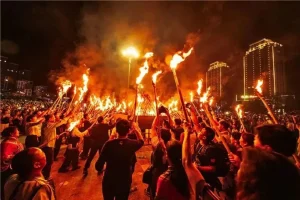
At 7:00 PM, A-Mei knocked: “The bonfire party is starting, I’ll take you.” In the clearing at the village center, a bonfire was already lit, and Mosuo people in ethnic costumes stood in a circle—the girls’ skirts were navy blue with small white flowers embroidered on them, and the boys wore navy vests with belts. Someone shouted, and everyone began to dance. The rhythm of the Gachuo dance was “dong-dong-dong,” and your steps had to hit the beat. A-Mei pulled me in, holding my hand and teaching me “left-right-left, front-back-front”: “Don’t be shy, everyone is here to have fun.” The heat of the fire wrapped around me, the laughter of the Mosuo people echoed, and I followed the dance without missing a step—it turns out happiness is contagious.
The party ended at 9:30 PM. I strolled along the lakeshore; the wind smelled of pine needles and lake water, and the distant Gemu Goddess Mountain was a blurred silhouette like a sleeping giant. A-Mei ran out and handed me a bag of roasted potatoes: “Just roasted, with salt, they’re hot.” I took one; the potato was soft and the saltiness combined with the heat warmed my stomach. Back at the guesthouse, I sat on the rattan chair by the window watching the moon over Lugu Lake—it was rounder than in Kunming, like a glowing piece of jade, its reflection on the water breaking into silver light.
Small Tip: It’s windy at Baoziqing Viewpoint, so bring a thin cardigan so you don’t hunch your shoulders while taking panoramas; black goat hotpot must be paired with mint—it’s not a garnish, it neutralizes the richness of the meat; the grass at Shede Grassland is knee-deep, so wear long pants or mosquito-proof pants to avoid scratching your legs; choose a lake-view room on the second floor or higher in Daluoshui for a better view and the sound of the lake; don’t wear high heels to the bonfire party; the grass is soft, so sneakers are more comfortable for learning to dance with the locals.
| Item | Details |
|---|---|
| Transport & Stops | Carpool driver picks up at 7:00 AM, 6.5h drive; first stop Baoziqing Viewpoint (1h drive) for meadow + lake panorama; pass Shede Grassland (4h drive), 10 min stop for the meadow |
| Viewing Experience | Baoziqing has knee-deep grass and small blue flowers; the lake looks like broken glass. Morning light is soft, photos look good without editing |
| Food | Qiubei “Lao Chu Jia” Black Goat Hotpot (120 yuan/pot), local free-range goat with fresh mint; pickled radish from the driver is sour and crunchy |
| Accommodation | “The Home by Lugu Lake” lake-view room (320 yuan/night), floor-to-ceiling windows facing the lake, watch the moon at night |
| Cultural Activity | Daluoshui Bonfire Party (30 yuan/person), Mosuo people dance “Gachuo” (harvest celebration), join in for a relaxed atmosphere |
| Avoiding Pitfalls | Bring thin jacket for viewpoints; wear long pants for meadows; choose 2nd floor for lake rooms; wear sneakers for bonfire; eat goat hotpot while hot |
Day 4: Lugu Lake Loop, Walking Marriage Bridge – Caohai (Grass Sea) – Lige Peninsula (Depart at 8:00 AM, 36 km cycling/charter around the lake)
I crawled out of bed at 7:30 AM rubbing my eyes. A large iron pot on the first floor was simmering corn porridge, the fragrance mixing with the wood smoke. The auntie selling Mosuo Baba downstairs had already set up her small aluminum pot over a glowing coal stove. She saw me and used bamboo tongs to hand over a Baba: “Just out of the pan, sweet style, I ground the peanuts myself.” The crust was so crispy it crumbled, and inside was hot brown sugar syrup mixed with crushed peanuts, sweet but not overwhelming. I finished it standing at the threshold, sugar on my lips; the auntie handed me a tissue with a smile: “Take it slow, little girl.”
I turned right out the door to rent an electric scooter—the owner was a middle-aged man in a navy apron. The handlebars were covered in cream-colored fleece. He squeezed the tires: “60 km range, perfect for the 36 km loop, you’ll still have battery when you get back at noon.” The key turned with a “click.” I hopped on, and the wind, smelling of salty lake water, rushed at me—a hundred times more vivid than air-conditioned air.
The asphalt on the Lugu Lake Loop Road was a bit soft from the sun, but there were few cars, so I rode slowly. Lugu Lake was on my left and green mountains on my right. At 9:00 AM, I arrived at Walking Marriage Bridge. The straw weaving of the bridge was a pale brown, like rope twisted from dried straw. I squatted to touch it—the stems were a bit rough but held the warmth of the sun. The Caohai (Grass Sea) below was full of knee-deep reeds. When the wind blew, waves of reeds leaned toward the lake, revealing small wild ducks hiding inside that would flutter away with grass seeds on their wingtips.
In the middle of the bridge was a wooden sign saying “Walking Marriage Bridge—The Love Bond of Mosuo People.” Nearby stood an auntie weaving a shawl, her spindle flying up and down. I approached: “How long does it take to weave this?” “About half a month, using goat wool, so it’s not cold in winter.” She looked up and smiled, the sun hidden in her wrinkles. I held my phone to my chest and took a panorama—the straw bridge curved like a crescent, and the green of the grass sea collided with the blue of Lugu Lake like God had tipped a palette. The wind blew my hair across the lens, and the auntie shouted: “Miss, move to the left a bit, let the lake water show!” In the retake, I lifted my skirt, and the arc of the bridge perfectly framed the water. Later, when I posted it, friends said it “looked like something out of a Mosuo legend.”
Continuing along the grass sea towards Lige Peninsula, there was a grandma selling apples by the road, piled like a small mountain in a bamboo basket. She wiped one with her sleeve: “Miss, have an apple, crispy and sweet, picked from my own tree.” I took a bite; it was indeed “crunchy” and sweet with a hint of tartness, like the Guoguang apples I ate as a child. Ten minutes later, I arrived at the peninsula entrance. The path was a wooden boardwalk; it was a bit wobbly, but you could hear the waves hitting the shore.
Lige Peninsula really looks like a heart—the tip of the small hill has a few pine trees, and the curve of the peninsula cradles the water of Lugu Lake. I walked along the path for half an hour. By the time I reached Lige Viewpoint, my legs were a bit sore, but the view made me forget the fatigue: the entire peninsula floated on the lake, the water transitioning from light to deep blue like a gradient gemstone. Smoke rose from the wooden houses on the peninsula, and in the distance, Gemu Goddess Mountain wore a snow cap, reflected in the water. I used the wide-angle lens to frame both the peninsula and the lake. I wasn’t in the photo, but I knew I had captured this scene in my heart.
At noon, I found a small eatery in Lige Village. The owner was a Mosuo woman with braided hair and silver headgear: “Want lake fish fried rice? Just caught Schizothorax, very fresh.” The rice arrived glistening with oil, the fish pieces were pan-fried to a golden crisp, and the grains were distinct, mixed with a bit of mint for a refreshing taste. As I ate, I asked her: “How do you make the fish so fragrant?” “Use rapeseed oil, slow-fry on low heat, and don’t flip too often.” She smiled and ladled a bowl of soup: “Pair it with this pickled vegetable soup, it’s good for the stomach.” The soup had sour pickles and tofu; one sip was sour enough to make me squint, but it felt incredibly comfortable.
At 3:00 PM, I headed back to Daluoshui Village, stopping at Lover’s Beach on the way. The beach was made of light gray gravel that didn’t hurt my feet. The lake waves hit the shore, the spray bringing a cool mist. I sat on the gravel watching the distant mountains and the ripples; the wind made a mess of my hair, but I didn’t care. A young couple was nearby taking photos, the boy holding up a phone: “Move left a bit, use the lake as a background!” The girl ran over laughing, gravel on her skirt, but she smiled like a child. I took a photo of their backs; the lake at their feet shimmered like scattered diamonds.
By the time I returned to Daluoshui Village, the sunset had dyed Lugu Lake orange-red. I rode back toward the guesthouse with the scent of the lake in the wind. A-Mei was standing at the door: “Did you have fun? Want to eat roasted lake fish tonight?” I nodded with a smile, touching the tissue from the Mosuo Baba in my pocket and the apple core from the grandma—these small details are more precious than any guide because they are the truest tenderness Lugu Lake gave me.
Small Tip: Check the battery when renting an scooter (an 80 yuan/day scooter with 60 km range is perfect for the loop); the straw weaving on Walking Marriage Bridge is rough, so be careful if walking barefoot; the path on Lige Peninsula is a bit steep, so wear non-slip sneakers; Lover’s Beach gravel is fine, but don’t wear high heels; eat Mosuo Baba while hot or the crust will soften; mint is the soul of the lake fish fried rice.
| Item | Details |
|---|---|
| Transport & Gear | Rent scooter 80 yuan/day (60 km range, enough for 36 km loop); fleece handle covers for sun/grip |
| Loop Route | Lugu Lake Loop Road → Walking Marriage Bridge (9:00) → Caohai → Lige Peninsula (11:00) → Lover’s Beach → Daluoshui Village (15:00) |
| Attractions | Walking Marriage Bridge straw is rough but warm, mid-bridge for Caohai + lake panorama; Lige Peninsula is heart-shaped; Lover’s Beach gravel and waves are healing |
| Food | Mosuo Baba (5 yuan/piece, peanut + brown sugar, crispy/sweet); Lake Fish Fried Rice (35 yuan/portion, Schizothorax fried crisp with mint); Pickled Vegetable Soup |
| Human Interactions | Auntie reminding to eat Baba hot; weaving auntie talking about Mosuo love; apple grandma giving sweet apples; the warm couple at the beach |
| Avoiding Pitfalls | Check scooter battery; wear non-slip shoes for bridge; take Lige path slow; no high heels at beach; bring a small bag for trash (keep Caohai clean) |
Day 5: Lugu Lake to Yubeng Village, Drive plus Trek into the Village (4h drive to Xidang Village, 3h trek, stay in Upper Yubeng)
At 7:30 AM, the morning mist from Lugu Lake filtered through the wooden window frames. I woke up rubbing my eyes—downstairs the owner was crouching by the earth stove flipping highland barley pancakes, the pan sizzling with oil as the scent of grain and pine needles drifted up. I threw on a fleece jacket and headed down. The owner looked up with a smile: “Take these to line your stomach; you’ll need energy for the Yubeng trek.” The pancakes were savory with a bit of peppercorn powder, crispy enough to crumble. I bit into one as I headed out. The Tibetan carpool driver was already waiting, the sleeves of his robe embroidered with auspicious knots. He patted the side of the car: “Let’s go, the road is flat today, we’ll head to Yubeng slowly.”
The car drove northwest along Lugu Lake. The morning mist pulled away like a veil, revealing the silhouette of Kawagarbo Peak—the snow on top hadn’t melted, looking like a white fur hat for the mountain. Clouds swirled around the mountainside like someone pulling cotton. The driver played Tibetan folk songs with melodies high enough to pierce the clouds. I looked at the alpine pines outside, their shadows swaying on my legs, and remembered the guesthouse owner saying last night: “Yubeng is a village at the foot of the sacred mountain; when you go, you must bring respect.”
At 11:30 AM, we reached Xidang Village. An old dog was napping on a rock at the entrance, the tip of its tail twitching occasionally. I tugged my backpack straps and walked into the village. A shop selling hiking sticks had a red cloth sign. The owner, in a navy jacket, sat on the threshold smoking and raised a wooden staff: “Miss, you want this—plastic ones slip, but wood grips. It will bite into the dirt paths of Yubeng.” I took it; the handle was wrapped with non-slip rope and smelled of bitter pine resin. The owner also handed me a small scripture charm: “Hang this on your bag, the sacred mountain will protect you.” Twenty yuan, half the price of the scenic area.
At 1:30 PM, I had lunch at Fatty Auntie’s noodle shop at the village entrance. Red-braised beef noodles were bubbling in the pot. The auntie in a floral apron wiped her hands: “Want it spicy? It’s cool in the mountains; spice drives out the cold.” “A little, I’m afraid of getting too much internal heat.” The noodles arrived with a broth thick enough to coat a spoon and beef chunks so large they were hard to chew. I slurped the noodles while looking at the photos of Meili Snow Mountain on the wall—the auntie pointed and said: “I used to be a muleteer, walked to Yubeng for twenty years. Now I open a small shop just to show people the snow mountain I see every day.” After I finished, she handed me a wet wipe: “Clean up, don’t catch a cold if you sweat during the trek.”
At 2:00 PM sharp, I set off with my hiking stick. The road from Xidang to Upper Yubeng is dirt path + steps. At first, I could walk on pine needles with sunlight dappling through the trees, but it turned into steep stone steps. I held onto the roadside bushes, my breathing grew heavy and sweat formed on my forehead. My sunglasses slipped; as I wiped them, I caught a glimpse of the distant peaks—the clouds were moving like a thin veil around the mountain.
At 3:30 PM, I reached Xiaonong Base Camp. Prayer flags hung at the entrance of the Tibetan wooden house, rustling loudly in the wind. The owner, a stout auntie in a blue apron, poked her head out: “Rest a bit, miss, have some ginger tea—home-grown ginger with brown sugar to prevent altitude sickness.” The ginger tea was in a coarse ceramic cup and was piping hot. The spicy taste rushed up my nose. The auntie brought a small stool: “Don’t rush up the steps ahead, take it slow, rest when you’re out of breath.” She also handed me a piece of chocolate: “Replenish your energy, the path ahead is steep.” The chocolate melted in my mouth, sweet with a hint of bitterness, like the trek itself.
At 4:30 PM, I reached Upper Yubeng Village. The sunset turned the wooden houses golden, and smoke carrying the scent of yak butter drifted over. The guesthouse owner, in Tibetan dress and silver jewelry, took my backpack: “Tired, right? Go to your room first, I’ll brew some butter tea for you.” The room was small but warm like being wrapped in a quilt—the electric heater was on, and the window faced Meili Snow Mountain. I could see the snow on Kawagarbo Peak like glowing jade, with the snow line so clear I could count it. The butter tea arrived, the savory milky taste mixing with tea. The owner sat across from me: “We Tibetans drink this in winter; it warms you to the bone. If you don’t like it salty, I’ll make it sweet next time.” I took a sip and swallowed slowly; the warmth spread in my chest, and even my fingertips weren’t cold anymore.
At 7:00 PM, I changed into a windbreaker for a stroll. The bluestone path was a bit slippery. I held my hiking stick and passed villagers’ homes, hearing laughter inside—someone was churning butter tea, the wooden mallet hitting the barrel with a “dong-dong”; someone was boiling yak meat, the aroma filling the whole street. I looked up at Meili Snow Mountain; moonlight fell on the snow, making it glow silver-white. The wind smelled of snow, cool and clean. I stood by the mani pile at the village entrance and touched the scriptures on it; the stones had been polished smooth by many hands, like they had collected many people’s wishes.
Back at the guesthouse, the owner brought a bowl of warm milk: “Drink this before sleeping, you can wake up from the cold in Yubeng.” The milk was warm with a faint gamey scent. As I drank, I listened to the wind and distant barking, slowly sinking into a dream—dreaming I was standing on the snow mountain peak, the wind blowing my hair, surrounded by mountains of prayer flags like a colorful cloud.
Small Tip: Get a wooden hiking stick at Xidang (three times the grip of plastic); don’t mind the spiciness of the ginger tea at the base camp (it really helps with altitude sickness); choose a room with heating in Upper Yubeng (it can be -5 degrees at night); wear a wide-brimmed hat (sun protection) + sunglasses (to prevent snow blindness, the reflection is piercing); wear a windbreaker for night walks (mountain wind can pierce thin sweaters); bring a bar of chocolate (a bite while climbing steps is more effective than candy).
Day 6: Yubeng Trek (Sacred Waterfall Line), Afternoon Return (4h round trip)
At 7:30 AM, the sunlight through the wooden window brought the scent of sweet tea. The owner, A-Jia, was crouching at the threshold brewing yak milk sweet tea, the copper kettle bubbling. She wiped the bowl as she handed it to me: “Have a hot drink, the mountain wind is cool during the trek.” The sweet tea had the richness of yak milk, not a powdered taste. I sipped it and picked up my backpack: the hiking stick was the wooden one recommended by Zhaxi, the sun hat was the Tibetan blue cloth one A-Jia gave me, and in my pocket were two orange candies from Zhaxi—”The waterfall path is long, have these to keep you going.”
At 8:00 AM sharp, Zhaxi was waiting at the village entrance. He wore a faded navy Tibetan robe, black sunglasses, and a prayer wheel at his waist made a soft clinking sound: “Let’s go, I’ll lead you on a steady path today.” We followed the dirt path behind the village. Zhaxi held a string of prayer beads: “There’s a prayer flag forest ahead, we must walk around it three times before entering—it’s the old tradition to ask the Sacred Waterfall to protect you.” The flags were red, yellow, and blue, tied to pine branches and rustling in the wind. I followed him three times, my fingers touching the bottom-most stone engraved with scriptures—it was cool, like it held the wishes of many people.
The Sacred Waterfall Line path was indeed steps, the bluestone polished by many feet. Dew on the grass dampened my toes, but it was a refreshing cold. Zhaxi pointed as we walked: “Look at that crooked tree; it’s a red ribbon tied by an elder on a pilgrimage last year, asking for family safety.” After two hours, he suddenly stopped: “We’re here.”
I looked up, and the Sacred Waterfall flowed down from the ravine of Kawagarbo Peak—it wasn’t a rushing torrent, but fine, dense lines of water like a silver belt tied to the snow mountain. The water was melted snow, clear and cold. I stood by the pool, the mist hitting my face; my eyelashes were instantly covered in tiny droplets, and even the tip of my nose was damp. Zhaxi stood nearby smiling: “Walk around it clockwise three times, don’t run, take it slow—the water of the Sacred Waterfall is holy water, bringing blessings.” I joined the crowd circling; the air was full of the scent of snow and the roar of the waterfall, and I suddenly felt at peace—those city anxieties felt like clouds scattered by the mist, leaving only warmth in my heart.
At 10:30 AM, we began our descent. Zhaxi picked up a dry branch to use as a cane for me: “The steps are slippery, take it slow.” We walked slowly, passing the prayer flag forest again. I took a photo—sunlight pierced through the gaps in the flags, falling on the back of my hand like scattered gold. Zhaxi held up his phone and shouted: “Look at the lens! Smile!” In the photo, my hair was damp with mist and I was surrounded by prayer flags; I felt like I had merged into the wind of Yubeng.
At 12:00 PM, back in the village, Fatty Auntie’s shop smelled of beef. I shouted: “A bowl of yak meat hotpot!” The pot arrived bubbling, the beef chunks were thick and tender, slightly pink inside, with the fragrance of Angelica and Codonopsis. Fatty Auntie wiped her hands and smiled: “Zhaxi told me you were coming, so I kept the tenderest front-leg meat for you.” I dipped a piece of beef in dried chili powder; it was so spicy I gasped but couldn’t stop—this is the true taste of the plateau, hot and spicy, warming to the stomach.
At 2:00 PM, the carpool driver arrived. He wore ripped jeans and a baseball cap, playing Zhaxi’s recommended “Tsering Lasso.” I sat in the passenger seat, and he handed me a bottle of chilled water: “There are no supply points on the road, drink this.” The car wound down the mountain road, and as we passed Baima Snow Mountain pass, I looked up—Jade Dragon Snow Mountain was ahead, the snow on top un-melted like a white fur hat, with clouds swirling around the waist. The driver said: “The snow is melting slowly this year, you can still see snow in July, you’re lucky.” I quickly grabbed my phone and took a close-up of Jade Dragon Snow Mountain—the reflection was so bright I squinted, but it was so beautiful it took my breath away.
At 8:00 PM, the car drove into Lijiang Ancient Town. I pulled my suitcase along the bluestone road, smelling the cured pork ribs in the alleys. A flower cake stall owner shouted: “Freshly baked, hot!” I bought one; the crust crumbled in my hand, and the rose filling was sweet but not greasy. Back at the hotel, I pulled the orange candy from my pocket—the one Zhaxi gave me. It was orange-sweet, like these six days, soft and carrying the sunshine of the plateau.
Finally, some practical advice for you:
- Find a driver recommended by Zhaxi for carpooling; it’s 30% cheaper than platforms, and he knows the road, stopping at viewpoints for you to photograph the snow mountains;
- Book accommodation at least a week in advance! I booked a lake-view room in Upper Yubeng for 300 yuan in late June; by July, the price doubled;
- Don’t buy specialties at the scenic area entrance! Maca and spirulina are ridiculously expensive. Yak jerky in the village shops is only 50 yuan per pound, fragrant and substantial;
- Yubeng Trek Must-haves: wooden hiking stick (three times the grip of plastic), Tibetan blue cloth hat (sun and wind protection), power bank (no supplies on the way, phone dying is scary), at least 1 liter of water (don’t drink raw water, there are parasites in the streams);
- The total cost for the whole trip was about 3500 yuan/person: transport 1000 (train + carpool), accommodation 800 (6 nights average 130), food 700 (about 100 per day, better than group meals), tickets and others 500 (Puzhehei boat, Lugu Lake entry, Yubeng guide). This saves over 1000 compared to a group tour and offers more freedom.
I didn’t rush a single step of this trip—I could squat at the guesthouse door drinking sweet tea in the morning, catch the mist under the Sacred Waterfall at noon, and eat yak meat hotpot while watching the snow mountain at night. Puzhehei’s lotus fragrance, Lugu Lake’s blue, and Yubeng’s cool snow are like three different colored cloths stitched into my summer memories.
If you want to escape the heat, don’t go to the crowded beaches—the mountains and waters of Yunnan will turn your heat into the tenderness of the wind.






