



Day 1: Arrival in Yuanyang · Stay in Xinjie Town · Scouting Shooting Locations
I set off from Kunming taking the Kunmo Expressway to Yuanman Expressway. This route is the most stable in winter—mountains along the Kunmo Expressway feature karst topography with clouds sitting low as if touching the peaks, but the road remains dry and fog-free. The Yuanman Expressway is a newly opened four-lane road. After crossing the Yuanjiang Bridge, tunnels become frequent; I always turn on my lights 50 meters before entering each tunnel to avoid being blinded by the glare upon exiting. The entire journey takes 5 hours, and at 12:30 PM, I arrived exactly at the entrance of Xinjie Town—Hani women were selling roasted Erkuai at stalls under the plane trees. I ordered a sweet Erkuai wrapped with a fried dough stick, with a thick layer of sweet chili sauce. It cost 10 yuan, felt warm in my hands, and was a better deal than buying inside the scenic area later.
Xinjie Town serves as the “logistics base” for the Yuanyang photography circle. I booked the Terrace People Guesthouse half a month in advance. The owner, Amu, is Hani and wears a navy-blue traditional buttoned shirt. Seeing me wheeling my suitcase, he hurried out from behind the counter to help: “Young lady, the temperature is dropping today; I turned on your electric blanket this morning.” The room is on the corner of the second floor, with a window facing the gentle slopes of the terraces. It’s not large but tidy—the bed is an old wooden one with homespun sheets. The electric blanket was at just the right temperature; my lower back felt warm within 5 minutes of lying down. The bathroom has a constant-temperature water heater with strong water pressure, unlike some homestays where you have to wait three minutes for hot water. Amu also handed me a handwritten note: “The entrance to Duoyishu Viewing Platform is behind the second banyan tree. Go early tomorrow to grab a spot in the third row; there are no pillars blocking the view.”
At 3:00 PM, I took my camera to scout the locations—the Duoyishu parking lot is open-air, with moss growing in the cracks of the bluestone. Even wearing V-sole anti-slip shoes, I had to hold onto the nearby plane trees for fear of slipping and damaging my equipment. Walking 200 steps up from the parking lot, I saw wooden stairs wrapped in red cloth (used by villagers for blessings). Following the stairs to the viewing platform entrance, I noticed the 30+ steps were worn down, clearly from heavy foot traffic. The platform is an open three-tier structure. I tested the middle position of the third row: on the left, a lush old banyan tree perfectly hides the nearby utility poles; the right side has enough space for a tripod. The view unfolds below—the entire terrace group looks like layered green silk, with distant peaks dipped in thin mist, allowing for great shots without much post-processing. I took a panorama with my 16-35mm wide-angle lens and used the 70-200mm telephoto to capture a villager on a distant ridge; the detail was so sharp I could see the weave of the bamboo basket on his back.
A lady nearby selling roasted corn was wrapped in a black padded coat, her apron covered in corn silk. The foil-wrapped corn was sizzling over charcoal. I asked her: “Auntie, can you save a sweet corn for me tomorrow morning?” She nodded with a smile: “I’ll be here at 6:30; I’ll pick the one with the fullest kernels for you, very sweet.” I tried one today; the kernels burst with juice and had a smoky charcoal aroma, far better than the 5-yuan ones at the scenic area entrance.
Before leaving, I put my camera in a moisture-proof bag—Amu mentioned the large temperature difference between day and night in winter causes lenses to fog up; the bag helps prevent this. On the way down, I passed the entrance of Pugao Old Village and saw several Hani children chasing a dog. The terraces behind them glowed in the afternoon light. I took a candid shot from the roadside, which later became my WeChat Moments cover photo.
Small Tip: It’s best to bring your tripod when scouting in the afternoon to test a few compositions at different focal lengths—I didn’t do this and almost missed capturing the layers of morning mist the next day because my lens angle wasn’t right. Also, the stone benches at the platform are bone-chillingly cold in winter; bring a folding cushion to sit on—it’s 10 times more comfortable than sitting directly on the stone.
Back at the guesthouse in the evening, Amu brought a free bowl of sweet ginger tea: “You need to wake up early tomorrow; drink this to warm your stomach.” Holding the cup by the window, I watched the terraces outside slowly darken as a few dog barks echoed in the distance. Suddenly, I understood why people travel so far to photograph these terraces—it’s not just for “masterpieces,” but to capture this living, breathing warmth of everyday life.
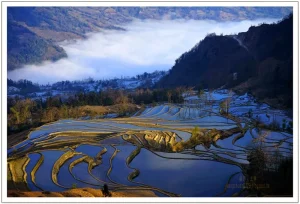
Day 2: Duoyishu Sunrise + Terrace Mist · Shooting from Dawn to Mist Dispersion
My 5:30 alarm didn’t even get a chance to go off—Uncle Amu was already knocking, holding a coarse ceramic cup. The ginger tea was steaming, and the cup was so hot it stung my fingertips: “Drink up, warm yourself. The wind on the mountain will be like a knife later.” I took a sip of the ginger tea; the spiciness wrapped in brown sugar sweetness rushed down my throat, warming my stomach instantly. I put on my fleece-lined windbreaker (bought specifically yesterday, with Velcro cuffs to seal out the wind) and my V-sole anti-slip shoes (the soles squeaked against the mossy threshold of the guesthouse). Carrying my camera and tripod, I headed out—the lights in the stairwell stayed on, casting a warm yellow glow that reflected on my tightly gripped camera strap.
At 5:50, I reached the foot of Duoyishu. The wind carried mountain mist that nipped at my neck, so I pulled up my collar. The climb from the parking lot to the viewing platform consists of over 300 bluestone steps. They were slippery with moss, so I held onto the blessing trees wrapped in red cloth, moving up step by step. At exactly 6:00, I took my spot in the middle of the third row—having scouted it yesterday, the old banyan tree on the left blocked the utility poles perfectly, and the view to the right was wide open, revealing the entire terrace group. I set up my tripod on the stone floor, tightening the screws, and aimed the lens toward the eastern sky—the light was just beginning to break, appearing like purple rice paper dipped in water, with layers of pinkish-purple clouds as the wind slowed down.
At 6:30, the sun emerged—first, the eastern clouds caught fire, turning orange-red, then a small sliver of the sun appeared, its light as soft as cotton. I set the camera to shutter 1/15s, ISO100, and aperture f/8, stabilized the tripod, and pointed at the thickest part of the morning mist. In the lens, the mist stretched into fine threads, wrapping around the terrace outlines like a thin veil over the layered ridges. The moment I pressed the shutter, my breathing slowed—fearing I might blow away the shape of the mist. After taking a dozen shots, I reviewed them: the layers of mist were all there—thick and inseparable up close, thinning into silk further away, with the curves of the terraces hiding in the mist like the breath of the earth.
At 7:10, the mist began to disperse—sunlight slanted in from the east, casting long shadows from the ridges, looking like silver threads embroidered onto green silk. I switched to the 16mm wide-angle lens and aimed at the terraces before me: the layered ridges extended from my feet to the mountainside. The water in the shadows compared to the water in the sun created a depth of color so vivid it felt tangible. An old woman in Hani traditional dress walked past the platform with a bamboo basket on her back; the vegetables inside were dripping with dew. I quickly pressed the shutter—her silver ornaments flashed, the dissipating mist as a backdrop, and the warm light hitting her face made every wrinkle seem gentle.
At 9:30, heading down, I passed a stall where a lady selling tea eggs shouted: “Young lady, want a tea egg? It’s hot.” I bought one; the shell was cracked, and the egg white was infused with tea fragrance, perfectly salty and fresh. I ate while walking toward Pugao Old Village—a 15-minute drive. The asphalt road was baking in the sun, so warm that the tea egg in my hand stayed hot.
There is a century-old banyan tree at the entrance of Pugao Old Village, its hollows filled with villagers’ blessing charms. Just as I stopped, I saw an old grandmother in a navy-blue traditional shirt, crouching on the drying ground flipping grain. Her silver hairpin was tucked into her hair, and her white temples were dusted with chaff. The terraces behind her had just been flooded, looking like a collection of broken mirrors reflecting the blue sky. I approached and asked: “Grandma, can I take your picture?” She looked up and smiled, wrinkles bunching like a flower: “Take it, take it. This field grew better than last year.” I crouched beside her, using a 50mm prime lens with side lighting on her face and the terraces behind—sunlight filtered through the banyan leaves, casting dappled gold on her face. With the blue-green terraces as a background, the photo captured the scent of drying grain, the sound of the wind, and the “shasha” of grain falling from her hands into the bamboo tray. I later printed this photo to hang in my study; every time I look at it, I remember her smile.
At 2:00 PM, I returned to Duoyishu to capture backlit terraces. With the sun in the west, light hit the water at an angle, making the terrace surfaces shimmer like crushed silver. I took out my polarizer and rotated it—until the glare disappeared, revealing the deep green of the water. Using the 70-200mm telephoto, I aimed at a distant ridge: a young boy with a schoolbag ran past, the ornaments on his bag swaying, his long shadow cast by the sun onto the water. As I shot, a nearby photographer remarked: “This one has spirit.” I smiled into the viewfinder—the spirit seemed to come from both the terraces and the people living on them.
Small Details Reminder:
- The stone benches are freezing in winter; I brought a folding cushion (bought for 10 yuan at a supermarket) to sit on, which was 10 times more comfortable than sitting on the bare stone;
- When shooting backlit terraces, the polarizer must be rotated correctly—I didn’t do it right at first and couldn’t get rid of the glare. An old photographer nearby told me, “Watch the reflection in the viewfinder while rotating until it disappears.” It worked after three tries;
- Don’t be shy with villagers; offer a bottle of water or a smile, and they are usually happy to let you photograph them—the grandma said, “Why not photograph me? I’ve farmed my whole life and want more people to see it.”
As I packed my gear at dusk, I put my camera back in the moisture-proof bag—Amu warned that the large temperature swings cause fogging. On the way down, the sunset dyed the terraces orange-red. I stood on a ridge and took a panorama; the air carried the faint scent of rice leaves. Today’s photos, from the sunrise mist to the grain-drying grandma, all carry a sense of warmth—not just “great shots,” but a touchable slice of life.
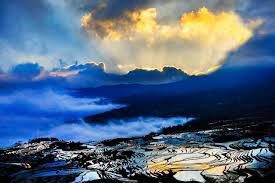
Day 3: Aichun Blue Terraces · Capturing the Purest Winter Blue
At 7:30, Xinjie Town was still bathed in light fog. I tucked my polarizer into the side pocket of my camera bag—I had checked the forecast three times last night to confirm a layer of thin clouds this morning, which would perfectly enhance the “transparency” of the blue terraces. Driving out of town, the asphalt road was still damp with morning dew, the tires making a soft “squeak” sound. The rice fields outside the window held the stubble of winter, with occasional sparrows fluttering from the grass. 30 minutes later, I arrived at Aichun Village. At the entrance, the red curtain of a “Convenience Store” flickered in the wind. A Hani grandfather wearing reading glasses sat on a bamboo chair peeling corn; seeing me, he pulled a bottle of water from a cooler: “Young lady, it’s soaked in mountain spring water, cold to the touch.” The chill of the bottle surged through my palm; I took two gulps, and even the frostiness on my nose dissipated.
A 10-minute walk led to the blue terraces. The foxtail grass on the ridges was covered in fine frost, feeling soft like stepping on cotton batting. Holding onto a roadside scarecrow (still clinging to some of last year’s rice ears), I slowly walked to higher ground—I had noted the large mossy rock at the end of the ridge as the best spot during scouting yesterday. At exactly 9:00, the sunlight slanted across, and the terrace water suddenly “woke up”: it wasn’t a jarring sapphire blue, but crushed blue crystals mixed with a hint of pale green, as if the winter sky had been kneaded into the water. Even the wind slowed down. I quickly set up my camera, switched to a 50-70mm mid-range zoom, and aimed at a low Hani thatched house nearby: light smoke rose from the black tiled roof, and the terraces in front framed it perfectly. Blue water against black tiles looked like an unfinished ink painting. Just then, I heard a child’s laughter from the house; looking over, a little girl in a red padded jacket was helping her grandmother start the fire. The smoke from the chimney drifted just over the thatched roof, adding a touch of lively warmth to the scene.
Wanting a panorama, I walked along the ridge to an earthen slope by the road—the slope was a bit steep, so I squatted and placed my camera on a rock, using Live View to adjust the angle slowly: I moved the utility pole on the right out of the frame, perfectly capturing the arc of the entire terrace group. The sun grew brighter, and the color of the blue terraces deepened slightly, like adding a layer of thin honey. I took three shots in a row; reviewing them, I saw the curves of the terraces and the distant peaks fit together perfectly, with the texture of the ridges so clear I could count the rows.
At 11:30, I headed down and back to Xinjie Town for Grandma’s Kitchen—located on the corner of the old street, the wooden sign had half its paint peeled off, with “Grandma’s Kitchen” written crookedly. Grandma, wearing a faded blue apron, saw me and lifted a bamboo steamer: “The bamboo rice just finished steaming, it’s hot.” The bamboo was fresh-cut that morning, still smelling of sweet bamboo when sliced open. The glutinous rice was stuffed with peanuts and cured meat; one bite, and the oil from the meat seeped into the rice—a blend of sweet and savory. I finished two bowls. The sour bamboo shoot fish was made with fresh tilapia; the bamboo shoots were pickled by Grandma herself. The broth was bright red like amber, spicy enough to numb the tongue, but the fish was so tender it melted in my mouth. I had two bowls of soup, and Grandma even gave me a side of pickled radishes—crispy and perfect for cutting the spice.
At 2:00 PM, I went to the Bada Terrace Road Section. A 20-minute drive brought me to the bend at K123+500 (there is a blue sign by the road saying “Yuanyang Terraces”). I parked in a spot at the bend, next to a small bamboo grove that wouldn’t block the way. Standing by the road, I used a 16-35mm wide-angle lens to capture the terrace curves—the road wound around the terraces, and the lines of the fields spread out like waves. Sunlight hit the water, shimmering like crushed silver. Soon, an auntie carrying a basket of eggs came by, a blue cloth covering the basket. I called out: “Auntie, can I take your picture?” She stopped and smiled, wrinkles blooming like a flower: “Go ahead, I’m going to town to sell eggs.” I captured the moment she looked back; her shadow was pulled long by the sun across the water, the egg basket swaying slightly—the frame was full of the warmth of daily life.
Small Details Reminder:
- The blue light at Aichun only lasts from 9:00 to 11:00 AM; after 11:30, the sun is too direct, and the blue fades like “washed-out cloth”—don’t miss it;
- Always use Live View for panoramas; utility poles you might miss with the naked eye show up clearly in the viewfinder. Don’t be lazy;
- Go to Grandma’s Kitchen between 11:30 and 12:00 to catch the freshly steamed bamboo rice; arrive late and you’ll only get cold rice;
- When shooting movement at Bada, wait for villagers to reach the middle of the terraces before pressing the shutter—their shadow will fall perfectly on the water, making the image more dynamic.
Packing up at dusk, I flipped through my photos: the clarity of the blue terraces, Grandma’s bamboo rice, and the auntie’s smile while carrying eggs—every one carried the warmth of winter. Aichun’s blue isn’t a “blockbuster” blue; it’s a blue that makes you feel still, like an old Hani song—slow-paced but stirring enough to make you want to stay a little longer.
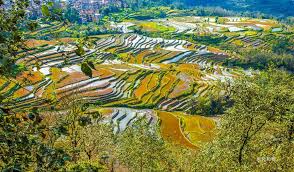
Day 4: Bada Sunset · Capture the Golden Glow Before Returning
At 15:30, Xinjie Town still held the warmth of the afternoon sun. I taped my spare battery to my chest—yesterday at the blue terraces, my last battery died automatically from the cold. Uncle Amu had specifically given me two heat packs: “Stick them on your battery bag; the wind at the terraces is like ice picks, don’t let the power ‘freeze stiff’.” The road to Bada is a winding mountain road. The asphalt was still soft, warmed by the sun after a morning of dew. Wind entered through the car window cracks, cooling my small thermos (filled with jujube tea given by Grandma this morning). 20 minutes later, I reached the entrance to the Bada viewing platform. The cement steps had anti-slip patterns. Gripping my tripod, I walked up. Passing the rest area, a lady selling water shouted: “Young lady, want some water?” I smiled and shook my head—the thermos wrapped with a heat pack was ten times more thoughtful than ice water.
I climbed straight to the third level (the highest point)—120 steps. The iron handrail was biting cold, but I didn’t stop—scouting here yesterday showed that this vantage point “cradles” the entire Bada terrace group: the eastern peaks still held the remnants of the sun, the western terraces spread out like green silk, and the ridges in between were like fine threads stringing emeralds. Once settled, I set my camera on the tripod and did a test shot of the sky: around 17:30, the sun began to sink behind the mountains. The sky turned a pale orange, like a peeled orange skin, then the terrace water began to “light up”—not just a reflection, but as if the sunset had been crushed and sprinkled into the water. Every ridge shadow glowed with gold dust. I switched to the 16-35mm wide-angle and tilted the lens down toward the lower terraces: the distant mountains, the nearby ridges, and the golden spots on the water were all framed. Reviewing it, the layers were distinct, as if God had tipped a palette over the fields.
At 18:00, the sun almost touched the peaks, and the sky burned into a deep orange-red, like thick honey. I switched to a 24-70mm mid-range lens and focused on a section of the terraces below: the shadows of the ridges stretched long, giving the terraces a black border, while the sunset reflected in the water dyed the shadows golden-red. A local photographer in a navy windbreaker stood nearby and looked over: “Your composition is clever; you captured the ‘dialogue’ between the mountains and the fields—Bada’s sunset needs those long shadows, otherwise it lacks that grand feel.” I followed his lead in adjusting the angle to include the distant peaks, giving the image instant depth, as if even the scent of rice leaves in the wind had entered the lens.
At 18:30, I began packing up—yesterday I saw a photographer leave his camera on a stone at the platform, and the lens fogged up instantly, leaving him rubbing his hands in frustration. I put my camera in the moisture-proof bag and wrapped it in my thermos towel, ensuring no exposed metal parts stayed cold.
For the return trip, I had two choices: If you don’t want to drive at night, stay at Nansha Grand Hotel in Yuanyang County—20 km from Xinjie Town. It’s an old-school hotel with plenty of hot water and heated rooms; last time I stayed, the front desk gave me a handwritten map marking nearby stalls for roasted Erkuai. If you’re in a hurry, drive slowly—the trip takes 5 hours. I kept my speed at 80 km/h and enjoyed the night views of Yuanyang along the way: lights from villages at the foot of the mountains sparkled like fallen stars. I should arrive in Kunming before 24:00, just in time for a piping hot bowl of Crossing-the-Bridge Rice Noodles.
A Few Heartfelt Tips:
- Expense Breakdown: I spent a total of 1300 yuan this trip—Kunming round-trip carpool 320, 3 nights at Terrace People Guesthouse 660, Yuanyang combo ticket 100, food 90 per day (including two bamboo rice meals and one sour bamboo shoot fish), staying within budget;
- Mistake Prevention: ① Water at the viewing platforms is 5 yuan; I brought a thermos, and it’s only 2 yuan at the foot of the mountain, saving 10 yuan; ② Even though water is lower in winter, the morning mist is still thick. I went 30 minutes early every day and caught that ethereal mist wrapping the terraces; ③ I previously wore a white down jacket for portraits, but it reflected light like a bulb; I switched to dark gray, and the effect was much “cleaner”;
- Gear Advice: Bring three batteries (low temperatures drain them fast), a polarizer (to remove water reflections), and a wide-angle + mid-range lens—the wide-angle captures the grand scale, and the mid-range handles details, covering all scenarios;
- Driving Tip: When driving at night, don’t touch a freezing steering wheel; I brought a fleece cover, which kept my hands warm and made driving much safer.
Flipping through the photos in my car, the golden glow of the Bada sunset still flashed on the screen—not a piercing light, but a warmth that could wrap around you. The Yuanyang terraces are like an old friend; I come every winter, and they show me the morning mist, the blue terraces, and the golden sunset. In return, I take photos and tell their story. Following this route, there’s no need to rush or chase the light. If you “catch” every moment of light and “take in” every view with your heart, even a beginner can take photos that make their heart skip a beat—after all, great photos aren’t just “taken,” they “wait” for the light to crash into the lens.
Yuanyang Rice Terraces and Jianshui — Practical Information
Tickets & Booking
- Jianshui Ancient Town mini-train: Round-trip hard seat adult CNY 120; concession ticket CNY 60 (departures 09:00, 14:30); advance booking required (OTA/on site)[src]
- Lin’an Prefecture Office / Imperial Examination Hall / Chaoyang Tower: Lin’an Prefecture Office CNY 32; Imperial Examination Hall CNY 20; Chaoyang Tower CNY 15; combined ticket for Zhu Family Garden + Confucian Temple + Lin’an Prefecture Office + Chaoyang Tower + Imperial Examination Hall CNY 115[src]
Transport & Schedules
- Kunming South Bus Station → Yuanyang Xinjie town | Long-distance coach: Fare about CNY 120–140, journey about 5.5 h, direct to the Xinjie town terrace area[src]
- Jianshui station → Yuanyang Nansha town | Passenger coach: Fare about CNY 38, rolling departures[src]
- Kunming South station → Jianshui station | High-speed rail: About 2 h, second class about CNY 56–75[src]
Where to Stay · Room Type · Nearby
- Near the Duoyishu scenic area | Room tip: The top choice for watching the sunrise; you can walk to the viewpoint in the early morning | Nearby add-ons: Duoyishu viewpoint, Azheke Ancient Village[src]
- Xinjie town / Shengcun market town | Reference price Cheaper on weekdays | Room tip: Restaurants and guesthouses are concentrated, convenient for Hani-style dining | Nearby add-ons: Bada viewpoint, Qingkou Hani Folk Village[src]






