



This nine-day itinerary has eight overnight stays: Kunming on Day 1, Dali Ancient City on Days 2–3, Shuanglang on Day 4, Lijiang on Days 5–6 and Lugu Lake on Days 7–8. It combines rail, road transfers and local outings rather than one continuous self-drive route. Confirm each transfer and accommodation address before booking; the undated prices and personal encounters below are not verified current offers.
Day 1: Arrive in Kunming, Visit Haigeng Dam and Consider Western Hills
Itinerary & Transportation
After arriving at Kunming Changshui Airport, allow time for baggage collection and follow signs to Airport Center Station on Metro Line 6. The original MU5937 flight number and 7:50 arrival have no travel date, so do not use them to book a transfer or promise a fixed morning programme.
Tangzixiang is the interchange for Metro Lines 6 and 2; Dongfeng Square is an interchange for Lines 2 and 3, not a Line 6 stop. Choose the onward station from the hotel’s confirmed address instead of following the original conflicting directions via North Railway Station, Dongfeng West Road and Nanping Street. Check current fares, service hours and walking directions for that journey. [1]
After checking in or arranging luggage storage at Green Lake Hotel, plan an afternoon transfer to Haigeng Dam. This itinerary returns to the same hotel tonight; it does not require checking out at 2:00 PM. The original 25-yuan taxi fare and 15-minute journey are undated and not transfer standards. Gull sightings are seasonal rather than guaranteed for a September visit.
The concrete walkway of Haigeng Dam is very flat. I walked along it toward Haigeng Park, the wind carrying the dampness of the lake water against my face. I tightened the hood of my windbreaker and saw several aunties in ethnic costumes holding red silk scarves for photos—the scarves were as red as sunset clouds. There was a grilled Erkuai stall by the road; the auntie shouted “add sweet or spicy sauce as you like.” I bought one with sweet sauce (5 yuan); it was crispy on the outside and soft inside, with a rice aroma mixed with sauce flavor—much more substantial than high-speed rail snacks.
Highlights & Details
Treat Western Hills as an optional separate outing, not a guaranteed late-afternoon bike ride from the dam. Check the actual access route, last admission and return transport before leaving Haigeng; if arrival leaves too little time, stay by the lake instead. The original Huanhu East Road cycling instruction does not establish a route to the Western Hills entrance.
Before visiting Longmen, confirm the current entrance, ticket package and scenic-area transport. The original 10-yuan entry and No. 44 bus to Longmen are not verified access instructions. Allow time for the uphill walk and descent, keep to permitted paths and leave enough time for the last return service.
From an open viewing area in Western Hills, look out over Dianchi rather than expecting a verified distant view of the same mountain from an unspecified pavilion. Stay behind barriers and avoid leaning on a railing that appears loose. The original Lingxu Pavilion location and photo account require confirmation.
Accommodation & Dining
The account returns to Green Lake Hotel for the night and describes creamy white bedding and a camellia on the bay window. The actual room type and view need confirmation with the hotel; the earlier afternoon stop was not checkout.
At 7:00 PM, I went to the nearby “Huixiang Xilou” for dinner. The storefront had a deep brown wooden door; pushing it open released a scent of pine. The waiters wore light blue cloth shirts and handed me the menu. I turned to the “Signature Steam Pot Chicken”—the soup in the clay pot was so clear it could reflect a person, the chicken was stewed until the meat fell off the bone, falling apart at the touch of chopsticks. Dipped in a side dish of millet chili, it was so delicious it made my eyebrows fly. The Poshu Steamed Bun was freshly made; steam puffed out when I broke it open. The sweet one was rose filling with visible petals; the savory one was mushroom and pork dice, with a perfect fat-to-lean ratio, every bite full of fragrance.
Day 2: Half-day tour of Kunming City (Green Lake + Yunnan University), afternoon Train to Dali
Morning: Morning Exercise at Green Lake + Red Walls of Yunnan University
I woke up at Green Lake Hotel—the pillow was soft memory foam from the hotel, and the camellia on the windowsill was still blooming, with morning dew on its petals. Checking my phone, it was only 7:50, 10 minutes earlier than my 8:00 alarm, so I didn’t rush to get up, leaning on the windowsill to watch Green Lake below.
After breakfast, walk to Green Lake Park using the hotel’s actual address and entrance. The original ten-minute walk via Nanping Street has not been mapped. The account’s sweet, milky-white Xi Dou Fen with fried potatoes also needs a real menu or photograph before it is presented as the dish’s standard preparation.
After eating, I squatted on a stone bench by the lake to soak up the sun and watch the people exercising: an old man in a white shirt was doing Tai Chi, his “Cloud Hands” move moving slowly; aunties with red hair ties were singing folk opera while waving silk scarves, the tune of “New Year comes in the first month” was a bit off-key, but they laughed so happily. At 10:00 sharp, I walked along Green Lake West Road toward Yunnan University. The bougainvillea on both sides of the road were blooming wildly, red and pink hanging from the courtyard walls like a spilled palette.
Check Yunnan University’s current visitor arrangements before including the campus. Admission to the campus does not establish access to Huize Building or its roof; the original “9:00–17:00 top floor” notice and ID-registration account are not verified opening rules.
If entry is permitted, view the campus and architecture from open visitor areas. Do not climb to a roof or enter a closed building for the red-wall photograph described in the original account.
Afternoon: Train Transfer and Arrival in Dali
Choose lunch according to permitted campus access; an unverified canteen meal is not essential to this plan. Check out or retrieve stored luggage, then travel to the departure station printed on your ticket. Allow time for station access, identity checks and boarding; a 12:20 departure from campus is not a reliable basis for catching a 13:00 train.
Book the Kunming–Dali train actually available for your date and verify its station names, train type and arrival time. The original G2836 and 13:00–15:00 figures are not a current timetable.
At Dali Station, arrange onward transport to the accommodation first, especially with luggage. If renting a scooter later, confirm the vehicle category, applicable licence requirements, insurance, helmet, permitted roads, charging and return point. The original 50-yuan daily rate, 50-yuan deposit and 80-kilometre range are unverified rental claims, not a guaranteed arrival plan.
Evening: Overnight in Ancient City + Rushan and Folk Songs
Arrange the station-to-Ancient-City transfer using the confirmed accommodation address, rather than assuming a 15:30 arrival after a 15:00 train. The original account names “Yundu Erhai Resort Hotel” and a balcony facing Wuhua Tower; confirm the exact property and room before reserving. Do not buy unidentified roadside mushrooms on the strength of a seller calling them porcini.
The room was a twin room with creamy white bedding that smelled of sunlight, and the bathroom had a heater (not cold for a shower in autumn). I threw my backpack on the bed and leaned on the balcony railing—the blue stone road of the Ancient City was glistening, girls in ethnic skirts were running with cameras, an uncle selling grilled Erkuai was shouting “It’s hot!”, and even the air wafted with the sweetness of rose sugar.
At 7:00 PM, I wandered to Renmin Road to find “Yang’s Rushan.” The stall was in the middle of Renmin Road, with an iron stove and a smooth stone slab. The owner was a middle-aged man in a blue cloth shirt, using bamboo pieces to flip and grill the Rushan (milk fans). The milky white skin slowly puffed up with small bubbles; he sprinkled a handful of rose sugar and rolled it up—”Pa,” he stuffed it into a paper bag. I took a bite: crispy outside, soft inside, the rose fragrance mixing with the milky scent. The man smiled: “Young lady, this Rushan is made from milk squeezed this morning, no additives.”
After eating the Rushan, I wandered to “Man Bar” on Foreigner Street. The wooden storefront was hung with a string of lights. Pushing the door open revealed a pine scent, and an old record player on the bar was playing “Blue Lotus.” I ordered a cup of sour plum juice (15 yuan, iced) and sat on a wooden chair by the window. At the next table were three photography students holding cameras to snap photos of stray cats under the streetlights; at the bar, an uncle played guitar and sang “Is it such a night that you would think of me like this.” Staring at the lanterns outside and listening to folk songs, I suddenly felt—the meaning of travel is probably like this: no need to rush for anything, just wandering slowly is quite nice.
Day 3: Wandering Dali Ancient City, Snacks on Renmin Road + Browsing Shops on Foreigner Street
Morning: Ancient City Streets and Renmin Road
The Ancient City streets and individual businesses do not share one opening time. Choose shops and attractions by their own schedules instead of treating 9:00 AM as a city-wide opening. With nights 2 and 3 planned in the Ancient City, there is no need to return to the South Gate just to “enter” again.
Walking in from the South Gate, the stone road is made of uneven old blue stones. I wore white canvas flat shoes, feeling the friction between the soles and the stones with every step. The shops on both sides weren’t all open yet, only a few breakfast stalls were steaming: the blue cloth curtain of “Zhao’s Private Kitchen” was lifted by the wind, revealing wooden tables and chairs inside; the glass counter of “Shijing Private Kitchen” held freshly grilled Erkuai, their golden surfaces reflecting light.
The original breakfast choice was “Zhao’s Private Kitchen.” Confirm the menu and price: the account calls the dish cold chicken rice noodles but describes drinking a bowl of chicken soup. Until supported by a menu or photo, do not treat that description as the standard dish; choose chicken that has been thoroughly cooked.
After finishing the noodles, I immediately ran into the grilled Erkuai stall of “Shijing Private Kitchen.” The lady boss was a sister with dimples when she smiled. She grilled the Erkuai over charcoal until both sides were slightly charred, spread a layer of peanut sauce with a bamboo sliver, and sprinkled a handful of sugar. “Crispy or soft?” she asked. I chose crispy—it went “crunch” when I bit into it, the aroma of peanut sauce mixing with the sweetness of the Erkuai. I ate two before stopping (6 yuan each, great value).
Honglong Well: Tie-dye Process and Collection Arrangements
When I wandered near Honglong Well, I was drawn to a small shop with a blue cloth curtain—a wooden plaque hung over the door reading “Lanxu Tie-dye Experience.” Pushing open the door, a faint herbal scent filled the room, blue and white tie-dye fabrics hung on the walls, and sunlight spilled through the wooden windows onto the dye vats, the indigo liquid shimmering.
The account describes folding, tying and dyeing a small cloth at Lanxu. Confirm the actual branch, dye and process with the workshop; the fermented woad-root claim and ten-minute soak are not verified universal instructions. Do not reach bare-handed into a dye vat: ask the instructor about protection, handling and cleaning for the material in use.
Follow the workshop’s dyeing, untying, rinsing and drying steps, and arrange collection before moving on. Traditional tie-dye can lose some colour during rinsing; six hours in the sun or ten washes does not establish a no-fading guarantee. Ask how to wash and pack the cloth separately before taking it away. [2]
Noon: Lunch at Yiheng Restaurant, With Fully Cooked Choices
At noon, my stomach growled while wandering Renmin Road, so I ducked into “Yiheng Restaurant”—the storefront wasn’t large, with a painting of Bai Three-Course Tea on the wall and celadon bowls on wooden tables. The owner was an uncle in a tie-dye shirt; seeing me hesitate at the door, he greeted me: “Little sister, want a bowl of sour and spicy fish?”
The account describes sour and spicy fish and a friend ordering Shengpi. The fish’s source and preparation need confirmation; translucent flesh is not evidence of adequate cooking. Choose thoroughly cooked fish and meat. A charred outer surface or chilli dip does not establish that pork is cooked safely throughout.
Do not treat the original Shengpi tasting as a food-safety demonstration. Raw or undercooked pork can transmit infection; cleaning, scraping or searing the skin is not a substitute for cooking the meat adequately. Choose a fully cooked alternative rather than sampling it raw.
Evening: Sunset at Wuhua Tower + Old Lady’s Warm Flower Cakes
Visit Wuhua Tower if access permits and choose a photo position without blocking steps. It is not established here as the Ancient City’s highest point. Sunset depends on the date; 5:00 PM is not a guaranteed sunset time for this itinerary.
While I was shooting, an old lady selling flower cakes at the foot of the tower handed me one: “Young lady, eat it while it’s hot!” I took it; the crust was so flaky it fell apart. Biting into it revealed a filling full of roses, the floral scent mixing with the sweetness of honey. She said: “These are edible roses I picked this morning, marinated by myself with no additives.” The account lists 5 yuan per cake but does not make the quantity and change clear; confirm the actual price when buying. I noticed her fingers were stained with rose juice, red like natural nail polish.
The sunset stretched my shadow very long. I chewed the flower cake while walking out of the ancient city, hearing children’s laughter behind me, the grilled Erkuai uncle shouting “Closing up!”, and the silver-selling sister packing her stall… The evening in Dali Ancient City had no tourist clamor, only life as it is—this slow-paced atmosphere of daily life was more memorable than any scenic spot.

Day 4: Erhai’s West-Shore Stops, Then Transfer to Shuanglang
Departure: Confirm Transport, Luggage and Vehicle Return
Check out of the Ancient City accommodation and arrange luggage transport to Shuanglang. Longkan and Xizhou are west-shore stops; continuing to Shuanglang is a separate cross-shore journey. Choose feasible stops and transport instead of relying on a promised 100-kilometre scooter range or an unverified Wase charging point.
Before renting, read the actual deposit, identification and return terms; do not treat surrendering an original ID as a required travel step. Confirm permitted roads and parking, use suitable sun protection and carry water. The original fixed half-hour sunburn claim is not a personal exposure limit.
Longkan Wharf: A West-Shore Walk or Permitted Cycle Ride
For Longkan, check the actual drop-off point and permitted walking or cycling route. Do not take an externally rented electric vehicle into the ecological corridor without permission; enforcement specifically covers unauthorised vehicle entry. [3] The Erhai corridor entrance and bike-return guide explains why vehicle type and return arrangements matter.
The account recalls the view near the wharf—the Erhai before me was glistening in the morning breeze like scattered broken silver. Beside the road, a Bai grandmother in a tie-dye apron was squatting on a field ridge picking vegetables, her bamboo basket filled with green garlic and mint. She looked up and saw me, shouting in non-standard Mandarin: “Young lady, take a photo!” I quickly grabbed my phone; she waved at the lens, her silver bracelet flashing in the sun.
The account then visits “Yundu” Cafe; ask about its actual address and parking rather than assuming a bicycle can enter. The wooden lintel was hung with wind chimes that tinkled in the breeze. I ordered an iced Americano (25 yuan) and sat on the terrace overlooking the lake. When the barista brought the cup, he specifically said: “These beans are from Pu’er; the acidity is light, perfect for the Erhai view.” I took a sip—it was indeed refreshing, the ice cubes clinking against the glass.
At the next table sat an elderly couple; the grandpa was filming a video of the grandma: “Old lady, look how clear this water is!” The grandma laughed and patted his arm: “Stop shaking! My hair is all blown messy.” The wind lifted her blue cloth headscarf, revealing a few strands of white hair. I stared for a while and suddenly felt—the meaning of travel is seeing other people’s stories, which also makes me think of my own grandparents.
Xizhou Ancient Town: A Food Stop if Time Allows
If Xizhou fits your route, arrange a stop before the cross-shore transfer. The account names “Deshenghe” as a snack stop; confirm the shop and menu rather than following a guaranteed 10:30 scooter arrival.
The Xizhou Baba was still hot when handed to me, the crust so flaky it fell apart. I took a light bite, the “crunch” sound mixed with the sweetness of brown sugar. The inner layer was as soft as cotton, and the sesame filling was intensely fragrant. I ate two before stopping (10 yuan each; the owner saw me eating with such gusto and gave me a rose sugar candy).
Shuanglang Sunset: Waiting for a Golden-Red Erhai
Arrange the onward journey to Shuanglang after confirming travel time, luggage and any rental return. The account names “Liuyue Shuanglang” for afternoon tea; confirm reservations directly. Claims shouted by silver sellers are not independent purity or refund guarantees.
Pushing open the door, I had indeed secured a good window seat. The account lists 50 yuan for afternoon tea and 8 yuan for Rushan Sachima, without establishing whether the snack was included or extra. Confirm the current menu and bill before relying on either figure. The Sachima was crispy outside and soft inside; the milky scent of Rushan mixed with the sweetness of brown sugar. I ate while looking at the Erhai outside—at this time it was still deep blue, like a piece of glass that hadn’t been crumpled.
If staying for sunset, check that date’s sunset time and the viewing location, and keep the evening transfer manageable. The original 3:00 PM scene is an afternoon view, not evidence of sunset; the account recalls changing light over Erhai and Cangshan.
While I was shooting, a girl in an ethnic skirt (red hem, silver collar) came over. She held up her camera and asked: “Sister, can you take one for me?” I took her camera and adjusted the angle: “Flower or sea?” She pointed at the distant bougainvillea: “The flowers; my grandma said if you photograph flowers and the sea together, you’ll have more luck.”
I squatted by the flower bed and took a shot for her—she was standing sideways, her skirt hem blown by the wind, and a few petals of bougainvillea had fallen into her hair. She looked at the photo and smiled: “Sister, you take great photos!” I waved it off: “It’s because you are beautiful.” The wind carrying the scent of flowers blew over, and I suddenly felt—the beauty of travel is the warmth of meeting strangers unexpectedly.
Accommodation: Lakeside Night at Erhai Yunshe
At 8:00 PM, I arrived at Shuanglang “Erhai Yunshe.” The guesthouse was in Bai style, with copper bells on the wooden door; pushing it open released a scent of pine. The front desk girl handed me the key card: “You booked a sea-view room; it’s right over the lake. The waves are big tonight, you can hear the ‘whoosh’ sound.”
The room was larger than expected, with creamy white bedding smelling of sunlight and blue-and-white tie-dye curtains that fluttered in the wind. I pushed open the balcony door, and the sound of Erhai’s waves “thumped” into my ears. The distant lights of Shuanglang Ancient Town were lit like scattered stars. I lay on the bed listening to the waves for a while and flipped through the photos I took today—the lakeside at Longkan, the Xizhou Baba in Xizhou, the sunset in Shuanglang—and suddenly felt this stage of the journey had been worthwhile.
Day 5: Train from Dali to Lijiang, afternoon Lijiang Ancient City Mu Mansion + Sifang Street
Transfer: The “Human Fireworks Road” from Shuanglang to Lijiang
When I checked out of “Erhai Yunshe” in Shuanglang, the front desk girl stuffed a bag of flower cakes into my hand (“Freshly baked, still hot”), with some flour still on the paper wrap. Arrange the departure time for the confirmed train and transfer to Dali Station. The account describes a driver in a straw hat playing “Little River Flowing” on the radio. Seeing me staring out the window, he said: “Young lady, Lijiang is busier than Dali, don’t find it too noisy when you get there.”
Book the actual Dali–Lijiang service for your travel date and work backwards from boarding time. The account’s Shuanglang-to-station taxi at 40 yuan in 30 minutes and D8126 at 9:30 are not verified transfer standards. Arrange the previous day’s vehicle return and a separate road transfer from the confirmed hotel, with a buffer for traffic and station checks.
On arrival at Lijiang Station, confirm the current bus route or licensed transfer to your hotel. The original 11:30 arrival, Bus No. 4 fare and Zhongyi Market stop require a dated service check; do not assume that waiting signs establish today’s route.
The bus was filled with aunties with kids, photographers with cameras, and an old grandma in Naxi costume holding a spotted dog in her arms; the dog’s ears were drooping, sleeping soundly. I took a photo with my phone. The grandma noticed and laughed: “Young lady, this dog’s name is ‘A Huang,’ he’s been wandering Lijiang City with me for twenty years!”
Use the hotel’s actual pedestrian entrance and luggage arrangements to decide the last leg from your arrival stop. Zhongyi Market is already beside the old-town area; an undefined “20 minutes to the Ancient City” does not locate your accommodation. Avoid accepting unsolicited rides solely because they are cheaper.
Mu Mansion: Check the History Against Exhibit Labels
If time remains after luggage drop-off or check-in, visit Mu Mansion using its current ticket and guided-tour arrangements. The original 40-yuan admission and 20-yuan tour figures are undated, not confirmed current prices.
The account attributes stories about the screen wall and furniture to a guide. The claim that a 200-year-old table was used by Mu Zeng needs a dated exhibit label or museum explanation; do not repeat it as verified provenance.
At Wanjuan Tower, consult current exhibit labels for the history, size and survival of the collection. The original “over 30,000 volumes” and claims that the displayed books are ancient originals have not been substantiated by collection records.
Coming out of the back gate of Mu Mansion, I walked along Guangyi Street. Shops on both sides were selling flower cakes, silver, and tie-dye; an old lady sat on a doorstep peeling walnuts, the shells going “crack, crack.” Passing “7 Sea Bar,” I was drawn to the blue-and-white storefront—the lintel hung with shells that tinkled in the wind. I pushed open the door to a pine scent; on the second-floor terrace with wooden chairs, I ordered a lime soda (30 yuan) and sat there watching the tile cats on the roofs.
Dinner & Night: Warmth of Cured Ribs Hotpot, Sound of Dancing on Sifang Street
At 6:30 PM, I wandered to “Grandma’s Cured Ribs.” An iron pot was bubbling at the door, wafting scents of water chestnuts, potatoes, and cured ribs. The owner was an auntie in a blue cloth apron; seeing me at the door, she shouted loudly: “Little sister, want a pot of cured ribs?”
The account describes cured-ribs hotpot and a vegetable labelled “Water-borne Poplar.” Confirm the menu name and edible ingredient with the restaurant; the story about a customer’s nickname does not establish the plant’s identity or the origin of its name. Have meat thoroughly cooked, and do not infer a health benefit from the soup’s flavour.
At 8:00 PM, the sound of accordions began at Sifang Street. I squeezed into the crowd and saw a dozen aunties in Naxi costume holding hands and dancing. Their movements were coordinated and steps light. An auntie in a red skirt turned and shouted: “Little sister, come dance!” I hesitated before joining the dance—I missed the rhythm and bumped into the auntie’s leg, and we all laughed. She patted my shoulder: “It’s okay, it’s only real fun if you make mistakes!”
Accommodation: Full-view Balcony at Yuegulou, Listening to the Ancient City Falling Asleep
At 10:00 PM, I returned to “Yuegulou Guesthouse” near Zhongyi Market. The front desk girl handed me warm honey water: “You have the balcony room, want to go up and see?”
The room was wooden-structured, with a paper lantern on the ceiling casting warm yellow light on the Naxi murals. The balcony wasn’t large but faced the Ancient City directly—the distant Mu Mansion, Sifang Street, and the signs of the bar street were all clearly visible. The breeze carried a scent of osmanthus. I heard the guitar from the bars below and distant dog barks, and suddenly felt—this is what travel should be like: not rushing to spots, not chasing check-ins, just sitting quietly and listening to a city breathe.

Day 6: Jade Dragon Snow Mountain One-day Tour, Taking Lake Photos at Blue Moon Valley + Riding the Big Cableway at Glacier Park
Before Pickup: Breakfast and Mountain Preparation
Before the mountain departure, eat a suitable breakfast and check that any food carried from the previous day was stored safely. Plastic wrapping alone does not establish safe overnight storage. Keep the morning flexible around the confirmed pickup and cableway booking.
At the arranged pickup time, I shouldered my backpack and went downstairs. The lady boss was feeding her cat in the courtyard. The account recalls the host reminding me to bring warm clothing for the mountain outing. Her cat rubbed against my pants, its orange fur glowing in the morning light.
The account describes a shared tour pickup at the guesthouse; confirm the pickup point and time with the operator. The driver was an uncle in a knit hat, with a “Jade Dragon Snow Mountain Line” sticker on the window. Six people were already inside—office workers and tourists heading to the mountain. The uncle handed out warm roasted potatoes (“Roasted at home, free to eat”). I took one; the skin was charred and crispy, and it had a starchy yellow center.
Before Departure: Confirm the Correct Cableway Reservation
Reserve the intended cableway before setting off, rather than relying on a last-second purchase in the car. A July 2026 scenic-area notice described advance booking through “丽江旅游集团” for the Glacier Park and Spruce Meadow cableways, separate from scenic-area admission and basic transport. Check the current official process and your reserved time; the original daily 1,200-ticket release and 7:30 scramble are not reliable booking rules. Other cableways serve different areas, not guaranteed substitutes with “half as good” scenery. [4]
Blue Moon Valley: Fit the Visit Around Your Reserved Slot
Confirm the current visitor centre, entrance and ticket components. The July 2026 notice separated basic scenic transport from optional electric carts; the original 15-yuan shuttle figure does not identify a current ticket. Follow the official transport arrangement for your reserved cableway slot instead of assuming Blue Moon Valley must come first.
We reached Blue Moon Valley. Stepping off the bus, I was stunned by the blue before me—the lake water looked like crushed gems, clear light blue in the shallow parts and deep indigo in the depths. The breeze created fine scales on the surface. Walking along the wooden walkway, there was the snow mountain on the left and the meadow on the right. An auntie in a red skirt was running with a silk scarf: “Old man, take a photo! This water looks better than Jiuzhaigou!”
Glacier Park: Assess Conditions Before Walking Higher
Board only for your reserved time and if the cableway is operating. Plan the rest of the day around that slot, weather and your condition, not a guaranteed 11:00 boarding.
The cableway visit does not reach the mountain summit. Check current conditions and bring suitable layers; the account’s −5°C reading and 50-yuan jacket hire are undated observations, not a forecast or clothing guarantee. If you feel unwell at altitude, do not push on for a photograph.
The 4,680-metre marker is an optional point on the visitor route, not a required achievement. Do not ascend higher with altitude-illness symptoms. If symptoms worsen while resting, descend and seek help; severe symptoms warrant urgent medical assistance. Allow acclimatisation time and discuss relevant medical conditions with a clinician before the mountain outing. [5]
Meal Break: Food and Rest Are Not Altitude Treatment
Fit lunch around the booked cableway time and available transport. The account names Blue Moon Valley Restaurant as its lunch stop. The buffet was 38 yuan, with beef stew with potatoes, stir-fried vegetables, and corn chowder. I took a large bowl of soup—the beef was tender and the potatoes melted in my mouth. Drinking it, the chill in my stomach dissipated.
After the outing, I took the arranged return transport. Passing “Ganhaizi,” the clouds suddenly parted, revealing the full view of the snow mountain. Sunlight fell on the snow like golden powder. The driver uncle played “Blue Lotus,” and passengers hummed along. An auntie filmed out the window: “This view looks better than on TV!”
Back at the Accommodation: Do Not Treat Symptoms With Tea
After returning to the accommodation, a warm drink may be pleasant, but ginger tea does not replace assessment or treatment for altitude illness. Do not dismiss symptoms as being cold; follow the altitude guidance above and obtain medical help when needed.
Day 7: Prearranged Road Transfer from Lijiang to Lugu Lake
Morning: Confirm the Road Transfer and Departure
Check out and arrange a clearly confirmed Lijiang–Lugu Lake transfer, including whether it is shared or private. The original account names the Lijiang host and driver Old Zhou; his identity and booking channel still need confirmation. Do not use newspaper or a pocket as overnight food storage. For motion-sickness medication, seek individual advice from a pharmacist or clinician rather than following a driver’s blanket instruction.
The car was a 7-seater MPV, creamy white, with an interior so new it could reflect a face. Besides me and Old Zhou, there was a young couple (the boy with a camera, the girl holding a teddy bear) and a middle-aged man with glasses (with a sketchbook, saying he was going to Lugu Lake to paint). Old Zhou pulled a bag of roasted potatoes from the trunk (“Roasted at home, still hot”) and handed them out: “Eat something on the road; we’ll have roasted suckling pig at Lugu Lake.”
Leave enough time for the road journey and stops; choose a lawful vehicle with a seat belt for every passenger. The original 7:15 departure and 2,400-to-3,000-metre road profile have no dated route trace. The account recalls winding roads and music during the journey, not a guaranteed transfer duration.
On Arrival: Lake Views From a Permitted Viewpoint
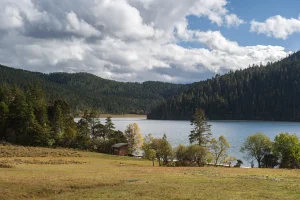
At the Lugu Lake viewpoint, use the permitted viewing area and stay behind barriers. Secure loose belongings; a ponytail is not a way to secure a hat. The account recalls turquoise water and sunlight across the lake, but the exact viewpoint and arrival time still need confirmation.
I snapped away with my phone, which went “beep beep” as memory filled—I took 327 photos. The young couple leaned on the railing for a photo, the girl’s teddy bear shaking in the wind; the man with glasses set up his easel, muttering as he painted: “This light and shadow are harder to catch than in a photo.” A little girl in an ethnic skirt ran over, holding a Galsang flower for a photo with me. I squatted down, and she stuffed the flower into my hand: “Sister, this is for you; Lugu Lake’s flowers are the most fragrant!”
Lunch: Confirm the Restaurant and Choose Fully Cooked Food
The account places lunch at “Mosuo Home” below the viewpoint; confirm the actual address and opening before making it a planned stop. The restaurant was a log house with pine branches on the roof and dried corn hanging on the lintel. The owner was an Amma in an indigo apron; seeing us enter, she shouted: “Little sister, want some roasted suckling pig? Freshly slaughtered this morning!”
When the roasted suckling pig was served, it was shiny with oil and the skin was crispy enough to “crunch.” Amma sliced a piece and put it in my bowl: “Try it, dip it in some chili water.” I took a bite; the skin was so crispy it fell apart, and the pork inside was so tender it could be pinched, mixing with the spice of the chili and the aroma of the pork. I had three pieces in a row.
The account describes Sulima wine, but the actual ingredients, alcohol content and water source need confirmation from the producer. Sweetness is not a measure of alcohol strength. Avoid alcohol during initial high-altitude acclimatisation, as advised by the CDC; do not drink if you will drive. [5]
Check-in at Lige: Confirm the Property and Final Approach
Confirm the lawful vehicle access and permitted drop-off for the actual Lige accommodation before booking. A narrow road described in an anecdote does not establish that vehicles may drive to the guesthouse door; allow for the last walking leg and luggage assistance.
The account names “Peninsula Cloud Guesthouse” as the accommodation. Confirm the arrival time and permitted final approach. It was a wooden building with white walls and blue tiles, with two bougainvillea bushes in full bloom at the door. The front desk girl was a Naxi sister; she handed me the key card: “You booked a lake-view room, it faces Gemu Goddess Mountain directly.”
Pushing open the door, the room was cozier than imagined—creamy white bedding with a sun-dried scent, and floor-to-ceiling windows that opened to Lugu Lake. I leaned on the balcony railing: lake water tapped against the rocks on the shore, splashing fine spray; the distant Gemu Goddess Mountain was shrouded in mist, with only the peak visible like a shy girl.
5:00 PM: “Duck Fleet” by the Lake and the “Transformation Show” of Gemu Goddess Mountain
At 5:00 PM sharp, I moved a wooden chair to sit by the lake. The breeze carrying the lake’s coolness blew over, so I wrapped myself in a light jacket and watched a group of ducks “flap” past—gray, white, and mottled ones, lined up in a row like a tiny fleet. The leading old duck occasionally turned its head to quack twice, and the little ducks behind followed closely.
While watching, the clouds on Gemu Goddess Mountain suddenly dispersed. Sunlight pierced through the clouds, lighting the upper slopes. The peak that was shrouded in mist just now became clear in an instant, revealing bare rocks and scattered pines. After 10 minutes, clouds gathered again, and the peak hid back into the clouds, leaving only a blurred outline.
Overnight: “Slow Time” in the Sound of the Lake
At 7:00 PM, I had dinner at the guesthouse. The account describes stone-pot tofu (30 yuan); the tofu was soft, and the soup floated with scallions and peppercorns. I took a sip; it was warm. Suddenly I thought of the little girl at the viewpoint; the Galsang flower she gave me was in a vase in my room, its petals still fresh with water.
Lying in bed, I heard the lake water “whooshing” outside, like someone whispering softly. I flipped through the photos of the day: the lake at the viewpoint, the roasted pig at the Mosuo home, the ducks at Lige Peninsula… The light from the phone screen reflected on the ceiling. I heard my own heartbeat mixing with the sound of the lake and the wind—this day combined a long road transfer and many photographs with quieter moments beside the lake.

Day 8: Lugu Lake Outings, Walking Marriage Bridge and an Optional Home Visit
Morning: Clothing and Photography Plans
The account begins at “Peninsula Cloud Guesthouse” and describes borrowing a red skirt. Confirm the lender, fee and item; embroidery is not enough to identify a universal Mosuo “Auspicious Knot” or ceremonial costume.
Arrange transport from the actual Lige guesthouse to Caohai and Walking Marriage Bridge, using mapped entrances and permitted paths. Do not follow an undefined left turn from Lige or walk into wetland grass for photographs. The account calls the host A Xiu; this name is retained as reported, not independently verified.
Walking Marriage Bridge: Allow a Separate Transfer
Walking Marriage Bridge is not established as a ten-minute walk from the Lige guesthouse. Check the route and return journey before setting out. The original 1980s construction date and claim that railing notches are courtship marks need local heritage evidence, not inference from their appearance.
View the grass sea from the permitted walkway. Keep off wetland vegetation and do not use the account’s dew-soaked clothing as an example of authorised access.
If taking red-skirt photographs, remain on the permitted walkway and keep access clear for others. The original scene says the skirt was already being worn, so a later description of A Xiu arriving holding it is not consistent; the photograph and participant details need confirmation.
Lunch: Confirm the Canteen and Cured-Pork Preparation
Choose lunch around your confirmed route. The account places “Dazu Village Canteen” in Nisai; confirm the actual business name and address rather than assuming those village references identify one place.
The account names Mosuo cured pork. Confirm the dish and preparation with the kitchen, and choose fully cooked meat. Curing, drying or a pleasant taste does not establish that pork is safe to eat without adequate cooking.
The side dish in the account was buckwheat cakes with honey. Honey is not “home-brewed”; its floral source, supplier and no-added-sugar claim require product evidence. Do not infer those facts from its fragrance or the vendor’s early-morning harvesting story.
Afternoon: An Optional, Consensual Cultural Visit
Arrange the return from the lunch stop before any afternoon home visit. Confirm the appointment and meeting place with the host rather than assuming a 2:00 PM visit at the guesthouse fits a journey from the other side of the lake.
Confirm the host, address, consent, fee and interpretation for any cultural visit. The original “Cultural Center” and claimed family relationships have not been verified; one narrated visit is not evidence for every Mosuo household.
Do not describe the unverified red garment as a universal Mosuo wedding dress or present the original age-13, curtain and gifts story as a rule of courtship. Coming-of-age customs and adult relationships must not be conflated. Ask a qualified local interpreter to explain the specific household’s customs, respecting privacy and consent.
Evening: Dinner and Music in a Permitted Area
Use the accommodation’s permitted cooking or dining area and confirm local fire and environmental restrictions. The original lakeside-grill story does not establish permission to light charcoal beside the water or allow sparks and waste into the lake.
The account recalls roasted potatoes and corn. Have food washed, prepared and cooked appropriately in a permitted area; soil on the potatoes or a blackened skin does not by itself establish safe preparation.
“Want a song?” The man with glasses (the one painting at the viewpoint) came over with a guitar. The moment he plucked the strings, I heard a familiar melody—”Small Happiness.” Moonlight fell on the lake like scattered silver. The man’s singing mixed with the “whoosh” of lake water. Chewing on a roasted potato, I thought: this trip to Lugu Lake was worth it.
Day 9: Returning by Bus from Lugu Lake, Ending the 9-day Multi-city Journey
Morning: Checkout and Confirmed Departure
Before checkout, pack food only if its storage and suitability for travel are known. Do not keep cooked potatoes overnight under a pillow and treat their sweet taste as evidence of safety. The account otherwise describes the last morning at the Lugu Lake guesthouse.
If offered dried mushrooms as a farewell gift, require reliable identification and sourcing; warmth, appearance and a host calling them porcini do not establish safety. Drying or cooking cannot be relied on to make an unknown poisonous mushroom edible. Hong Kong’s Centre for Health Protection documented poisonous “porcini” with irritants that can remain after cooking. [6]
Settle checkout and confirm the bus boarding point, first transfer and any onward driver before leaving. The original account moves Old Zhou from the Lijiang guesthouse to the Lugu Lake checkout desk and introduces Xiao Duo as yesterday’s costume instructor, although Day 8 names different participants. Those identities and relationships need confirmation; they should not be used as booking contacts.
Lugu Lake → Lijiang: Original Bus Log, Not a Current Timetable
Confirm the actual boarding point and departure with the carrier, and arrange the first leg from your guesthouse. The undated times below are an account of a journey, not a service schedule or guaranteed airport connection. Allow a substantial buffer for road delays; do not book a tight same-day flight from these figures.
| Time | Event/Details | Feeling/Notes |
|---|---|---|
| 7:30 | Waiting at Lugu Lake Passenger Station, bought hot soy milk (5 yuan) | Waiting hall wafted with the scent of boiled potatoes; an auntie from Ninglang shared oranges, the juice sweet as honey |
| 7:50 | Departed on a navy blue bus, chose a seat in the second-to-last row | Seat was old but clean; the auntie next to me talked about her grandson, just like my grandmother |
| 8:30 | Passed Ninglang County; bougainvillea became scarce, replaced by vast cornfields | Corn ears hung heavy; occasional flashes of Yi ethnic log houses, bronze bells on eaves tinkled in the wind |
| 10:00 | The account recalls food offered by a fellow passenger | Accept food only when its ingredients and safe storage are known |
| 11:30 | Saw the distant peak of Jade Dragon Snow Mountain, snow glistening on top | Recalled the mountain outing on Day 6, three days earlier; do not treat the marker photograph as an obligation |
| 12:00 | Arrived at Lijiang Passenger Station | Sunlight was dizzying; a jelly stall at the station wafted sour and spicy aromas, so I rushed over to buy some |
In Lijiang: Stop for Food Only if the Connection Allows
If time allows before the airport transfer, the account suggests a jelly stall at the station entrance. The owner was an uncle in a straw hat; the red oil bowl floated with sesame, crushed peanuts, and mint leaves. “Want it spicy?” he asked. I nodded: “Put a lot!”
When the jelly was served, the slippery jelly was quivering. Biting into it made a “slurp” sound; it was so sour I squinted, yet I couldn’t stop eating—this taste was even punchier than Kunming’s Xi Dou Fen or Dali’s cold chicken rice noodles! The uncle saw me eating with gusto and smiled: “My wife is from Sichuan; she mixed the seasoning, it’s a secret recipe!”
For a same-day departure from Sanyi Airport, work backwards from the airline’s check-in and baggage deadlines and leave room for road delays. The original 13:00 taxi, 50-yuan fare and 40-minute ride do not establish a safe connection. If the verified bus arrival leaves too little margin, change the onward plan rather than relying on the narrative’s clock times.
Airport Departure and Budget Scope
| Location/Item | Details/Reminders |
|---|---|
| Airport Check-in Counter | Boarding pass printed with “Thank you for flying Lucky Air.” Suddenly remembered packing my bags before departure: Mom’s sunscreen, Lijiang flower cakes, Lugu Lake postcards (with A Xiu’s “Welcome back”) |
| Security Check | Allow time for security checks. A suntan is not evidence that a person is healthier; continue suitable sun protection. |
| By the Gate Window | Flipped through phone photos: Dianchi lakeside, Dali Honglong Well tie-dye, Lijiang Mu Mansion Tower, Lugu Lake Walking Marriage Bridge… The most precious weren’t the check-in photos, but: the Bai grandma’s smile, the Mu Mansion guide’s voice, the old lady’s warm flower cakes, and the roasted potato scent of the Lugu Lake guesthouse |
| Total Cost (Excluding long-distance transport) | The original estimate is about 3500 yuan, excluding long-distance transport. It has no travel date, itemised costs, room-sharing basis or precise transport exclusions. Budget for eight nights plus the chosen transfers and activities; confirm prices before relying on this figure. |






