



Day 1: Tianmen Mountain Scenic Area · Cableway Viewing Route
I arrived at the Tianmen Mountain Cableway Lower Station at 8:30 AM. The Line A early-bird ticket I had snagged on the official WeChat account the night before came in handy—the third queue on the left of the ticket window had the fewest people. It took only 3 minutes to issue the ticket by scanning my ID, saving at least 20 minutes compared to buying on-site. The cableway cabin features a blue-and-white color scheme with floor-to-ceiling glass wiped crystal clear. Even with 28 people, it didn’t feel crowded. I picked a window seat and kept my eyes glued to the view during the 28-minute ride: when we first started, the mist was as thick as cotton wool wrapping around the peaks; as the sun rose, the bluish-gray rock walls slowly took shape, and the spiral bends of the mountain road below looked like silver ribbons wound around the mountainside. I changed my phone’s angle three times to take photos, fearing I might miss any part of this panorama.
- The Glass Skywalk is located at the entrance of the West Line on the mountain top. You have to buy shoe covers at the small booth nearby (5 yuan/pair for the transparent plastic version). The skywalk is 60 meters long and built against the cliff. The deep valley beneath your feet is clearly visible. Some tourists were screaming while clutching the handrails, but I felt quite steady—the handrail is chest-high, and my legs didn’t feel weak after walking across;
- The Guigu Skywalk follows the Glass Skywalk. The wooden steps are worn shiny, and the iron chains at the edge clatter. When the wind is strong, it blows your jacket into a ball. I met an elderly photographer here who said, “Wait for sunset to take backlit photos; the shadows of the rocks can stretch very long”;
- Yihong Pass is a small platform with stone benches and a stall selling mineral water (3 yuan/bottle). I waited 10 minutes here for the clouds—they seemed to be racing with the wind, alternately hiding the cave opening and revealing half of it. After taking seven or eight consecutive photos, I chose one where the clouds parted and sunlight spilled into the cave; it later received the most likes on my social media;
- The mountain top simple meal was in a wooden house near Yunmeng Fairy Peak. The window seats offer a view of the peaks. I ordered tomato and egg over rice (38 yuan). The rice was a bit hard but filling, the eggs were fluffy, and it came with a small dish of pickles. It’s pricier than at the foot of the mountain but saves the trouble of going down and back up;
- Near Yuhu Peak on the East Line, there is a “Best Shooting Point” sign. Using the 0.5x wide-angle on my phone, the small stone peaks look like an upside-down teapot. The Tianmen Water Turning waterfall had low volume that day, looking like a strip of white gauze; it must be spectacular after rain. Yunmeng Fairy Peak is the highest point (1518 meters above sea level), with a bronze monument marking the height and a nearby stall selling keychains for 20 yuan;
- The downward mountain-piercing escalator consists of 7 sections, each several dozen meters long. Staff members guide you at the intervals. The escalator moves slowly enough to see the textures of the rock walls. There is an option to walk the 999 steps, which are about 30 cm wide with rest platforms, but I chose the escalator to save energy (32 yuan one way);
- The Tianmen Cave Viewing Platform has chest-high railings. To take a full panorama, you need to step back two steps below the stairs and use the rule of thirds—place the cave in the bottom right and the mountain body in the top left to frame the entire “Heaven’s Gate” and the peaks behind it;
- At 5:00 PM sharp, I took the eco-bus down the mountain. The 40-minute drive was steady, and we passed a few houses with chimney smoke in the mountain hollows. I stayed at the Home Inn on Jiefang Road (200 yuan/night). Check-in was fast, the room faced south with a window, and while I could hear the snack street downstairs at night, the soundproofing was decent. Breakfast was included (plenty of buns and soy milk).
While waiting for clouds at Yihong Pass, an auntie saw me hesitating with my phone and leaned over to say: “Young lady, don’t just photograph the cave, capture the movement of the clouds!” I waited a while as she suggested and indeed caught the moment the clouds surged into the cave—I later realized she was using an old-fashioned feature phone but was better at finding angles than I was.
| Item | Cost (Per Person) | Remarks |
|---|---|---|
| Tianmen Mountain Ticket | 278 yuan | Line A includes cableway up + escalator down; buying in advance on WeChat saves queuing time |
| Glass Skywalk Shoe Covers | 5 yuan | Bought at the entrance booth, transparent plastic version |
| Mountain Top Simple Meal | 38 yuan | Wooden house near Yunmeng Fairy Peak; tomato and egg over rice (rice + 1 meat + 1 veg) |
| Mountain-piercing Escalator | 32 yuan | One way downward; 7 sections; walking the 999 steps is an alternative |
| City Accommodation | 200 yuan | Home Inn Jiefang Road standard room (twin beds, breakfast included, 10-minute walk to snack street) |
The rhythm of this day felt like a massage for the eyes, especially the shock of seeing the peaks for the first time during those 28 minutes on the cableway—it turns out you don’t need perfect weather; mountains in the mist have their own ink-wash painting charm.
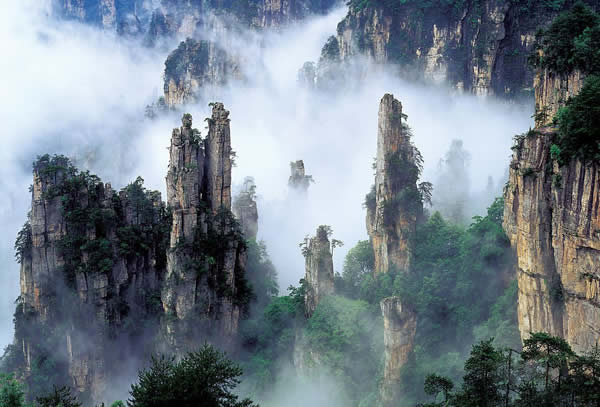
Day 2: Yuanjiajie Scenic Area · Mihun Stage Core Route
I woke up at 6:50 AM at dawn; the 7:30 AM alarm I had set was actually unnecessary—as the sky outside was just turning pale, I headed out with my bag. The eco-bus station near the Wulingyuan Landmark Gate starts at 6:00 AM, and the first bus at 7:00 AM was crowded with seven or eight tourists. The driver said, “Going to the Bailong Elevator early can avoid the tour groups.” The bus took 20 minutes to reach the lower station of the Bailong Elevator. I arrived at 7:50 AM. There were already about a dozen people in the queue, but fortunately, the electronic screen showed “Estimated wait 15 minutes.” Sure enough, I entered the elevator a quarter-hour later. The elevator is a silver cylinder; my eardrums felt pressure like being on a plane as we ascended. After 1 minute and 58 seconds, it stopped with a “ding.” When the doors opened, I was stunned: the peak forest of Mihun Stage was stabbing straight up before my eyes, possessing a sense of pressure far greater than any high-definition image online, with moss on the rock walls glowing green in the morning light like a layer of light ink.
- Mihun Stage is a semi-circular wooden viewing platform with thick log railings and non-slip stone slabs on the ground. The grayish-black stone peak directly in front is the prototype for the Avatar Floating Mountain. Its top is flat as if shaved, and a vertical crack on the side looks like the pivot for “floating.” The 8:00 AM oblique light brings out the rock layers. I squatted low and used the 0.5x wide-angle on my phone to frame both the peaks and the platform; after cropping out the messy edge trees, it makes a perfect wallpaper;
- Walking from Mihun Stage toward the First Bridge under Heaven, follow the signs for “Back Garden Direction”. It’s mostly flat road. The 20-minute walk passes a group of stone peaks—some look like stacked mushrooms, and some have jagged tips like a giant brush holder. I took a photo of a friend standing in the middle; she said, “The background feels like entering a land of giants”;
- The First Bridge under Heaven is a natural stone arch between two isolated peaks. The top of the arch is about 300 meters above the ground, and the bridge surface is only 2 meters wide. Standing at the edge and looking down, the valley floor is a dense forest. When the wind blows, the leaves rustle, and you can vaguely see mist flowing at the bottom. Make sure not to lean too close to the railing—the railing is only waist-high, and it’s easy to panic if your center of gravity is unstable;
- I had lunch at the “Tujia Rice Noodle Shop” on the right side of the bridgehead of the First Bridge under Heaven. The shop is just two rooms with five or six wooden tables. I ordered beef noodles for 25 yuan (including a marinated egg for 3 yuan). The rice noodles were thick, round, and handmade, served in a portion piled high like a small mountain. The beef slices were thin but tenderly stewed, and the broth mixed the aroma of beef bone with the slight spiciness of local chilies; I could even scoop up some dried radish slices at the bottom;
- At 1:30 PM, I went to Yangjiajie. The eco-bus reached the Wulong Village entrance in 15 minutes. The steps were indeed steep, about a 45-degree angle for 187 steps. There’s a flat spot midway to catch your breath. The “Tianbo Mansion” stone tablet at the village gate is made of bluestone, with its characters worn shiny from being touched. I took a panorama in front of the tablet, with the peaks behind layered like soldiers in formation; a tourist said, “It looks like an ancient battle formation”;
- At 4:00 PM sharp, I took the eco-bus back to the lower station of the Bailong Elevator. After coming down, I hailed a local taxi (25 yuan metered) back to my Wulingyuan guesthouse. I stayed at “Shanshe Courtyard” in Xibu Street (180 yuan/night). The courtyard has an osmanthus tree with a clothesline right under it. The room has a bamboo-woven ceiling and the bedsheets smell like they’ve been dried in the sun. The owner said, “You can hear the sound of the stream at night.”
While taking photos at Mihun Stage, a middle-aged man in a windbreaker leaned over to look at my phone: “Young lady, lower your lens and let the peak tips emerge from behind your shoulder; it makes the person blend with the scenery.” I tried it, and it indeed had more character than standing straight—I later found out he was from the local photography association and often comes to shoot the sea of clouds after retirement.
- Trap Warning: The walking paths in Yuanjiajie are all flat roads or gentle slopes, so don’t wear flat shoes or leather shoes. I wore old sneakers all day and my soles didn’t feel sore at all. Only carry a bottle of water (500ml) and your phone in your bag; keep your camera on a neck strap. Traveling light is the only way to keep moving;
- Recommended Experience: Although the steps at Wulong Village are steep, you can go back and forth in half an hour. It saves more time than going to other attractions in Yangjiajie and is suitable for people on a tight schedule.
| Item | Cost (Per Person) | Remarks |
|---|---|---|
| Bailong Elevator (One Way) | 65 yuan | Not included in the Wulingyuan pass, must be purchased separately |
| Eco-bus (Inside Scenic Area) | Free | Included in the pass for unlimited rides |
| Beef Noodles + Marinated Egg | 28 yuan | “Tujia Rice Noodle Shop” at the First Bridge under Heaven; handmade thick noodles, rich broth |
| Wulingyuan Guesthouse | 180 yuan | “Shanshe Courtyard” standard room in Xibu Street (bamboo ceiling, air-conditioned, near snack street) |
The biggest surprise of the day was the morning light at Mihun Stage; the peaks looked like giants just waking up in the light, and even the folds in the rock walls seemed full of life. Later, when going down the mountain, I met a porter who said, “You came at the right time; in this season, there are fewer clouds before 8:00 AM”—it seems waking up for the first eco-bus was worth it.
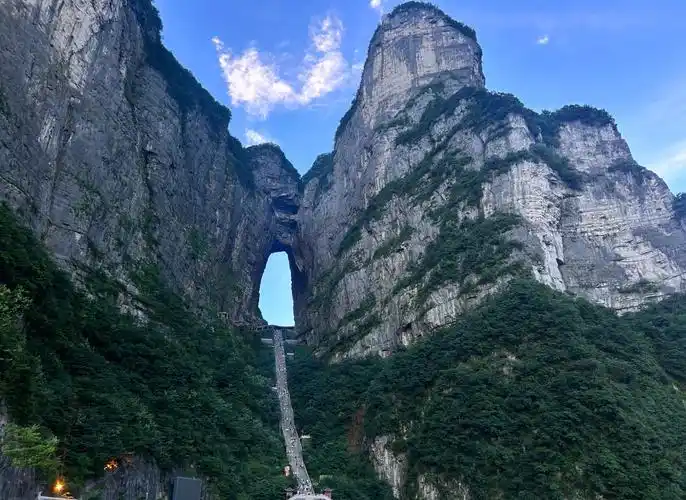
Day 3: Golden Whip Stream Scenic Area · Canyon Trekking Route
I arrived at the Wulingyuan Landmark Gate at 8:00 AM sharp. The electronic screen at the gate displayed “Today at Golden Whip Stream: Sunny to cloudy.” Before the tour groups started to cluster, I hurried to the bus station to catch the scenic area eco-bus (green minibus with “Golden Whip Stream Special Line” pasted on the front). The ride took 10 minutes, and I arrived at Shuiraosimen at about 8:10 AM—this is the starting point of Golden Whip Stream. A chest-high bluish-gray rock is engraved with the vermilion characters “Golden Whip Stream,” the strokes slightly rough as if by a local stonemason. The stream flows beneath the rocks, so clear that you can see small fish in the crevices of the pebbles. I squatted down to touch the water; the coldness surged up through my fingers.
- Walking 2 km toward Golden Whip Rock, the flat road is paved with crushed stones, and the bamboo forests on the roadside are as dense as walls. After walking for about 20 minutes, I heard tourists ahead shouting “Monkeys!” and looked up to see three or four macaque monkeys perched on branches. One mother monkey was holding an infant and staring at a plastic bag in a tourist’s hand. I gripped my empty water bottle tightly—I had heard from a forest ranger earlier that these monkeys become addicted after stealing snacks and might even chase people; the sound of a plastic bag being torn is distressing to hear;
- I reached Golden Whip Rock, and it indeed looked like a golden stone whip plunged into the ground, about 300 meters high. The rock wall glowed with a beeswax luster in the sunlight. Following my plan, I walked into the shadow under a Chinese wingnut tree on the opposite bank to take photos—there was no reflection there, and the phone captured the textures of the rock wall like wood grain, ten times clearer than photographing in strong light;
- Zicao Pool is hidden downstream from Golden Whip Rock. The water is a pale emerald color, like green tea mixed with milk. A few plane tree leaves floated on the surface, their stems still green. I rested here for 15 minutes, munching on a Red Fuji apple I brought (crisp and sweet with no residue), and listened to two elderly men chatting nearby: “This pool water is warm in winter and cool in summer; villagers used to wash clothes here”;
- Meeting from a Thousand Miles Away consists of two rounded rocks—one looks like an old man in a hat and the other like a bowing scholar, separated by a narrow stream. Nearby is a small log bridge that creaks when you step on it. After crossing the bridge, there’s a flat section where the stream slows down. I squatted on a rock and used the macro setting on my phone to photograph the current—the tiny splashes of water droplets hitting the pebbles were more soulful than a wide-angle shot;
- I reached the final stop at the lower station of the Huangshi Village Cableway. I checked my watch (about 11:30 AM). Thinking I had to return at 3:00 PM, I didn’t buy a cableway ticket (65 yuan one way)—while the panorama from the top is great, it’s better to save energy for the return trip when time is tight;
- At 3:00 PM sharp, I took the eco-bus back to the Landmark Gate. The driver said, “The last bus is at 3:30 PM, you made it just in time.” Looking back at Golden Whip Stream as I got off, the water was shimmering with broken gold in the sunset, like a road that hadn’t been fully traveled.
While resting at Zicao Pool, a forest ranger in camouflage came by to pick up trash. He pointed at the monkey troop not far away and said: “Young lady, look at that one with the broken tail. It was scraped by a wire fence while stealing bread from a tourist last year; now it hides whenever it sees people.” He handed me a card printed with “Golden Whip Stream Monkey Observation Rules”: Do not feed, do not provoke, keep plastic bags away—later I understood that the beauty of this stream lies not just in the stones and water, but in this restraint between humans and nature.
- Cost Details: Trekking Golden Whip Stream itself has no entrance fee (included in the 248 yuan Wulingyuan pass). I brought my own apple and water and only spent 8 yuan on a boiled corn (5 yuan) and a bottle of ice-cold mineral water (3 yuan) at a roadside stall to avoid carrying too much weight;
- Recommended Experience: Walking the 5 km essence section is just right, from Shuiraosimen to Meeting from a Thousand Miles Away. The flat road isn’t tiring, every spot has its own character, and there’s plenty of time for photos;
- Trap Warning: Don’t wear flip-flops or hard-soled shoes as the crushed stone paths are uncomfortable; don’t stay alone for too long in areas where monkeys appear (near Golden Whip Rock), and parents with children must keep a close watch.
| Item | Cost (Per Person) | Remarks |
|---|---|---|
| Eco-bus (Round Trip) | Free | Included in the Wulingyuan pass; direct from Shuiraosimen to Landmark Gate |
| Boiled Corn + Mineral Water | 8 yuan | Roadside stall (Corn 5 yuan/ear, Water 3 yuan/bottle) |
| Other Dry Rations | 22 yuan | Brought my own apple (market price), no additional spending |
After these three days, Golden Whip Stream felt like a gentle conclusion—without the excitement of the cableway or the pressure of the peak forests, just strolling along the stream, listening to birds, watching monkeys, and touching the cool water. I even subconsciously lightened my steps. Recalling my worry that “3 days would be too rushed” before starting, I now feel that if the transport connections are well-coordinated (1 hour for the city-Tianmen Mountain bus, and eco-buses in Wulingyuan available on demand), you can reach all the core attractions, and the rest is for your own eyes to remember.
“`
Zhangjiajie National Forest Park — Practical Information
Tickets & Booking
- Zhangjiajie National Forest Park (Wulingyuan core scenic area) single ticket: Standard ticket year-round CNY 165 each, with optional CNY 3 insurance, valid 4 consecutive days; concession ticket year-round CNY 83 each. Per the Hunan Provincial Development and Reform Commission “Notice on Matters Concerning Ticket Prices of the Wulingyuan Core Scenic Area” (Xiang-Fa-Gai-Jia-Fei-Gui [2024] No. 977), effective from Jan 1, 2025, valid 5 years; advance booking required (Timed and site-specific reservation entry is used; visitors are encouraged to use the “Zhangjiajie One-Machine Tour” WeChat mini-program for real-name reservation tickets and fast ticket-check entry)[src]
- Ticket concession policy: Free admission: children under 14 (exclusive), seniors 65 and above (inclusive), disabled persons, active-duty military personnel and retired military cadres with valid ID; half price: minors 14 (inclusive)–18 (exclusive), seniors 60 (inclusive)–65 (exclusive), and current full-time university undergraduate students and below; no booking required[src]
Transport & Schedules
- Inside the Wulingyuan scenic area → The various sights | Scenic-area eco-bus (included in the combined ticket/separate purchase): Eco-buses inside the scenic area connect the various zones; the high-platform touring lines at Tianzi Mountain, Yuanjiajie and Yangjiajie operate one-way loops, so plan to avoid backtracking[src]
Where to Stay · Room Type · Nearby
- Wulingyuan district (near the ticket stations) | Reference price Guesthouses/chain hotels about CNY 150–500 per night (reference) | Room tip: Close to the ticket stations, good for entering the park early and multi-day visits (the ticket is valid 4 days); conven | Nearby add-ons: Golden Whip Stream, Huangshizhai, Yuanjiajie, Tianzi Mountain, Yangjiajie, Ten-Mile Gallery, Xibu Street[src]
- Zhangjiajie city (Tianmen Mountain cableway lower station/Dayong Ancient Town area) | Reference price About CNY 140–550 per night (reference) | Room tip: If you also visit Tianmen Mountain, staying in the city is closer (the lower station of the Tianmen Mountain cableway is | Nearby add-ons: Tianmen Mountain, Dayong Ancient Town, Nanmenkou, Tujia Folk Customs Park[src]
Typical Climate & Packing (Past Years)
- January: 2.6 °C–9.4 °C °C, Zhangjiajie has a humid subtropical monsoon climate, humid and rainy
- February: 4.5 °C–11.5 °C °C
- March: 7.8 °C–15.9 °C °C
- April: 13.4 °C–22.7 °C °C, Spring is cloudy and misty, with a higher chance of cloud seas
- May: 18.0 °C–27.2 °C °C
- June: 21.6 °C–30.2 °C °C, Relatively high rainfall; watch for rain gear and slippery surfaces






