Zhangjiajie 6-Day Niche Hiking Route
Key Reminder: Restaurants at the entrance of Xibu Street are expensive and less authentic; be sure to walk further in. “Shanjian Xiaozhu” needs to be booked 3 days in advance (the owner often keeps rooms for regulars during peak season). The last minibus is at 18:30; if you miss it, you can take a ride-hailing car (approx. 80 yuan to town center).

Day 2: Yaozi Village Hiking—Through Dense Forests and Rocky Slopes, Peak Views Up Close
On the second morning, I woke up at 7:00. Li, the guesthouse owner, said Yaozi Village should be visited early to avoid the harsh sun. I carried the bag I packed the day before (containing trekking poles, a 1.5L water bottle, and energy bars) and walked 10 minutes to the Wulingyuan Ticket Station, just in time for the first shuttle bus at 8:00 (miss it and you wait half an hour). The bus fare is included in the pass; just swipe your ID card to board. The bus headed toward Golden Whip Stream, and the mountain mist outside the window hadn’t dissipated yet, looking like a thin veil.
Arriving at the Golden Whip Stream trail entrance, walk 0.5 kilometers along the stone path by the stream. When the water sound gets louder, you’ve reached the “Qianli Xianghui” (Thousand-Mile Meeting) junction—where the stream splits into two around a gap between two large rocks with vermilion characters carved on them. At this point, look up for the blue sign (labeled “Yaozi Village Hiking Entrance”). The arrow points toward the dense forest on the upper right. After walking a few dozen meters, the path disappears, and you have to use both hands and feet to climb the rocky slope. The rocks vary in size; some are half-buried in the soil with green moss on the surface. I held onto the iron chains (rusty but sturdy) anchored in the rock crevices to pull myself up, my palms covered in sweat. During a rest stop, I saw a guy in a baseball cap using a thick branch as a cane with a red cloth tied to the end. He said he brought it from Mount Hua, and it “works here too,” which almost made me laugh out loud.
The first time I took this route, I hesitated at the junction for 5 minutes and followed a crowd to the left onto another wild path, ending up wandering until 1:00 PM to reach the top, my legs feeling like jelly. I later learned from a forest ranger that the dense forest to the right of the blue sign is the correct path; don’t trust shortcuts that “look easy.”
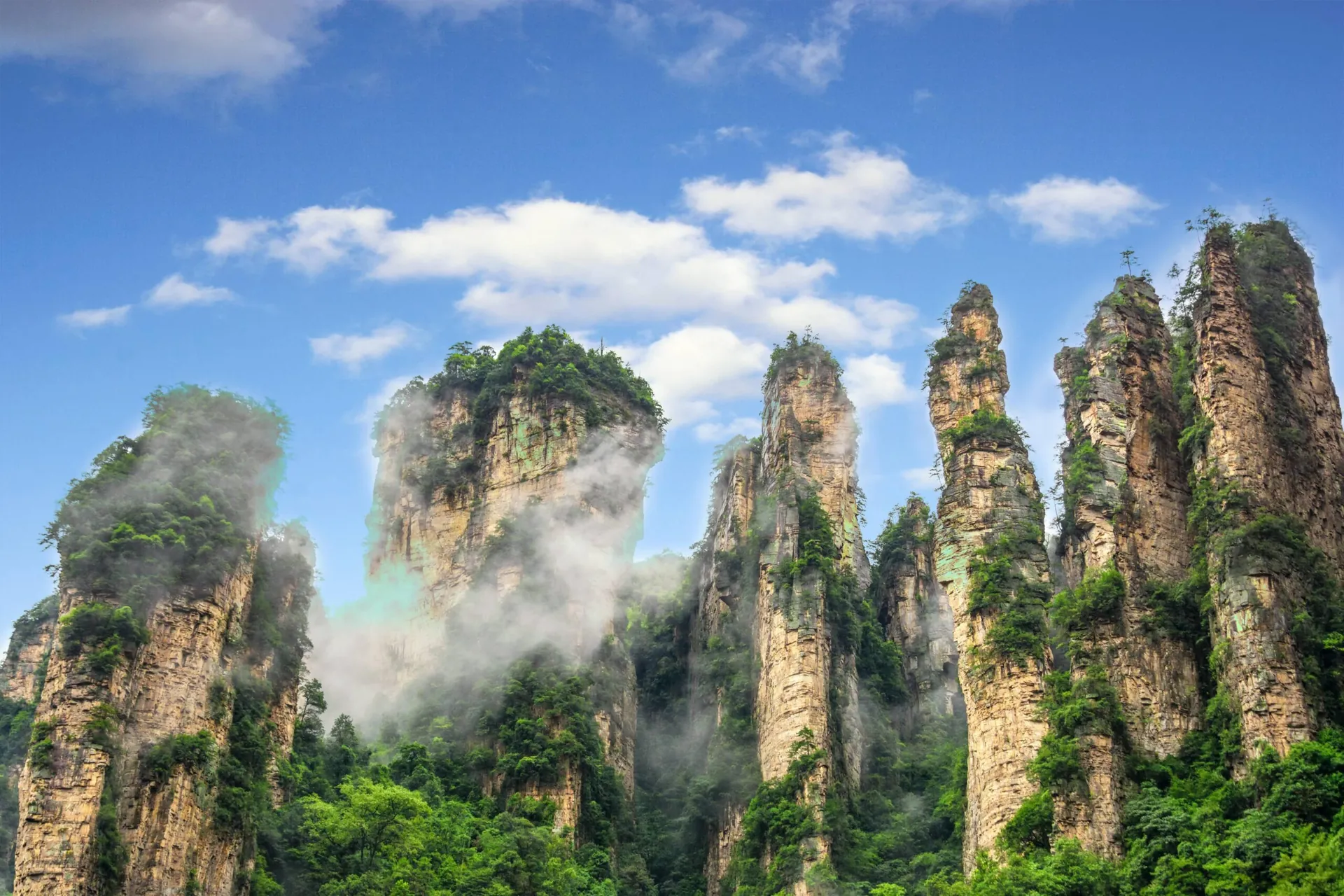
Reaching the top of Yaozi Village took 2 and a half hours (9:00-11:30). Upon reaching the summit, I found a small flat area with a wooden sign saying “Yaozi Village Elevation 1200m.” Next to it is the viewing platform. It has no railings but offers an expansive view—the peaks of Huangshi Village directly opposite look as if split by a giant axe, with conical mountain tops piercing through the clouds. When the sun shines at an angle, the rock textures look like a carved landscape painting. I crouched on a rock and took photos for half an hour; zooming in, I could see pine trees among the peaks swaying in the wind, like green hats for the mountain tops.
| Time |
Activity |
Details/Reminders (Personal Experience) |
| 8:30 |
Depart from Wulingyuan Ticket Station |
The first shuttle bus leaves at 8:00 sharp; the stop is to the right of the hall. Don’t go to the wrong window (I once waited 10 mins at the group ticket window). |
| 9:00 |
Arrive at “Qianli Xianghui” |
Look for the blue sign pointing right toward the forest. Make sure it says “Yaozi Village” and don’t confuse it with “Shadao Gully.” |
| 9:00-11:30 |
Ascend Yaozi Village |
Grip chains on the rocky slope (don’t hold too tight, rocks can move). There’s a crooked tree halfway up where you can sit (marked with red cloth on roots). |
| 11:30-13:00 |
Rest at the summit platform |
The Huangshi Village panorama is not backlit now; use wide-angle for depth (I adjusted exposure to -0.3 to prevent sky blowout). |
| 13:00-15:30 |
Descend via the same way |
Take the gentle slope on the left (a beaten dirt path); it’s 20 mins faster. Bend knees slightly and use poles behind you. |
| 16:00 |
Return to Guesthouse |
Roasted corn at the foot of the hill is 5 yuan (sweet/sticky); eat it while hot to fuel up. Don’t buy cold ones (gave me a stomach ache last time). |
On the way back, I specifically took the gentle slope on the left—that was the “wild path” I discovered when lost before. It has a gentle gradient and is lined with dwarf bamboo forests; the bamboo leaves tickled my arms as I brushed past. Going down is harder on the knees than going up, so I lengthened my trekking poles and ensured the tip touched the ground first with every step, which made it much more stable. Reaching the bottom at 15:30, my calves were shaking, so I quickly bought a roasted corn; the warm sweet aroma mixed with the scent of corn silk instantly recharged me.
- Gear Essentials: Trekking poles (as a “third leg” on rocky slopes), non-slip gloves (to protect hands on chains), quick-dry hat (sun protection in the forest).
- Route Tips: Don’t believe in “shortcuts” (especially toward Shadao Gully at the junction); it’s easy to get lost. Don’t wear Crocs on rocky slopes (my friend tried and slipped three times).
- Cost Breakdown: Shuttle bus included in pass (248 yuan/person), roasted corn 5 yuan, mineral water 3 yuan (1 yuan more expensive than in town).
Final honest word: The “wildness” of Yaozi Village lies in the lack of finished stairs; don’t rush when climbing, and move only after confirming your footing. The peak views are absolutely worth the fatigue—standing on the rocks feeling the wind and hearing the birds below is much better than squeezing onto a glass skywalk for a photo.
Day 3: Exploring Laowuchang—Finding Ancient Tujia Villages, Waiting for Sunrise and Sea of Clouds
I woke up at 4:30 AM. The guesthouse window wasn’t closed tightly, and the mountain breeze blowing in was chilly. The night before, I heard from the owner that the sunrise and sea of clouds at Laowuchang depend on luck. I set my alarm for 5:00, threw on a softshell jacket, and headed out in the dark. Arriving at the Wulingyuan Bus Station, the sky was just starting to turn gray and the streetlights were still on. A handwritten note was pasted on the sign: “Laowuchang Minibus departs 6:30, 7 yuan/person” (I later found out this is an informal line run by villagers, not a regular bus).
While waiting, I met a local lady carrying a bamboo basket. She said she was going to the Laowuchang market. Seeing my backpack, she chatted: “Young man, here for the sunrise? You have to grab a spot early; later the sun will dry up the sea of clouds.” She pointed to a mountain col in the distance: “Last time I arrived at 6:00, the sea of clouds was just overflowing the ridges. When the sun came out, it was golden, like a blanket over the mountains.” Her words made me even more anxious to get there.
The minibus arrived exactly at 6:30. It was an old Wuling van with a door that wouldn’t close properly, and the 20-minute ride to Laowuchang Village entrance was bumpy. The van stopped by a dirt road, the driver shouted “We’re here!”, and I jumped out and ran toward the village viewing platform—a platform built of stones with no railings, its edges overgrown with wild azaleas. Just as I stood firm, the horizon began to show a pale white, and the sea of clouds surged up from the valley like a tide, first covering the terraced fields below and then slowly climbing up to the ridges of the “Fields in the Sky.”
My first time at Laowuchang was last autumn. I overslept and arrived at 9:00 AM; the sea of clouds had long dispersed, leaving only bare terraces and a few wisps of kitchen smoke. This year, I gritted my teeth to wake up early. At 5:40 AM when I reached the platform, the clouds were thick. The moment the sun popped out from the clouds, golden light hit the sea of clouds like a handful of crushed gold, even outlining the terraces with a warm glow—those two hours of sleep lost were truly worth it.
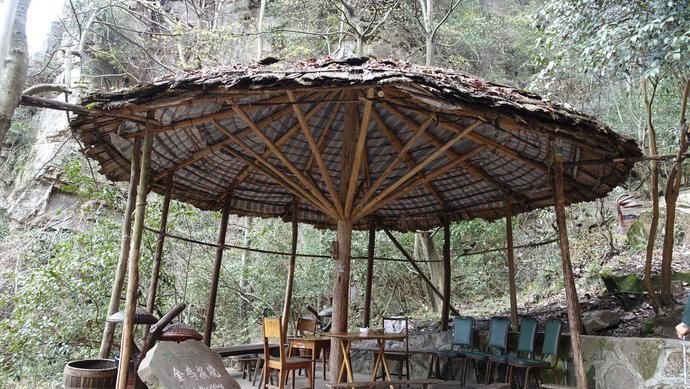
Below the platform is the Ancient Tujia Village. The wooden pillars of the stilt houses (Diaojiaolou) stand on stone pedestals half a meter off the ground to prevent moisture. I stepped down the creaking wooden stairs into the village. An old woman in a blue cloth shirt was sitting at her door sewing insoles. Seeing me peek in, she waved: “Come look, I wove these patterns myself.” The insoles were indigo with Tujia brocade patterns (diamonds and butterflies) and dense stitching. She said “15 yuan a pair, respectable for a gift.” I bought a pair, and she wrapped them in old newspaper, saying “they won’t hurt your feet when walking mountain paths.”
- Transport Logistics: Wulingyuan Bus Station 6:30 AM minibus (handwritten sign, 7 yuan/person, 20 mins to village); if missed, hire a car (80 yuan/car; driver Mr. Wang 138xxxxxxx, a local who knows the way); you can rent an e-scooter at the village (30 yuan/day, check battery for hiking points).
- Hiking Details: Take the e-scooter to the “Farm Road Starting Point” (villager-directed, at the end of the cement road) → Walk 1km along the farm road (scent of soil and grass, chili seedlings on the side) → Arrive at Fields in the Sky Viewing Platform (stone platform, unobstructed view).
- Cultural Interaction: The ancient village has no commercial development; the old lady sells insoles to supplement her income (don’t haggle, it makes her feel awkward); if you meet a villager blocking a path with a bamboo pole, just shout “Old neighbor, just looking at the scenery!” to pass (I was once blocked for 5 mins for not greeting).
Day 4: Hiking the Fields in the Sky—Walking Ridges to See Layered Terraces, Capturing Pastoral Life
At 8:30 AM, I set out from Laowuchang Village. I specifically changed into river tracing shoes—the sole pattern is as deep as sawteeth. Last time I wore them on the muddy ridges of Mount Wuyi after rain without slipping, and I figured they’d be stable on the dirt paths of the Fields in the Sky. Starting from under the old locust tree at the east end of the village, walk east along the field ridge. The ridge is only about half a meter wide; to the left are freshly planted paddy fields (yellowish water), and to the right are vegetable patches (peppers and eggplants). The mud was soft, and I sank in about a finger’s depth, but the drainage holes in the shoes quickly shed the mud, making them much more efficient than regular sneakers.
I passed two houses, both with low-walled yards of stilt houses and morning glories climbing the fences. A little girl with pigtails was chasing a hen barefoot. The chicken flapped its wings toward the end of the ridge, and she chased it shouting, “Grandpa’s chicken ran away again!”, her voice as crisp as a mountain spring. Her grandpa peeked out of the house, holding a bowl of corn porridge, smiling and waving his hand, saying “let it play for a bit.” That sense of ease felt much more real than the staged “pastoral style” in tourist spots.
- Gear Essentials: River tracing shoes (deep tread for slip resistance, fast drainage for mud), long-sleeved quick-dry shirt (many mosquitoes on ridges, tighten cuffs), CPL filter (reduces water surface reflection on terraces, makes clouds clearer).
- Route Details: East end of Laowuchang Village (locust tree) → Walk east along ridge (past 2 houses) → Halfway up viewing platform (stone pile, no railing) → Descend via dirt path on the right (less gravel, 20 mins faster).
- Best Shooting Time: 9-11 AM oblique light (sun is to the side-front, casting shadows for terrace depth, clouds with golden edges).
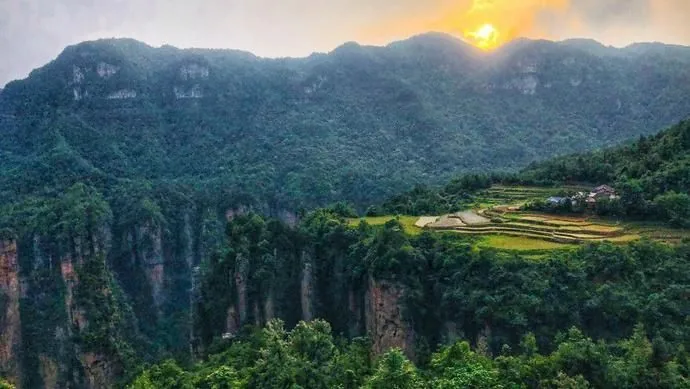
Arriving at the mid-mountain platform just after 9:00 AM, the sun had climbed to the eastern slope. The terraces before me looked as if measured with a ruler, stacked layer upon layer. The bottom was freshly turned mud (dark brown), the middle layers were vibrant green rice seedlings, and the top layer still had golden rice stubble mixed with withered grass. Mist wound around the mountainside like a ribbon, occasionally drifting over to cover half the terraces, then dispersing to reveal the chimneys of houses below.
Last time I was filming here, just as the lens focused on the top terrace, a gust of wind blew the mist away, and sunlight splashed down. Countless light spots immediately floated in the paddy fields like scattered silver. I quickly hit record, but my hand shook and it was blurry, so I slapped my thigh in frustration—later I found that if you stand still for 30 seconds, the mist will gather again. I learned my lesson.
I didn’t take the same way down. Villagers told me there was a dirt path on the right. It was actually a path trodden by villagers for transporting fertilizer, made of gravel mixed with yellow soil, twice as wide as the ridge and with a gentler slope. I followed it and reached the bottom in 20 minutes, saving a lot of energy. The end was an open space converted into a parking lot with a few farm trikes. Under the shade of a large tree sat an auntie in a blue shirt. She told me “the rural bus is once an hour, the 11:30 one is less crowded,” and handed me a cucumber: “Picked from my own field, 2 yuan to quench your thirst.” It crunched when I bit into it, the juice running down my chin with a raw, crisp sweetness—much better than those from the supermarket.
The parking fee was 10 yuan, collected by a dark-skinned villager. He said, “This land belongs to our group, charging a bit for parking isn’t much.” As I scanned the code to pay, he pointed to the fields where rice was being planted: “Don’t step on those seedlings; one step and they’ll float away. The fine is a small thing, but it’s not good to disrupt their farming season.” His words were practical, so I stuck close to the edge of the ridge afterward, afraid to misstep.
The bus back to town was bumpy for 40 minutes, and the terraces outside the window gradually turned into blurry green blocks. Feeling the half-cucumber left in my pocket, I suddenly felt the hike wasn’t in vain—the “pastoral life” city people chase is nowhere near as real as the mud on the ridge, the children’s laughter, and the cucumber handed over by a villager.
Final reminder: The ridge is narrow, don’t walk side-by-side or you’ll collapse the edge. Only turn the CPL filter enough to see cloud textures; overdoing it makes the picture gray. Don’t be shy if villagers sell vegetables; prices are a third cheaper than in town.
Day 5: Linking Three Scenic Spots—A Light One-Day Trek through Yaozi Village, Laowuchang, and Fields in the Sky
That day I set my alarm for 8:00 AM, thinking that to link the three highlights, I had to start early. I checked my bag carefully the night before: trekking poles adjusted, 1.5L water bottle filled, two energy bars packed (nut flavor, good for hunger), and a pain patch—knowing my legs would be sore after 7 hours of walking.
- Route Nodes: Yaozi Village entrance (Enter at 8:00) → Summit overlooking Laowuchang (Arrive 9:30, see a corner of Fields in the Sky) → Descend and take shuttle bus (Departs 11:30) → Bailong Elevator Station transfer → Rural bus to Laowuchang (40-min drive, arrive 12:50) → Farm road to Fields in the Sky (Depart 13:10) → Return at 15:30.
- Transport Details: The shuttle bus from Yaozi Village departs every hour (the 11:30 one is less crowded). The bus from Bailong Elevator Station to Laowuchang runs only 3 times a day (8:00/12:30/16:00); if missed, hire a car (150 yuan/car).
- Lunch Record: Brought energy bars (1 bar lasts 2 hours) + Ciba (Glutinous rice cake) sold by a lady at Laowuchang entrance (5 yuan each, freshly steamed, sticky skin with soybean powder and brown sugar; hot but irresistible).
- Fitness Note: Approx. 7km total (Yaozi 4km + Laowuchang road 1km + Fields in the Sky 2km) with 350m elevation gain. Descent is hard on the knees (my hiking shoes were worn out; I used a patch afterward).
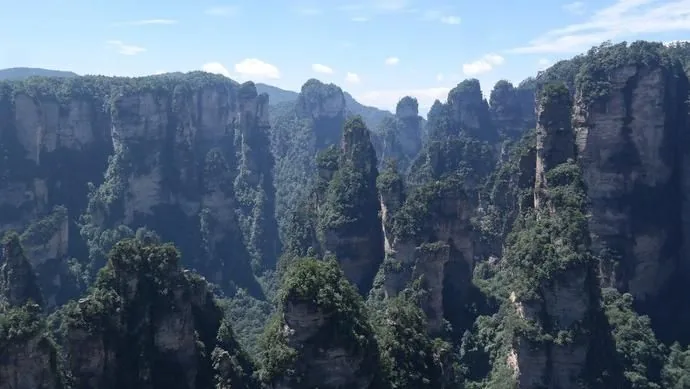
Climbing Yaozi Village was relatively easy. Reaching the summit at 9:30, I looked toward Laowuchang—sure enough, I saw a corner of the Fields in the Sky. The ridges looked like golden ribbons in the sun, floating in the mist. When the wind was strong, I could faintly hear the shouts of villagers below. The view was much further than when visiting Laowuchang alone, giving a satisfying “all mountains look small” feeling.
The first time I tried to link the three spots, I thought I could take a taxi directly from the Yaozi exit to Laowuchang. It turned out three drivers said it wasn’t on their way. I spent an extra hour going back to Wulingyuan Town to transfer and almost missed the sunset at Laowuchang. I’ve got it figured out now: you must take the shuttle back to the Wulingyuan hub and then transfer to the rural bus; it takes longer but the time is controllable.
I took the 11:30 shuttle bus down and met a guy from Beijing who said he specifically came for this “off-the-beaten-path three-point link.” Speaking of advantages, he said: “I only have 3 days off. This way I can see the thrill of Yaozi, the antiquity of Laowuchang, and the beauty of Fields in the Sky, saving more time than point-to-point trips.” That hit home—it’s indeed suitable for friends with short holidays who want to see more.
Arriving at the Bailong Elevator Station at 12:10, I waited 20 minutes for the rural bus. It was crowded with local villagers who made room for me when they saw my big pack. 40 minutes later, I arrived at the Laowuchang entrance and met the lady selling Ciba. Her cart was steaming. I bought two and ate while walking, my mouth covered in soybean powder. She smiled and said, “Slow down, don’t choke.”
Walking the farm road to the Fields in the Sky, the road was wider than when I went alone because of farm vehicles. Passing a chili field, an uncle was picking peppers. Seeing me take photos, he waved: “Make them look good! These are our village’s ‘red babies’.” That simple sincerity felt much more comfortable than the “pastoral photos” deliberately posed in scenic spots. I returned from the Fields in the Sky at 3:30 PM, took a villager’s trike to the entrance (10 yuan), and caught the 4:00 PM bus back to Wulingyuan Town.
That night, lying on the guesthouse bed, my legs were so sore I couldn’t sleep—my calves were as hard as rocks, and my knees twitched whenever I bent them. I put on the pain patches and thought of the three views from the day. It felt worth it: the peaks of Yaozi, the sea of clouds at Laowuchang, and the terraces of the Fields in the Sky all captured in one day. This “efficiency” travel is truly suitable for those short on time.
Key Reminder: There is no direct bus from Yaozi Village to Laowuchang; you must transfer at Wulingyuan Town (shuttle bus to the hub, then transfer to the rural bus). Don’t buy cold Ciba (the lady said they get hard; 5 yuan each and only sold hot). Watch out for farm vehicles on the road; step aside when they honk.
Final honest word: This route is for physically fit young people. If you rarely exercise, I suggest splitting it into two days. After 7 hours of walking that day, it took me half of the next day to recover—but that sense of achievement of “seeing three spots in one day” is definitely more exciting than slowly visiting a single spot.
Day 6: Wrap-up and Departure—Organizing Memories, Leaving with Ease
Around noon, I organized my luggage at the guesthouse, thinking I’d head back to Xibu Street for some last-minute souvenirs before leaving. Last time, the rock ears and dried kiwis I bought at the scenic area entrance were painfully expensive. This time I specifically asked Li, who said, “Go further in, there’s a ‘Tujia Shop’ in an alley near the exit that locals often visit.” I walked deep into Xibu Street, past the silver jewelry stalls, and saw a small shop with a blue cloth curtain and piles of dried rock ears and bamboo baskets of dried kiwis. It was indeed the “Tujia Shop.”
- Souvenir Shopping Details: For rock ears, choose dark brown, thick, and debris-free pieces (they produce a rich broth with local chicken). The owner charged 80 yuan for half a jin (scenic area entrance was 160 yuan/jin). For dried kiwi, pick thick, soft-to-the-touch, deep yellow ones (avoid bright yellow ones as they might have added saccharin). It was 35 yuan/jin, and I bought 1 jin in a cloth bag.
- Transport Arrangements: Take the direct minibus to Zhangjiajie West Station from Wulingyuan Town Bus Station (15-min walk from guesthouse). The blue sign says “Zhangjiajie West, 1 Hour Arrival,” and the fare is 35 yuan/person. I suggest buying tickets for after 3:00 PM to allow time for checkout (before 12:00) and lunch (a bowl of beef noodles at “Old Noodle House” near the station at 12:30).
- Organizing Memories: Flipping through my phone photos, seeing the iron chains on the Yaozi rocky slope, the old woman’s insoles at Laowuchang, and the cucumber from the Fields in the Sky, I suddenly felt these 6 days were like a condensed forest dream—not just rushing through spots, but witnessing the lives of the Tujia people.
Last time I bought rock ears at the entrance, the owner said they were “wild” and asked for 160 yuan/jin. I gritted my teeth and bought 100g, only to find they were cultivated and thin as paper after rehydrating. This time at the “Tujia Shop,” the owner showed me directly: “Look at the fuzz on the back; these grow on cliffs and produce more gelatin in soup.” He even gave me a small sample and said, “Try it at home, if it’s not good, return it next time”—that’s what I call an honest business.
I took a window seat on the minibus. The driver, Mr. Wang, has driven this line for 8 years and said “traffic is light after 3:00 PM.” Crossing the Lishui Bridge, I saw villagers washing clothes on the shore, the thumping sound of wooden clubs the same as when I arrived 6 days ago. The ride took 1 hour with no signal along the way; luckily I had downloaded offline maps. I arrived at Zhangjiajie West Station at 4:30 PM, just in time for the 5:00 PM high-speed train. The sound of my suitcase wheels on the station tiles made me feel a bit reluctant to leave—the wind, mud, and smiles in the forest felt much more grounded than air-conditioned city rooms.
When checking out, Li gave me a small bag of dried mushrooms: “Dried them myself, good for stewing meat.” He also reminded me, “The mountain weather changes quickly, take an umbrella on your way.” I walked out with my luggage and looked back at the second-floor window, remembering the Smoked Bacon Stir-fried with Fern Root Cake on Xibu Street that first evening—that wok hei aroma still seemed to linger at the tip of my nose.
Appendix: Daily Hiking Intensity Reference (with personal feelings)
| Segment |
Distance |
Elevation Gain |
Difficulty |
Target Audience |
Personal Experience Notes |
| Yaozi Village Roundtrip |
4km |
300m |
Moderate |
Experienced hikers |
Chains on the rocky slope are hard on hands; Huangshi peaks are worth the climb. |
| Laowuchang + Fields in Sky |
3km |
50m |
Easy |
Beginners, families |
Ridges are narrow but flat; insoles and cucumbers add charm. |
| Three-Spot Link |
7km |
350m |
Moderate-Light |
Fit young people |
High efficiency; use patches for sore legs at night. |










