home » Zhangjiajie 7-Day In-Depth Slow Travel

Zhangjiajie 7-Day In-Depth Slow Travel

Day 1: Arrival in Zhangjiajie, Downtown Adaptation and Rest

I landed at Hehua Airport at 3:30 PM on Tuesday. The flight was on time, and 50 meters to the right after picking up luggage is the taxi waiting area; most drivers display “Wulingyuan Special Line” signs. Do not trust illegal taxis at the exit holding signs for “50 yuan direct”; a friend of mine took one last month and was detoured to the suburbs and charged an extra 30 yuan to arrive. I used the meter directly. The driver suggested taking Zhangqing Highway (the high-speed auxiliary road) to avoid downtown traffic jams. The whole journey took 40 minutes and cost 80 yuan (including expressway fees). Passing through Yongding District, I caught a glimpse of the Lishui River; the green mountains flanking the clear water were more transparent than I imagined.

  • Accommodation Experience: I chose Qingfeng Xiaozhu Guesthouse near “Xibu Street” (the owner is Auntie Tian, of the Tujia ethnic group). I booked through a platform, attracted by reviews saying “5-minute walk to Wulingyuan Ticket Station” and “south-facing rooms with windows.” Upon check-in, Auntie Tian brought a cup of Berry Tea, saying “the mountains are damp, drink this to dispel the cold,” and handed me a hand-drawn map marking nearby delicious restaurants. I booked three days in advance at a weekday price of 180 yuan/night, which was 50 yuan cheaper than the weekend. The room was 10 square meters but clean, with linen bedding, hot water in 3 seconds, and full WiFi (I realized how important this was after entering the mountains). She warned, “don’t choose rooms facing Xibu Street; the bar noise at night is loud,” which was more honest than the photos.
  • Food Record: At 6:00 PM, I went to Laozaofang (middle section of Xibu Street, red lantern sign) recommended by Auntie Tian. The place was full of locals, brimming with life. I ordered Stir-fried Tujia Cured Meat with Bracken Root Cake (38 yuan) and Stewed Local Chicken with Fir Mushrooms (68 yuan). The cured meat was “homemade in the last lunar month” as Auntie Tian said, with balanced fat and lean, sliced thin and fried until translucent, savory but not too salty. The bracken root cake was handmade by an old lady from the neighboring village, cut into strips and fried until crispy outside and chewy inside with a hint of firewood aroma. Stewed Local Chicken with Fir Mushrooms was even better: dried fir mushrooms were soaked that morning, local chicken was freshly butchered, and the soup was simmered into a milky white color. One sip was incredibly fresh, the chicken was stewed to the point of falling off the bone, and I drank three bowls in a row. With two bowls of rice (2 yuan/bowl), the two of us were stuffed and packed half a chicken to go.
  • Adaptation Details: After dinner, I strolled along Xibu Street. The flagstone paths were lined with stalls selling Tujia brocade and cured meat. Auntie Tian said, “Don’t buy brocade at the scenic area entrance; the ones handmade by old ladies inside Xibu Street are half the price.” Back at the guesthouse, I organized my luggage, putting a light jacket, folding umbrella, and power bank in my daypack (as there are many mountain rain showers) and hiking boots at the bottom of the suitcase (don’t wear new shoes to avoid blisters) per her suggestion. I checked the weather before bed; it would be cloudy turning clear the next day, suitable for entering the mountains.

Important Reminder: Wulingyuan Ticket Station closes at 6:00 PM. If entering the mountain early the next morning, be sure to buy the ticket (four-day pass 228 yuan) online. Swipe your ID card to enter directly and save queuing time. Do not believe those selling “discounted tickets” on the roadside; they are all fake.
Day1ArrivalinZhangjiajie,Downtow

Day 2: Wulingyuan Core · Exploring Strange Peaks in Yuanjiajie

That day, I woke up just after 7:00 AM. Auntie Tian, the guesthouse owner, cooked sweet potato porridge with pickled chili. After eating, I brought the Berry Tea I bought last night (she said the mountains are cool) and headed out at 8:00 AM. Wulingyuan Ticket Station is diagonally opposite the guesthouse, a 5-minute walk. Swipe your ID card to enter directly (the four-day pass for 228 yuan was bought online, saving time). At the entrance, three or four blue and white battery-powered shuttle buses were lined up. The driver shouted “Bailong Elevator direction is further in.” I found the seats were waterproof cloth and the windows were wide open to catch the mountain breeze. About 20 minutes later, we stopped at the Bailong Elevator Lower Station.

  • Route Conditions:
    • The lower station plaza was already crowded. Arrived at 8:30 AM, queued for about 40 minutes (actually queued from 9:00 to 9:40). There were two lines: left for one-way elevator (65 yuan) and right for round-trip (130 yuan). I chose one-way. An old lady nearby said, “fewer people before 7:00 AM or after 4:00 PM,” but I was in a hurry and didn’t try.
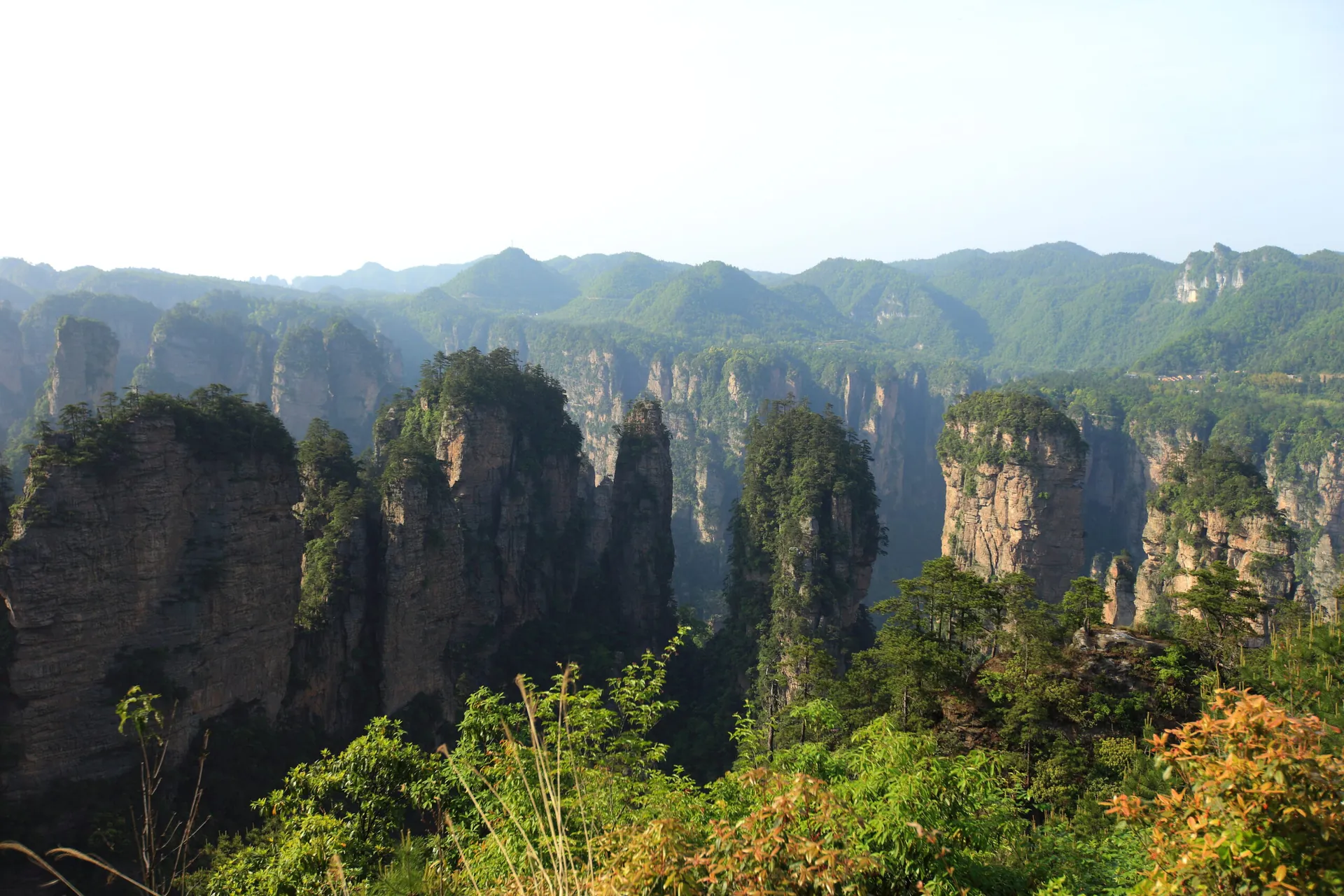
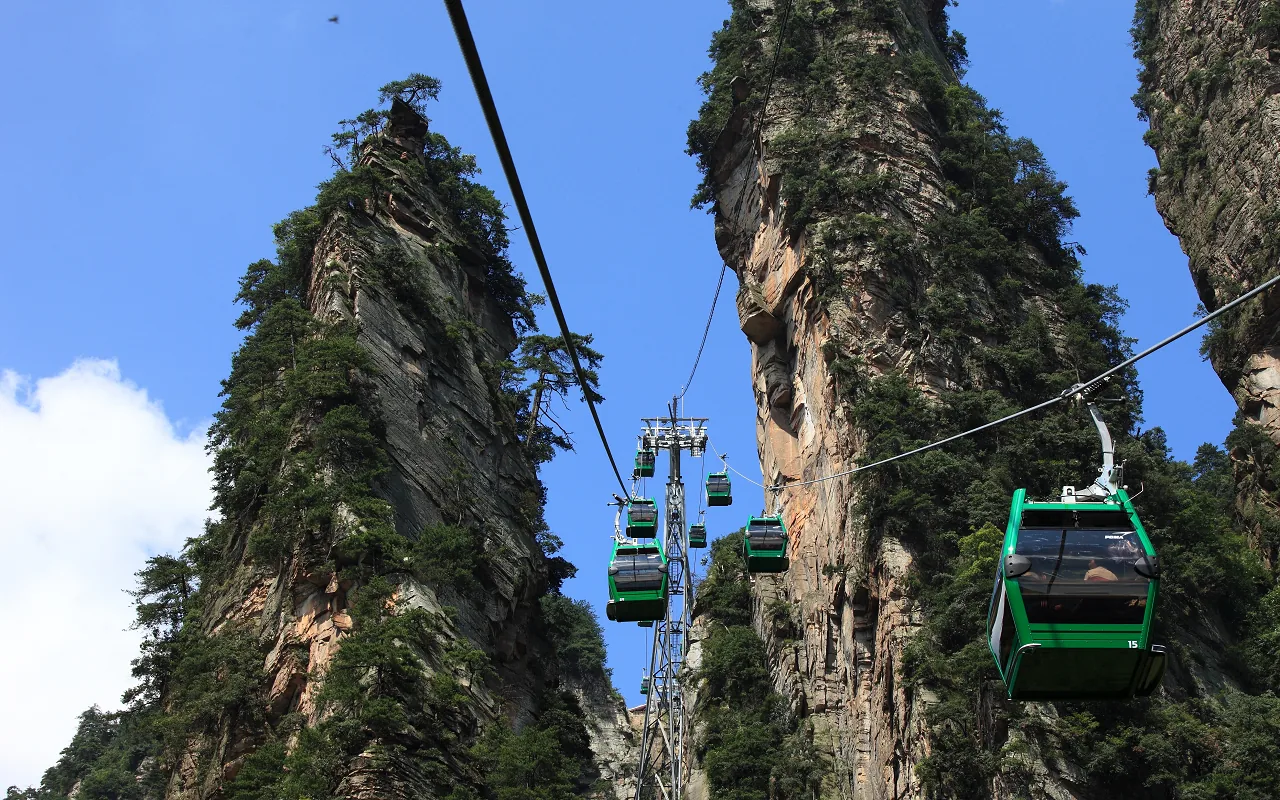
    • The elevator is a double-deck fully transparent observation cabin. The ascent took 1 minute and 58 seconds (timed it myself). The sandstone peak forest below looked carved by a knife, surging upward layer by layer. Near the top, the mist suddenly cleared, revealing distant “Harry Potter-style” mountain peaks.
    • After exiting the elevator, walk for about 15 minutes on the flagstone road to Mihun Stage. There are signs along the way: “Mihun Stage → Southern Sky Column → First Bridge under Heaven.” I met porters carrying mineral water, each bottle costing 2 yuan more than at the bottom. I brought a thermos with warm water.
  • Key Scenery Details:
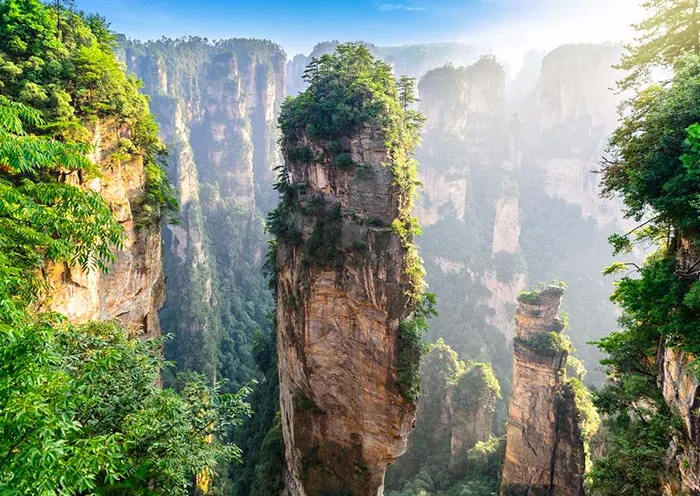
    • Southern Sky Column (The prototype for the Hallelujah Mountains in “Avatar”): Walk for 5 minutes on the side path at Mihun Stage. Low-angle shots from the side are best—stand on the viewing platform 20 meters from the pillar, aim the lens at the base, and let the sky occupy two-thirds of the frame. The rock folds and pine needles at the top are clearly visible. At 10:00 AM that day with direct light, the stone pillar was bluish-grey, looking steeper than from the front, as if piercing the clouds.
    • First Bridge under Heaven: Walk for another 10 minutes along the boardwalk from Southern Sky Column. A natural stone arch spans a valley about 50 meters deep. The bridge surface is flat, and the railings on both sides are thick iron chains. It had just rained when I went; the mist below surged like boiling water, occasionally revealing green trees at the bottom. Stand in the middle of the bridge to take a panoramic photo, framing the stone arch and mist horizontally, which is more powerful than photographing the bridge alone.

The guesthouse owner later told me: “Those rocks in Yuanjiajie look hard but are actually heavily weathered. Don’t lean too close or touch them, especially after rain when the surface is slippery.” Last week, he just repaired a tourist’s cracked phone screen from a fall.

  • Accommodation Experience: At 1:00 PM, I took a shuttle bus from First Bridge under Heaven back to Dingxiangrong Village (15-minute ride) and stayed at Yunshang Guesthouse (the owner is Mr. Wu, a veteran). The guesthouse is on a high point of the village, a two-story wooden building. The window opens directly to the sandstone peaks (just like the promotional photos, no filter). The room was 15 square meters with a firm wooden bed (good for the back), and the air conditioning cooled quickly. Note: Only one bar of soap, a small tube of toothpaste, and a toothbrush are provided; you must bring your own shampoo and body wash (I later bought travel packs at a supermarket downstairs, 3 packs for 10 yuan). Mr. Wu said, “It’s expensive to transport supplies to the mountaintop, so basics are enough.” He also lent me a kettle (none in the room).
Item Details/Cost Personal Tips
Bailong Elevator One-way 65 yuan (not included in ticket) Stand in the shade while queuing, wear a hat for sun protection
Southern Sky Column Photo Side low-angle, 10:00 AM direct light Use wide-angle mode for panoramic photos
First Bridge under Heaven High probability of mist after rain Iron chains are slippery, hold steady before shooting
Yunshang Guesthouse 180 yuan/night (includes breakfast) Ask for a “quiet room” in advance, away from stairs
Personal Items Toiletries, thermos, non-slip shoes Mineral water is 3 yuan/bottle on the summit, bring your own to save 5 yuan

Lunch Note: After dropping my luggage, Mr. Wu recommended “Yuanjiajie Farm Dishes” at the village entrance. I ordered Scrambled Eggs with Wild Green Onions (28 yuan, eggs were tender) and Stir-fried Fir Mushrooms (35 yuan, fresh and grit-free), with unlimited rice. The proprietress said the mushrooms were picked that morning. “Don’t buy at scenic area restaurants; it’s fresher and cheaper here.” It was indeed tastier than the meal downtown the previous day.

In the evening, I sat on the guesthouse balcony for a while, watching the peak forest dyed orange-red by the sunset. Mr. Wu handed me a cup of vine tea he roasted himself: “The mountains are damp, drink this at night to help you sleep.” Thinking back to the anxiety of queuing in the morning, at this moment, I felt that slowing down to wait for a scene was worth it.
Day2WulingyuanCore·ExploringStra

Day 3: Wulingyuan Core · Yangjiajie + Golden Whip Stream

At 7:50 AM, I finished the corn porridge with homemade pickled leeks cooked by Mr. Wu at Yunshang Guesthouse, packed my hiking pole (folding type, useful for Yangjiajie’s steep slopes), and departed from Dingxiangrong Village at 8:00 AM. There was a handwritten sign at the village shuttle bus station: “Yangjiajie Wulong Village direction.” I took the blue shuttle bus for 10 minutes (5 yuan/person) to the Wulong Village entrance. The driver reminded, “Take the flagstone path on the left; the right is a wild path where it’s easy to get lost.”

  • Hiking Yangjiajie (Wulong Village Route):
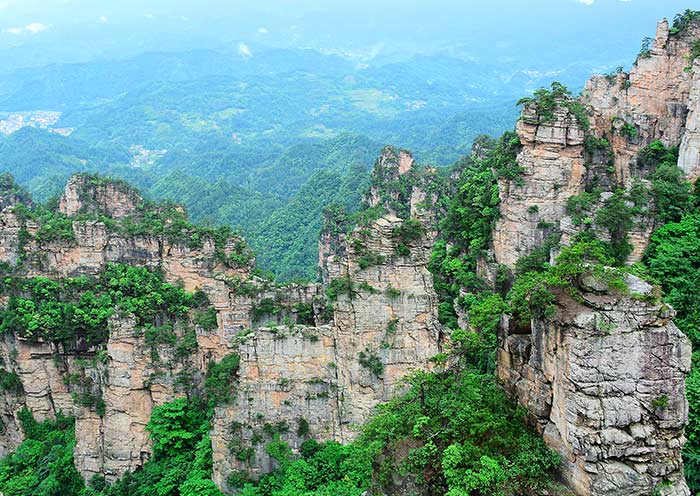
    • There is a “Wulong Village” stone tablet at the entrance. Follow the steps upward; the slope is gentler than imagined, with bamboo signs along the way (“Natural Great Wall → 500m”, “One Step to Heaven → 800m”). After walking for about 15 minutes, I reached the “Natural Great Wall“—actually horizontally extending sandstone walls, stretching about 200 meters, with stubborn pine trees growing in the crevices. I crouched at the base of the wall to capture depth. The direct light at 9:00 AM hit the stone wall perfectly, creating a stark contrast between light and shadow, ten times more three-dimensional than photos on a cloudy day.
    • Another 20 minutes upward leads to “One Step to Heaven“: a vertical iron ladder about 6 meters high fixed to the rock wall. The ladder steps have non-slip textures, but the edges show rust. I wore the work gloves I bought yesterday (10 yuan/pair at a hardware store); I felt much more secure grabbing the chains. I met a girl on the ladder who was afraid of heights, moving for 5 minutes with her eyes closed. I let her hold my shoulder to descend slowly; afterward, she said, “Glad I didn’t force it.”

    Porter Master Wang, carrying cement, said: “This ladder is very slippery on rainy days. Wearing gloves is life-saving. Last month a young man climbed barehanded and scraped his palms until they bled.”

  • Golden Whip Stream Walk (Shuiraosimen → Great Oxygen Bar):At 12:30 PM, I took the shuttle bus from Yangjiajie back to Shuiraosimen (25-minute ride, 10 yuan/person) and had bread I brought as lunch at the entrance. At 2:00 PM sharp, I began walking along Golden Whip Stream. The entire 7.5 km route is a gentle slope, with the stream babbling at my feet and the air filled with negative oxygen ions.
    • Golden Whip Rock: Walking to the 3 km mark, a 30-meter-high stone pillar stands abruptly by the stream, with three steep sides looking like a golden horse whip (it turns yellowish in sunlight). The stream at the base is shallow; I took off my shoes to step in for a reflection shot. The rocks were slippery, so I quickly put on my non-slip shoes (Auntie Tian said, “Rocks in Golden Whip Stream grow moss, don’t follow young people going barefoot”).
    • Journey to the West Scene: Walking another 1 km, I saw several macaques squatting on rocks near a tablet inscribed “Journey to the West” (stone statues of the four characters). I pulled out an apple to feed them, but was immediately stopped by the guesthouse owner’s warning. Sure enough, a man nearby holding a snack bag was suddenly lunged at by a monkey; the bag tore, and chips scattered everywhere. I quickly placed the apple on the ground and stepped back two steps; the monkey picked it up, peeled it, and ate, remaining fairly docile.
Item Details/Cost Personal Tips
Yangjiajie Shuttle Bus Dingxiangrong → Wulong Village entrance, 5 yuan/person Look for blue and white vehicles; don’t take black vans
Wulong Village Route Mainly flagstone paths, no steep cliffs Bring 1L of water (no supplies along the way)
One Step to Heaven Ladder 6m vertical, free Wear non-slip gloves; if afraid of heights, face sideways and hold the chain
Golden Whip Stream Walk Shuiraosimen → Great Oxygen Bar, 7.5 km Wear Vibram-soled non-slip shoes and avoid mossy areas
Monkey Interaction Common at the Journey to the West spot Hide food in your backpack; don’t make eye contact or provoke them
Consumables on the Way Mineral water 3 yuan/bottle (stream-side stalls) Bring your own cup to fill with mountain spring water (drinkable after boiling)

Day3WulingyuanCore·Yangjiajie+Go

Day 4: Hiking Huangshi Village · Reaching the Summit for Panorama

On the fourth day, at 6:30 AM, I had green bean porridge with pickled sugar garlic at Yunshang Guesthouse and checked out at 7:00 AM. There is no direct bus from Dingxiangrong Village to the Forest Park Ticket Station, so I walked 10 minutes to Wulingyuan Ticket Station and transferred to the scenic area shuttle bus (15 yuan/person, 25 minutes) to the Forest Park entrance. The bus fare was included in the pass, so no extra payment was needed.

  • Hiking Choice Testing:
    • Round-trip Cableway (Time-saving version): Turn right 50 meters after the main gate to the lower cableway station. Queued at 8:00 AM, a 25-minute one-way trip (ascent 8:20-8:45), price 65 yuan one-way (not included in ticket). The cabins are transparent; during the ascent, you can overlook cedar forests spread like a green carpet across the valley, with sunlight filtering through leaves. It’s faster to reach the top than hiking. The downside is the crowd (I queued for 20 minutes) and missing the details of the mountain paths.
    • Hiking Up (Challenge version): I chose this one, starting from the east side trail of Great Oxygen Bar Plaza (there’s a wooden sign for “Huangshi Village Hiking Trail”). It took 2 hours and 10 minutes (timed). The first half is a gentle slope; the steep sections are concentrated near “Dianjiangtai” (about 300m elevation gain, 40-degree slope). I rested for 3 minutes every 50 meters, panting while holding roadside tree trunks. I met a porter who said, “don’t run on steep slopes; your knees can’t take it,” and pointed to a flat rock for me to sit on, which had “Keep Going” carved by a predecessor.
  • Ring Trail Highlights:
    • Star-picking Platform: Turn right after exiting the upper cableway station and walk for 15 minutes along the ring trail. At 10:00 AM on a clear day, the Tianmen Mountain Cave (about 8 km from Huangshi Village) is visible to the naked eye, looking like a skylight in the sky. Using 10x zoom on my phone, I could clearly see the cable cars near the cave.
    • Golden Turtle in the Sea of Mist: Located 200 meters below Star-picking Platform, the stone turtle shape faces east. When the sea of clouds overflows the turtle’s back (I waited until 11:30 AM after a light rain), the turtle’s body becomes faintly visible like an ancient ship floating on the sea. I quickly took a panoramic photo with a wide-angle lens.
    • Liuqi Pavilion: The highest point of the ring trail. Climbing the 3-story wooden building gives a 360-degree view of the peaks. On a clear day, Golden Whip Stream looks like a silver ribbon winding around the mountain.

Porter Uncle Li, carrying beer, said while passing Liuqi Pavilion: “Golden Turtle in the Sea of Mist is only obvious when it clears after rain. It’s too foggy to see in the morning, and the fog disappears by noon when the sun comes out, losing the vibe. Now is the best time to shoot.”

  • Descent Tip Execution:At 2:50 PM, I departed from Liuqi Pavilion to descend (10 minutes earlier than the planned 15:00), choosing the Cedar Forest Trail (entrance on the west side of Liuqi Pavilion). The trail takes 1.5 hours. The cedars on both sides block the sun, with a shade coverage of over 90%, so it’s not sunny at all. I sprayed Thai Green Herb Balm (used as repellent, 20 yuan/bottle) and only got 1 bite (companions who didn’t apply were bitten 5 times). The end of the trail is Luoguta Community, where an old lady sells jelly (5 yuan/bowl); adding a spoonful of pickled chili is refreshing and appetizing.

In the evening, I stayed at “Shanyu Guesthouse” in Luoguta Community (150 yuan/night). The owner said “the sunset at Huangshi Village is better than the sunrise,” but unfortunately, I had to catch the sunrise at Tianzi Mountain the next day, so I’ll have to come back next time. My legs were a bit sore before bed, and I remembered the rock where I rested on the steep slope, feeling that only by slowing down can you clearly see the mountain’s character.

Day4HikingHuangshiVillage·Reachi

Day 5: Tianzi Mountain · Waiting for the Sunrise and Sea of Clouds

Just after 4:00 AM, I was woken by the alarm at Shanyu Guesthouse. It was pitch black outside. The owner left a porch light on and placed warmed ginger tea and roasted buns on the table (saying “the mountain is cold in the early morning, have something to eat”). I drank half a cup of ginger tea to warm up, put on my camera bag at 4:20 AM (packed with a tripod and light down jacket), and gently closed the door—afraid of waking guests catching early flights.

  • Sunrise Battle Record:
    • Transportation: Walked 8 minutes from Luoguta Community to the shuttle bus station (only one bus at this hour). It departed at exactly 4:30 AM. The blue and white battery bus was empty. The driver said, “This is the only daily direct bus to the Tianzi Mountain Cableway Lower Station; if you miss it, you have to take a taxi, which is twice as expensive.” The 25-minute ride went up the winding mountain road. Just as the sky turned pale, we arrived.
    • Finding a Spot on Foot: After getting off, I followed the signs for “Imperial Brush Peaks Observation Deck” and reached the spot in 10 minutes. There were already a few people. I headed straight for the protruding rock on the left (no railing, sticking out half a meter)—this was the “secret spot” the guesthouse owner told me yesterday. Squatting on this rock, the view was completely unobstructed, directly facing the Imperial Brush Peaks.
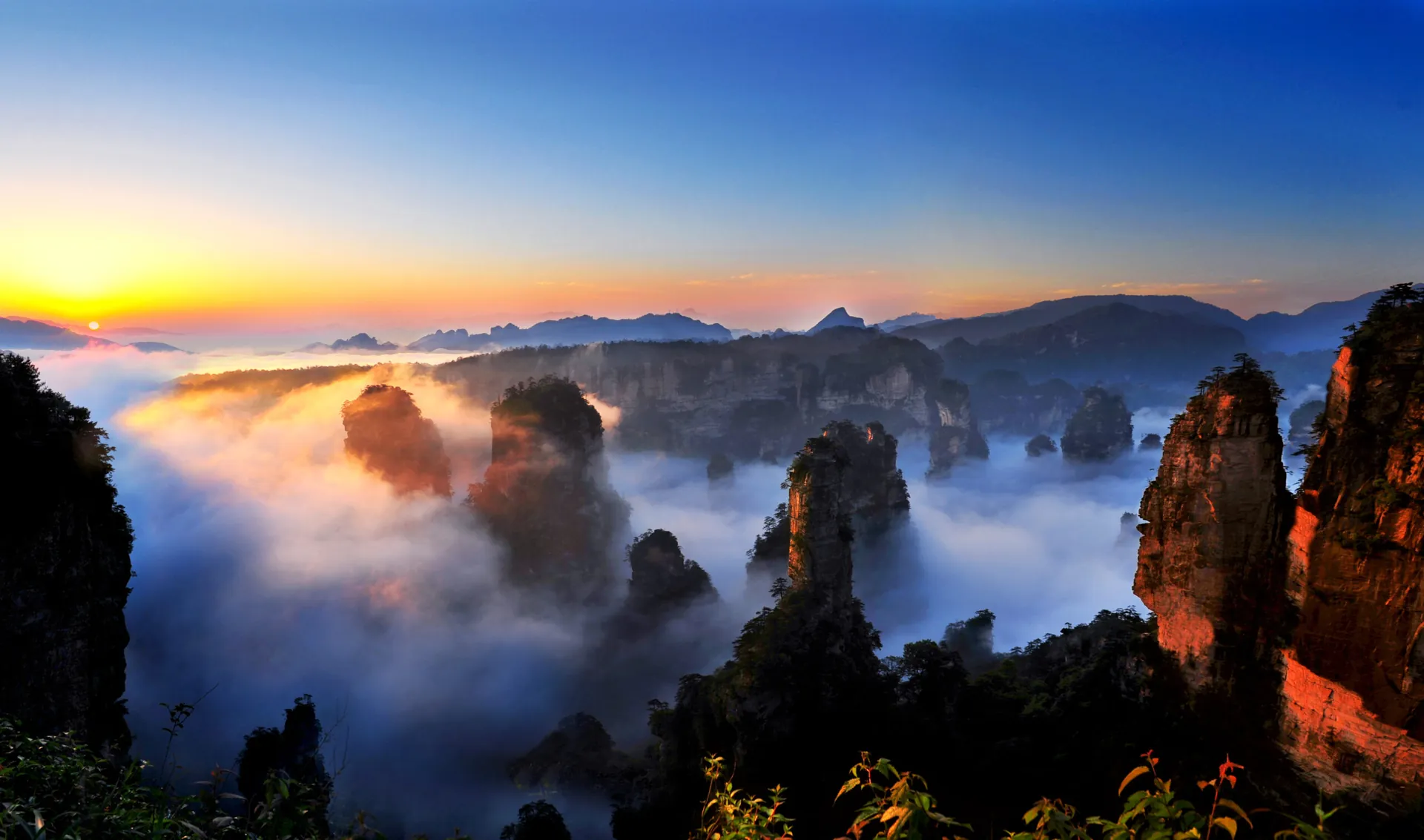
    • Waiting and Capturing: At 5:10 AM, the sky turned red, and the sea of clouds began to surge at the bottom of the valley (the scenic area’s WeChat account predicted a “70% chance of sea of clouds after rain,” which was accurate). At 5:25 AM, the sun jumped out from behind the peaks. Golden light first dyed the sea of clouds red and then lit up the tips of the stone peaks. I used a tripod for a time-lapse (2-second interval, 50 photos in total), aiming at the boundary between the sea of clouds and the sunrise. The layers were very strong during post-processing.

The guesthouse owner later teased me: “I also squatted on that rock at Imperial Brush Peaks when I was young. Now that I’m older, I can only shoot from the side. Remember, wait for the sea of clouds to ‘wave’ before pressing the shutter; it’s boring when it’s flat.”

  • Daytime Route Walk: Finished watching the sunrise at 7:30 AM, bought a corn (5 yuan, hot) at a stall for breakfast, and took a shuttle bus (10 yuan/person, included in the pass) to Helong Park.
    • Helong Park: Walked 5 minutes to the bronze statue plaza. Marshal Helong’s statue is 10 meters high, with the base inscribed with “Revolution with Two Kitchen Knives.” Behind it are layers of peak forests, suitable for taking photos of people with the background (I asked a passing lady to help; she taught me to “stand to the left front of the statue and aim the lens lower to make the peaks look higher”).
    • Fairy Scattering Flowers: Walked 15 minutes along the wooden boardwalk from Helong Park to see a group of stone peaks resembling a girl holding flowers; the flowers are small protruding stalagmites nearby. At 8:00 AM in direct light, the stone peaks were light brown, softer than in backlit conditions. A stone tablet nearby said, “Legend has it they are flower baskets dropped by a fairy.” I walked halfway around the peak and found the shape of the “flowers” changed from different angles.
    • West Sea Stone Forest: Another 20-minute walk to the entrance and entered the “Stone Pillar Maze”—hundreds of sandstone pillars rising from the ground, with the narrowest gaps barely allowing one person. Wear non-slip shoes! The ground has slippery stone steps covered by fallen leaves. I almost slipped but fortunately grabbed a nearby stone pillar (inscribed with “Caution: Slippery” by someone before).

At noon, I took a shuttle bus from West Sea Stone Forest back to Yangjiajie (30-minute ride) and stayed at Yunshang Guesthouse in Dingxiangrong Village again. Seeing me back, Mr. Wu handed me a cup of hot tea: “The Tianzi Mountain sunrise was worth it, right? I’ve lived here for ten years, seen it a hundred times a year, and still don’t get tired of it.” I nodded, remembering stomping my feet in the cold on the rock at dawn, yet waiting for that beam of light was entirely willing; it was a trade of patience.

Day5TianziMountain·Waitingforthe

Day 6: Ten-Mile Gallery + Supplementary Light Hike

At 8:40 AM, I had pumpkin porridge cooked by Mr. Wu at Yunshang Guesthouse, packed my camera (with a telephoto lens for distant views), and walked 10 minutes from Dingxiangrong Village to Wulingyuan Ticket Station at 9:00 AM (same entrance as previous days). I swiped my ID card to enter—must use it up. At the entrance, the blue and white shuttle bus driver shouted “Ten-Mile Gallery direction is further in.” After a 15-minute ride, we reached the entrance. The fare was included in the pass.

  • Mini Train Experience and Recommended Walking Section:
    • At the entrance is the “Mini Train Ticket Office.” A one-way ticket is 38 yuan (76 yuan round-trip). I chose one-way going in (to save strength for walking back). The mini train is a dark green vintage style with open observation decks on each carriage. The speed is very slow (5 km/h), convenient for taking photos anytime.
    • Recommended Walking Section: Get off at “Three Sisters Peak” station (not the starting point!). Walk in the reverse direction toward “Herb Picking Old Man” (the driver said, “this section has fewer people and dense scenery”). This stretch is about 1.2 km with flat flagstone roads. Along the way are “Couple Carrying a Child” (peaks looking like a family of three) and “Index Finger Peak” (an isolated pillar looking like a finger). The direct light at 10:00 AM stretched the peaks’ shadows long, creating a layered look. I met a photography enthusiast who said, “walking in the reverse direction avoids the tour group crowds. A group with flags was there just now, making it impossible to shoot.”
    • When I reached the end at “Herb Picking Old Man” (the peak looks like an old man carrying a basket), I didn’t want to go back the same way, so I waited for the return mini train (every 20 minutes) to avoid backtracking.

Guesthouse owner Mr. Wu warned the day before: “Don’t take the mini train for the whole trip at Ten-Mile Gallery. Walk at least 1 km, otherwise it’s a wasted trip. Locals love that reverse section; it’s quiet.”

  • Yaozi Village Light Hike (Trial Record):At 1:30 PM, I took a shuttle bus from the mini train terminal back to the “Thousand-Mile Meeting” spot at Golden Whip Stream (10-minute ride). I looked for the Yaozi Village entrance—walk 50 meters along the stream following the “Yaozi Village Hiking Trail” sign. There is an upward stone step path with a sign saying “Light Hike 2.5 Hours.”
    • Hiking Details: The total ascent is 300 meters. The first half consists of stone steps (steep), while the second half is a dirt path mixed with gravel (flatter). I wore non-slip hiking boots and didn’t slip on the stone steps, but the dirt path would be slippery in light rain (it didn’t rain that day, so it was stable). It took 2 hours and 40 minutes (timed). There are no supply points along the way, so I bought a 1.5L mineral water (5 yuan) at the entrance, drank half, and put the rest in my thermos.
    • Core Scenery: After reaching the top, it suddenly opened up, and the Fields in the Sky appeared before me, planted with corn and sweet potatoes. The ridges were built with stones, looking like a green waistband for the mountain. I leaned over the cliff to take a panoramic shot (be careful!), using the telephoto lens to see an old lady working in the field. She looked up and smiled, waving her hand.
    • Descent: Returned the same way, 20 minutes faster than the ascent. My legs were a bit sore at the entrance, but luckily the bamboo forest along the way provided shade, so I didn’t get sunburned.
Item Details/Cost Personal Tips
Shuttle Bus Wulingyuan Ticket Station → Ten-Mile Gallery entrance, 15 mins Look for blue and white vehicles; don’t take illegal taxis
Mini Train One-way 38 yuan (not included in ticket) Walk in the reverse direction from Three Sisters Peak station to avoid crowds
Reverse Walking Section 1.2 km, flat flagstone road 10:00 AM direct light for peak shadows
Yaozi Village Entrance 50m from “Thousand-Mile Meeting” at Golden Whip Stream Hold railings on steep stairs; wear non-slip shoes for dirt paths
Yaozi Village Hike 300m ascent, 2.5 hours Bring at least 1.5L of water; no supplies on the way
Fields in the Sky Three layers of terraces on the cliff, corn/sweet potatoes Use telephoto for farm scenes; be careful at the cliff edge
Cost Reference Mini train 38 yuan + water 5 yuan Yaozi Village has no entrance fee, pure physical effort

In the evening, back in Wulingyuan Town, I had Tujia Sanxiaoguo at “Laojie Fantang” (a pot of pork belly, tofu, and radish stewed together, 48 yuan) with Steamed Pumpkin (10 yuan). The owner said, “Sanxiaoguo must be stewed for 40 minutes to be flavorful,” and indeed it was tender and not dry. After dinner, I bought a bag of Kudzu Root Crisp (15 yuan/bag, sweet but not greasy) at Xibu Street as a souvenir. After this day of walking, my legs felt heavy, but the moment I saw the Fields in the Sky, I felt that choosing the right place for a light hike is much more comfortable than rushing through attractions.

Day6Ten-MileGallery+Supplementar

Day 7: Departure Packing · Final Souvenirs

At 10:00 AM, I woke up at Yunshang Guesthouse. Mr. Wu had cooked the last pot of sweet potato porridge, saying “eat first and pack slowly, don’t rush.” I followed his “rolling method” for packing (saving more space than folding), transferred the photos from the past few days to a USB drive (over 200 panoramic peaks shots), and checked out at 11:00 AM. He handed me a hand-drawn map: “Next time come to the west line; it’s quieter.”

  • Souvenir Shopping Record: Walked 10 minutes to the middle of Xibu Street and found the “Guaiyaomei” Tujia Brocade shop (run by Auntie Yang, with an “Intangible Cultural Heritage” sign). The glass cabinets displayed table runners, small bags, and scarves. Table runners start from 120 yuan; I chose a Xilankapu pattern (red background with yellow thread, the pattern is “Phoenix through Peony”) for 140 yuan. Auntie Yang said, “Check the thread ends on the back yourself.” I pinched the edges and pulled; the stitching was tight with no loose ends, and the fabric was thick. She also showed a small bag (80 yuan): “This is light; it’s perfect for your camera batteries.” I learned she has been making brocade for 30 years, with patterns passed down from ancestors: “Machine-woven ones don’t have this hand-strength.” Finally, I bought the runner and bag, wrapped them in old newspaper, and put them in my suitcase.

    Auntie Yang wiped her hands and said: “Those ‘low-price brocades’ at the Xibu Street entrance are synthetic. They feel slippery but will pill after two washes. Look for the ‘Guaiyaomei’ name; I’ve been here for 20 years and never moved.”

  • Transportation Details: At noon, I confirmed with Mr. Wu to “call a car exactly at 13:00.” The driver, Mr. Zhang, is a regular collaborator (Tel: 138xxxxxxx) and took the familiar Zhangqing Highway. At 13:00, the car arrived. While helping with luggage, he reminded me, “Leave 1 hour for airport check-in.” We chatted for a while; he said, “There are more mountain guesthouses now, but few stay for 6 nights like you. Slow travel is how you see it truly.” Arrived at Hehua Airport at 14:00, took 20 minutes for check-in (no checked luggage), and 15 minutes for security, just in time for the 15:30 flight. The fare was 100 yuan including expressway fees, more honest than the 120 yuan estimate on the app.
  • Key Experience Review (Honest advice based on the pitfalls I encountered during these 7 days):
    • Cost Reference (Actual spending per person):
      • Tickets: 228 yuan for the four-day pass (includes insurance, bought online 3 days early, swipe ID to enter, saving 2 hours of queuing)
      • Accommodation: 350 yuan/night × 6 nights (average price for mountain guesthouses; Yunshang Guesthouse 180-220 yuan, Shanyu Guesthouse 150 yuan, includes simple breakfast)
      • Dining: 60 yuan/meal × 14 meals (Standard meals with meat and vegetables, e.g., Cured Meat with Bracken Cake 38 yuan, Stewed Chicken with Mushrooms 68 yuan, Wild Onion Eggs 28 yuan; snacks extra)
      • Transportation: Shuttle bus + Mini train + Cableway about 400 yuan (Pass covers some; self-paid items have clear pricing)
    • Pitfall Warnings:
      • Bailong Elevator has fewer people before 8:00 AM or after 5:00 PM (I queued 40 minutes at 8:30 on Day 2, but only 10 minutes at 17:00 on Day 6). Don’t buy round-trip for 65 yuan one-way unless you lack stamina.
      • Don’t make eye contact or carry plastic bags around Golden Whip Stream monkeys (on Day 3, I saw a tourist’s chip bag snatched; zipping your backpack tight is safest). Place apples on the ground and step back two steps to feed them.
    • Recommended Gear:
      • Folding hiking pole (used for Yangjiajie steep slopes on Day 3, saving 30% effort, palm-sized when folded);
      • Light raincoat (a sudden shower on Day 4 while hiking Huangshi Village; it kept me and my bag dry and is more wind-resistant than an umbrella);
      • Thermos (mineral water is 3 yuan/bottle on the summit; fill it with boiled spring water to save money and stay hydrated).

As the plane took off in the evening, I looked back at Zhangjiajie from the window. The peak forest under the sunset looked like an ink wash painting. After these 7 days of measuring the wonder of Yuanjiajie, the danger of Yangjiajie, the clouds of Tianzi Mountain, and the entirety of Huangshi Village with my feet, I finally understood that “not visiting Huangshi Village is like not visiting Zhangjiajie at all” is no exaggeration. My suitcase holds brocade and kudzu root crisp, while my heart holds the early morning peak views from the window and the dawn wait for the sunrise on the rock—these fragmented moments are the gifts the mountain gives.

Zhangjiajie National Forest Park — Practical Information

Tickets & Booking

  • Zhangjiajie National Forest Park (Wulingyuan core scenic area) single ticket: Standard ticket year-round CNY 165 each, with optional CNY 3 insurance, valid 4 consecutive days; concession ticket year-round CNY 83 each. Per the Hunan Provincial Development and Reform Commission “Notice on Matters Concerning Ticket Prices of the Wulingyuan Core Scenic Area” (Xiang-Fa-Gai-Jia-Fei-Gui [2024] No. 977), effective from Jan 1, 2025, valid 5 years; advance booking required (Timed and site-specific reservation entry is used; visitors are encouraged to use the “Zhangjiajie One-Machine Tour” WeChat mini-program for real-name reservation tickets and fast ticket-check entry)[src]
  • Ticket concession policy: Free admission: children under 14 (exclusive), seniors 65 and above (inclusive), disabled persons, active-duty military personnel and retired military cadres with valid ID; half price: minors 14 (inclusive)–18 (exclusive), seniors 60 (inclusive)–65 (exclusive), and current full-time university undergraduate students and below; no booking required[src]

Transport & Schedules

  • Inside the Wulingyuan scenic area → The various sights | Scenic-area eco-bus (included in the combined ticket/separate purchase): Eco-buses inside the scenic area connect the various zones; the high-platform touring lines at Tianzi Mountain, Yuanjiajie and Yangjiajie operate one-way loops, so plan to avoid backtracking[src]

Where to Stay · Room Type · Nearby

  • Wulingyuan district (near the ticket stations) | Reference price Guesthouses/chain hotels about CNY 150–500 per night (reference) | Room tip: Close to the ticket stations, good for entering the park early and multi-day visits (the ticket is valid 4 days); conven | Nearby add-ons: Golden Whip Stream, Huangshizhai, Yuanjiajie, Tianzi Mountain, Yangjiajie, Ten-Mile Gallery, Xibu Street[src]
  • Zhangjiajie city (Tianmen Mountain cableway lower station/Dayong Ancient Town area) | Reference price About CNY 140–550 per night (reference) | Room tip: If you also visit Tianmen Mountain, staying in the city is closer (the lower station of the Tianmen Mountain cableway is | Nearby add-ons: Tianmen Mountain, Dayong Ancient Town, Nanmenkou, Tujia Folk Customs Park[src]

Typical Climate & Packing (Past Years)

  • January: 2.6 °C–9.4 °C °C, Zhangjiajie has a humid subtropical monsoon climate, humid and rainy
  • February: 4.5 °C–11.5 °C °C
  • March: 7.8 °C–15.9 °C °C
  • April: 13.4 °C–22.7 °C °C, Spring is cloudy and misty, with a higher chance of cloud seas
  • May: 18.0 °C–27.2 °C °C
  • June: 21.6 °C–30.2 °C °C, Relatively high rainfall; watch for rain gear and slippery surfaces