



Day 1: Arrival in Guilin · Check-in at a Child-Friendly Guesthouse
I chose this Yangshuo “Shanzhu Xiaozhu” guesthouse because its claim of being “child-friendly” is not just empty words. I remember arriving early that morning; as soon as the kid got out of the car, he broke free from my hand and ran inside barefoot—on the low bookshelf, there was a colorful edition of “Guilin Landscapes.” He flipped to the page with karst peaks, poked the illustration with his finger, and shouted: “Mom, look! I’m going to see real mountains tomorrow!” The padded slide and ocean ball pit in the corner weren’t left idle either; he rolled in clutching a blue ball and didn’t come out until half an hour later, rubbing his eyes and saying “there’s a secret passage in the ball pit.”
- Itinerary and Transportation: We took the early high-speed train (Guangzhou South → Guilin North, departing at 7:30). The kid watched the clouds from the window, and we reached Guilin North Station right at 10:00, avoiding the morning rush hour. I used a ride-hailing app and chose “Budget Express.” The driver was a local Guilin master who played Liu Sanjie’s folk songs. The 1-hour drive was steady all the way to the flagstone road in front of the guesthouse. The fare was 150 RMB (saving 15 RMB compared to a taxi), and he even helped us carry our suitcases up the steps, saying, “The road is narrow here, I know it well.”
- Accommodation Experience: The room featured a viewing balcony facing a bamboo forest. At 7:00 AM, the birds were more effective than an alarm clock. Wrapped in a quilt, the kid said it was “like sleeping in a forest.” The host, Auntie Wang, is a Yangshuo local. Seeing the kid holding a bamboo dragonfly tightly, she specially brought out a bamboo one she carved herself, saying, “It’s very light, it won’t hurt his hands.” The room was equipped with a child’s toilet ring and corner protectors, and even the slippers had bear patterns. The details were solid.
- Food Diary: Right across from the guesthouse is “Old Zhou’s Rice Noodle Shop,” where the 10 RMB Guoshao Rice Noodles are a must-order. Auntie Zhou, wearing a blue cloth apron, ladled out creamy white pork bone broth, spread out freshly blanched rice noodles, and topped them with crispy fried Guoshao pork (perfectly marbled and not greasy), finished with a handful of scallions. The kid finished more than half a bowl of rice soaked in soup. Auntie Zhou smiled and said, “You need pickled beans for the real flavor.” Sure enough, after a bite, he smacked his lips and said, “It tastes better than at home.”
- Nearby Activities: In the afternoon, I took him for a walk along the rice field ridges near the guesthouse. He learned to recognize bamboo (hollow stem—I taught him to blow with his mouth to make a “woo woo” sound) and plantains (the large leaves curled up like umbrellas; he ran with one saying, “I’m Monkey King”). He crouched to count ant nests and suddenly looked up: “Mom, this looks like a mini cave!” In the evening, we read “Guilin Landscapes” in the picture book corner. He pointed to the stalactite illustration and asked, “Can we go see this tomorrow?”, which perfectly led into the next day’s cave exploration.
I remember talking to him about this day once; he said his favorites were Auntie Wang’s bamboo dragonfly and Auntie Zhou’s pickled beans. This is probably what “small certain happiness” looks like—not an expensive experience, but the moment the child’s eyes light up.
|
Item
|
Details
|
Cost (Per Person)
|
Notes
|
|---|---|---|---|
|
High-speed Train
|
Guangzhou South → Guilin North (Second Class)
|
185 RMB
|
Early train at 7:30; the kid napped and arrived in high spirits.
|
|
Station Pickup
|
Guilin North → Shanzhu Xiaozhu
|
150 RMB
|
Ride-hailing “Budget Express”; local driver knew the way and helped with bags.
|
|
Day 1 Meals
|
Rice Noodles + Guesthouse Meal
|
35 RMB
|
Noodles 10 RMB (Auntie Zhou’s), Guesthouse meal 25 RMB (Porridge + Farm eggs).
|
|
Nearby Activities
|
Ridge walking + Picture books
|
0 RMB
|
Books provided; field ridges are free public areas.
|
Recommendation for this guesthouse: Auntie Wang doesn’t just teach kids about plants; she also boils mung bean soup for them in the evening, adding a touch of human warmth that pure hotels lack. Transportation-wise, from Guilin North to Yangshuo, ride-hailing is more flexible than a bus; we could stop by the road anytime if the kid got tired.
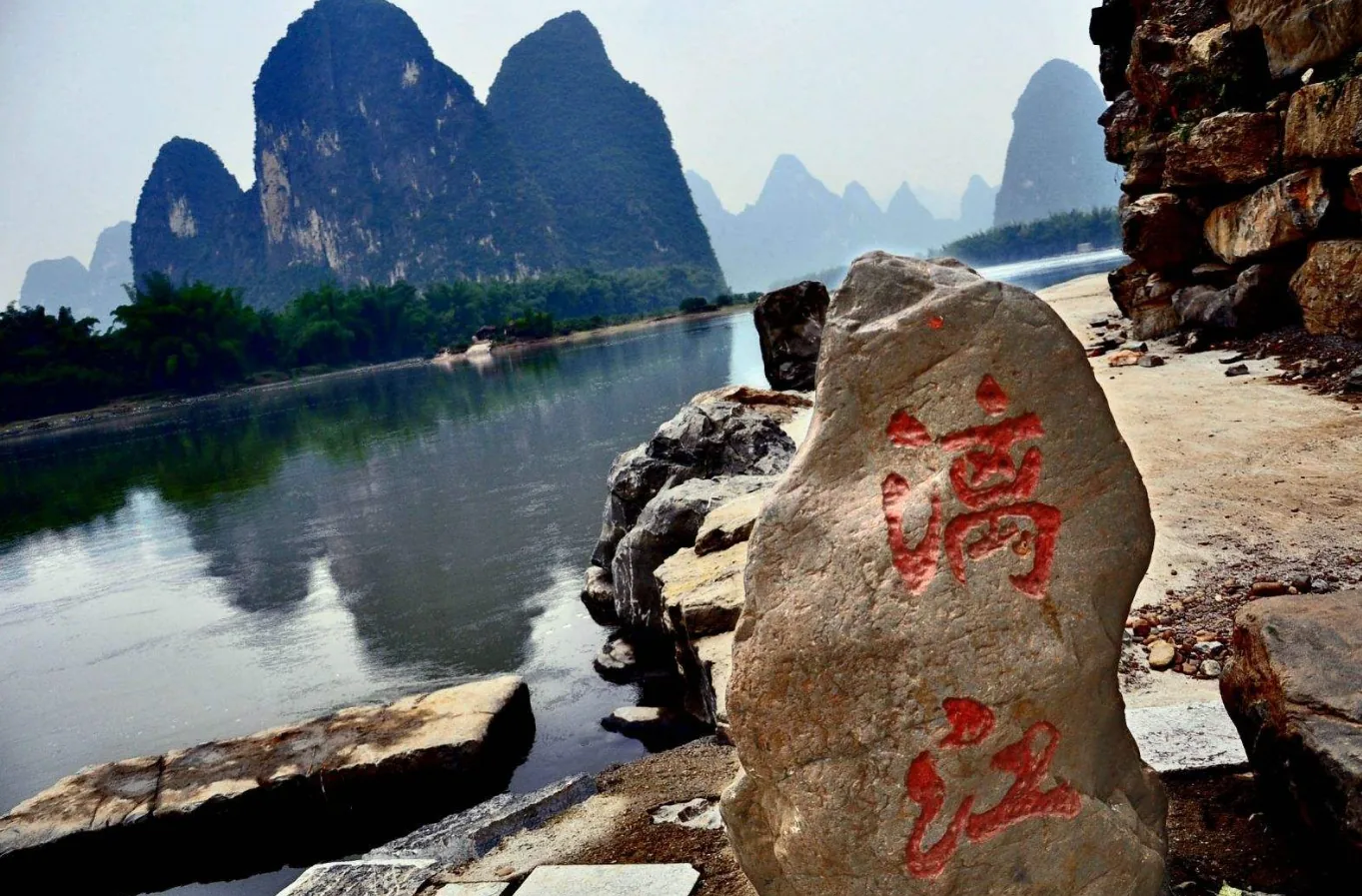
Day 2: Cave Exploration · Geology Mini-Class
I specifically chose Silver Cave as our “geology classroom.” Before leaving, I flipped through the kid’s nature textbook, which happened to cover “karst landforms.” I verified that the stalactites here are formed by long-term deposition of calcium-carbonate-containing water droplets, and seeing it in person would be the most intuitive way to learn. That morning, he woke up early, carrying his little dinosaur backpack, saying he wanted to “bring a magnifying glass for the stalactites.”
- Itinerary and Transportation: We left at 9:00 AM sharp. Auntie Wang helped me contact a local van (she had the driver’s number, saying “Old Zhang has driven the Yangshuo route for 5 years, very steady”). The 60 RMB fare was 20 RMB cheaper than on platforms. Old Zhang drove a white Wuling Hongguang with a safety charm hanging inside. He chatted with the kid: “Hey little guy, ever seen a rock grow taller?” The kid kicked his legs: “Never, I’m gonna see it today!” Along the way, we passed a sugarcane field; Old Zhang slowed down so we could watch farmers cutting cane. The kid leaned out the window shouting, “They look like big brooms!” 40 minutes later at the parking lot, Old Zhang helped us with our bags and said, “It’s cool inside, bring a thin jacket for the boy.”
- Attractions and Activities: Inside, we followed Guide Li. She used a megaphone to explain the “Three Wonders and Three Treasures”—the Musical Stone Screen (makes a ‘ding-dong’ sound when tapped; the kid actually ran to tap it, saying it felt like piano keys), the Guanghan Palace (large stone curtains hanging from the roof; she said they looked like “Chang’e’s gauze skirt”), and the Snow Mountain Waterfall (stalagmites resembling accumulated snow; the kid looked up counting “1, 2, 3… there are 7 snow mountains!”). I brought a portable LED magnifying glass for him. He leaned close to a stalagmite and suddenly yelled: “Mom, look! These patterns are like tree rings!” Indeed, there were fine rings on the surface, and the guide said “one ring represents one year of growth.” He pulled out a notebook and drew three forms: the pointed “Stalactites” (written as “like icicles, hanging upside down”), the curtain-like “Stone Drapery” (colored light blue, written as “like a frozen waterfall”), and the pillar-like “Stone Columns” (painted brown, labeled “drops fall from the top and hold hands with the rocks on the ground”).
- Interactive Experience: To the right of the exit was a blue tent with a craft station offering clay and cardboard cave-roof models. The kid squeezed a lump of brown clay, rolled it into a thin strip, and stood on tiptoe to stick it to the “roof,” muttering, “This is my water drop, it’ll turn into stone tomorrow.” He even swapped clay colors with a girl nearby, saying, “My rock wants to wear colorful clothes.” When finished, he ran to find me with clay marks on his nose and a beaming smile.
- Food and Tips: We had bamboo rice at “Cave Family” outside the scenic area for 25 RMB. The boss, a sturdy man, said the “bamboo was freshly cut this morning.” The rice was mixed with diced preserved meat and peas, and it smelled amazing when opened. The kid gnawed on the bamboo tube, saying it was “tastier than rice cooker rice.” I washed the tube afterward, and he insisted on taking it back to use as a pen holder. Important tips: The cave floor is slippery; I put him in non-slip sneakers (he usually wears Crocs, but I swapped them). I still saw a kid ahead slip and fall. Also, where the roof is low, I held his arm and protected his head with my other hand while he looked up.
The kid later told his kindergarten teacher that the rocks at Silver Cave “grow up.” When asked how he knew, he said, “I saw the rings with my magnifying glass, and the guide said one ring is one year”—that is the meaning of field exploration.
|
Cave Observation Points
|
Form Characteristics (Kid’s Version)
|
Formation Principle (Simplified)
|
Kid’s Fun Association
|
|---|---|---|---|
|
Stalactite
|
Hanging pointed tip, has ring patterns (like tree rings)
|
Roof water drops contain calcium carbonate, depositing drop by drop downwards
|
“Icicles hanging on the ceiling; they turn to stone when it rains”
|
|
Stalagmite
|
Rising from the ground, thick bottom and thin top (like a cone)
|
Calcium deposits after water hits the ground, growing upwards
|
“Little bamboo shoots drilling out from underground”
|
|
Stone Column
|
Connected from top to bottom (some as thick as two people)
|
Stalactite and stalagmite grow together, holding hands
|
“Stone giants acting as pillars in the cave”
|
Recommendation for Silver Cave’s guide service: Guide Li was very engaging. Seeing how much the kid liked to observe, she took us to a quiet side cave to see “miniature stone flowers,” saying “these small ones grow slowly and are more precious.” Cost-wise, van + ticket + lunch was 150 RMB per person (kids under 1.2m get free entry), which is high value. On the way back, Old Zhang told us many tourists only see the main cave, but the side caves have better details—next time, try asking the guide to “see the small stalactites.”
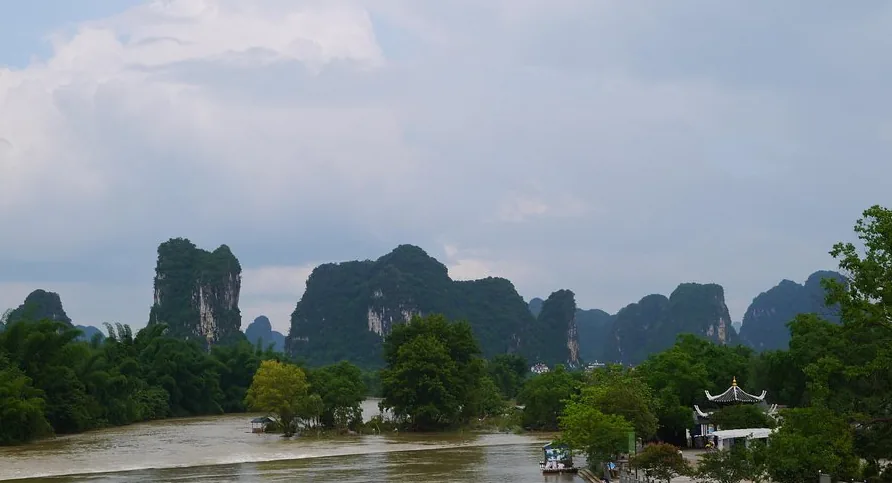
Day 3: Li River Cormorant Fishing · Fishing Culture Experience
Before leaving, I thought the cormorant fishing show in Xingping was just a “specialty performance,” but after seeing Grandpa Li and his birds, I realized it’s a continuation of an old fisherman’s livelihood—not a play for others, but a lifetime of river skills laid out for kids to see. That morning, the kid woke up particularly early, carrying his little fish backpack, saying he wanted to “bring biscuits for the cormorants” (we later learned they can’t eat snacks).
- Itinerary and Transportation: We left shortly after 8:00 AM. I pre-booked Old Zhang. The 50-minute drive to Xingping cost 100 RMB (taking the national highway past an orange orchard). In the ancient town, we walked the flagstone paths, worn shiny by time. The kid touched the woodcarvings of the old Ming and Qing houses, saying they looked “like the patterns on Grandma’s old cabinet.” The moss at the base of the walls was thick like a carpet; he stepped on it on purpose, making a “crunch” sound to “tickle the moss.”
- People and Culture: The performance began at 10:00 AM sharp. Grandpa Li was waiting by the pier. He’s in his sixties with bronze-tanned skin and pant legs rolled to his knees. The bamboo raft was made of three thick bamboos, with 5 cormorants standing at the bow—their feathers were shiny black with brown spots. Grandpa Li shouted “Hey-yo!”, tapped the water with a bamboo pole, and the birds all dove in. In less than 3 seconds, one surfaced with a small fish in its beak. He said: “This bird ‘A-Hei’ has been with me for 8 years. It’s smart; it only catches small fish and leaves the big ones to protect the ecology. Traditional fishing emphasizes ‘catching the big and leaving the small,’ and we stop fishing for three months when the river rises—these are rules from the elders. We respect the water we live off.” The kid listened intently, asking if the birds could talk. Grandpa Li laughed: “It’ll flap its wings against your hand to ask for fish.”
- Parent-Child Activity: Wearing orange life jackets, we boarded a raft in the shallow area (one adult per child). Grandpa Li held the side saying, “Stand steady, don’t wobble.” He taught the kid: “Don’t touch the bird’s neck; there’s a gland there, and it’ll peck you if it gets itchy.” For the photo, the kid held a plastic fish model provided by the guesthouse, shouting “I helped the bird get a fish!” A-Hei tilted its head and actually didn’t fly away. Back at the guesthouse, Auntie Wang taught him to make a “mini bamboo raft” using foam board and straws, tying them with string. In a buoyancy contest, the kid’s raft held 10 blocks without sinking (mine only held 8). Auntie Wang rewarded him with a hand-painted postcard of a raft and bird, with “Little Captain, come back to the Li River soon” written on the back.
- Food Diary: We had dried Li River fish at “Old Fishing Village Restaurant” for 38 RMB. The restaurant is right by the pier with a view of the mountains. The owner, an uncle in a bamboo hat, said the fish were small carp caught that morning and fried in tea oil. They were golden and crispy with a faint saltiness. Paired with crunchy pickled radishes, the kid was licking his fingers and said they were “tastier than potato chips.”
That day after returning home, the kid stuck his drawing of the cormorant on the fridge, titled “A-Hei and Grandpa Li.” I think letting kids see real life is more effective than any picture book.
|
Experience Item
|
Highlight (Details in Kid’s Eyes)
|
Precautions (Grandpa Li’s Advice)
|
Cost
|
|---|---|---|---|
|
Cormorant Fishing Demo
|
Grandpa Li’s 8-year stories; bird diving for fish in 3 seconds
|
Keep quiet, don’t scare the birds or throw things
|
30 RMB/person
|
|
Raft Experience
|
Rafting in shallow water; photo with A-Hei
|
Don’t touch neck/wings; stand steady and hold the pole
|
20 RMB/person
|
Recommendation for Grandpa Li’s performance: He doesn’t rush. Seeing the kid’s curiosity, he let the birds demo fishing twice more and said, “If you want to hear about the huge fish in the old Li River, come back next time.” The price is transparent; 30 RMB for a real fishing scene is more meaningful than scenic acrobatics. Wear light shoes as the pier stones are slippery.
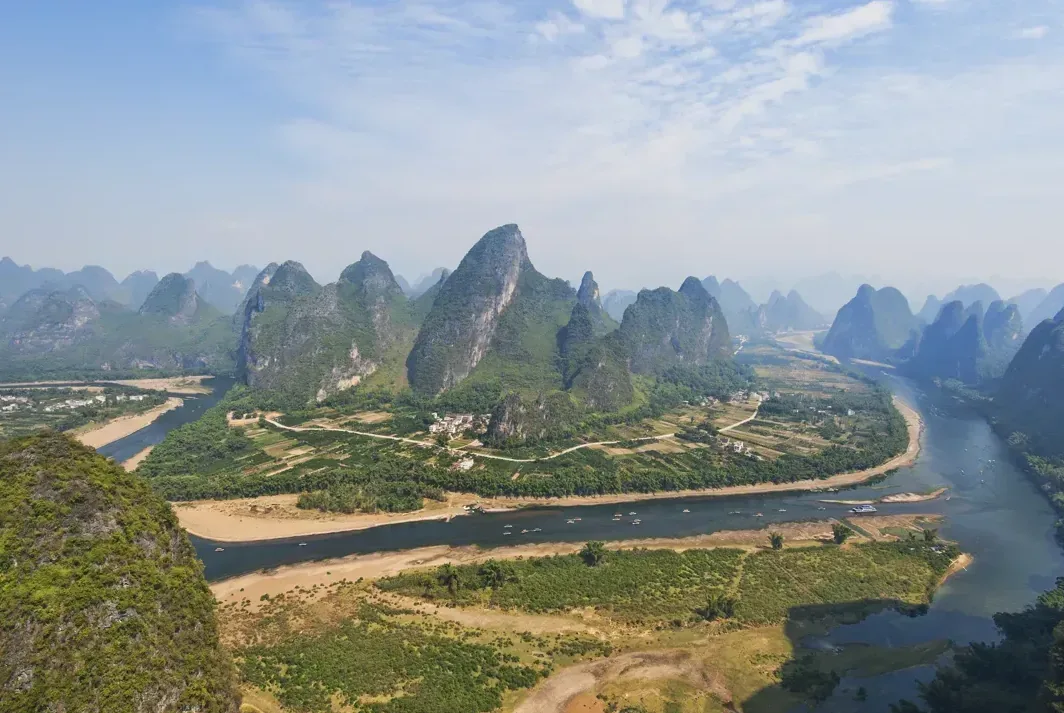
Day 4: Nature Observation · Preparation for Return
On the last day, I didn’t arrange any long-distance trips. I wanted the kid to have a grounded finish near the guesthouse, seeing how food travels from the field to the table. He woke up late and said, “No rushing today, let’s look slowly,” and I happily agreed. After a tight 4-day schedule, he needed time to digest what he’d seen.
- Itinerary and Transportation: Near noon, we walked 5 minutes to a nearby rice field. We left for the airport at 1:30 PM. After lunch, the 1.5-hour drive to Guilin Liangjiang Airport cost 180 RMB (with Old Zhang again). He played Guilin opera segments while the kid napped in the back seat clutching his bamboo dragonfly.
- People and Culture: The rice field smelled of freshly turned soil. Auntie Wang crouched on the ridge, pointing to the fruiting rice ears: “Look at these green ears; they’re heavy and will turn yellow in two months.” I touched an ear; the grains weren’t full yet, but I could feel the life inside. she pulled back taro leaves (larger than the kid’s face) to show the tubers: “These grow for half a year; they’re starchy and different from sweet potatoes.” Red and green peppers hung like little lanterns. When the kid tried to pick one, Auntie Wang stopped him: “Wait until they’re red to lose the spice; picking them now is a waste.” The kid pulled up a piece of barnyard grass with thin leaves and said, “This isn’t rice, the leaves are thinner.” Auntie Wang nodded: “Correct! It steals nutrients and must be pulled early.” she explained the farming process: “Seedlings need temperature control, transplanting requires bending over in rows, weeding in summer peels the skin off your back, and autumn harvest wears out your hands on the sickle—all that for just this little grain. Is it easy?” The kid bit his lip and suddenly said, “I won’t leave leftovers anymore.”
- Learning Summary: Back at the guesthouse, the kid went through his photos—the stalagmites (“grown by water drops”), the cormorant (“A-Hei catches fish in 3 seconds”), the raft race, and the rice field. He wrote with crayons: “Stalactites are made of water drops, cormorants catch fish, and rice takes a long time to grow.” His writing was wobbly, and he drew a picture of a farmer in a straw hat (looking like Auntie Wang) weeding, labeled “I helped the farmer.” He drew the grass with jagged edges, saying “barnyard grass looks like this.”
- Food Diary: Lunch was a farewell meal by Auntie Wang: tomato and eggs, stir-fried vegetables, and a small bag of animal crackers and dried mango (Yangshuo local style, sweet and sour). She said, “Snack on these if you’re hungry; don’t buy those expensive things at the airport.” As I took the bag, I saw rice milk stains on her apron from the morning’s noodles, and it felt very warm.
- Return and Recommendations: After lunch, the kid hugged his bamboo dragonfly and said, “Next time let’s dig for bamboo shoots.” Seeing the light in his eyes, I thought about his questions over the 4 days—”How much does a rock grow?” and “How long do cormorants live?”—and realized letting a child see real life is more substantial than ten hobby classes.
I remember him showing his notebook to Grandpa at home, saying, “Grandma Wang says rice takes 4 months; I won’t drop a single grain when I eat.” This is the lingering warmth of travel—not just photos, but the seed of “learning to cherish” planted in a child’s heart.
|
Return Info
|
Details
|
Cost/Notes
|
|---|---|---|
|
Farewell Meal
|
Home-style meal + packed snacks
|
Included in stay (no extra charge)
|
|
Airport Ride
|
Shanzhu Xiaozhu → Guilin Airport (1.5 hours)
|
180 RMB (Old Zhang, “on-the-way” price)
|
|
Recommendation
|
Auntie Wang teaches about plants/farming, provides kid supplies, and gives handmade gifts.
|
More warmth than a hotel; the child felt at home.
|
Recommendation for “Shanzhu Xiaozhu”: Auntie Wang isn’t just a landlord who cleans; she remembers the kid likes bamboo dragonflies, explains the difference between weeds and rice, and stuffs a bag of dried bamboo shoots in your hand when you leave. After 4 days, the kid said, “Grandma Wang is like my grandma,” which is more real than any “child-friendly” label. As we left, the kid yelled, “Goodbye Grandma Wang!”, and she stood at the door waving while a bamboo dragonfly spun over her head—a scene I’ve saved in my phone’s “Warmest Moments” album.
Keep Reading
- Couple’s 3-Day Romantic Route in Guilin | Stargazing Camping + Ten-Mile Gallery Cycling + Yangshuo West Street Candlelight Dinner
- Guilin 4-Day Cultural Tour | Jingjiang Royal City + Lingqu Ancient Site + Dong Ethnic Village, Unlock the Code of Lingnan Culture
- Guilin 5-Day Essence Tour | Night Cruise on Two Rivers and Four Lakes + Yangshuo Cycling + Longji Terraced Fields + Impression Liu Sanjie, Internet’s Hottest Route
- Guilin 6-Day Summer Escape Plan | Climbing Waterfalls at Gudong Waterfall + Exploring Yinzi Rock Cave + Boating on Qingshitan Lake, A 25℃ Summer
- Guilin 7-Day Humanities Journey | Intangible Cultural Heritage Handicrafts + Ancient Architecture Exploration + War of Resistance Sites, A Must-See for Deep Cultural Enthusiasts
Guilin Li River Cruise — — Key Facts
Transport & Schedules
- Guilin city → Mopanshan pier / Zhujiang pier | Taxi/dedicated line: A taxi about CNY 70–80, or take the dedicated line; setting off 1.5 h ahead is recommended[src]
- Guilin station/Guilin North station/Guilin West station → Yangshuo station | High-speed rail/EMU: Fastest about 22–30 min, fare about CNY 22–30, frequent departures[src]
Where to Stay · Room Type · Nearby
- Guilin city (Two Rivers and Four Lakes/Elephant Trunk Hill area) | Room tip: Convenient for leaving early the next day to board at the pier; the city sights are concentrated | Nearby add-ons: Elephant Trunk Hill, Sun and Moon Twin Pagodas, East-West Lane, Prince Jing’s Palace·Solitary Beauty Peak[src]
Typical Climate & Packing (Past Years)
- January: 5.2–11.9 °C, Guilin climate normals (China Meteorological Administration, publish
- February: 6.5–12.5 °C, Guilin climate normals (China Meteorological Administration, publish
- March: 10.5–16.8 °C, Guilin climate normals (China Meteorological Administration, publish
- April: 15.6–22.4 °C, Guilin climate normals (China Meteorological Administration, publish
- May: 20.2–27.4 °C, Guilin climate normals (China Meteorological Administration, publish
- June: 23.2–30.4 °C, Guilin climate normals (China Meteorological Administration, publish






