



Day 1: Arrival at Shangri-La from Various Locations
Last Saturday, I flew from Hangzhou Xiaoshan to Shangri-La. I chose a 9:00 AM flight and specifically picked a window seat. Looking down at takeoff, the Qiantang River looked like a silver ribbon. The higher we flew, the more clouds appeared until we pierced through the cloud layer, leaving only a vast expanse of white outside the window. After a 3-hour and 40-minute flight, we landed at 1:30 PM. The moment I stepped out of the cabin, the wind hit me with a scent of sun-dried highland barley mixed with yak butter, which felt ten times more comfortable than the humid air of Hangzhou’s plum rain season. Zhaxi was standing at the exit holding a white cardboard sign with my name on it, wearing a faded navy blue jacket with a beeswax prayer wheel hanging around his neck. When he smiled, the wrinkles at the corners of his eyes piled up like small hills: “Lass, I am Zhaxi, our car is parked in the P2 parking lot.”
On the way, Zhaxi drove an old Toyota Land Cruiser; the chassis felt as stable as if it were glued to the ground. He pointed to the G214 National Highway outside the window and said: “Yesterday, a young girl from Shanghai didn’t check the room status at Feilai Temple in advance. When she reached Deqin, she found all the landscape rooms were full. At midnight, she had to take a night bus to Yanjing wrapped in a hardshell jacket, crying from the cold.” I quickly pulled out my phone to check my order—I had just booked a landscape room at “Mingzhu Laka” in Feilai Temple the day before yesterday. Zhaxi glanced at the screen and nodded: “This place has a good location; you can see the Meili Snow Mountain’s golden sunrise directly in the morning.” He then pulled a carbon fiber trekking pole from the passenger drawer and handed it to me: “The wooden planks in Yubeng have been damp lately. Your white shoes have slippery soles; use this, it’s ten times sturdier than the 10-yuan plastic sticks at the scenic entrance.”
At noon, we reached Shangri-La city. Zhaxi took me to “Are Tibetan Restaurant” located in an alley north of Dukezong Ancient Town. A string of red silk hung at the door, and scriptures were carved on the lintel. Pushing the door open, a fireplace was burning yak dung patties, and the smoke carried the aroma of meat toward us. The owner was an Ajia (Tibetan for “older sister”) wearing a Tibetan robe. She wiped her hands and smiled: “Zhaxi brought a friend for Yak Meat Covered with Quilt again?” When it was served, a large pot of stewed beef was steaming. The beef was stewed until tender, even the tendons melted in the mouth. It was covered with a layer of yak butter pancakes; the pancakes were soaked soft by the broth. One bite, and the meat fragrance wrapped in the scent of yak butter spread in my mouth. I drank two large bowls of soup in a row. Seeing my curiosity about the butter tea, Ajia handed me a cup: “Hold the cup handle and rotate it while drinking, don’t touch the ash on the rim. This tea is made with milk freshly squeezed this morning and fresh yak butter; it’s hot and can dispel the cold.” I followed her instructions; the milky aroma blended with the tea scent. Eating it with tsampa—Ajia taught me to knead the tsampa into small balls and soak them in the tea to soften—it was a bit choking at first, but I gradually got used to it and found it even more fragrant than cake.
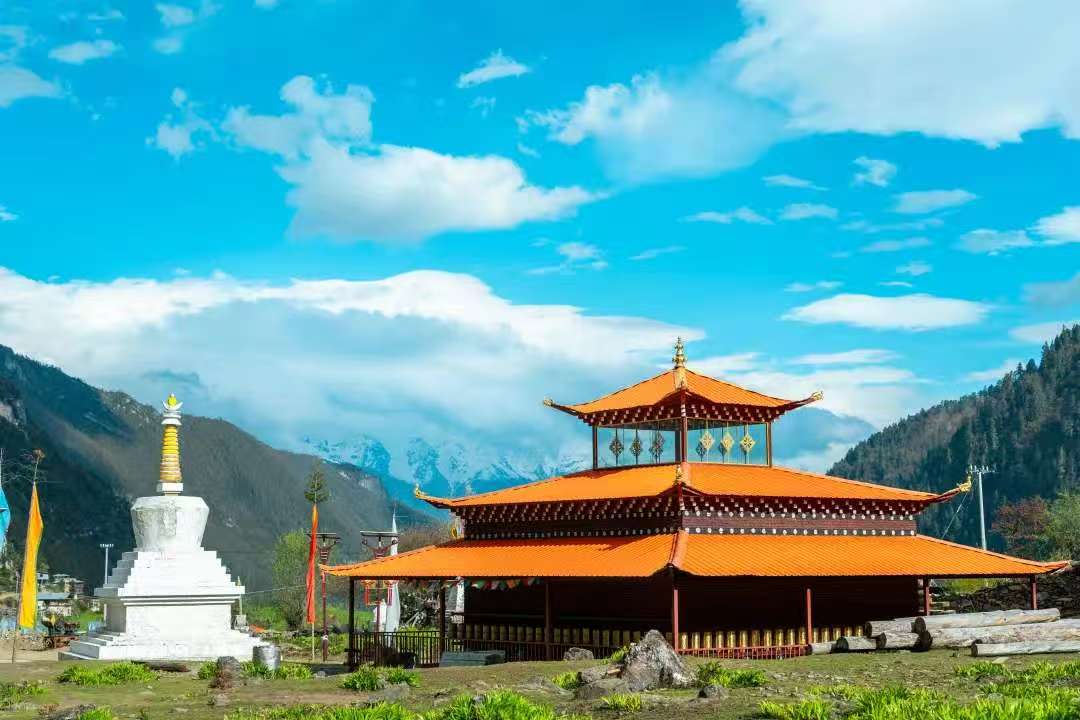
At 2:00 PM, I explored Dukezong Ancient Town. No ticket is required. Walking along the blue stone path, the soles of my shoes rubbed against the polished stones. In some places, you can still see deep and shallow hoof prints, likely left by ancient tea-horse caravans. Walking to Sifang Street, an over-man-high prayer wheel stood in the center, gilded with gold and carved with Tibetan scriptures. A blue sign with white text stood nearby: “Requires 5 people to rotate together, clockwise three times for blessings.” I waited for a few tourists to gather, and everyone shouted “1, 2, 3” to push together. The prayer wheel creaked and turned, and the wind made the nearby prayer flags flutter loudly. My palms sweated a bit as I followed everyone’s rhythm. After three rotations, my chest felt like it was holding a hand warmer; I didn’t even feel the cold wind on my face.
The small shops in the ancient town held many surprises: at the corner of an alley, there was a small Tibetan incense shop. The owner was a young Tibetan man wearing black-rimmed glasses. Seeing me approach, he proactively handed me a stick to smell: “This is made of cedar and saffron. Take a box when you go around the mountain; it repels mosquitoes and helps you sleep soundly.” I bought a box for 25 yuan. It had a slightly bitter but calming scent compared to the 50-yuan ones sold at the scenic entrance. I also encountered an old lady in a Tibetan robe sitting on the steps soaking up the sun, clutching a string of dark brown Buddhist beads. When she saw me, she smiled, and I smiled back. Although we didn’t speak the same language, she reached out and touched my head. The warmth was like my grandmother’s hand, making my nose tingle.
At 8:00 PM, I stayed at the “Songtsam Green Valley” hotel deep in an alley of the ancient town. Several highland willows were planted at the entrance. The room was on the second floor. Entering, Tibetan carpets were spread all over the floor, and a Tara Thangka hung on the wall with colors as vivid as if they were just painted. The biggest surprise was the floor heating—as soon as I walked in, warmth spread from the soles of my feet. I took off my shoes and stepped on the carpet, sighing in comfort. The bathroom had 24-hour hot water; the water temperature was just right after washing my face, unlike previous guesthouses where it was either scalding or freezing. Lying in bed and pulling back the curtains, I could see the distant Shika Snow Mountain. The peak still had some residual snow, and the sunset shone on it like a layer of gold powder.
Before sleeping, Zhaxi sent a voice message: “Tomorrow at 8:00 AM, go to the visitor center at the ancient town entrance to buy the mountain trekking ticket. Remember to bring your ID card, don’t forget—last time a guy forgot his, queued for half an hour, and was sent back.” I put my ID on the nightstand, staring at the snow mountain outside the window, listening to the crackling of the yak dung patties in the fireplace, and fell into a deep sleep. This was my first time sleeping so soundly at an altitude of 3459 meters; even my dreams were warm.
Small Reminders (Personal Pitfall Avoidance):
- Don’t miss the sweet tea shops in the ancient town, 5 yuan a cup, brewed with brick tea and milk. It’s healthier than milk tea; I drink two cups every morning.
- Don’t buy Tibetan jewelry at the ancient town entrance; they are overpriced. In the small alley shops, you can bargain down by half. I bought a beeswax pendant for 100 yuan, and the owner threw in a turquoise string.
- Landscape rooms at Feilai Temple must be booked a week in advance, especially during peak season (7-8 months). You won’t find any rooms last minute. My colleague couldn’t book one last year and stayed in a Deqin hotel, having to wake up 1 hour earlier for the drive to see the golden sunrise.
Appendix: Shangri-La First Day Practical Checklist (Tested & Effective)
| Category | Recommended Item/Shop | Pitfall Tip |
|---|---|---|
| Transport | Zhaxi’s Land Cruiser (Reliable, knows trekking) | Avoid unlicensed taxis; prices double and they aren’t safe |
| Food | Are Tibetan Restaurant (Yak Meat Covered with Quilt, Butter Tea) | Don’t buy “Specialty Yak Jerky” at scenic entrances; most are made of pork |
| Accommodation | Songtsam Green Valley (Floor heating, quiet) | Avoid noisy hotels in the center of the ancient town |
| Essentials | Carbon fiber trekking pole, high-SPF sunscreen | Don’t bring plastic poles; Yubeng planks are slippery |
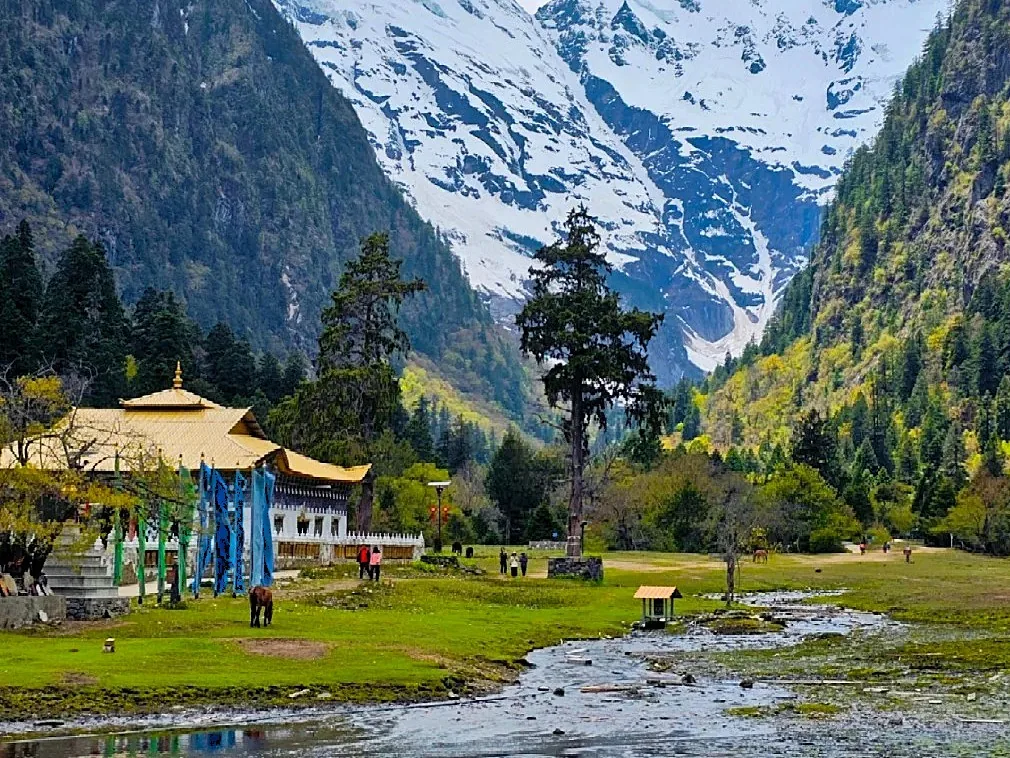
Day 2: Shangri-La → Deqin Feilai Temple
At 7:50 AM, Zhaxi’s Land Cruiser stopped punctually at the ancient town alley entrance. Last night, he cleared the passenger storage box and stuffed in a thermal flask of sweet tea, two packs of glucose oral liquid, and a folding oxygen bag: “Yesterday an older sister from Xi’an got altitude sickness at the pass; she recovered in ten minutes after breathing this.” I sat in the car clutching the oxygen bag, smelling the scent of the seat covers dried in the sun.
As the car left Shangri-La city, the surface of the G214 National Highway changed from asphalt to gravel. Zhaxi turned on the radio, and a Tibetan song drifted out, the melody like wind through prayer flags. He pointed to the rising mountain shadows ahead: “40 more minutes to Baima Snow Mountain Pass. Roll down your window, don’t close it; there’s the scent of snow in the wind.” Sure enough, before long, the white of the mountain peaks hit my eyes.
8:40 AM, Baima Snow Mountain Pass. The numbers on the road sign jumped to “4292 meters”. I reached out to touch the car door frame, my fingertips catching some frost. Zhaxi stopped the car and said, “Get out and walk a bit.” The wind blew with fine snow, so I quickly pulled up the collar of my hardshell jacket, only to see azaleas on the slope—pink like soaked cherry blossoms and white like snowy cotton, covering the entire slope from the pass downwards. In the distance, the outlines of the Prince Thirteen Peaks floated in the clouds; Kawagarbo Peak only showed half its snowy top, like a shy girl hiding her face with a veil. Zhaxi took out his phone to take a photo, muttering: “This time last year, the snow was thicker than this; the pass had snow half a person high, cars couldn’t even drive up.”
At 12:30 PM, we arrived at Benzilan. Zhaxi parked the car in front of “Old Silversmith Local Chicken Hotpot,” with crooked Chinese characters on the sign. The owner was an uncle in a Tibetan robe. Seeing Zhaxi, he smiled and lifted the kitchen curtain: “Zhaxi, the usual? Freshly slaughtered local chicken with matsutake and porcini mushrooms!” When the chicken soup was served, the lid of the clay pot was lifted, and the heat surged out with the mushroom fragrance. The chicken was stewed soft, even the breast meat melted away. The broth was so fresh I drank three bowls in a row, finally finishing the green onions at the bottom with rice. The uncle wiped the table and said: “This chicken is free-range from my back mountain, caught this morning; the mushrooms were picked by me on the mountain this morning, very fresh.”
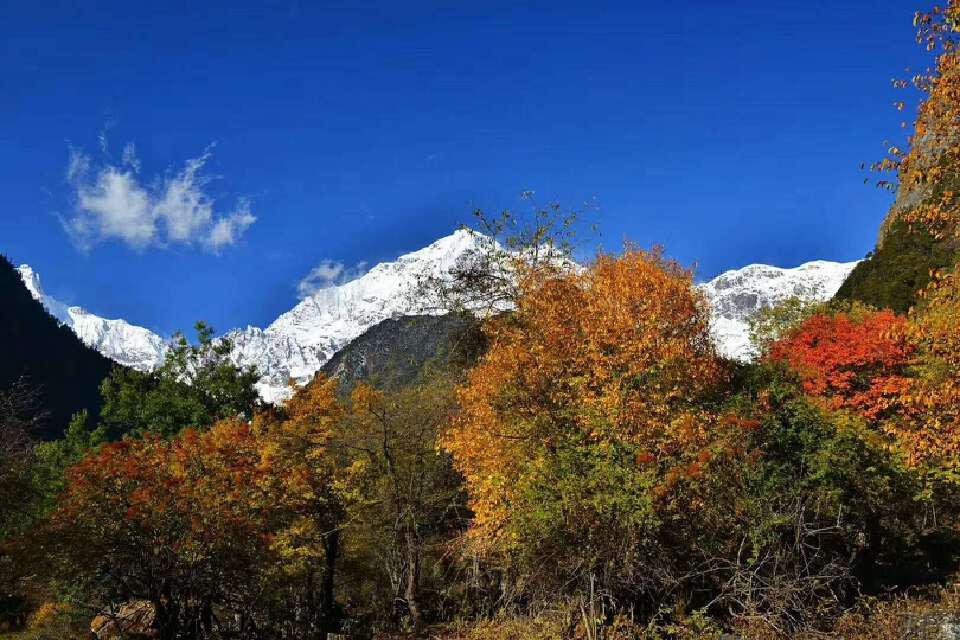
At 4:10 PM, the car turned into the parking lot at Feilai Temple. Zhaxi helped me carry my backpack to the guesthouse, saying: “You booked room 302 at ‘Mingzhu Laka,’ the balcony faces Kawagarbo Peak directly; don’t forget to go to the balcony later.” Pushing open the guesthouse door, the wooden stairs creaked. The heating in the room was already on, and a copper hot water kettle sat on the Tibetan carpet. I dropped my luggage and rushed to the balcony—the snowy peak of Kawagarbo was right before my eyes, shimmering with pale blue light. The surrounding Prince Thirteen Peaks were like guards in formation, some wearing snow caps, others showing brown rock. Wind blew from the canyon with the moisture of the Lancang River. I gripped the balcony railing, my fingers stiff with cold, but I didn’t want to move—this was my first time seeing Meili Snow Mountain so close, a hundred times more shocking than in photos.
At 6:30 PM, the guesthouse restaurant was filled with Tibetan incense. Ajia, wearing a red headscarf, brought a Tibetan earth hotpot: a copper pot stewing yak meat, radishes, potatoes, and tofu. The broth was made from bone marrow and seasoned with a few peppercorns. Ajia handed over the dipping sauce: “This is Tibetan chili powder, mixed with yak butter and salt; it’s very fragrant with meat.” I took a piece of yak meat; it was so tender it burst with juice. The radish soaked up the soup and was sweet. Drinking the highland barley wine brewed by the owner herself—the alcohol content wasn’t high, like sweet rice wine, but the aftereffect was quite strong. I drank half a cup, and my face turned red. Ajia sat across from me, telling her trekking stories in broken Mandarin: “When I was young, I trekked with my father for three days and nights. We met a blizzard and hid in a cave. My father wrapped his down jacket around me while his own nose turned red from the cold. Since then, I trek every year for the safety of our livestock and my own health.”
Before bed, I stood on the balcony looking toward the snow mountain. The sound of chanting from the temple drifted over, distant yet clear. Zhaxi sent a message: “Tomorrow morning at 7:00 AM, I’ll take you to the Feilai Temple viewing platform for the sunrise. Don’t oversleep.” I put my phone by my pillow, listening to the wind outside, and slowly fell asleep—that night, I dreamed I turned into a cloud on the mountain, floating over the top of Kawagarbo Peak.
Tested Practical Details (Note these to save time):
- There are no toilets at Baima Snow Mountain Pass; tell Zhaxi 10 minutes in advance, and he will stop at a hidden spot by the road.
- Choose “freshly slaughtered” for the chicken hotpot in Benzilan; ask the owner for the “matsutake + porcini” combo for the freshest soup.
- At Feilai Temple, you must choose south-facing rooms (like 302, 305), otherwise the mountain body will block the snow mountain view.
- Don’t overindulge in highland barley wine; the aftereffect is bigger than you think. I felt dizzy after half a cup. The owner said: “Mix it with some hot water; it’s milder.”
Appendix: Shangri-La → Deqin Itinerary Practical Table
| Time Node | Itinerary Details | Precautions |
|---|---|---|
| 7:50 | Arrival at Baima Snow Mountain Pass | Wear hat and gloves; the wind is strong and can cause headaches |
| 12:30 | Benzilan “Old Silversmith Local Chicken Hotpot” | Ask how long the chicken soup simmered (at least 2 hours to be rich) |
| 16:10 | Arrive at Feilai Temple “Mingzhu Laka” Guesthouse | The room heating is sufficient; no extra blankets needed |
| 18:30 | Guesthouse Tibetan Earth Hotpot + Barley Wine | Use Tibetan chili powder for dipping; it’s perfect with yak meat |
| 21:00 | View snow mountain + hear chanting from balcony | Wear a thick coat; the balcony is windy |
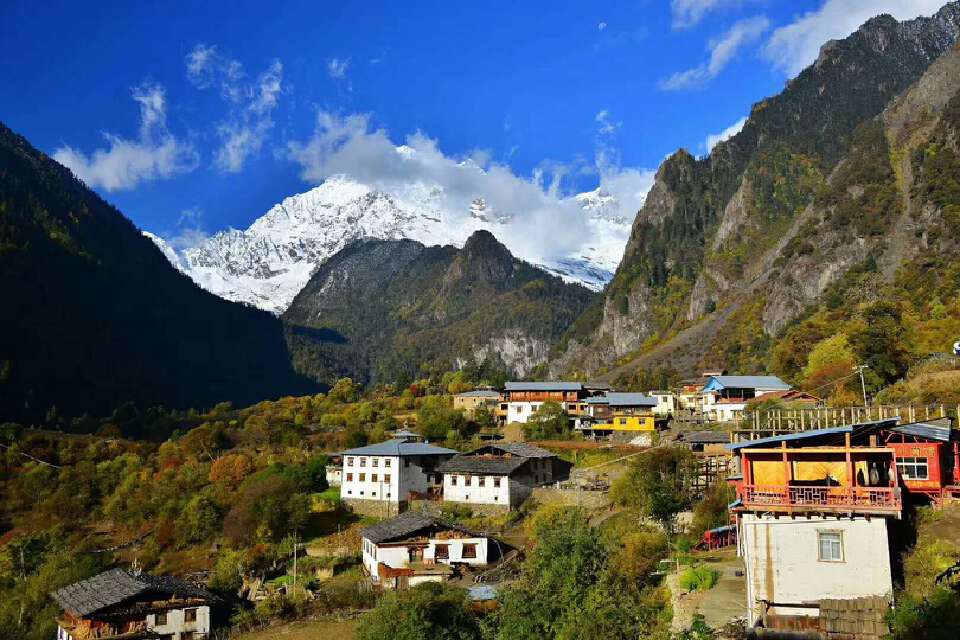
Day 3: Feilai Temple → Xidang → Yubeng Village
At 6:40 AM, Zhaxi’s Land Cruiser stopped punctually at the guesthouse door. My hiking pack on the back seat still carried last night’s dew. An aluminum thermal flask sat on the passenger seat, its body covered in fine condensation—he specifically brewed hot butter tea last night, “Drink it on the road; it’s warmer than mineral water and helps prevent altitude sickness.” I opened the lid, and the milky aroma mixed with tea scent surged out, suddenly reminding me of my grandmother stirring milk tea by the stove, the copper kettle making the same “gurgle-gurgle” sound.
At 7:00 AM sharp, the car drove toward Deqin along the G214. After only half an hour, the roar of the Lancang River hit the car window—the river water was a murky earthy yellow, as if someone had kneaded the entire mountain’s mud into the water, crashing against the rocks on both banks and leaving mottled yellow marks on the roadbed. Zhaxi steered with one hand and pointed out the window with the other: “This river flows from Tibet; when it reaches the foot of Yubeng Mountain, it turns clear, and you can see fine-scaled fish.” I leaned out to look; the mountains on the other side were as steep as if sliced by a knife, with a few stunted pines growing from rock crevices, twisted but with roots dug deep.
8:10 AM at Xidang—the entrance to Yubeng. A faded wooden sign stood by the road, with “Yubeng Scenic Area” written in crooked characters. Zhaxi parked in the lot, turned around, and pulled a folding backpack from the trunk for me: “It has compressed biscuits, glucose, and a flashlight—Xiaonong Base Camp has no streetlights, just in case you walk late.” He tilted his chin toward the off-road jeep parked nearby: “You can take that for ten minutes into the village, but I advise you to walk—only by walking in do you truly reach Yubeng. You can smell the pine needles and hear the Lancang River, not just see fake scenery through a car window.”
I shouldered the hiking pack and headed for the trail. It started as a dirt path, soft to step on and leaving grass clippings on my feet; the wind carried the bitter scent of pine needles mixed with the fishy sweetness of the river. After walking for forty minutes and turning a corner, the road became a wooden plank path—dark brown boards that “creaked” underfoot, with iron railings polished smooth by hands. I leaned over the railing to look down—the Lancang River was right below my feet, like a writhing yellow snake. The sound of water hitting rocks was louder, making my ears tingle. Zhaxi shouted from behind: “Slow down! The boards in the next section are loose, step in the middle!” I looked at my shoes—I was wearing the anti-slip hiking shoes I bought last week with deep treads, very stable on the boards. I remembered Zhaxi saying this morning, “Don’t wear those white shoes, you’ll slide right into the river,” thankfully I listened.
11:30 AM at Xiaonong Base Camp. The wooden sign read “Altitude 3600m,” with several bags of yak dung piled nearby, and smoke from the stove rising high. The Ajia selling sweet tea was wrapped in a Tibetan robe, her black woolen hat pulled low. Seeing me, she handed over a coarse ceramic cup, the rim stained with a bit of milk: “5 yuan, hot, with milk dregs added.” The cup was hot enough to sting my palm, and the sweet tea had a scorched aroma; the grainy texture of the milk dregs slowly dissolved on the tip of my tongue. I sat on a wooden bench to rest, watching a few Tibetans carrying hiking packs uphill, sweat soaking the backs of their robes, yet they still laughed and offered cigarettes to each other, adding words of “keep going” in Tibetan.
At 2:00 PM sharp, I finally saw the smoke from Upper Yubeng Village. The village was hidden at the foot of the snow mountain, with roofs covered in dark gray stone slabs and prayer flags hanging under the eaves, fluttering “huala-huala” in the wind. Uncle Ciren stood at the guesthouse entrance, his navy blue apron stained with flour. Seeing us, he came to welcome us, clutching a copper ginger tea pot: “You finally made it! Come in and drink ginger tea to dispel the cold.” The ginger tea was so spicy I gasped, but it warmed my stomach until it tingled—the mountain wind I blew into while hiking was completely forced out by this cup of tea. He turned and brought roasted potatoes, the skins charred black, fluffy inside when broken open, sprinkled with a bit of salt and yak butter: “Line your stomach first; tonight I’ll make you yak meat buns with two spoons of yak milk, very fragrant.”
At 7:00 PM, I sat on a stone block at the guesthouse entrance. The starry sky filled the sky above; the Milky Way was like crushed silver sand, stretching diagonally from east to west. The stars were so bright and numerous I could even count the ladle of the Big Dipper. Uncle Ciren brought out a small table and set down a butter lamp: “Yubeng has no streetlights; the stars are ten times brighter than in the city—I used to graze yaks here when I was a kid, lying on the meadow looking at the stars until midnight.” I bit into a yak meat bun, the juice bursting in my mouth—the freshness of yak meat mixed with the scent of butter. Looking up at the sky, I suddenly felt it was all worth it—the road into Yubeng isn’t driven by car; it’s stepped over pine needles, smelled through river mist, and walked step by step drinking sweet tea.
Before sleep, I felt my pocket; it had the flashlight Uncle Ciren gave me—a plastic case with a handle worn smooth, and a note he wrote: “Tomorrow at 7:00 AM, I’ll take you to the Sacred Waterfall, wear anti-slip shoes.” The wind outside blew in with the scent of butter lamps. I hugged my quilt and smiled, hearing the distant roar of the Lancang River, like it was saying “see you tomorrow.”
Today’s Tested Practical Details:
- For the Yubeng entrance section, you must wear anti-slip hiking shoes (I wore Salomon X Ultra, didn’t slip on the planks).
- Drink the sweet tea at Xiaonong Base Camp hot; with milk dregs, it’s more effective than mineral water.
- Uncle Ciren’s ginger tea is home-brewed with a strong ginger flavor; the cold-dispelling effect is better than store-bought ginger candy.
- The Yubeng starry sky is brightest at 1:00 AM; I got up to look for half an hour and could see the texture of the Milky Way.
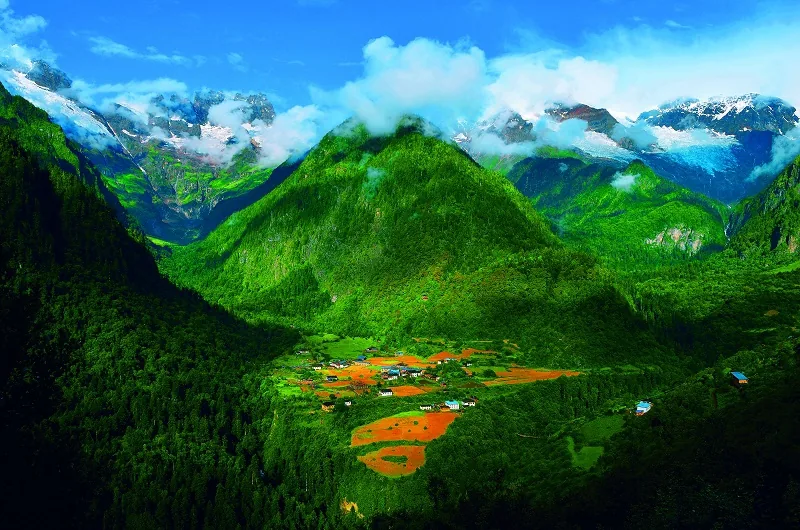
Day 4: Yubeng Village → Ice Lake (Round Trip)
At 6:50 AM, Uncle Ciren’s knock on the door came with the aroma of butter pancakes—he carried a stainless steel tray with a tea-stained thermal cup (freshly boiled water, you could hear bubbles rattling), chocolate wrapped in aluminum foil (with crooked Tibetan writing, likely bought at the village shop), and a folding trekking pole (aluminum alloy rod, handle wrapped in worn rubber, two pounds heavier than my plastic one but stable on gravel roads). He shoved the pole into my hand: “Borrowed it from Xiaonong Base Camp yesterday; a girl from Guangzhou fell yesterday because she didn’t hold one of these firmly.” As he handed over the cup, the steam made my palm itchy: “Take a sip every half hour, don’t wait until your throat is dry—altitude sickness fears dehydration most.”
At 7:00 AM sharp, we stepped out of the guesthouse into the morning mist. Early morning in Yubeng Village was like being soaked in milk; the bitter scent of pine needles wrapped in the sweetness of the neighbor’s yak butter. The prayer wheels in the alley creaked, the ropes wearing the wooden axles smooth. Uncle Ciren walked ahead, the hem of his robe brushing past blue gentian flowers along the road. I knelt to touch them; they were cold enough to make my fingertips shrink. He looked back and laughed: “Slow down, the meadow ahead is slippery; even a local dog took a tumble yesterday.”
The first hour was knee-deep meadow, soft to step on. Dew from the grass seeped into my hiking shoes, making my socks gradually damp, but the wind had a fishy sweetness of green grass, like the smell of rolling in the fields back home as a child. After passing the Xiaonong Base Camp sign, the road suddenly turned hard—gravel road, every piece hurting the soles of my feet. I had to shift my center of gravity forward to avoid slipping. Uncle Ciren stopped and pulled a Tibetan copper pot from his chest: “Rest for five minutes, drink something hot.” The sweet tea had milk dregs floating in it, thicker than yesterday’s. I drank the tea while watching him wipe sweat.
After another two hours of walking and turning a ridge covered in shrubs, the Ice Lake suddenly hit my eyes. I almost shouted—the lake water was pale blue, like the morning sky crushed and sunk into the valley. Surrounded by blue-white glaciers, with fine icicles hanging from the edges, the sunlight hit them, sparkling like crushed diamonds. Five-colored prayer flags hung on the stones: red, yellow, blue, green, and white, fluttering “huala-huala” in the wind like someone chanting in the distance. Uncle Ciren stood beside me, his voice very soft: “The first time I came here, I also stood and watched for half an hour—I didn’t even notice my yaks had run off.”
I knelt by the lake and touched a chunk of glacier—it was piercingly cold, my fingertips numbed instantly, like being bitten by a small bug. The glacier had deep fissures, like wrinkles on an old man’s face. Uncle Ciren tapped it with his pole: “These are traces of the glacier moving for hundreds of years; there was a large ice cave here last year, but it melted this year.” I found a flat rock by the lake to sit on. The wind blew my hat away, and Uncle Ciren picked it up, a fragment of a prayer flag stuck to the brim. The sun slowly climbed up, and the Ice Lake’s color deepened, like a piece of blue crystal soaked in water. I took out my camera and took more than twenty photos—each one different because the clouds were moving and the light was changing.
At 2:00 PM, we began the trek back. My legs were a bit sore, every step feeling like stepping on cotton. I clutched the Sanqi powder paper packet Uncle Ciren gave me, crushed it, and stuffed it into my mouth—so bitter it made me frown. He handed me a fruit candy: “Tibetans carry this when trekking to relieve leg soreness.” We followed the path we came from, the shadows on the gravel road growing longer. When passing the meadow, those gentian flowers had closed up, like children having a nap.
Back in Yubeng Village, Zhuoma was waiting at the guesthouse entrance, her apron stained with flour. She brought freshly steamed yak meat buns—the skin so thin you could see the filling inside. One bite, and the juice burst in my mouth—the freshness of yak meat mixed with the scent of onions. Zhuoma wiped her hands and laughed: “Uncle Ciren said you’d be tired today, so I put two extra spoons of beef and added a bit of yak butter.” I sat on a wooden stool, eating the buns and looking at the distant snow mountains—the peak of Kawagarbo still held the glow of the sunset, the wind carrying the scent of butter lamps. I even forgot the soreness in my legs.
Lying in bed at night, feeling the ache in my knees and thinking of the blue of the Ice Lake, the wind through the prayer flags, and Uncle Ciren’s chocolate—it was as sweet as today’s sun. The sound of chanting drifted in from the window. I hugged my quilt and smiled, thinking about going to the Sacred Waterfall tomorrow. Uncle Ciren said he’d take me to step on the mani stones by the waterfall, and Zhuoma said she’d save me a bowl of hot butter tea. I turned over and slowly fell asleep—my dreams were filled with the blue of the Ice Lake and the sight of prayer flags fluttering.
Today’s Tested Practical Details:
- For the Ice Lake road, you must wear anti-slip hiking shoes (I wore Scarpa, didn’t slip on the gravel).
- Uncle Ciren’s Sanqi powder is homegrown by Tibetans; it’s more effective than pharmacy versions and a trekking essential.
- Eat the yak meat buns while they are hot; once cold, the juice congeals, though they are still fragrant.
- Don’t stay too long at the Ice Lake—altitude is 3900m. I sat for half an hour and got slight altitude sickness; it only faded after a cup of sweet tea.
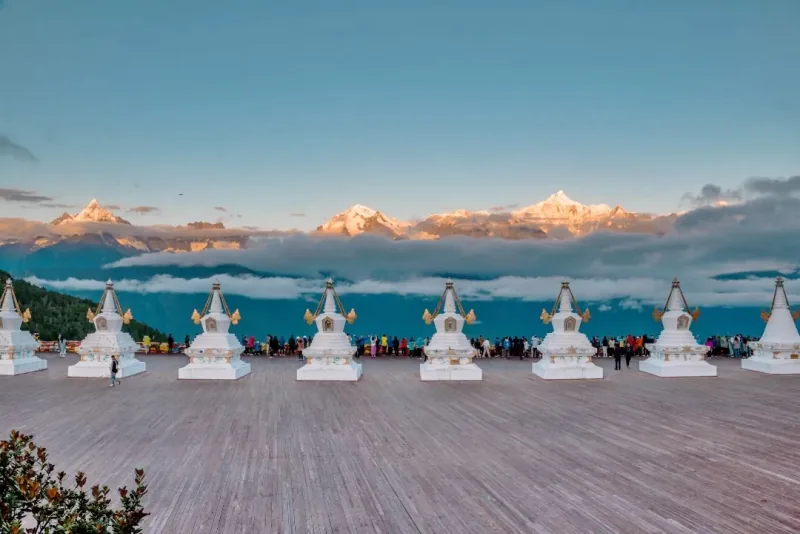
Day 5: Yubeng Village → Sacred Waterfall (Round Trip)
At 7:50 AM, Uncle Ciren’s knock on the door came with the residual warmth of butter pancakes—he held a galvanized iron water bag, the body stamped with the faded Tibetan words “Tashi Delek”. “Fill it up; the Sacred Waterfall has no supply points. This bag will last the whole trip.” The water bag was heavy. I gripped the opening and could smell the crispness of the water inside. He also stuffed a handful of five-colored prayer flags into my hand, the paper edges frayed: “Find a clean spot at the waterfall to hang them, add some blessings.”
At 8:00 AM sharp, we left the village. The road was packed dirt, feeling solid underfoot, with occasional small stones but not requiring the tight grip on the trekking pole like yesterday’s trip to the Ice Lake. The wind carried the faint scent of alpine azaleas; pink petals were scattered by the road, condensed with dew. I knelt to touch them; the petals were as soft as cotton. Uncle Ciren walked ahead, the hem of his robe brushing the grass, and suddenly stopped: “Look—” Ahead was a mani pile on a slope, stones carved with blurred scriptures, topped with red and yellow prayer flags fluttering in the wind. “Each pile is a Tibetan’s wish,” he picked up a flat stone, “You place one, doesn’t have to be many, just the intent.” The stone hit the mani pile with a “dong” sound, like a quiet greeting to someone.
After two hours of walking, the sound of the Sacred Waterfall drifted over first—”huala-huala,” like wet cloth being torn in the distance. Looking up, the waterfall plunged from the 30-meter-high snow mountain into the stone pool below. The splashed water hit my face, cold enough that my eyelashes caught small droplets. Stones by the pool were carved with the Six-Syllable Mantra; the red pigment had faded from rain but still showed the brushstrokes. Tibetans were already circumambulating: an Ajia in a Tibetan robe was turning a prayer wheel, chanting softly; an uncle with a red headscarf held prayer flags, shaking them with every step. I followed them, stepping clockwise—the first lap, smelling the water and the soapberry scent of the flags; the second lap, hearing the “creak” of the wheels and the low chanting; the third lap, sunlight pierced the mist, and a small rainbow actually appeared, hanging between the snow mountain and the waterfall, like someone had scattered crushed colored paper.
At 2:00 PM, we headed back. My legs were soft, but not from fatigue—it was the satisfaction of “having walked enough.” Uncle Ciren pulled out wild strawberries from his bag, bright red and translucent, and gave me a handful: “Just picked, very sweet.” The juice splashed on my hands, sweet and sour like the orange candy from my childhood. Back at the village, Zhuoma was at the door holding a copper butter tea pot, steam rising from the spout: “Added walnuts, you’ll definitely love it.” The tea entered my mouth, so fragrant my tongue almost melted—the crunch of walnuts, the smoothness of butter, and a hint of salt, warming my stomach until it trembled. She then handed me a piece of yak yogurt, so thick it could be pulled into threads, sprinkled with parched rice. It was sour and sweet; eating it with the tea made my breathing slow down.
I sat on a stone block by the guesthouse door soaking up the sun. In the distance, Kawagarbo Peak showed half its face from the clouds, its snowy top gleaming. The wind carried the scent of butter lamps and the smell of the sun on the quilts Zhuoma was airing. Uncle Ciren sat down smoking a pipe: “The water of the Sacred Waterfall is the tears of the snow mountain; it can wash away troubles.” I looked at the five-colored prayer flags in my hand; the wind blew them up, just touching my fingertips—at that moment, I suddenly understood that for Tibetans, trekking isn’t a task; it’s chatting with nature and reconciling with oneself. All the exhaustion and chaos were washed away by the water of the Sacred Waterfall, leaving only peace in my heart, pure like the starry sky of Yubeng.
Lying in bed at night, feeling the wild strawberry seeds in my pocket and thinking of the rainbow at the waterfall. Moonlight spilled onto the snow mountain outside. I hugged my quilt and laughed—going to the Sacred Lake tomorrow should be just as peaceful, right?
Today’s Tested Small Details:
- The Sacred Waterfall path is light; a galvanized water bag is easier than plastic bottles.
- Don’t disturb mani piles; choose a neatly stacked one to place your stone out of respect for the Tibetans.
- You must eat Uncle Ciren’s wild strawberries; they are ten times sweeter than city fruit.
- Adding walnuts to butter tea is Zhuoma’s secret; it’s much more fragrant than plain butter tea.
Sacred Waterfall Round Trip Key Experiences:
- Before starting, remember to hang your prayer flags on the outside of your backpack so you can grab them directly at the waterfall without digging through your bag.
- The water in the pool by the waterfall is very cold; don’t cup it directly with your hands. It’s fine if it splashes your face, but don’t drink it.
- No need to rush the circumambulation; follow the pace of the Tibetans. Three clockwise laps are just right.
- Buy a bunch of wild strawberries on the way back, five yuan a handful, so sweet you’ll stomp your feet.
Day 6: Yubeng Village → Ninong Canyon Exit → Deqin County
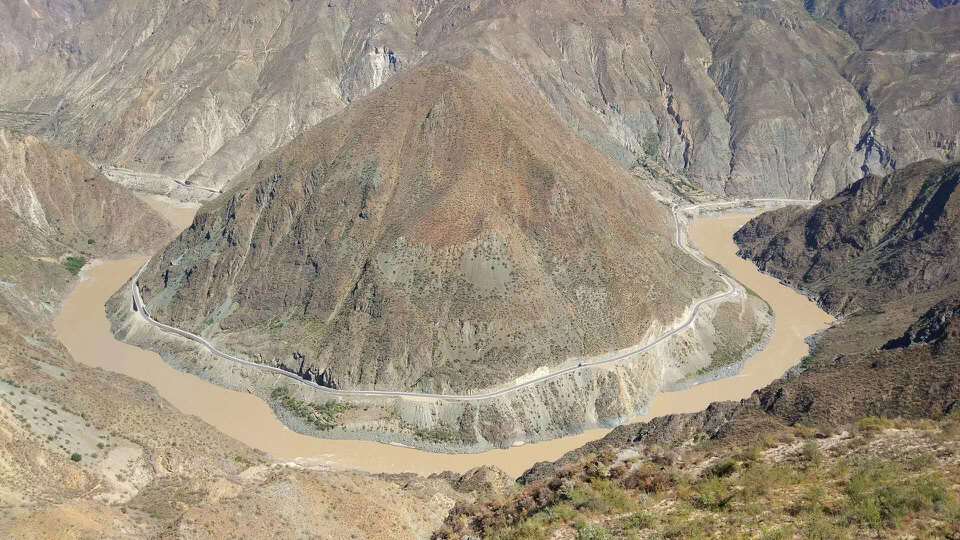
When the early morning wind carrying the scent of pine needles entered the tent, I was rubbing my eyes while clutching the anti-slip gloves Uncle Ciren gave me. He stood outside the tent and laughed: “The canyon chains are cold; these gloves are worn soft and won’t hurt your hands.” The gloves were Tibetan-style, with a piece of deerskin sewn at the knuckles, carrying his scent of yak butter. As I put them on, my fingertips brushed the calluses on his palms—worn down by years of trekking.
At 7:05 AM, we set off stepping on the morning dew. The dirt at the canyon entrance was still damp, soft underfoot like stepping on cotton. Uncle Ciren walked ahead, the hem of his robe brushing wild chrysanthemums, leaving yellow petals on his pants. “We’re reaching the chains ahead,” he suddenly stopped, pointing to the cliff face, “Don’t be afraid, the villagers pooled money to replace the chains last year; they can hold two hundred pounds.”
Turning a corner, the sound of a Lancang River tributary hit us first. The water was emerald green, plunging from a 30-meter-high cliff into a stone pool. The splashed water shattered into silver stars, cold enough to make my hand tremble. Uncle Ciren knelt and filled half a mineral water bottle: “Taste it, it’s sweet.” I took a sip; it indeed had the crisp sweetness of vegetation, not as harsh as the snow water in Yubeng. He pulled an aluminum lunch box from his chest, containing leftover tsampa and milk dregs from last night: “Eat a few bites; you’ll need strength for the chains later.”
The chains hung on the mountain wall, rusty but solid to the grip. I gripped the gloves tight, my knuckles turning white, hearing the “honglonglong” roar of the river below like someone beating a giant drum. Wind blew from deep in the canyon, making the Tibetan robes flap loudly. I tucked my neck in but didn’t dare let go of the chain—in the abyss below, the Lancang River churned with white waves like a struggling green fish. Uncle Ciren shouted ahead: “Step firmly on the chain links! A girl slipped last week, luckily she had a safety rope around her waist.” I stared at the links under my feet, moving step by step. Half an hour later, sweat had soaked my inner layers.
After another two hours of walking, the road suddenly widened a bit. The sound of fine waterfalls drifted down from above. Looking up, several silver falls hung from the top of the canyon; the water hitting the rocks created a mist that dampened my eyelashes. Uncle Ciren laughed: “Almost there, the exit is ahead.” After another half hour, I finally saw the exit of Ninong Canyon—the prayer flags by the road floated like colored clouds. A few Tibetans sat on stones smoking, and seeing us, they waved and smiled: “Hard work! Zhaxi is waiting at the road!”
Zhaxi’s Land Cruiser was parked by the road. He jumped out, his hair messy from the wind, holding a bottle of iced mineral water: “You finally came out! I checked my phone every hour fearing you’d be trapped!” The water made a “zhi” sound when opened, so cold I licked my lips; drinking it felt refreshing from my throat to my stomach. He threw my hiking pack into the back seat and stuffed a bag of fried highland barley into my hand: “Eat this on the road to line your stomach.”
The drive to Deqin County was one hour. Zhaxi played Tibetan songs with lyrics about “Meili” and “Snow Mountain,” the melody like wind through prayer flags. The wind in the county changed, losing the dampness of the canyon and gaining the dryness of the plateau, blowing on my face like a cotton quilt dried by my grandmother. Reaching “Meili Shanju,” a young man in a Tibetan robe took my bag, his mouth curving like a crescent moon: “The room is on the 3rd floor, you can see the snow mountain.” The room was small but clean, the window facing Kawagarbo Peak directly—the sunset dyed the snowy top orange-red like honey. I leaned on the windowsill and watched for ten minutes, not even hearing Zhaxi calling me for dinner.
At 6:30 PM, the scent of Tibetan incense from the restaurant arrived first. The owner brought Deqin Lamb: stewed in a copper pot, the broth milky white with wolfberries and dried hawthorn. The lamb was stewed extremely soft, breaking with a touch of chopsticks. One bite, and the meat fragrance wrapped in broth surged out; there was no gaminess, only a faint scent of grass—like the beef stewed at home as a child. Served with highland barley pancakes, crispy outside and soft inside, dipped in the lamb soup, I even forgot to eat my rice. The owner brought highland barley wine in a coarse ceramic cup, the liquid clear: “Home-brewed, plateau barley, no alcohol added, drink with peace of mind.” I took a sip; it was sweet like grape juice. The owner sat across from me, telling his story in broken Mandarin: “I used to graze yaks in Yubeng, following the herds over mountains. Later I wanted more people to know the beauty of Yubeng, so I came to open a guesthouse.”
At night, lying in bed, I heard the wind outside and distant dog barks. I touched the fried barley in my pocket, thinking of the chains in the canyon, the green of the Lancang River, and Zhaxi’s iced water. All the exhaustion dissipated, leaving only softness in my heart, warming me just like the Deqin lamb. Tomorrow I’m going to Yanjing to see the salt pans; the owner said “The salt pans are made of wood and mud, and the sun-dried salt has a scent of earth.” I hugged my quilt and smiled, drifting off—my dreams were filled with the canyon wind and the orange-red of the snow mountain.
Day 7: Deqin → Yanjing Ancient Salt Fields → Hongla Mountain Yunnan Snub-nosed Monkey Observation Station
At 8:30 AM, Zhaxi’s Land Cruiser rolled over the blue stone road of Deqin County. My aluminum thermal cup and a bag of milk dregs cakes sat on the passenger seat—he specifically packed them last night: “There isn’t much decent food in Yanjing, line your stomach before exploring.” The car headed southeast along G214. Outside the window, the mountains slowly receded from the snow line to dry-hot valleys. The thorns of cacti shimmered in the sun. Zhaxi steered with one hand and pointed to the Lancang River: “See? Yanjing is right on the canyon walls. Tibetans have been drying salt here for centuries, living off this river water.”
Three hours later, the car stopped at the Yanjing Ancient Salt Fields sign. Zhaxi bought the 100-yuan ticket for me; he said “This money goes to the village salt field maintenance fund, consider it supporting the old craft.” Stepping over the threshold, layers upon layers of salt fields hit my eyes first—trapezoidal platforms built with thick wooden frames, covered with a layer of dark brown soil, with semi-dry salt crystals embedded in the mud like someone had scattered crushed silver. A Tibetan Ajia in a robe and a salt-stained blue apron was turning the soil with a wooden shovel. Her palms were wrapped in old tape, her knuckles as thick as old tree roots. The shovel made a “shasha” sound against the soil, and salt grains fell. “Ajia, how is this salt made?” I approached. She looked up and laughed, her missing front tooth letting the wind through: “Water from the Lancang River is brought up, poured on the soil and dried for three days; when dry it becomes coarse salt. Dry it for another week and it becomes ‘old salt’—best for pickling, it won’t mold for a year.” She handed me a piece of salt, irregular in shape and stained with fine soil. I put it in my mouth—salty enough to make me squint, but with an earthy fishy sweetness, like the “soil salt” my grandmother used for pickling radishes.
At noon, I ate Yanjing Local Chicken at a small restaurant by the salt fields. The owner brought a clay pot with milky white broth and a few dried peppercorns. The chicken was stewed soft, even the breast meat melted away. I took a sip of the soup—it was so fresh my tongue tingled. The owner scratched his head and laughed: “The chicken is fed with salt field water; they’re used to the river water, so the meat is very fragrant.” Paired with the pickled radishes made by the owner’s wife—salty with a bit of sweetness—I finished the entire bowl of rice.
At 1:30 PM, Zhaxi drove toward Hongla Mountain. The road moved from the dry-hot valley into coniferous forests. The wind carried the bitter scent of pine needles. Zhaxi played Tibetan songs about “Meili” and “monkeys.” An hour later at the observation station, a sign read “No feeding, keep quiet.” A staff member in a hardshell jacket handed me high-powered binoculars: “The monkeys are in the eastern trees, don’t be loud, they are shy.” I knelt on a stone under a tree, lifting the binoculars—golden-brown figures suddenly darted between branches! A mother monkey held a baby, her tail curled around a branch. The baby peeked out with round eyes like two black grapes. Soon, a male monkey jumped onto a rock, its fur shimmering golden in the sun. It picked up a wild fruit, took a bite, and looked up at me as if saying hello. The staff member whispered: “There are more than three hundred monkeys in this troop. They come to forage every morning; you’re lucky to catch them while they’re active.” I knelt for half an hour until my neck was sore, but I didn’t want to leave—wild monkeys aren’t like the dull ones in zoos; they jump, call, and groom each other, their eyes full of a wild spirit like untamed wind.
In the evening back in Deqin County, Zhaxi took me to eat a Salt Field Pickled Vegetable Feast. The owner of the small restaurant brought a plate of pickled radishes and pickled cucumbers, all made with Yanjing old salt. Biting into a radish, the crisp saltiness had a hint of sweetness, ten times better than the oversalty pickles from supermarkets. I felt the salt chunk in my pocket—given by the Ajia in a small sewn cloth bag. I plan to take it back to the city and put a bit in my instant noodles next time to taste the Lancang River.
Lying in bed at night, the wind carrying the scent of pine needles blew in. I thought of the Ajia’s rough hands in the salt fields, the golden-brown figures of the monkeys, and the salty scent of the old salt—travel isn’t about taking photos; it’s about meeting people who live their days like old salt and monkeys who carve freedom into their bones. Tomorrow I’ll explore Deqin’s old street; Zhaxi said “There’s an old silversmith who makes Tibetan-style silver jewelry carved with the Six-Syllable Mantra.” I hugged my quilt and smiled, drifting off—my dreams were filled with the white of the salt fields and the golden-brown of the monkeys.
Today’s Tested Useful Details:
- Choose old salt that has been dried for a week; it’s more fragrant for pickling than regular salt and lasts longer.
- Be quiet when watching monkeys at Hongla Mountain; don’t use camera flash, as it scares them.
- At the restaurants by the salt fields, Yanjing Local Chicken is a must-order; the soup is fresh enough to drink three bowls.
- You can ask Ajia for a piece of salt to take away; keep it in a small cloth bag. Don’t mind the dirt; that’s the taste of an old craft.
Day 8: Deqin → Foshan Township → Jiaying Village (Meili North Slope Entrance)
At 7:40 AM, Zhaxi’s Land Cruiser parked below Meili Shanju. My hiking pack, the folding trekking pole from Uncle Ciren, and the thermal flask of sweet tea from Zhaxi were piled in the back—”Drink it on the road; Jiaying Village has no supply points. This flask will last until noon.” When the lid was opened, the milky aroma mixed with tea scent drifted out. I remembered the ginger tea I drank in Yubeng the day before yesterday—all brewed by Tibetans, warming and solid.
The car headed toward Foshan Township along G214. The road changed from asphalt to gravel, making my bottom numb from the bouncing. Zhaxi steered and laughed: “This road was only paved last year; before it took three days by horse to reach Jiaying.” Outside the window, tributaries of the Lancang River emerged from the dry-hot valley. The water was light green, like sun-bleached emerald. Purple gentian flowers were scattered on the meadows with dew condensed on the petals. I rolled down the window, and the wind carried the flower scent in, making even Zhaxi’s Tibetan songs sound soft.
After 3 hours and 40 minutes, the car turned onto the dirt road of Foshan Township. Zhaxi stopped: “Jiaying Village is ahead, 20 more minutes.” The mountains on both sides suddenly grew steep, and highland willows emerged from rock crevices, their branches hanging over the road as if greeting us. After driving a bit more, the Jiaying Village wooden sign stood at the road entrance—”Meili North Slope Entrance” written in red paint, with a string of prayer flags hanging nearby, fluttering “huala” in the wind.
Jiaying Village Accommodation Experience:
- Luosang’s guesthouse is built of stone, the stone slab roof heated by the sun
- The room has Tibetan carpets and a faded Thangka on the wall
- In the morning, you can hear distant yaks calling, as if saying hello to you
The houses in Jiaying Village are all built of stone, with roofs covered in dark gray stone slabs and prayer flags hanging under the eaves like colored hats for the houses. The guesthouse owner was a young man in a Tibetan robe named Luosang. Seeing us, he came to welcome us, clutching a copper butter tea pot: “You finally arrived! Come in and drink butter tea; I’ve been brewing it for half an hour.” The tea entered my mouth, so fragrant my tongue almost melted—the proportion of butter was just right, neither greasy nor bland. Paired with the roasted potatoes he handed over—crispy skin and soft inside, sprinkled with a bit of salt and butter—it warmed my stomach until it trembled.
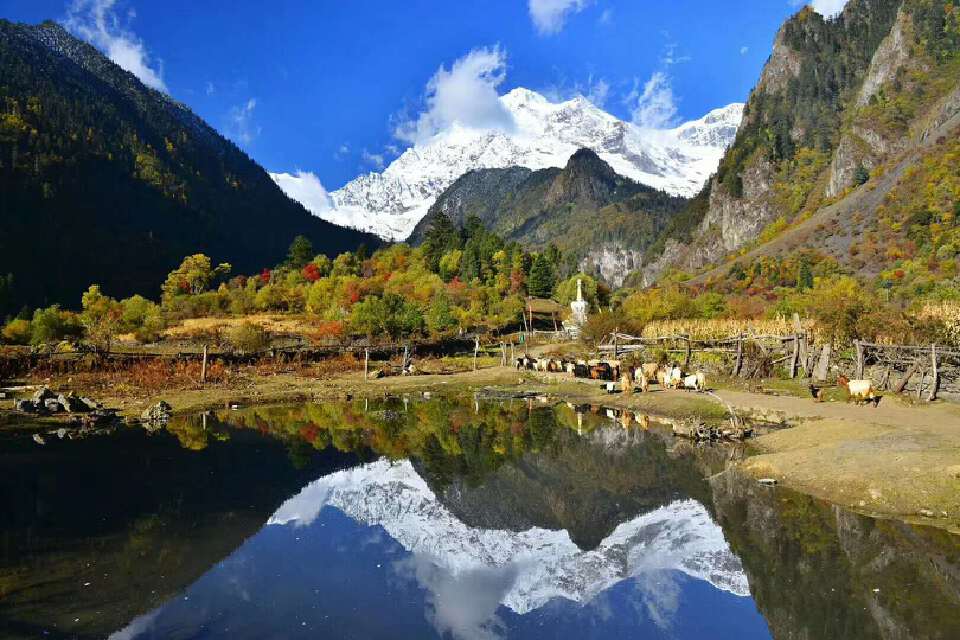
At 2:00 PM, Luosang took us to the Meili North Slope Viewing Platform. The path was an uphill meadow, soft to step on, the wind carrying the soapberry scent of prayer flags. After thirty minutes of climbing, we reached the platform—the snow mountain peaks were right before our eyes. Kawagarbo Peak’s snowy top shimmered, and the nearby “Prince Thirteen Peaks” were like guards in formation, some wearing snow caps, others showing brown rock. The wind was strong enough to blow a person away. I gripped the fleece scarf Luosang gave me and wrapped it tight around my neck, but I didn’t want to move—this was my first time seeing the Meili North Slope so close. It was wilder and more primitive than the snow mountains in Yubeng, like an untouched piece of jade. Luosang pointed to a distant peak: “That one is ‘General Peak’; Tibetans say it’s the protector, guarding the grasslands of Meili North Slope.”
Lying on the stone slab bed of the guesthouse at night, I heard the wind outside and the distant calling of yaks. I felt the roasted potato crumbs in my pocket, thinking of Luosang’s butter tea, Zhaxi’s sweet tea, and the gentian flowers on the road. Life in Jiaying Village is very slow—slow enough to hear the wind through the prayer flags, slow enough to see the textures of the snow mountain, and my breathing slowed down along with it.
Jiaying Village Tip:
“Jiaying Village only has about a dozen households, all Tibetans. Their life is very simple—grazing yaks, trekking, and drinking butter tea. There are no shops in the village; you have to go to Foshan Township to buy things, so it’s recommended to bring more snacks.”
Day 9: Jiaying Village → Sacred Lake → Return to Deqin
At 6:50 AM, Luosang’s knock on the door came with the aroma of butter pancakes. He held a galvanized water bag: “Fill it up; the Sacred Lake has no supplies. This bag will last the whole trip.” He also stuffed a handful of five-colored prayer flags into my hand: “Find a clean spot at the Sacred Lake to hang them, add some blessings.” The water bag was heavy. I gripped the opening and could smell the crispness of the water inside.
At 7:00 AM sharp, we left the village. The road was a packed meadow path, feeling solid underfoot with occasional small stones. The wind had a fishy sweetness of green grass. From the distance came the roar of the Lancang River, like someone beating a giant drum. After two hours of walking, mani piles became more frequent—stones carved with blurred scriptures, topped with red and yellow prayer flags. Luosang stopped and picked up a flat stone: “You place one; every mani pile is a Tibetan’s wish.” The stone hit the pile with a “dong” sound, like a quiet greeting.
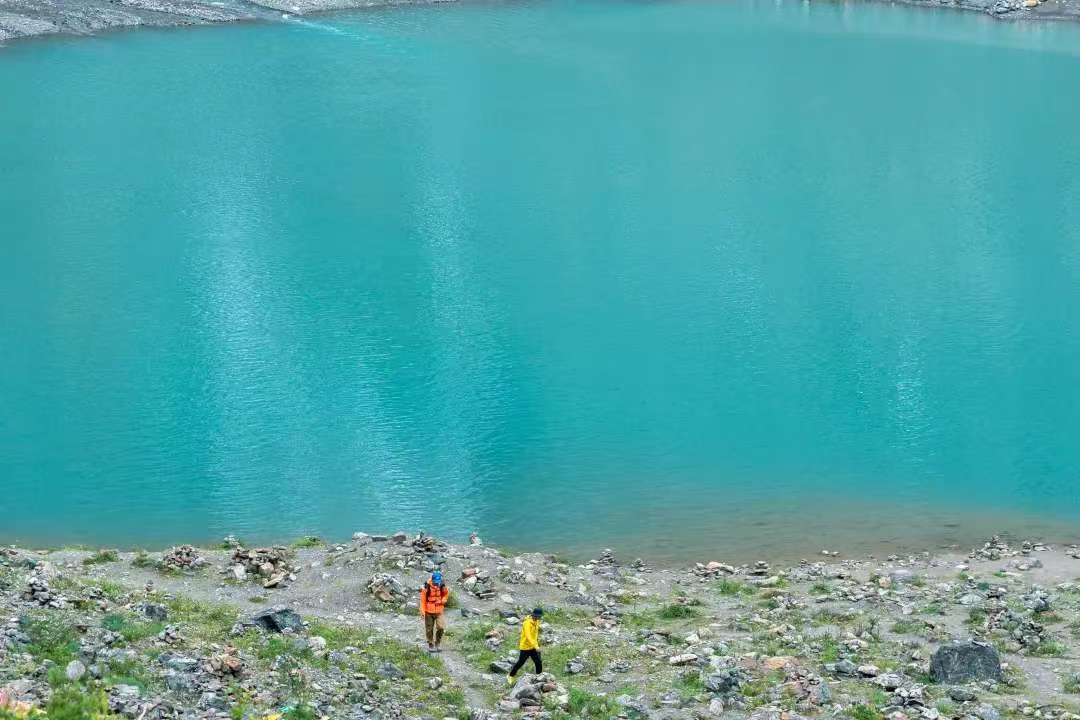
After another half hour, the sound of the Sacred Lake arrived first—”dingdong-dingdong,” like spring water flowing over rocks. Looking up, the Sacred Lake was hidden between two mountains. The lake water was deep blue, like a polished sapphire reflecting the snowy top of Kawagarbo Peak. The lakeshore was covered with alpine meadows blooming with small white flowers, waving in the wind. I knelt by the lake and touched the water—it was piercingly cold but so clear I could see the stones at the bottom. Luosang sat nearby and pulled out the thermal flask of sweet tea: “Drink something hot; the wind is strong, don’t freeze.” The sweet tea warmed my palms until they tingled. Looking at the sky, even the clouds seemed soft.
Sacred Lake Impressions:
The Sacred Lake was quieter and more divine than I imagined. The blue water seemed capable of absorbing all distractions. The snow mountain’s reflection in the water made it hard to tell which was real. The wind skidded across the lake surface, creating ripples like someone gently stroking a mirror. I sat on a rock by the lake, closed my eyes, and heard the wind, the water, and my own heartbeat—at that moment, all troubles were washed away, leaving only inner peace.
At 2:00 PM, we began the trek back. My legs were soft, but not from fatigue—it was the satisfaction of “having walked enough.” Luosang pulled out wild strawberries from his bag, bright red and translucent, and gave me a handful: “Just picked, very sweet.” The juice splashed on my hands, sweet and sour like the orange candy from my childhood. Back at Jiaying Village, Luosang brought Tibetan earth hotpot: yak meat, radishes, and potatoes stewed in a copper pot with bone broth and a few peppercorns. The beef was stewed extremely soft. One bite, and the meat fragrance wrapped in broth surged out; the radish was sweet. Luosang sat across from me, telling me in broken Mandarin: “The Sacred Lake is the tear of Meili; it can wash away troubles. You are lucky today; the lake water was especially blue.”
In the evening back in Deqin County, Zhaxi was waiting for us at the road entrance. He jumped down, holding a bottle of iced mineral water: “You finally returned! I feared you two were stuck in the mountains and checked my phone every hour!” The water made a “zhi” sound when opened, so cold I licked my lips; drinking it felt refreshing from my throat to my stomach. Zhaxi took me to eat one last meal of Deqin lamb. The milky white broth and soft lamb made my tongue tingle as if I wanted to swallow the entire taste of Meili.
Day 10: Deqin → Return Journey
At 8:00 AM, I explored Deqin Old Street with my hiking pack. The stone path was polished smooth. On both sides were Tibetan shops hanging incense, silver jewelry, and Pulu (Tibetan wool fabric). I walked into an old silversmith shop. The owner was an old Tibetan man in reading glasses sitting at the door hammering silver. Seeing me, he held up a silver Six-Syllable Mantra pendant: “Carved for three days, it says ‘Om Mani Padme Hum’, it can keep you safe.” The pendant was pure silver with deep carvings, carrying the warmth of his body. I bought it for 80 yuan—half the price of scenic areas and with a story.
The owner also handed over Tibetan incense: “Try this, made of cedar and saffron. Take a box when trekking; it repels mosquitoes and helps you sleep soundly.” I pinched the incense, smelling the faint bitter scent like the pine needles of Meili.
At noon, I had one last Tibetan meal on the old street: Yak Meat Covered with Quilt, butter tea, and highland barley pancakes. The owner’s wife brought pickled radishes made with Yanjing old salt, the crisp saltiness having a hint of sweetness. Eating the radishes, I thought of the Ajia in Yanjing, her wooden shovel, and the salt chunk she handed me.
Pre-departure Shopping List:
- Tibetan Incense: Made of cedar and saffron, 15 yuan a box, can repel mosquitoes
- Silver Jewelry: Handcrafted by old silversmiths, affordable and meaningful
- Yanjing Old Salt: You can bring some home; it’s great for instant noodles or pickling
- Yak Jerky: Choose freshly made ones; don’t buy those with too pretty packaging, as they might not be authentic
At 2:00 PM, Zhaxi drove me to Shangri-La Airport. The car followed G214 back. Outside the window, the mountains slowly changed from dry-hot valleys back to snow mountains, and the roar of the Lancang River grew more distant. Zhaxi played Tibetan songs with lyrics about “Meili” and “Snow Mountain,” the melody like wind through prayer flags. I touched the silver pendant, incense, and salt chunk in my pocket, thinking of these ten days—the starry sky of Yubeng, the rainbow at the Sacred Waterfall, the old salt of Yanjing, the monkeys of Hongla Mountain, the snow mountains of Meili North Slope… all the images flashed through my mind like a movie, and I almost cried.
At the airport, Zhaxi helped me with my luggage: “Come again next time, I’ll take you to see the Meili golden sunrise; it’s more beautiful than in photos.” I nodded and watched his car disappear, then walked into the airport. The boarding announcement came over the speakers. I touched the incense in my pocket, thinking of the wind of Meili, the blue of the snow mountain, and the smiles of the Tibetans—these ten days weren’t a trip; it was coming home, back to the home of nature, back to the home of the Tibetans.
As the plane took off, I looked at the clouds outside the window, thinking of Luosang saying “the Sacred Lake is the tear of Meili” and Uncle Ciren saying “trekking is chatting with nature.” I realized that the most precious scenery isn’t the snow mountain in photos; it’s the people who live their days like old salt, the monkeys who carve freedom into their bones, and the people willing to wait for you, hand you sweet tea, and roast potatoes for you.
Would you like me to create a packing list or a budget breakdown based on this 10-day itinerary?“`
Related Guides
- 9-Day Self-Drive on the Yunnan-Tibet Highway: Kunming → Dali → Lijiang → Shangri-La → Deqin → Markam, Snow Mountains & Tibetan Culture
- Yunnan Travel Anti-Scam Guide: 3 Places to Avoid! 3 Must-Eat Food List, with Route Pitfall Tips
- Yunnan High Altitude Sickness Prevention Guide: Shangri-La / Yubeng / Jade Dragon Snow Mountain, Route Planning + Medicine Preparation + Precautions
- Yunnan Photo Outfit Guide: Dali Bai Style × Lugu Lake Forest Aesthetic × Yubeng Hiking Gear, What to Wear for Different Scenes
- Yunnan Homestay Selection Guide: High-Value Accommodation Recommendations for Dali Erhai Lakefront, Lijiang Old Town, and Lugu Lake View Rooms
Shangri-La — — Practical Data
Tickets & Booking
- Tiger Leaping Gorge (Shangri-La section, Upper Tiger Leaping): Adult CNY 45; ticket + round-trip sightseeing escalator (Pingbu Qingyun escalator) CNY 125[src]
Where to Stay · Room Type · Nearby
- Inside Dukezong Ancient Town | Room tip: Convenient for getting around, but vehicles cannot enter, so confirm with the guesthouse whether they carry luggage | Nearby add-ons: Great Buddha Temple, prayer wheel, Guishan Park, Moonlight Square[src]
- Along Napahai | Room tip: Good views and quiet, but far from the city | Nearby add-ons: Napahai Yila Grassland, Shika Snow Mountain[src]
Typical Climate & Packing (Past Years)
- January: -7 °C–9 °C °C, [Travel climate reference]
- February: -5 °C–11 °C °C
- March: -2 °C–14 °C °C
- April: 2 °C–17 °C °C
- May: 5 °C–19 °C °C, The meadow turns green again
- June: 8 °C–20 °C °C






