



Day 1: Hengfu Historical Area (Former French Concession) Autumn Leaves Stroll
10:00 AM to 11:30 AM: Professional Angles and Crowd-Avoiding Tips at Wukang Mansion
Many friends rush straight to the front of Wukang Mansion as soon as they exit Jiaotong University Metro Station (Line 10/11), resulting in photos filled with crowds crossing the street. I prefer arriving around 10:00 AM, when the sunlight hits the red bricks of the building from a perfect diagonal angle, creating beautiful shadow layers.
- Best Shooting Spot Advice: Don’t get stuck at the intersection of Tianping Road and Middle Huaihai Road. I recommend walking to the sidewalk on the side of the Former Residence of Soong Ching Ling, using the fallen plane tree leaves on both sides of the walkway as a foreground.
- Shooting Details: Try crouching down and using a wide-angle lens close to the fallen leaves on the ground, pointing diagonally toward the mansion. This creates a sense of depth as if “autumn colors are enveloping the old architecture.”
- Note: Although the famous Instagrammable cafe at the corner of Wukang Mansion is popular, it usually has long queues at this time. There’s no need to waste time waiting for a seat.
My Personal Experience in Avoiding Pitfalls
I once took a friend and waited through 30 minutes of traffic lights just to get a “clean” shot of the building. Later, I realized that if you just tilt the lens up slightly or use a passing vintage bus as a screen, the texture of the image improves instantly. Don’t always focus on empty shots; the sense of flow with Shanghai elements feels more authentic.
11:30 AM to 2:00 PM: Retreat from the Crowded Wukang Road, Dive into West Fuxing Road
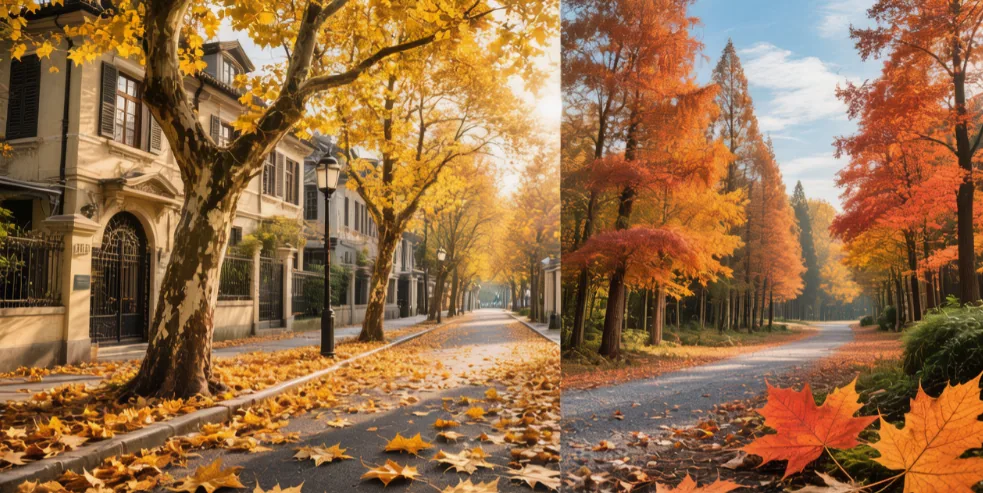
The middle section of Wukang Road is very densely populated. Usually, after seeing the mansion, I quickly turn left into West Fuxing Road or Hunan Road. These two roads are the essence of Shanghai’s autumn, with wider streets and fewer vehicles.
- Leaf Landscape: The plane trees on West Fuxing Road are quite old, and the leaves show a deep caramel color. There is no noisy commercial shouting here, and you can hear the “crunch, crunch” sound of feet treading on dry leaves.
- Architectural Observation: Keep an eye on the old villas along the street; many courtyard walls will have ginkgo trees peeking out. The interweaving of golden and caramel colors is the specific color logic of this area.
- Walking Pace: It is suggested to maintain a speed of 2 kilometers per hour. This place is suitable for reading architectural plaques while watching elderly residents sunbathing by the road.
| Road Name | Landscape Features | Tourist Density | Shooting Advice |
|---|---|---|---|
| Wukang Road | Dense European architecture, many popular shops | Extremely High | Suitable for street fashion snapshots, not for wide scenes. |
| West Fuxing Road | Courtyard-style villas, thick layers of fallen leaves | Medium | Suitable for low-angle shots of street extension. |
| Hunan Road | Many bends, strong sense of tranquility | Low | Suitable for portraits with very clean backgrounds. |
2:00 PM to 4:00 PM: Cultural Observation on Anfu Road and Crowd-Free Lunch on Wuyuan Road
Around 2:00 PM, sunlight filters through the dense plane tree leaves, casting mottled shadows. Anfu Road becomes very lively at this time. If you want to see Shanghai’s most fashionable people and interesting pets, sitting here for half an hour is enough.
- Middle Urumqi Road: This place is full of Western-style casual dining and imported supermarkets, brimming with local life. I like to buy a cup of pour-over coffee here and walk while looking at the fruit stalls and flower shops; the combination of chic and local charm is fascinating.
- Anfu Road Street Photography: If you like street photography, you can wait near The Beast or HARMAY. Shanghai’s youth dress with great layers in autumn, making them excellent models.
- Dining Notes (Avoiding Overrated Spots): Restaurants on the main streets of Wukang Road and Anfu Road have high markups. I strongly recommend going to the adjacent Wuyuan Road. There are several long-standing Bistros or Italian restaurants there.
My Dining Recommendation
I frequently visit a small shop on Wuyuan Road that has been open for nearly five years. Their lunch sets are very cost-effective, and you don’t have to take a number and wait for one or two hours. In autumn, sitting at the counter along the street, eating a steaming plate of truffle pasta while watching plane tree leaves fall outside, is a much more comfortable experience than posing in a popular Instagrammable shop.
Travel Suggestions and Pitfall Warnings for This Day
- Regarding Transportation: The roads in this area are very narrow, so do not take a taxi or drive. Shanghai’s one-way streets will make you doubt your life while sitting in a car. Using shared bikes or walking the whole way is the wisest choice.
- Regarding Clothing: Shanghai’s autumn is warm in the sun but can be very cool in the shadows of old villas (alleyway winds). It is suggested to wear a trench coat or a thin wool coat, and choose earth tones for colors to best match the environment.
- Regarding Expenses: There are basically no ticket costs for this day. The main expenses are on coffee and lunch, and you can have a high-quality experience for 150-300 Yuan per person.
- Pitfall Guide: If you see a queue of more than 20 people at a cafe, please move on. There is definitely a better, quieter alternative within 200 meters.
Day 2: Gongqing Forest Park Nature and Ecology Photography
First Hour in the Park: Capturing Tyndall Light in the East China Plant Zone
From 8:00 AM park opening to around 9:30 AM is the most dreamy time for light and shadow. I suggest skipping the large lawn and heading straight for the East China Plant Zone. The Dawn Redwood forest here is very dense and near water.
- Morning Mist Viewpoint: In the autumn mornings, there is often a thin mist on the water. When the sun rises and the light penetrates the leaves at an angle, it creates what is known in photography as the “Tyndall Effect.” I’ve found the best angle is standing on the wooden plank path and shooting into the woods in the direction of the light, which clearly shows the linear sense of light and shadow.
- Lens Selection: If you have a telephoto lens, try capturing the repetitive lines of the tree trunks; if you only have a phone, it is recommended to use Portrait Mode to blur the distant trees, making the image more layered.
- Clothing Advice: The temperature in the woods is 3-5 degrees lower than the city center, and there will be dew on the grass in the morning. I suggest wearing dark-colored non-slip outdoor shoes, and clothes in beige, earth tones, or navy blue, which harmonize perfectly with the redwood background.
My Field Experience Sharing:
Many photographers gather to shoot those one or two iconic trees. I suggest you walk deeper into the forest; the further you go, the thicker the fallen leaves on the ground. I once tried crouching on an unnamed path deep in the woods, waiting for the sunlight to hit a single dry leaf through the gaps. That sense of tranquility is stronger than any popular Instagrammable spot.
Approaching Noon: Mirror Photography Tips by Ying Lake
Between 9:30 AM and 11:00 AM, the sun rises higher, and reflections on the water become clear. Ying Lake is the heart of the park, with scenic spots all around the lake.
- Finding the Perfect Reflection: By Ying Lake in autumn, the weeping willows are still green, but the redwood trees behind them have turned completely red. I recommend going to the South Bank and using the calm water surface for symmetrical composition.
- Avoiding Crowds: Tourists start to increase at this time. My technique is low-angle shooting, letting the reeds or changing leaves by the water block the benches and passersby on the opposite bank.
- Light Utilization: The light is quite harsh now, so wide scenes are not recommended. You can try shooting details of fallen leaves on the water surface or the colored ripples of the redwoods in the water.
| Area Name | Landscape | Best Shooting Point |
|---|---|---|
| East China Plant Zone | Dense redwood, morning mist, light and shadow | Wooden plank path near the riverbank |
| Ying Lake Bank | Lake reflection, color gradient | South bank area near the stone bridge |
| Autumn Color Garden | Ginkgo forest, maple leaves | Sloped area in the center of the park |
Afternoon Period: Depth of Field Composition with the Vintage Mini-Train
From 11:00 AM to 12:30 PM, you can move to the Forest Mini-Train area. This is the place with the most storytelling potential in the park, but it also tests your photography skills.
- The Secret of the Curve: Don’t shoot next to a straight track; the image will look very stiff. I suggest waiting on the outer side of a track curve. When the green mini-train emerges from behind the red trees, the color contrast is very strong.
- Compressing Spatial Sense: If you have a 70-200mm lens, you must use it. Utilizing the compression of a telephoto lens can make sparse trees look very dense. Phone users should use 3x zoom and stand further back; the effect will be much better.
- Rest Suggestion: There is a snack area near the mini-train, but the taste is mediocre. I personally prefer bringing my own sandwiches and energy bars to eat on a nearby bench, saving more time for photography.
Practical Transport Details:
Gongqing Forest Park is indeed quite far. I suggest taking Metro Line 8 to Shiguang Road Station. After exiting, don’t wait for a bus; take a taxi to the South Gate (about 10 minutes). Try not to drive, especially on weekends. I’ve seen many people arrive at the park gate at 10:00 AM and spend an hour finding a parking spot, only to park two or three kilometers away. By the time they walk over, they’ve missed the best light.
Expenses and Pitfall Warnings
- Ticket Costs: The park is currently open to the public for free, but you need to book in advance on the “Shanghai Gongqing Forest Park” WeChat account.
- In-Park Expenses: A one-way ticket for the mini-train is about 20 Yuan; if you want to take photos, it’s worth experiencing once.
- Pitfall 1: Avoid the amusement park area in the park. It is noisy year-round with cluttered backgrounds, making it impossible to capture a “forest vibe.”
- Pitfall 2: Do not try to call a ride-hailing car to leave on a weekend at noon. Many people leave at that time, and the queue could exceed 40 minutes. It is suggested to walk out a bit further to a slightly more open intersection before calling a car.
- Recommendation: After entering the South Gate, walk to the right. There is an area that isn’t very famous but has many ginkgo trees. If the East China Plant Zone is too crowded, this is an excellent alternative.
Day 3: Along the Suzhou Creek and Waitanyuan Architectural Landscapes
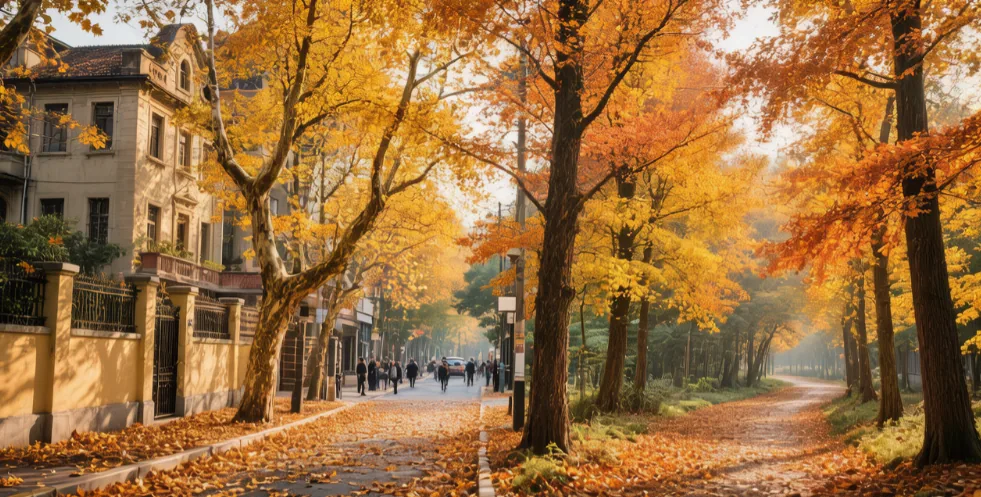
Yuanmingyuan Road: The Golden Combination of Red Brick Buildings and Ginkgo
From 2:00 PM to about 3:30 PM, I suggest going first to Yuanmingyuan Road in ROCKBUND. This road is one of the most concentrated areas of existing historical buildings in Shanghai, with a vintage paved street surface and century-old red brick buildings on both sides.
- Light and Shadow Details: In autumn at 2:00 PM, the light just leaks through the gaps between buildings, hitting the ginkgo trees on both sides. I’ve found the ginkgo here shows a gradient from green to yellow due to uneven light. Don’t just shoot the whole street; try getting closer to the buildings and use the red brick walls as a background to capture one or two hanging yellow branches. This clash of warm and cool colors looks very high-end.
- Crowd-Avoiding Techniques: Although Yuanmingyuan Road is a pedestrian street, there are many people doing wedding and street photography in the afternoon. My experience is to walk toward the entrances of the Hamilton House or the True Light Building, using these heavy doorways as frames to enclose the distant ginkgo and pedestrian silhouettes; the image will instantly become quiet.
- Cultural Experience: The cultural atmosphere here is very thick. You can notice the benches by the road, where you can often see students sketching or office workers drinking coffee. I suggest maintaining a “snapshot” mindset here; don’t pose deliberately, as this flowing city life is the soul of Waitanyuan.
My Personal Photography Advice
I once tried waiting at a corner of Yuanmingyuan Road for ten minutes just for a pedestrian in a dark trench coat to pass by. At that moment, the sun hit the pedestrian’s shoulder and the nearby ginkgo leaves perfectly. This combination of “architecture + plants + people” is much more engaging than just shooting scenery. Don’t be afraid of people in the frame; as long as they appear as part of the environment, they add a sense of story to the photo.
Suzhou Creek Promenade: Walking Through Flowing Autumn Colors
From 3:30 PM to 5:00 PM, it’s just a few minutes’ walk from Waitanyuan to the Suzhou Creek. Walking west along the southern promenade, you’ll find the pace here is much slower than the Bund.
- Route Choice: You must walk along the South Bank. The South Bank offers a more open view, allowing you to see iconic buildings on the North Bank like the Union Church and the Postal Museum in full. The water of the Suzhou Creek is deeper in color in autumn, and the greenery along the banks will have color changes of redwoods and willows, providing a strong sense of horizontal color extension.
- Fusion of Architecture and Nature: You will pass the former site of the Rowing Club, where there is a large open space. I like standing by the river railings, pointing the lens at the Postal Building clock tower on the opposite bank, and using the leaves by the river to frame the top of the image, creating a natural “frame.”
- Rest Suggestion: There are many built-in public benches along the Suzhou Creek. I suggest sitting for a while if you are tired. Watch the cleaning boats glide slowly by on the river and listen to the time-telling chimes from the clock tower across the river. In these moments, you will truly feel the elegant side of Shanghai in autumn.
| Location Name | Suggested Stay Time | Landscape | Practical Tips |
|---|---|---|---|
| Yuanmingyuan Road | 60 – 90 minutes | Historical red brick buildings, ginkgo avenue | Entirely walking; the ground is uneven, so flat shoes are recommended. |
| Rowing Club | 30 minutes | Suzhou Creek curve, Waibaidu Bridge panoramic view | It’s very windy here; remember to button up your coat. |
| Sichuan Road Bridge / Zhapu Road Bridge | 45 minutes | Lujiazui Big Three, Suzhou Creek sunset | The famous “pro” spot; it’s recommended to claim a spot early. |
Zhapu Road Bridge: Welcoming the “Golden Hour” in the Magic City
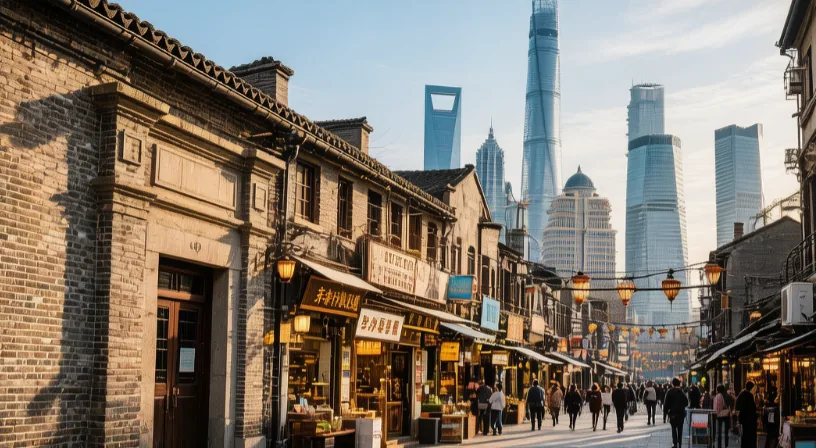
Around 5:00 PM, no matter where you are, please make sure to get to Zhapu Road Bridge. This bridge is called the “Pro Bridge” by many photographers because it’s the perfect spot to capture the Lujiazui Big Three and the Suzhou Creek in the same frame.
- Sunset Shooting Point: When the sun starts to set, the afterglow will dye the glass curtain walls of Lujiazui and the nearby Suzhou Creek water completely golden. At this time, you can see the steel structure of Waibaidu Bridge looking very textured in the golden light.
- Avoiding the Tripods: There are indeed many veteran photographers with tripods on the bridge. I suggest you don’t squeeze into the center; move a bit toward the south end of the bridge. From that angle, you can use the ginkgo tree shadows by the river as a foreground, avoiding messy tripods and getting a cleaner shot.
- Capturing Motion: In the autumn evening, traffic and pedestrian flow on the bridge will increase. If you have a tripod, try taking a long exposure to let the river water flow. The rising lights of Lujiazui combined with the crisp autumn air hit just right.
My Dining Record (Private Recommendation)
After shooting the sunset, don’t go to the popular shops near the Bund or East Nanjing Road. I usually walk a bit north to the vicinity of Huqiu Road or East Beijing Road to find those local Benbang restaurants converted from old villas. Although the decor is simple, a bowl of sizzling eel slices or Yan Du Xian (though most popular in spring, there are good versions in autumn) can instantly heal your fatigue from walking all day. It costs about 100 Yuan per person for a very solid meal.
Transportation and Pitfall Solutions
- Transportation Scheme: There is no need for a taxi here at all; even shared bikes are a bit redundant. Walking the whole way is best because the beauty is in those small alleys. You can take Metro Line 2 or 10 to East Nanjing Road Station and then walk over.
- Pitfall Guide: Although Waibaidu Bridge is famous, there are too many people taking photos, making it hard to get a clean background. I personally recommend using Waibaidu Bridge as a background rather than standing on it. Also, ignore street vendors who approach you offering to take photos.
- Regarding Expenses: All landscapes on this route are free. Apart from an afternoon coffee and dinner, you don’t need to pay for any tickets. If you want to save money, bring your own water; the public rest areas here are very well-equipped.
- People and Culture: You will meet many old Shanghainese people walking here. If you see an elderly person fishing by the river, try chatting with them; they might tell you which year the ginkgo turned yellow earliest. This authentic local perspective is very interesting.
Day 4: Central Urban Park Ginkgo Viewing
Jing’an Sculpture Park: Art and Golden Hues from 9:30 AM to 11:30 AM
I’ll start this day at Jing’an Sculpture Park. This is not just a green space but more like an outdoor art museum. The direct morning sun gives the ginkgo leaves the highest transparency, making it the best time to shoot the combination of architecture and nature.
- Shooting Spot: Go to the ginkgo grove opposite the main entrance of the Shanghai Natural History Museum. The ginkgo trees here are planted very densely, with the canopies almost merging into a golden cloud. I suggest using the museum’s famous “Cell Wall” as a background and shooting sideways; the texture of modern architecture and the natural golden yellow create a strong visual contrast.
- Interaction Between Sculptures and Plants: The park is scattered with many sculpture works by international artists. In autumn, I look for dark grey or cool-toned sculptures and use the falling yellow leaves as a foreground. If you’re lucky enough to arrive before the cleaners, the yellow leaves covering the sculpture bases create a great sense of tranquility.
- Crowd-Avoiding Tips: Because it’s near the museum, there are many parents with children. I suggest avoiding the central lawn and walking toward the edge along West Beijing Road. The forest paths there are narrower and can actually capture a deeper forest vibe.
While taking photos at Jing’an Sculpture Park, I noticed many friends like to stand under the trees and shoot upward. Actually, you can try crouching next to those stainless steel sculptures and use the mirror reflection to capture the tree shadows; the resulting photos will have more design sense than just plainly shooting leaves.
Yan-Zhong Green Space: High-Angle Overlook View from 12:00 PM to 2:30 PM
After leaving the sculpture park, walk a bit or take one metro stop to reach Yan-Zhong Green Space. This is a massive “urban lung” surrounded by the Yan’an Road elevated highway. Autumn here is not two-dimensional but three-dimensional.
- Exclusive View Advice: Don’t just walk on the ground. I strongly recommend walking up to the pedestrian bridge at East Yan’an Road / Chengdu Road. Looking down from above, you’ll find the color distribution here is stunning: deep red redwoods, golden ginkgo, and evergreen camphor trees interweaving like a palette.
- Water Feature Photography: There are man-made lakes and small waterfalls in the center of the green space. Due to the undulating terrain, autumn leaves falling on rocks and water create an illusion of a mountain valley. I like shooting the cascading water features here around 2:00 PM, as the light and shadow best highlight the stone texture.
- Rest Suggestion: There are many benches hidden in the thickets within the green space. Most of the noise is filtered out by the dense vegetation, making it an excellent physical recovery station mid-trip.
| Landscape Name | Suggested Shooting Time | Features | Recommended Shooting Spot |
|---|---|---|---|
| Jing’an Sculpture Park | 09:30 – 11:30 | Art sculptures + dense ginkgo | Museum glass curtain wall reflection spot |
| Yan-Zhong Green Space | 12:00 – 2:40 PM | Strong sense of layers, elevated bridge overlook | North Chengdu Road cross-line bridge |
| Huaihai Park | 3:00 PM – 4:30 PM | Tall old trees, thick local life atmosphere | Ginkgo avenue on the west side of the park |
Huaihai Park: Local Sunset Glow from 3:00 PM to 4:30 PM
For the final stop, I suggest Huaihai Park. It is hidden behind the Middle Huaihai Road commercial area, a typical place “hidden in the city.”
- Sense of Scale from Old Trees: The ginkgo trees here are very old with thick trunks. When the 3 or 4 PM sunset hit at an angle, the whole grove is dyed orange-yellow. I most enjoy shooting the thickness of fallen leaves on the ground here because it’s relatively quiet and the leaves are less crushed, retaining their complete fan shape.
- Observation of People and Culture: Unlike the tourist feel of the previous parks, Huaihai Park is filled more with neighbors from the area. You’ll see elderly gentlemen playing chess or practicing calligraphy here. I’ve found that capturing a photo of an old man reading a newspaper on a bench covered in ginkgo leaves best represents Shanghai’s elegant and calm pace of life.
- Ending the Trip: After shooting, Middle Huaihai Road is right outside the door. You can go to a nearby mall (like IAPM or K11) for a good meal or buy some Shanghai specialties as souvenirs; it’s very convenient.
I once met an “Old Clerk” (old Shanghai gentleman) here, walking under the ginkgo trees in a well-fitted trench coat. I realized that autumn in this land is beautiful not just for the leaves, but for this refined attitude toward life. If you can bring this human element into your shooting, the photos will feel very warm.
Near Jing’an Sculpture Park is Wujiang Road Pedestrian Street, which has many old-brand snacks. I suggest having lunch here, where you can eat well for 50-80 Yuan per person. If you reach Huaihai Park, you can queue at Guangmingcun for some fresh meat mooncakes, or go into the small nearby alleys.
Related Reading
- Shanghai 4-Day Essential Route | Lujiazui Financial Center + Xintiandi Shikumen + Tianzifang Cultural Creativity | A Journey of Ancient & Modern Intersection
- 3-Day Classic Shanghai Tour | The Bund Night View + Yuyuan Garden + Wukang Road Stroll | Complete Guide to First Impressions of the Magic City
- Shanghai Night Tour Essentials: 4 Hours | Huangpu River Cruise + Old Shanghai Style Street 1192 + Jing’an Temple Night View
- 3-Day Shanghai Food Tour | Michelin Restaurants + Time-Honored Local Cuisine + Nanxiang Xiaolongbao Flavor Map
- Shanghai 3-Day Romantic Route for Couples|Old Shanghai Vibe at Lane 1192 + Riverside Promenade Cycling + Jing’an Temple Art Night Tour






