



Day 1: Extreme Height Experience on the 118th Floor of Shanghai Tower
To avoid the metro congestion during the subsequent evening rush hour, I usually suggest arriving at Lujiazui Metro Station around 3:00 PM. Taking Exit 6 of Line 2 is the optimal choice; after exiting, there is no need to cross the street, and you can reach the office building entrance of Shanghai Tower in about ten minutes by walking along the pedestrian bridge. Before entering the sightseeing entrance on the B1 level, make sure to bring your original ID card. The real-name verification here is very strict, and electronic IDs can sometimes cause longer queues due to system delays.
The vertical transportation system of the entire building is a masterpiece of technology. After passing through security, I head straight for that famous ultra-high-speed elevator. The elevator can send people to a height of 546 meters in dozens of seconds, with a peak ascent speed reaching 18 meters per second. The physical feedback brought by this speed is intense; every time I take it, there is a noticeable pressure on my eardrums. To relieve this discomfort, I have found that continuous swallowing or chewing gum is much more effective than simply opening one’s mouth.
Personal Experience Sharing: Many people only think about looking at the skyscrapers outside after reaching the top, but the “Tuned Mass Damper” located on the 125th and 126th floors is more worth spending time researching. Although visiting the 126th floor usually requires purchasing a package ticket that includes this project, observing that massive 1000-ton mass block suspended by 12 steel cables, each 25 meters long, is the only way to truly understand how skyscrapers remain stable during typhoons.
| Segment Name | Suggested Stay Duration | Notes |
|---|---|---|
| B1 Exhibition Hall | 20 minutes | Learn about the construction history and structural technology of Shanghai Tower |
| 118th Floor Observatory | 60 to 90 minutes | The south side offers the best angle for photographing the World Financial Center and Jin Mao Tower |
| Tuned Mass Damper (Ticket Required) | 30 minutes | Observe the damper in operation and experience the combination of optics and acoustics |
| Air Post Office | 10 minutes | You can buy postcards with exclusive postmarks to mail out |
If you reach the 118th-floor observatory three-quarters of an hour later, you will just catch the turning point of the light. I prefer standing at the south window of the hall, where you can overlook the top of the “Bottle Opener” (World Financial Center) and the spire of the Jin Mao Tower. At this height, the once-prominent Lujiazui architectural complex looks like exquisite miniature models; this visual inversion of proportions is truly staggering.
Regarding photography details, I have a very practical suggestion: for safety reasons, the glass of the observatory uses a multi-layer structure, and the reflection of indoor lights on the glass can seriously interfere with photo effects. When shooting, please make sure to press your phone or camera lens tight against the glass surface, or use dark clothing to block the light sources around the lens. This will improve the clarity of the final shot by a significant margin.
- Crowd Avoidance Strategy: Tour groups usually pour in after 5:30 PM. To secure a prime spot by the window, I arrive half an hour to an hour early.
- Weather Prediction: Shanghai has high humidity. If the cloud base height is lower than 400 meters on that day, you will only see white mist after reaching the top. I check “cloud base height” data on weather websites in advance; as long as the value is greater than 600 meters, the landscape quality is guaranteed.
- Souvenir Selection: The derivative shop on the 118th floor has many scale models of the building. The prices are slightly higher than the lobby downstairs, but some limited-edition stamps can only be added on this floor.
As it approaches 6:00 PM, the landscape lights of Lujiazui turn on in stages, and the International Architecture Exhibition at The Bund transforms from daytime grey tones to golden yellow. This color contrast is the essence of the Shanghai high-altitude experience. After finishing the visit, I choose to leave from the B2 exit, which connects to the underground commercial area, making it convenient to find dinner spots or take Line 14 to leave, avoiding the terrifying rush hour crowds of Line 2.
The ticket cost for this trip is approximately 180 yuan, and it will be higher if it includes a package for the damper visit.
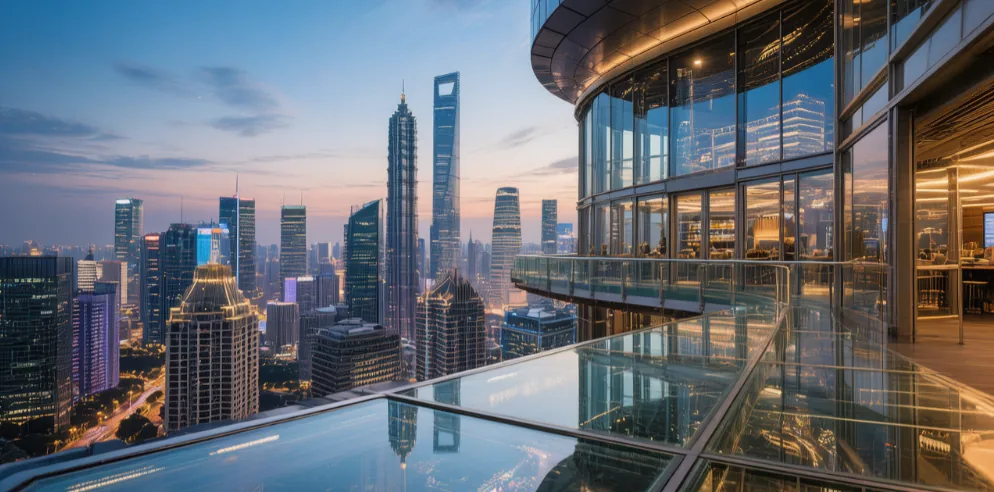
Day 2: Outdoor Challenge on the 88th Floor Skywalk of Jin Mao Tower
Around 10:00 AM, I avoid the white-collar rush hour crowd in the Lujiazui financial district and exit from Exit 5 of Metro Line 2. The entry for the Jin Mao Tower Skywalk experience is near Gate 4 of the office building, which is separate from the flow of simply buying tickets for the 88th-floor observatory. I recommend completing a real-name reservation online in advance and exchanging your ID for a wristband on-site, which can save a lot of time queuing at the manual counter.
| Segment | Specific Operational Details | Personal Practical Advice |
|---|---|---|
| Equipment Check | Must change into the official one-piece protective suit; the zipper must be fully closed. | Try not to wear thick hoodies, or the protective suit will look very bulky. |
| Safety Reinforcement | Long hair must be tied up, and glasses must be secured with a specialized reinforcement rope. | I suggest wearing contact lenses; the wind is very strong at a height of 340 meters, and glasses can shake and affect your vision. |
| Buckle Operation | Learn how to connect the three-point safety belt to the steel cable guide rail. | Listen clearly to the switching logic of the buckle at the rail junctions. Keep the buckle vertical during operation and do not pull it forcefully. |
About twenty minutes were spent in the preparation area for safety briefings and gear-up. I noticed many people overlook the choice of footwear; flip-flops or high heels are strictly prohibited here. If your shoes do not meet the standards on the day, the officials will provide communal sneakers, but for comfort and hygiene, I still recommend wearing non-slip sports shoes with good grip.
The moment I stepped out of the glass door and onto that walkway, which is only 1.2 meters wide, the most intense physical sensation was the wind. At a height of 340 meters, there is no shelter on the outside of the building, and the wind speed feels two to three levels higher than on the ground. I tried the backward-leaning movement guided by the instructor, with my heels pressed against the edge of the walkway, arms wide open, and my body completely surrendered to the safety rope leaning outward. At this time, don’t look down at your feet; look straight at the Shanghai Tower opposite. That feeling of weightlessness, as if the body is suspended over the Huangpu River, is very real—an experience that is completely impossible to get through glass indoors.
As the approximately thirty-minute outdoor experience comes to an end, the safety officer will guide everyone back inside. At this point, do not rush to take the down elevator; in the center of the 88th-floor observatory of the Jin Mao Tower, there is a famous spiral corridor.
- Overlooking the Hotel Atrium: Looking down from the 88th floor, the rooms of the Grand Hyatt Shanghai surround a deep golden funnel. I suggest using the curve of the corridor as a foreground when shooting to capture photos with great structural beauty.
- Storage of Personal Belongings: When experiencing the outdoor skywalk, even mobile phones and cameras cannot be carried and must be locked in specialized lockers. If you want photos, you can only rely on the safety officer’s follow-up shots; I recommend choosing a package that includes imagery when buying tickets.
- Dining Supply: There are many light meals on the B1 level of Jin Mao targeted at office workers, with prices much more affordable than high-level restaurants. If you finish the experience just in time for lunch, solving it there is more efficient than looking for shops around the scenic area.
The total cost for the ticket plus the skywalk experience is around 388 yuan. I think the value of this expense lies in that unobstructed physical presence. Compared to looking at the scenery through double-layered tempered glass, this experience of breathing the air at 340 meters and feeling the wind strike you is the true meaning of challenging height. Completion of the descent is around noon; at this time, going for a stroll in the Lujiazui Central Green Space allows you to observe the narrow path you just walked from the ground up.
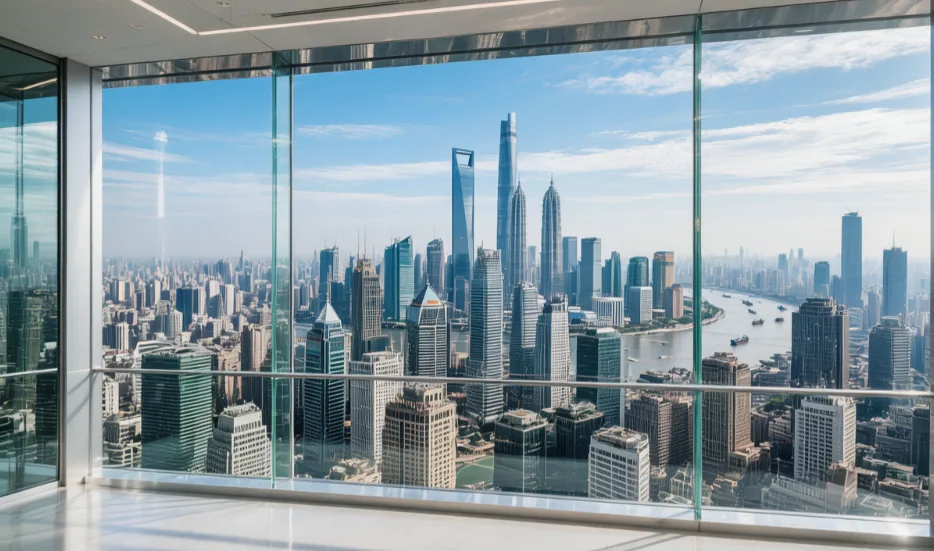
Day 3: Oriental Pearl Revolving Restaurant and Suspended Viewing
Around 5:30 PM, I arrived punctually at the Gate 1 entrance of the Oriental Pearl Radio & TV Tower. As an old-school landmark of Shanghai, the admission process here is more cumbersome than at other skyscrapers. Pay special attention during the security check; security officers will carefully inspect bags for prohibited items. Long umbrellas, lighters, and any flammable or explosive items will be required to be stored. I suggest everyone enter empty-handed, otherwise, the combined time for storage and retrieval at the gate might consume twenty minutes.
When ascending in the fully transparent elevator, the field of vision expands rapidly as the height increases, reaching the revolving restaurant at 267 meters in about one minute. The operational logic here is very mechanical and efficient; the entire dining platform moves slowly along a track at the bottom, completing one full rotation in about two hours. You don’t need to stress over scenic seats when booking because, as time passes, the views of The Bund, the Lujiazui financial district, and the lower reaches of the Huangpu River will appear before your window in turn.
| Project Segment | Execution Details | Personal Practical Sharing |
|---|---|---|
| Entry Verification | Show ID and meal booking QR code | Revolving restaurant packages usually include tickets for two spheres; no need to buy tickets repeatedly. |
| Dish Selection | Buffet style, featuring seafood and Western hot dishes | The steak and sashimi stations have the longest queues; I suggest taking cold plates first. |
| Dining Duration | Suggest allowing 1.5 to 2 hours for dinner | Coinciding with the rotation speed, this is just enough to see a complete circle of Shanghai night views. |
| Descent Route | Take the dedicated elevator down to the 259m viewing gallery | Avoid peak descent times, otherwise, the elevator queue might exceed half an hour. |
Regarding the quality of the dining, I must give an objective evaluation. The buffet here is of standard star-rated hotel quality—decent, but without a sense of amazement. Meat dishes mainly consist of freshly grilled steaks and lamb chops, while the seafood station provides common shrimp, crabs, and shellfish. My personal suggestion is to view this meal as a sightseeing activity with dining services, with the focus being on the light and shadow transitions. When the restaurant rotates to The Bund side, make sure to capture the moment when the lights on Zhongshan East 1st Road turn on; that golden light reflecting on the river is the soul of Shanghai’s night view.
- Table Selection Suggestion: Although seats rotate with the track, try to choose the first row by the window to minimize the reflection of indoor lights on the glass when taking photos.
- Weekend Avoidance Strategy: The food pick-up area is very crowded on Saturdays and Sundays, and there may even be delays in replenishing popular dishes. The experience will be doubled if you go on a weekday.
- Dress Code: Although there are no strict dress restrictions, it is suggested to wear slightly darker, non-reflective clothing for better photo results.
After finishing dinner around 8:00 PM, I went down to the fully transparent viewing gallery at 259 meters. Although the thickness of the glass gives a sense of security, when you actually stand on it with both feet and look at the buses crawling on Century Avenue like beetles below, the dizziness is very real. I found a small trick to overcome the fear, which is to look level at the distant Nanpu Bridge or observe the ground through the camera’s viewfinder; this can effectively relieve the brain’s physiological rejection of the height.
The transparent corridor here is a complete circle, and since there are no pillars blocking the view, there is great room for wide-angle lenses to perform. I usually stay at this height for thirty minutes, focusing on observing the light arrays on top of those buildings. If you intend to mail letters, there is a dedicated postal service point on this floor where you can add special commemorative stamps of the Oriental Pearl.
After completing the sightseeing, don’t rush to leave. The Shanghai Municipal History Museum on the zero-meter level at the bottom of the Oriental Pearl is included in the ticket; I suggest setting aside thirty to forty minutes to walk through it. It restores the streets and market life of old Shanghai. This contrast of cutting back to market history from a futuristic height allows you to have a more complete understanding of the depth of Shanghai. After leaving the tower area, a few minutes’ walk toward the river will take you to Binjiang Avenue; looking up at this glowing building from there will make you feel its volume even more than when you were inside it.
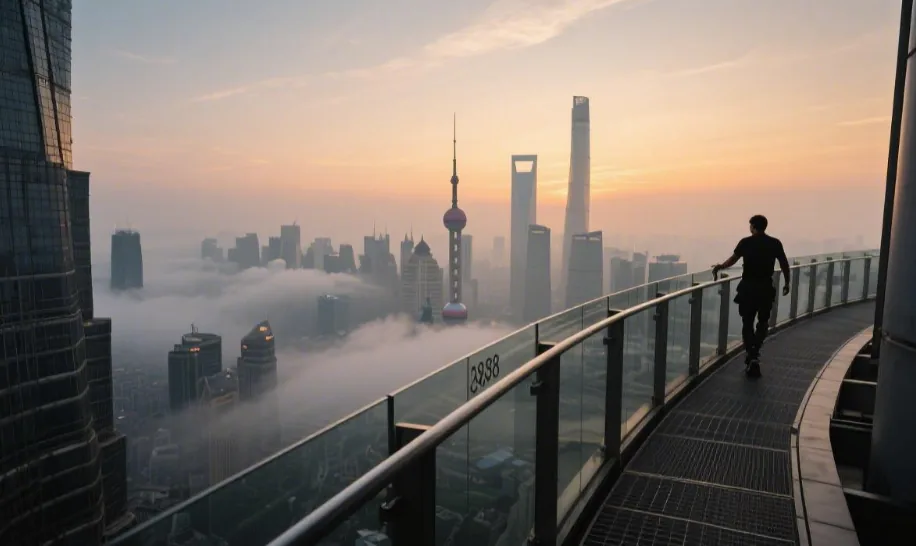
Day 4: Ground Perspective Review and Departure
Before 9:00 AM, I usually choose to return to The Bund again. Having experienced the overlook from several hundred meters high over the previous three days, returning to the ground on the last day and walking south from Chen Yi Plaza on Zhongshan East 1st Road makes this sharp shift in perspective very strange. At the 118th floor, the buses on the ground were the size of a fingernail, but now standing at the foot of the Peace Hotel or the Bank of China building and looking across the river, you will truly feel the sense of power “suppressed” by several ultra-high-rise building clusters. This visual tension brought by steel and concrete is a city culture unique to Shanghai.
During my last walk on this route, I found that the 8:00 AM sun hits Lujiazui from the side, and the International Architecture Exhibition at The Bund is in a front-lit position; the texture of photos is most transparent at this time. Compared to the evening peak when it is too crowded to move, The Bund in the early morning has more of a lifestyle atmosphere. You can see many locals exercising and cleaning vehicles working by the river; this is the most authentic base color of this city.
| Segment Plan | Execution Details | Personal Pitfall Avoidance Advice |
|---|---|---|
| Early Morning Shoot at The Bund | Walk south along the Huangpu River waterfront platform, looking for the “Big Three” in one frame. | Avoid the area around large sculptures; use the riverside railings as leading lines for shooting. |
| Souvenir Purchase | Go to Taikang Food or First Food Hall on East Nanjing Road Pedestrian Street. | Butterfly Leicha must be bought fresh by weight; the crispness of the bagged ones is much worse. |
| Lunch Arrangement | Find a local time-honored noodle shop on Jiujiang Road or Hankou Road. | Avoid the internet-famous fast food shops on the main Nanjing East Road; walking into the back alleys has more of a local vibe. |
| Departure Transportation | Take Metro Line 2 or Line 10 directly to Hongqiao Transportation Hub. | Allow at least 40 minutes for security at Hongqiao Station, especially on weekend afternoons. |
Near noon, I walk for about ten minutes from The Bund into East Nanjing Road. Although this is a famous tourist area, the food hidden in the time-honored shops is indeed worth a try. My personal habit is to queue at Taikang Food to buy a bag of freshly baked Butterfly Leicha; this Haipai pastry with a rich buttery aroma is a microcosm of Shanghai’s food culture. If you intend to bring gifts for friends, the freshly cut bacon or traditional fresh meat mooncakes (if it’s the right season) are also very safe choices.
- Route Planning Logic: The route from The Bund to East Nanjing Road is purely for walking. It is suggested to wear comfortable shoes. Although this section of the road is only one or two kilometers, the total time will be around two hours because of the need to stop for photos and browsing shops.
- Food Recording Techniques: When looking for lunch on Nanjing Road, I prioritize avoiding restaurants with overly flashy decorations. Haling Noodle House on Jiujiang Road or the snack counters of Shen Da Cheng, although the environment is average, the taste of their products has always been maintained above the average level in Shanghai.
- Baggage Handling Advice: If your accommodation is not near Lujiazui or The Bund, it is suggested to store your luggage in a self-service locker at a metro station or a storage area in a large shopping mall after checking out in the morning. This way, you can complete the final ground-level exploration unburdened.
Around 1:00 PM, I will start to retreat toward Hongqiao Railway Station or the airport. Shanghai’s rail transit is very punctual. Taking Line 2 from East Nanjing Road to Hongqiao Railway Station takes about 45 minutes, but considering the huge volume of the Hongqiao Hub, it often takes an additional fifteen minutes of walking from getting off the train to entering the waiting hall. I will strictly follow the principle of “setting off two hours in advance” because at Hongqiao Station, the queue length at any security check can exceed your expectations.
If you are heading to Pudong Airport, it is suggested to transfer to the Maglev train at Longyang Road. That sense of speed at 300 kilometers per hour can serve as the final footnote to this “Height and Speed” challenge journey. Calculating the costs for this four-day trip, excluding the bulk of accommodation and the revolving restaurant, the daily per capita consumption can be controlled between 300-500 yuan.
You May Also Like
- 6-Day Shanghai Panoramic Tour | City Landmarks + Disney Resort + Zhujiajiao Water Town | No Backtracking Itinerary
- 4-Day Shanghai Autumn Guide | French Concession Fallen Leaves on Wukang Road + Forest Photography at Gongqing Forest Park
- Shanghai 4-Day Essential Route | Lujiazui Financial Center + Xintiandi Shikumen + Tianzifang Cultural Creativity | A Journey of Ancient & Modern Intersection
- 3-Day Classic Shanghai Tour | The Bund Night View + Yuyuan Garden + Wukang Road Stroll | Complete Guide to First Impressions of the Magic City
- Shanghai Night Tour Essentials: 4 Hours | Huangpu River Cruise + Old Shanghai Style Street 1192 + Jing’an Temple Night View






