



Yunnan Plateau Climate “Different weather every ten miles”:
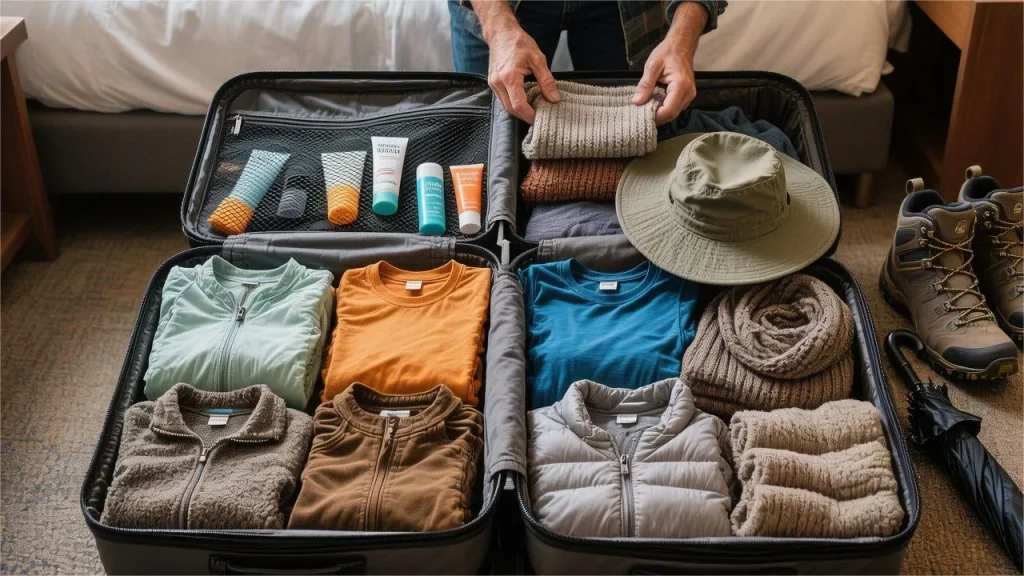
Spring and Autumn (10-22°C): Slightly cool in the morning and evening; a long-sleeved T-shirt plus a thin windproof jacket is sufficient;
Summer (15-26°C): It gets cold whenever it rains and the UV rays are extremely strong; umbrellas and SPF50+ sunscreen are mandatory;
Winter (5-15°C): The temperature difference between day and night often exceeds 10 degrees; prepare a fleece hardshell or a lightweight down jacket for mornings and evenings.
Regardless of the season, a pair of non-slip hiking shoes and high-moisture face cream are your practical essentials!
Weather Analysis
Yunnan Province has an altitude span of 6663.6 meters. The topographical drop superimposed with low-latitude monsoons forms a vertical climate. The average annual sunshine exceeds 2200 hours. The altitude of cities like Dali and Lijiang ranges between 1500-2800 meters, and the UV index on sunny days is often ≥ 10. The daily temperature difference consistently reaches 12°C-15°C, and approximately 85% of the province’s precipitation is concentrated from May to October. Weather forecasts need to be specific to prefecture-level cities or even districts; data from the provincial capital, Kunming, cannot represent the entire province.
Altitude and Temperature
The terrain of Yunnan presents a step-like descent, high in the northwest and low in the southeast, with an average provincial altitude of around 2000 meters. The standard atmospheric lapse rate in meteorology is manifested here as: for every 100 meters increase in altitude, the temperature drops by 0.6°C. Hekou County in Honghe Prefecture is located on the China-Vietnam border at an altitude of only 76.4 meters, where the average daily maximum temperature in July reaches 34°C. Kawagarbo Peak of Meili Snow Mountain in Diqing Prefecture stands at 6740 meters, covered by glaciers year-round, with peak temperatures staying below -15°C even in summer.
Within a north-south distance of less than 900 kilometers, the absolute vertical drop of 6663.6 meters crosses 7 temperature zones in geographical space, including Northern Tropical, South Subtropical, Middle Subtropical, North Subtropical, Warm Temperate, Middle Temperate, and Plateau Climate zones.
Tourists crossing different altitude cities in a single trip will experience temperature fluctuations far exceeding those in plain areas at the same latitude. Taking a self-drive trip on National Highway 214 as an example, when traveling from Jinghong City at 500 meters altitude to Shangri-La City at 3300 meters, the environmental temperature drop within the 780 kilometers journey can reach 25°C.
| Typical Tourist Destination | Measured Altitude | Jan Avg Low/High | July Avg Low/High | Vertical Climate Zone |
|---|---|---|---|---|
| Jinghong (Xishuangbanna) | 553m | 12°C / 25°C | 23°C / 32°C | North Tropical Monsoon |
| Hekou (Honghe) | 76.4m | 15°C / 23°C | 25°C / 34°C | Tropical Rainforest Transition |
| Kunming Urban Area | 1891m | 2°C / 15°C | 16°C / 24°C | North Subtropical Semi-humid |
| Dali Urban Area | 2052m | 2°C / 15°C | 15°C / 24°C | North Subtropical Semi-humid |
| Lijiang Old Town | 2418m | -2°C / 14°C | 14°C / 23°C | Warm Temperate Mountain |
| Shangri-La Urban Area | 3280m | -10°C / 6°C | 10°C / 19°C | Cold Temperate Alpine |
| Deqin (Feilai Temple) | 3400m | -7°C / 8°C | 11°C / 22°C | Cold Temperate Alpine |
Kunming’s altitude of 1890 meters combined with its 25°N low latitude offsets extreme summer heat and winter cold. Meteorological data shows that Kunming maintains daily average temperatures between 15°C and 20°C for more than 240 days a year. Dali City, at 2052 meters, is about 160 meters higher than Kunming, and winter night temperatures are usually 1°C to 2°C lower. Malong Peak, the highest point of Cangshan Mountain at 4122 meters, creates a local microclimate together with Erhai Lake at 1966 meters.
The 256 square kilometer water area of Erhai acts as a massive constant temperature tank. In areas like Shuanglang or Caicun within 500 meters of the shoreline, winter night temperatures are about 3°C higher than in the inland mountain areas of Dali. Moving north to Lijiang at 2418 meters, the lower air density causes surface heat to radiate rapidly into space at night. The daily temperature difference in Lijiang from November to March is consistently stable between 15°C and 18°C.
Based on the specific temperature distribution patterns in alpine valley areas, luggage clothing should follow the “onion” layering principle to deal with heat loss across different altitudes:
- In Pu’er or Xishuangbanna (below 1500m), focus on short sleeves and sun-protective clothing, with one thin single-layer jacket (approx. 200g) for 15°C mornings/nights.
- Along the Kunming-Dali-Lijiang route (1500-2500m), use a cotton long-sleeve base, a 250g fleece middle layer, and a windproof jacket outer layer.
- In Diqing (above 3000m), wear moisture-wicking thermal underwear as a base and a down jacket with over 150g of white duck down as an outer layer.
In addition to cooling caused by altitude, strong temperature inversion occurs in dry-hot valleys like the Nu River and Yuan River. Yuanjiang County, at only 380 meters altitude, once reached an extreme maximum temperature of 43.1°C in May due to the Foehn effect. Cold air sinks to the valley floor under gravity, forcing warm air to rise. In the winter mornings of the Hengduan Mountains, temperatures at 1000 meters can sometimes be 4°C to 5°C higher than at 500 meters in the valley.
The Jade Dragon Snow Mountain cableway rises from 3356 meters to the 4506-meter Glacier Park, a vertical ascent of 1150 meters. During the 10-minute ride, the temperature drops linearly by about 7°C. If Lijiang City is 15°C at noon, the temperature at the Glacier Park viewing platform is only about 2°C. With gusts often exceeding level 5, the perceived temperature on exposed skin can drop below -5°C.
Tengchong in western Yunnan (1640m) is influenced by warm, humid currents from the Indian Ocean blocked by the Gaoligong Mountains. The average daily high in January can reach 15°C, and the area features 97 volcanic landforms with abundant geothermal springs. Puzhehei in southeastern Yunnan (approx. 1450m) features typical Karst topography. With water and peaks intertwined, high temperatures in July and August stay around 28°C, dropping to 18°C at night due to evaporative cooling.
Precipitation in Dry and Wet Seasons
Yunnan spans six latitude zones. The period from November to April, controlled by westerly circulation, is the dry season. Most meteorological stations record precipitation during this time at less than 15% of the annual total.
Central Yunnan areas like Kunming and Chuxiong often have over 60 consecutive days without rain during the dry season. Relative humidity frequently drops below 40%, and the rate of moisture loss from the skin’s stratum corneum is more than 30% faster than in eastern coastal areas. Cloud cover reaches its annual minimum, and the proportion of solar radiation reaching the ground peaks. Shangri-La in January averages 8 hours of sunshine daily, with noon temperatures on sunny days approaching 12°C.
Lack of cloud insulation intensifies long-wave radiation heat loss from the ground at night, easily forming inversion layers in basins and valleys. Thick fog often appears in Pu’er and Xishuangbanna mornings from December to February, with visibility below 50 meters. The fog usually dissipates between 10:00 AM and 11:00 AM as temperatures rise.
For the dry season, travel planning and clothing should refer to these parameters:
- Choose skincare products with an oil content higher than 20%.
- Wear N95-rated masks outdoors in the morning and evening to prevent wind and dust.
- Use Modal or pure cotton for inner layers to prevent static electricity.
- The probability of seeing “Golden Mountain under Sunshine” at Meili Snow Mountain exceeds 85% in December and January.
- Yuanyang Terraces are flooded from late November to March.
Starting in late May, the southwest monsoon brings massive moisture from the Bay of Bengal into the Yunnan-Guizhou Plateau, marking the official start of the wet season. Over 85% of annual rainfall is concentrated from May to October. Southern border areas like Xishuangbanna and Dehong can receive 1500 to 2800 mm of annual rainfall. Rain mostly takes the form of thunderstorms or showers from strong convection, usually lasting 30 minutes to 2 hours.
Topographic uplift causes rainfall differences of several times between windward and leeward slopes. The western slope of Gaoligong Mountain (Tengchong) receives 1530 mm, while Baoshan on the eastern slope, less than 100 km away, receives only 970 mm. Frequent encounters of cold and warm air cause sharp temperature drops during rain. The environment temperature can plummet by 8°C to 10°C within 1 hour after rain starts, described by the local saying “One rain brings winter.”
Increased humidity changes the perceived temperature. On a rainy summer night in Lijiang with 80% relative humidity, even if the recorded temperature is 15°C, the equivalent wind-chill temperature felt by the body is only about 10°C. Night rain is another prominent feature. From the Sichuan Basin to the Yunnan-Guizhou Plateau, 60% of precipitation occurs between 20:00 PM and 8:00 AM the next day due to topographic thermal circulation.
For the wet season’s complex rain distribution, luggage needs to meet both moisture-proof and quick-drying requirements:
- Prepare a lightweight hardshell with a waterproof rating of 10000mmH2O or higher.
- Keep at least two folding umbrellas or disposable long raincoats in your backpack.
- Choose hiking shoes with a GORE-TEX waterproof membrane.
- Carry insect repellent with 10%-15% DEET concentration.
- Avoid pure cotton for base layers; choose polyester quick-dry fabrics.
Abundant wet season rain activates mycelium in forests; July and August are the peak for wild mushrooms. Kunming’s Mushuihua Wild Mushroom Market trades hundreds of tons daily. Sustained rainfall saturates mountain soil. The frequency of landslides or mudslides in the Nu River Canyon and Diqing Plateau is 4 times higher in July and August than usual.
The Yunnan sections of G214 (Yunnan-Tibet) and G318 (Sichuan-Tibet) often face road blockages. Self-drive tourists should reserve more than 20% buffer time to handle traffic controls that could last 3 to 5 hours. After mid-September, the subtropical high retreats south and the monsoon weakens. Monthly rainy days drop from around 20 in August to under 10, and air transparency improves.
During this period, temperatures drop gently, with Dali and Lijiang staying at 18°C to 22°C during the day. As some moisture remains, the probability of rainbows or the Tyndall effect in the morning and evening is the highest of the year.
Wind and UV Rays
Yunnan spans 21°N to 29°N, meaning solar radiation has a very short path through the atmosphere. At 1890 meters, Kunming’s atmosphere is about 20% thinner than at sea level, greatly reducing the attenuation of UV rays. Data shows that for every 1000 meters of ascent, UV intensity increases by 10% to 12%. Shangri-La at 3300 meters receives a daily UVB dose over 1.5 times higher than the Shanghai plains.
During the peak of winter in January, the noon UV Index (UVI) in Lijiang Old Town remains stable between 8 and 10 for 15 consecutive days, reaching the “Strong Radiation” level.
UVA waves can penetrate clouds and 8mm thick ordinary glass; the skin still receives over 90% of UVA radiation even on cloudy days or inside a vehicle.
Without protection in a UVI 10 environment, Asian skin’s stratum corneum will show microvascular expansion (erythema) within 15 minutes. High-altitude air is dry, speeding up sweat evaporation, which can cause cracks in the protective film of sunscreen within 2 hours.
At 4500 meters in Jade Dragon Snow Mountain’s Glacier Park, snow reflection of UV rays reaches 80%. On the viewing platform, the face endures both direct overhead sunlight and secondary radiation reflected from the snow, with total light intensity nearly 3 times that of a summer day in the plains.
For high-intensity UV environments, physical and chemical sunscreens must meet these standards:
- Sunscreen must be labeled SPF50+ and PA++++, with a single facial application of 2mg per square centimeter.
- Wear polarized sunglasses with UV400 protection to block 99% of UV rays.
- Sun-protective clothing must have a UPF value greater than 50.
- Wide-brimmed hats should have a brim wider than 8cm to fully cover the jaw and neck.
Complex mountainous terrain creates unique local wind systems in canyons. Dali City, located between Cangshan and Ailao Mountains, forms a natural narrow funnel. Between February and May, cold air pouring over Cangshan accelerates due to the venturi effect, with average daily wind speeds in Dali’s Xiaguan area reaching 4.5m/s.
Every March, Xiaguan station records an average of 15 days with winds above level 8, with instantaneous maximum speeds often exceeding 20m/s.
Strong winds drastically change perceived temperature. When the actual temperature is 10°C and wind speed reaches 10m/s (level 5 wind), heat loss from the skin doubles, and the human equivalent wind-chill temperature drops to 2.7°C.
This effect is especially noticeable when riding electric scooters around Erhai. Without a windproof helmet and gloves, fingertips can drop below 15°C and feel numb within 20 minutes. Northwestern Yunnan’s Shangri-La experiences prevailing westerlies from November to April. Around Napa Lake, dry cold gusts of level 7 or higher often occur between 14:00 PM and 17:00 PM due to the lack of high vegetation.
To cope with high-altitude winds, the windproof and breathable performance of clothing materials is more important than thickness. Equipment should include:
- Outerwear: Softshells with WINDSTOPPER or similar membranes.
- Pants: Avoid knit pants; use high-density nylon blend wind-resistant hiking pants.
- High-altitude: Windproof gloves with fleece lining and all-around neck gaiters.
Xishuangbanna in southern Yunnan, surrounded by branches of the Hengduan Mountains, has a 40% frequency of calm winds. The average wind speed in January is only 1.2m/s. This lack of wind makes it hard for moisture in the rainforest to dissipate, keeping relative humidity near the ground above 80% year-round.
Dressing Strategy
Yunnan travel dressing is based on handling a daily 15°C temperature difference and high-altitude UV rays. Morning/evening temperatures in Dali and Lijiang are around 10°C, while reaching 25°C under direct sunlight at noon. A “Three-layer dressing system” is recommended: Base layer with 150g/m² polyester wicking T-shirt; Middle layer with 200g fleece or 600-fill power lightweight down; Outer layer with a windproof jacket (waterproof index > 5000mm). Equip with UPF50+ sun clothing and hats with brims > 7cm. Shoes should be hiking shoes with rubber soles > 3cm thick for stone paths and scenic steps.
Three-layer Dressing
The average altitude between Kunming and Dali is about 1900 meters. Surface temperatures reach 25°C during sunny periods but quickly drop below 10°C within 2 hours of sunset. Single heavy garments cannot satisfy frequent temperature adjustment needs.
Pure cotton, after absorbing moisture equal to 8% of its weight, sees its thermal conductivity increase 5-fold instantly. In a 3000-meter cold wind, wearing wet cotton underwear can easily lead to hypothermia.
100% polyester wicking T-shirts have a special irregular-shaped groove cross-section. The capillary effect sucks sweat to the outside of the garment within 2 to 3 seconds. For low-altitude summer areas, 120g/m² to 150g/m² short-sleeved wicking shirts with breathability > 500mm/s are advised.
In Shangri-La, where temperatures are often below 15°C, 150g/m² to 200g/m² Merino wool base layers provide better static control and anti-bacterial properties. Fiber diameters of 18.5 to 19.5 microns ensure a soft feel against the skin, maintaining a 36.5°C microclimate even after absorbing 30% moisture.
The insulation layer outside the wicking layer uses air’s low thermal conductivity (0.024W/(m·K)). A 200g/m² polar fleece jacket traps air to provide about 0.6 Clo, enough to resist the 8°C morning chill in Lijiang.
| Temp Range | Altitude Reference | Base Layer (Weight/Material) | Insulation (Fill/Thickness) | Shell (Waterproof/Breathable) |
|---|---|---|---|---|
| 15°C – 25°C | Kunming/Xishuangbanna | 120g/m² Polyester | 100g/m² Thin Fleece | UPF50+ Sun Clothing only |
| 5°C – 15°C | Dali/Lijiang | 150g/m² Quick-dry blend | 200g/m² Polar fleece | 3000mm Water-repellent windbreaker |
| -5°C – 5°C | Jade Dragon Snow/Meili | 200g/m² Merino wool | 800-fill 70g Down | 10000mm Taped-seam Hardshell |
As altitude climbs above 3500 meters and temperatures approach 0°C, animal down shows an absolute advantage in warmth-to-weight ratio. A lightweight down jacket with 60g to 80g fill and 700 to 800 fill power compresses to the size of a 250g apple.
Ribbed stitching keeps down in 5-8cm independent chambers, preventing shifting and avoiding “thermal bridges.” Synthetic insulation (like Primaloft) retains 98% warmth when wet. In the 60% rainfall rate of southern Yunnan’s wet season, 60g/m² synthetic jackets can replace down for 10°C wet-cold weather.
The shell layer blocks external convection and liquid water, protecting the inner layers. In Dali’s Xiaguan (wind level 4-5), wind-chill can make it feel 3°C to 5°C colder.
Hardshell membranes keep air permeability (CFM) below 1. Yunnan’s summer rain is intense but short. The waterproof index of an outer jacket should be 5000mmH₂O to 10000mmH₂O to withstand 15mm/h rain without leaking.
- Outer fabric needs DWR (Durable Water Repellent) treatment
- Water contact angle on the fabric should be > 90 degrees
- Internal seams must be covered with 1.5cm wide waterproof tape
PTFE membranes have about 1.4 billion micropores per square centimeter. Micropores are 20,000 times smaller than a water drop but 700 times larger than water vapor molecules. Moisture vapor transmission rate (MVTR) should be above 5000g/m²/24h. Hiking generates about 500ml of sweat vapor per hour, which relies on these pores to escape. 20-30cm underarm zippers can increase airflow by 50% during intense activity.
Zippered jackets take 4-6 seconds less to put on or take off than pullovers. In environments with > 15°C temp differences, using YKK resin zippers reduces snagging. A systematic clothing setup can keep total weight under 1.2kg.
UV Protection
For every 1000 meters of altitude, UV radiation increases by 10% to 12%. Regular Yunnan routes at 2000 meters altitude record noon UVI values of 11 to 14. At this level, melanin cells in the skin produce pigment within 15 minutes of unprotected exposure.
Chemical sunscreen alone struggles to last after sweating; physical gear must have certified parameters. Sun protection efficiency depends on fiber material and weaving density.
Original yarn technology mixes TiO₂ particles into the fibers during spinning, maintaining UPF 50+ even after 50 washes. Coated sun clothing uses PU glue, which peels off after 15-20 washes, causing UVA penetration to rise above 8%.
Under the same material and thickness, dark colors (black, navy) absorb about 15% more UVA than white. In the high-reflection snow of Jade Dragon Snow Mountain, coverage area matters more than thickness.
- Extended finger loops should cover up to the second knuckle
- Hooded designs should zip up to the jawline
- Fabric weight: 100g/m² to 130g/m²
- Mesh panels (> 2mm) at armpits or back for ventilation
UV protection blind spots often occur at the back of the neck and side cheeks. Typical caps with 5-6cm brims only shade up to the nose. Low-latitude sunshine angles between 10:00 AM and 16:00 PM often expose the sides of the face.
Straw-braid or nylon quick-dry wide-brimmed hats effectively block slanted light. The brim width must reach 8-12cm to fully cover the jawline and the 7th cervical vertebra. In Dali’s level 4-5 winds, hats must have adjustable wind cords.
Umbrellas provide the largest shadow area in flat scenic spots. Regular umbrellas have large gaps in the weave, with 15%-20% UV penetration. Effective sun umbrellas depend on coating and density.
High-quality sun umbrellas use high-density PG cloth (190T to 210T). Black glue coatings on the inside absorb reflection to cool down, making it 2°C to 3°C cooler under the umbrella.
- Black glue coating should be 3-4 layers thick for opacity
- Frame material: Aluminum alloy or fiberglass (weight < 300g)
- Diameter: 95cm to 105cm
- Compact size: < 20cm (5 or 6-fold) for easy carrying
Long-term retinal exposure to UV rays accelerates cataract formation, and snow environments can cause acute keratitis. Tinted glass lenses only reduce visible light; they cannot block UVA (315nm-400nm).
Check for the GB39552.1-2020 standard on sunglasses. Lenses must be labeled “UV400,” indicating they block all UV rays below 400nm. Category 3 (VLT 8%-18%) is suitable for Yunnan’s noon direct light.
- Polarized lenses filter 99% of water surface glare
- TAC material lenses are light and shatterproof
- Frames should fit the brow and cheekbones to reduce side light leakage
- Myopic travelers can use custom prescription transition lenses or clip-ons
Wash and friction reduce sun clothing efficiency over time. UV coatings on sunglasses degrade when exposed to sweat, sunscreen, or high temperatures. Verifying the condition of old gear before traveling is essential.
Footwear Materials
A standard 7-day Yunnan trip involves 18,000 to 25,000 steps daily. Stone paths in Dali and Lijiang Old Towns are extremely slippery due to centuries of use. Height differences between adjacent stones commonly reach 2 to 5 cm.
For slippery stones, the outsole material ratio is key. Pure foam soles drop to a friction coefficient below 0.2 when wet. Composite outsoles with over 30% carbon rubber maintain a coefficient above 0.6.
- Lug depth: 3 to 4 mm
- Multi-directional triangular tread pattern
- Mud-clearing channels at the forefoot
- Rubber hardness (Shore A): 60-70 degrees
Long walks on uneven stones or climbing 1000 steps at Tiger Leaping Gorge put 1.5 times body weight of impact on the fascia. Midsole cushioning thickness and rebound rate absorb this impact.
Regular EVA foam deforms permanently after 2 hours of use. ETPU midsole materials maintain over 60% energy return. Midsole thickness should be 3 to 4.5 cm.
The probability of summer afternoon showers in NW Yunnan is 70%; morning humidity in meadows often exceeds 85%. Mesh shoes will be completely soaked within 10 minutes on wet morning grass.
Microporous breathable membranes (like Gore-Tex or eVent) on the upper are physical barriers to keep feet dry. With 1.4 billion pores per cm², they are 20,000 times smaller than water drops but 700 times larger than vapor molecules.
- Waterproof rating: > 10000mmH2O
- Breathability (RET): < 6
- Standard heat-pressed waterproof tape at seams
- 2mm thick rubber toe cap for protection
At 3000+ meters in Shangri-La or Jade Dragon Snow Mountain, atmospheric pressure is 30% lower. Capillary expansion slows lower limb blood return, causing feet to expand by 4% to 6% in the afternoon.
When trying on shoes, simulate high-altitude swelling; there must be 1 to 1.5 cm of space in front of the toes. Tight, slim shoes will cause painful friction during downhill braking.
Pure cotton socks under 40g dry very slowly; fiber friction increases 3-fold when wet.
- Material: 50% to 70% Merino wool blend
- Thickened terry loops at heel and toe
- Sock height: > 2 cm above the shoe collar
- Spandex arch band to prevent slipping
Every 100g of weight on the foot is equivalent to 500g of weight on the spine. At 3500 meters where oxygen is only 68% of sea level, heavy shoes will double muscle fatigue.
For single-day light hiking, a size 42 shoe should weigh 350g to 450g. Using Cordura ripstop nylon with TPU films instead of full-grain leather can reduce weight by 30% while ensuring durability.
Luggage List
For a single person on a 7-10 day trip to Yunnan, it is recommended to carry one 24-inch checked suitcase (15-20 kg, matching domestic airline allowances) plus one 20L daily backpack. Luggage should be distributed as: “40% Clothing/Shoes + 30% Daily/Protection + 20% Electronics + 10% Medicine.” For the > 15°C temperature difference between regions, use the three-layer dressing method; for areas above 2500m, SPF50+/PA++++ sun protection and specific adaptive medicines are required.
Sun Protection and Moisture
Yunnan’s average altitude is about 2000 meters. For every 1000 meters ascent, UV rays increase by 10% to 12%. On sunny days, the UV Index (UVI) in Dali and Lijiang often exceeds 11, which is extremely dangerous. Relative humidity in the dry season hovers around 25% to 35%. High-altitude, low-pressure environments accelerate skin moisture evaporation by about 150ml per day compared to plains.
Carry 50ml to 100ml sunscreen bottles to comply with civil aviation regulations. Sunscreen must be SPF50+ and PA++++ to block 98% of UVB and most UVA. Lotion textures have better spreadability; the dosage should reach 2mg per square centimeter, which is about the size of a one-yuan coin (approx. 1.2g) for the entire face.
Wait 15 to 20 minutes for a film to form before going outside. In high-reflection areas like snow mountains or Erhai, snow and water can reflect up to 80% of UV rays back to the face. Reapply every 1.5 to 2 hours.
Areas easily missed:
- Edges of the ears and behind the ears
- Back of the neck (especially with collarless T-shirts)
- Backs of hands and finger joints
- 1cm below the hairline
- Ankles when wearing cropped pants
Physical shading blocks UV penetration. Prepare UPF50+ sun clothing, preferably nylon mixed with spandex, with breathability > 50mm/s. Darker fabrics have lower UV penetration. Lightweight single-layer sun coats under 150g are easier to store.
Head protection requires a brim width > 8cm to cover the face and neck. If traveling to areas like Shangri-La with winds > 5m/s, the hat needs an adjustable cord. Eye protection should be UV400 polarized sunglasses, Category Cat.3 (8%-18% VLT). Gray or brown lenses reduce intensity without distorting colors.
For the dry climate, pack high-moisture face cream containing ceramides, squalane, or hyaluronic acid. Apply within 3 minutes of washing your face (before the skin is completely dry) to lock in 15% to 20% of moisture.
Skin oil secretion drops by over 30% in dry, cold air. Carry a 100ml bottle of moisturizing body lotion and apply it generously to limbs and torso within 5 minutes after a bath. Use an extra 0.5g on elbows, knees, and heels.
Carry stick lip balms:
- Ingredients: Vaseline, Lanolin, or Jojoba oil
- Colorless and odorless to reduce irritation
- Approx. 1.5cm diameter for pocket portability
- Apply every 3 hours during the day
- Apply 1mm thick as a lip mask before sleep
Nasal mucosa can rupture when humidity is below 30%. Carry a 50ml bottle of 0.9% physiological saline nasal spray. Spray 1-2 times morning and night to keep the nasal environment moist. Use a 500ml to 750ml 304 or 316 stainless steel vacuum flask. Adults need 2000ml to 2500ml of water daily in Yunnan.
Drink small amounts frequently, about 150ml to 200ml of warm water (35°C to 40°C) each time to avoid stomach irritation. Adding a Vitamin C effervescent tablet (approx. 1000mg) can replenish trace elements lost through sweat.
Medicine Preparation
Popular Yunnan routes range from 1800m to 4680m in altitude. Kunming is 1890m, Lijiang is 2416m, and Shangri-La is 3280m, where oxygen levels are only 68% to 72% of sea level. Heart rates for unadapted tourists at 2500m+ usually increase by 10 to 20 bpm.
A fingertip pulse oximeter (< 50g) is a quantitative way to monitor health. At 3000m+, if resting oxygen saturation stays below 90%, stop strenuous activity. If it falls below 85% with a severe headache, use oxygen and descend immediately.
Compressed oxygen cans are banned on planes/trains; buy them at reputable pharmacies or supermarkets in Lijiang or Shangri-La.
| High Altitude Equipment/Medicine | Specifications | Usage/Dosage |
|---|---|---|
| Portable Oxygen Bottle | 1000ml/bottle | Provides 2-3 mins continuous or 15-20 mins intermittent oxygen. Snow mountains require 2-3 bottles per person. |
| Rhodiola Preparation | 200mg capsule | Start 7-10 days before departure; 200mg-400mg twice daily. |
| Ibuprofen Sustained-Release | 300mg capsule | For mild high-altitude headaches; usually relieves pain within 1 hour. |
| Levofloxacin Tablets | 0.5g/tablet (Prescription) | For acute bacterial gastroenteritis; once daily, usually a 3-day course. |
Beyond altitude, 60% of Yunnan’s roads are winding mountain paths. Dimenhydrinate (50mg) for motion sickness should be taken with 200ml warm water 30-40 mins before travel.
- For those with stomach sensitivity to oral meds, use Scopolamine patches.
- Apply behind the hairless area of the ear; effective for up to 72 hours.
- Adults use 1 patch; children under 12 use half.
- Remove 2 hours after the journey and clean skin residue.
Mountain roads and diet changes (spicy food, wild mushrooms) increase the burden on the gut. Carry Montmorillonite Powder (3g per sachet). For acute diarrhea, take 2 sachets in 50ml warm water initially to protect the digestive mucosa.
For indigestion from cold food, digestive tablets with 800 units of pepsin help. Altitude temperature differences can cause respiratory infections. At 3000m+, the incidence of pulmonary edema from a common cold is 4 times higher than in plains.
- Prepare Paracetamol (500mg) for fevers over 38.5°C.
- Wait at least 6 hours between doses.
- Chronic patients should bring a 3-day buffer supply of regular meds.
- Nifedipine (30mg) must be in carry-on to prevent treatment interruption due to luggage delays.
For minor cuts or insect bites in rainforests/canyons, use compact external meds (under 100ml). Remove paper boxes from oral meds but keep foil packs with expiry dates.
| External First Aid/Protection | Specifications | Usage |
|---|---|---|
| Iodophor Cotton Swabs | 0.5ml each | Break the colored ring to release liquid; for disinfecting cuts < 5cm. |
| Waterproof Band-aids | 72mm × 19mm | Covers small wounds or protects heels from friction. |
| Calamine Lotion | 100ml bottle | For Xishuangbanna insect bites; shake well to relieve itching. |
| Artificial Tears | 0.4ml single-use | For dry eyes from wind/altitude; use 3-4 times daily. |
| Mupirocin Ointment | 10g tube | For minor skin infections; highly antibacterial. |
The first aid kit should weigh under 300g and be placed in a waterproof pocket. Folded instructions and meds in a 10cm × 15cm zip bag with marked dosages save 30% of time in emergencies.
Documents and Electronics
Mainland China residents must carry a valid ID card covering the trip plus 3 days. 95% of Yunnan’s high-speed rail and 5A sites use facial recognition linked to IDs, taking only 3-5 seconds.
Travelers over 60 should bring their ID for half-price or free entry at public sites like Shilin or Jade Dragon Snow Mountain. Full-time students (Bachelor’s and below) need a stamped physical ID for 40%-50% discounts.
For renting electric scooters in Dali or Xishuangbanna, a Class D or E motorcycle license is required. Renting a car requires a C1/C2 license with at least 1 year of driving experience.
Prepare 300 to 500 CNY in cash, mainly in 10, 20, and 50 denominations. In deep areas of Pudacuo National Park or Nu River Canyon, network coverage can be below 60%; cash ensures payment for food and transport.
- Store documents in an A6 (105mm × 148mm) waterproof bag
- Keep high-res photos of all IDs on your phone
- Activate electronic IDs on WeChat/Alipay platforms
- Passports or Permits must have > 6 months validity
CAAC rules state power banks cannot exceed 100Wh, equal to 27027mAh at 3.7V. A 20000mAh power bank can charge a 3200mAh smartphone about 4.5 times.
In mountain areas below 5°C, lithium batteries drain 30% to 50% faster. Prepare two heat patches to stick on the back of your phone or power bank to maintain an operating temperature above 15°C.
Bring a 65W or 100W GaN multi-port charger (< 70cm³, < 150g). Two 1.5m to 2m braided cables can charge your phone, earbuds, and power bank simultaneously, saving time.
Clear 20GB of phone storage for daily photos (200-300 per day). Camera users should have two 128GB UHS-I SD cards (170MB/s) for 4K video.
- Mirrorless cameras: 2 original spare batteries
- One microfiber lens cloth for dust
- Drones under 249g to avoid registration
- Download offline no-fly zone maps on your phone
Upload 5GB to 10GB of media to cloud storage via hotel Wi-Fi each night. Mountainous terrain weakens 4G signals; download offline maps (80MB-150MB per city) before departure.
The Kunming-Dali train or intercity buses take 2 to 4 hours. Noise-canceling earbuds (> 35dB) can filter 80% of low-frequency engine noise. Battery life should exceed 5 hours.
Keep Reading
- Essential Items Checklist for Yunnan Travel | What Practical Luggage Do You Really Need to Prepare for Yunnan
- 2026 Dali Travel Must-Visit Attractions Ranking | Besides Erhai, What Else is Fun in Dali
- Dali Travel Intangible Cultural Heritage Experience | Tie-dye, Bai Three-Course Tea & Jianchuan Wood Carving Handcrafted Slow Life
- Yunnan Travel FAQ | Must-Read Before Your First Trip to Yunnan
- Yunnan Travel Off-the-Beaten-Path Destinations | Avoid Crowds & Visit 6 Primitive Secluded Ancient Villages
Shangri-La — — Key Facts
Tickets & Booking
- Tiger Leaping Gorge (Shangri-La section, Upper Tiger Leaping): Adult CNY 45; ticket + round-trip sightseeing escalator (Pingbu Qingyun escalator) CNY 125[src]
Where to Stay · Room Type · Nearby
- Inside Dukezong Ancient Town | Room tip: Convenient for getting around, but vehicles cannot enter, so confirm with the guesthouse whether they carry luggage | Nearby add-ons: Great Buddha Temple, prayer wheel, Guishan Park, Moonlight Square[src]
- Along Napahai | Room tip: Good views and quiet, but far from the city | Nearby add-ons: Napahai Yila Grassland, Shika Snow Mountain[src]
Typical Climate & Packing (Past Years)
- January: -7 °C–9 °C °C, [Travel climate reference]
- February: -5 °C–11 °C °C
- March: -2 °C–14 °C °C
- April: 2 °C–17 °C °C
- May: 5 °C–19 °C °C, The meadow turns green again
- June: 8 °C–20 °C °C






