



Day 1: Fragrant Hills Park, an Early-Morning Climb to See the Red Leaves Before the Crowds
When people complain about seeing the autumn leaves at Fragrant Hills, 90% of the frustration comes down to two things: “there are more people than leaves,” and “the traffic is so bad you want to cry.” And honestly, that is true. If you head there at 10:00 a.m. on a weekend, you are basically signing up for a full-scale crowd battle. Based on the fact that I have gone every autumn for the past several years, if you move your schedule forward by three hours, you get a completely different experience—quiet, elegant, and much closer to the atmosphere of an imperial garden. The key is not simply getting up early. The real point is to get through the gates before the tour buses and private cars turn Xiangshan Road into a dead stop.
My actual timing, for reference
05:40 Wake up, wash up, and eat something light. Hiking on an empty stomach can easily lead to low blood sugar.
06:00 Call a ride or drive out. At this hour, the Fifth Ring Road on the west side is usually very clear.
06:30 Arrive at Fragrant Hills Park East Gate. At that point, the sky is only just getting light, and most people at the entrance are elderly Beijingers coming in for their morning exercise with annual passes. There is basically no queue. You scan your ID and walk straight in.
At that hour, the light is side-backlit, which makes the leaves look especially luminous and translucent. The temperature is usually around 5 to 8°C, crisp and refreshing, and after only a few steps uphill your body warms up naturally. One important thing: do not try to drive up the mountain. The parking capacity at Fragrant Hills is extremely limited. Once the lots fill up, traffic police start restricting cars several kilometers away, and walking in from there will burn half your energy before the climb even begins. Taking a taxi or ride-hailing car to the East Gate is by far the easiest option.
South Route Climb: the Scenic Line That Is Kinder to Your Knees
After entering through the East Gate, most visitors instinctively follow the main flow straight ahead. My advice is to turn left immediately and take the South Route instead. It is a little longer, but the gradient is gentler, and it contains about 70% of Fragrant Hills’ cultural and historic sights, which makes it much better for a slow climb with photo stops along the way.
- Jingcui Lake to Xiangshan Temple: this is your warm-up stretch. Xiangshan Temple was extensively restored a few years ago and is now quite impressive in scale. With the sun just coming up, if you stand at the base of the steps and look upward, the golden light falls across the red temple buildings and the autumn leaves behind them, and the color saturation is incredible.
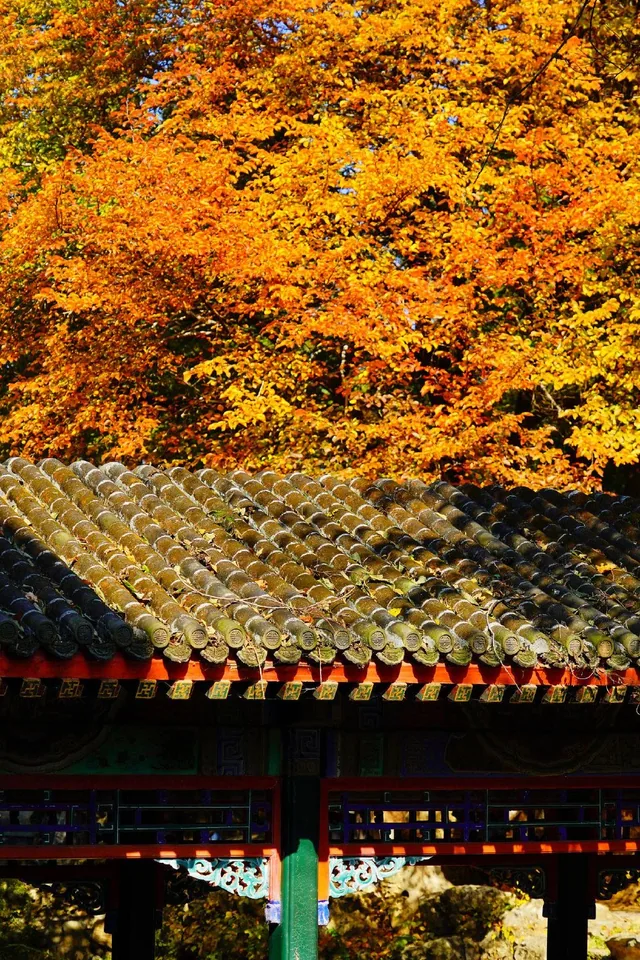
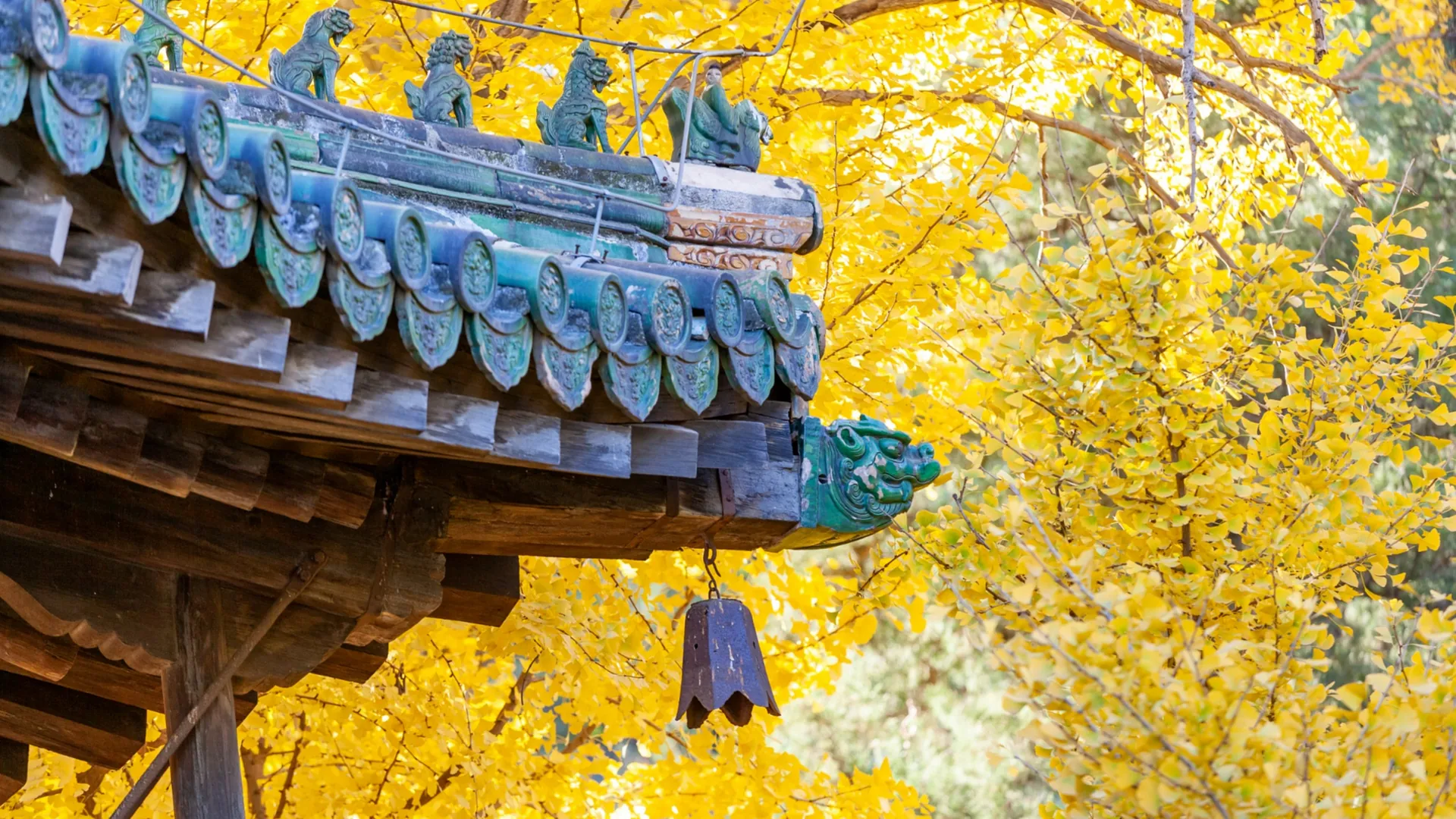
- Shuangqing Villa: this is a must-stop. It is famous as a historic revolutionary site, but beyond the history, the two ancient ginkgo trees in the courtyard are stunning. By late October they turn completely golden, and the fallen leaves carpeting the pond are even more eye-catching than the red maples.
- The final push to Incense Burner Peak: after Shuangqing Villa, the trail gets steeper. The last section, known as “Guijianchou,” is nothing but steep stone steps. Slow your pace here. Do not force it. Every time you climb another fifty steps, turn around and look back. By then, the full city panorama will already be spreading out below your feet.
| Section of the Climb | Estimated Time | Scenic Features | How It Feels Physically |
|---|---|---|---|
| East Gate – Xiangshan Temple | 20 minutes | Gentle walkway with a lake and temple scenery | Easy warm-up, light sweating |
| Xiangshan Temple – Shuangqing Villa | 20 minutes | Tree-lined path, best ginkgo viewing | Comfortable, fresh air, high oxygen feel |
| Shuangqing Villa – Incense Burner Peak | 40–50 minutes | Steep stone steps, wide-open views | Tests your lungs and legs, thighs will start to burn |
How to Descend, and a Proper Old-School State-Run Lunch
Once you reach the summit at Incense Burner Peak, check in, take a few photos, and head back down. The wind on top can be quite strong, and if you stay too long it can give you a headache. I have two specific descent options, depending on how your knees are feeling:
- Walk down via the North Route (recommended): if you are not in a rush, take the North Route. You will pass Jianxin Studio, which is my personal favorite corner of Fragrant Hills. It is a semi-circular Jiangnan-style courtyard with a pond full of hundreds of red koi. At that point, most visitors are still on the mountain or only just entering the park, so Jianxin Studio is wonderfully quiet. Sitting in the covered corridor and staring at the fish feels strangely timeless.
- Take the cable car down (only if it suits you): the Fragrant Hills cable car is an open chairlift, the kind where your feet hang in the air, and a one-way ride costs RMB 100. The views are unbeatable, and you can look out over the mountainside covered in autumn leaves, but if you are afraid of heights, or traveling with a very young child, it can feel quite terrifying. Also, during peak season, after 10:00 a.m. the line for the downhill cable car can easily exceed an hour, at which point walking is often faster anyway.
For lunch, skip the roadside grilled sausages that cost RMB 15 each and head to the Songlin Restaurant inside the park.
Ordering guide for Songlin Restaurant
This is a very old-school state-run restaurant. The servers are efficient, loud-voiced, and direct. Do not expect the kind of service you get at Haidilao.
- Songlin steamed buns: absolutely essential. These are not delicate soup dumplings. They are large northern-style yeast buns with fluffy dough and a savory meat filling with a faint soy aroma. After a hike, that kind of carb hit feels deeply satisfying.
- Northern-style braised meatballs: a classic northern preparation. The meatballs are first fried, then braised, so they absorb all the sauce. They are fantastic with rice.
- Wild greens cornbread cakes: if you want something more rustic and grain-forward, this is another specialty, with a crisp browned bottom.
Lunch here usually comes to about RMB 50–60 per person, and it is exactly enough to warm you back up. By then it will be around noon. When you look down at the dense crowds only just entering at the foot of the mountain, you will feel very glad you finished everything early.
Day 2: A Deep Dive into the Summer Palace, with the “Painting-in-the-Picture” Complex as the Highlight
As the absolute pinnacle of imperial garden design, the Summer Palace is so large that if you wander without a plan, you can walk yourself into exhaustion and still only see the surface. Standard group tours usually enter through the East Palace Gate and then push through the crowds in a straight line. I strongly suggest doing it more cleverly: walk it in reverse and use the terrain to make the route easier. The logic here is to use the metro location and the shape of the park to put the most physically demanding uphill stretch in the morning, when you still have energy, and then spend the rest of the day with easy downhill walking and a water route out.
Enter from the North, Exit from the South: the Best One-Way Route
Do not drive. The parking around the Summer Palace is easily among the three most frustrating parking situations in Beijing. Take Metro Line 4 to Beigongmen Station, use Exit D, and follow the crowd for two minutes. You will be there.
- 08:30 — the overlook above Suzhou Street
As soon as you enter through the North Palace Gate, you will first cross a bridge over Suzhou Street. A lot of people hesitate over whether to buy the extra ticket to go down and walk through it. Honestly, unless you are especially interested in a reconstructed Jiangnan-style commercial street, the overhead view from the bridge is enough. In autumn, the dried lotus leaves and the reflections of the waterside shopfronts are actually more beautiful from above than from ground level. And once you go down, it is mostly souvenir shops anyway. - 09:30 — the visual impact of the Four Great Buddhist Regions
Past Suzhou Street, you arrive at the back side of Longevity Hill. Here you will find a large Tibetan-style Buddhist architectural complex known as the Four Great Buddhist Regions. It spent years under restoration and has only fully reopened recently. Red walls, golden roofs, white stupas—the color palette is intensely dramatic. The steps here are steep, but because it is early in the day, your energy level is exactly where it needs to be.Photo spot tip
Once you reach the middle platform of the Four Great Buddhist Regions, do not just shoot the buildings straight on. Step back and use the red parapet walls in the foreground to frame the view, with the deep blue sky behind and, if the air is clear, the faint silhouette of the pagoda at Fragrant Hills in the distance. The result has a solemn, almost “Little Tibet” quality.
“Painting-in-the-Picture”: the Peak of Garden Aesthetics After Restoration
Cross over the summit near the Tower of the Fragrance of the Buddha and walk down just a little, and you reach the true highlight of the day: Painting-in-the-Picture. This area was closed for restoration for many years, and now that it is open again, it feels like a paradise for photographers.
The defining feature here is that the buildings are layered into the hillside in descending terraces. It is not a flat courtyard at all. It is more like a three-dimensional maze.
| Viewing Point | How to See It / Photograph It | What to Watch Out For |
|---|---|---|
| Aishan Lou / Jieqiu Lou | Stand in the corridor and use the octagonal windows or begonia-shaped moon gates to frame Kunming Lake in the distance. | If the crowd is thick at the doorway, do not stop there. Walk farther in. The side corridors are often empty. |
| The west-side high pavilion | This is the best view in the entire complex. There are two red columns here. Stand just behind one of them and use it to block the crowd, and you can photograph a seemingly empty panoramic view of Kunming Lake. | The steps are very steep and narrow, so anyone wearing long Hanfu or a floor-length skirt should be especially careful. |
| The winding stone stairways | The stone paths that connect the different pavilions twist and fold beautifully. They are perfect for shooting that “walking through a painting” kind of deep-perspective video. | – |
Between about 10:30 and 11:30 a.m., the sunlight hits the south-facing side of the Painting-in-the-Picture complex at exactly the right angle, and the layering of light and shadow is at its richest. If you happen to catch a day with only a light breeze, the water on the lake shimmers just enough that the entire place truly lives up to its name—it feels like you are moving inside a painting.
Walk the Long Corridor, Then Leave by Boat
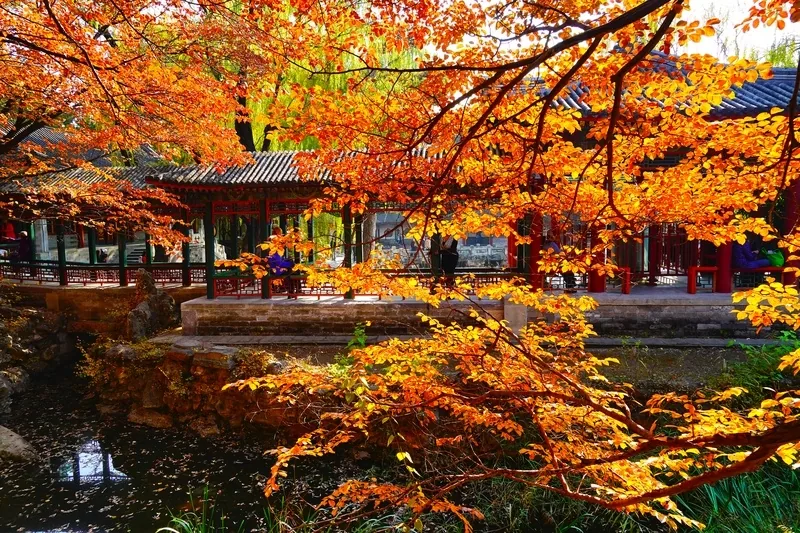
From Painting-in-the-Picture, follow the slope downward and you should reach the Long Corridor around noon. By then your legs may be starting to complain, and the benches along the corridor are the perfect place to pause. The Long Corridor is always crowded, but if you lift your gaze and look at the painted beams overhead, every section tells a story. You will see scenes from Journey to the West, Romance of the Three Kingdoms, and more.
For lunch, I suggest bringing a small snack and eating beside the corridor, or stopping near Tingli Guan for a few imperial-style pastries just to keep yourself going. The full meals around there are relatively expensive and the quality is hit or miss, so I do not particularly recommend sitting down for a formal lunch.
At around 1:30 p.m., do not try to return to Beigongmen by retracing your steps. That would mean climbing back over Longevity Hill all over again.
The smartest way to leave the park is by boat.
Walk to the Marble Boat at the end of the Long Corridor. There is a pier right beside it. Buy a ticket to South Ruyi Gate or Xinjiangongmen.
- Why the boat is worth it: this is not just transportation. It is part of the visit. From the middle of Kunming Lake, when you look back toward Longevity Hill, you get the full postcard view of the Tower of Buddhist Incense rising from the mountainside.
- The practical value: the ride takes about 15 to 20 minutes and drops you close to one of the exits, completely sparing you the pain of walking back the same way. It also gives your feet a real rest. The ticket costs a few dozen yuan, but in terms of comfort, it is absolutely worth the money.
Day 3: A Dongsi Hutong Citywalk and Independent Coffee Shops
After a climb at Fragrant Hills and a long day of walking through the Summer Palace, by the third day my legs are usually starting to protest. So I intentionally designed this day as a low-energy route. Dongsi feels completely different from places like Nanluoguxiang, where tourists pile in by the thousands. This part of the city still preserves the original texture of old Beijing hutongs—quiet, lived-in, and full of surprises.
10:30 a.m.: Start with the dappled tree shadows along Wusi Street
Sleep in, have a late breakfast or brunch, and then head out. Set your first stop as the National Art Museum of China. I do not necessarily recommend going inside to see the exhibitions, since that takes time and usually requires a reservation. The key thing here is the main building itself, a grand traditional-style structure. At around 10:30 a.m., the sunlight hits the yellow glazed roof just right, and with the pines in front, the whole scene feels very stately.
Then walk east along Wusi Street from the museum entrance. This is one of my own private picks for the most beautiful autumn streets in Beijing.
- The visual texture: tall plane trees line both sides of the road, and by late October the leaves are already turning yellow. The sunlight filters through the canopy and falls across the red brick walls—most notably the Peking University Red Building. That combination of red walls and yellow leaves makes almost any photo look like a still from a film.
- The pace of the walk: it is not a long stretch, about fifteen minutes to Dongsi intersection, but I would urge you to walk slowly. Pay attention to the older buildings along the road. Many date back to the Republican period and carry that calm, steady atmosphere of an earlier Beijing.
Into the heart of the hutongs: the maze from Dongsi 4th to 8th Alley
Once you reach the Dongsi intersection, do not linger on the main road. Go into the hutongs. Dongsi’s hutongs are laid out in an unusually regular grid, from First Alley through Fourteenth Alley, like neat slices of tofu. The area I return to most often is Fourth through Eighth Alley.
You will not find streets full of people shouting about “Old Beijing yogurt” or stalls selling mass-produced trinkets. What you find here is actual neighborhood life.
One “autumn-only” moment I saw in the hutongs
Last autumn, I stood for a long time outside a house in Dongsi Sixth Alley. A heavily laden persimmon tree stretched out above the gray brick wall, with bright orange fruit hanging like little lanterns. Underneath it stood an old bicycle dusted with fallen leaves, and beside that, a row of cabbages an elderly man had just put out to dry. That image was more moving than any posed shot at any scenic attraction. That is the kind of everyday warmth Beijing does unlike anywhere else.
As you walk these alleys, even the soundscape changes. There is no constant roar of traffic. You hear the occasional electric scooter passing by, or an exchange of greetings between elderly neighbors over a courtyard gate. That kind of acoustic emptiness is incredibly rare in a huge city, and it feels luxurious in the best way.
Independent coffee shop scouting: finding the cup that feels most like Beijing
Once you get tired, it is time to find a place to collapse for a while. Dongsi has some truly excellent independent coffee shops, and most of them have a distinct personality. I am not going to recommend specific names, because places open and close so quickly here, but I can absolutely tell you how to recognize the two types most worth stepping into:
| Type of Café | How to Choose It | Best Way to Enjoy It | What to Avoid |
|---|---|---|---|
| Courtyard terrace style | It must have roof access. If the café is set in a courtyard house and lets you go up to a rooftop terrace, it immediately jumps to the top of the list. | Order a pour-over, maybe a Yirgacheffe or something floral, sit on the roof, and do not talk. Just listen for the pigeon whistles—the sound made by flocks of pigeons flying overhead with little whistles attached. It is airy, distant, and unmistakably old Beijing. | If the terrace is packed with influencers holding reflectors and doing full photo shoots, turn around and leave. It will be too noisy to enjoy anything. |
| Minimalist neighborhood style | The more hidden, the better. The best ones may be next to a public toilet or beside a tiny convenience shop. They usually have concrete-gray interiors, light wood, and almost no signage. | The Dirty coffee at places like this is often excellent. The hot espresso floating over cold milk, taken in a few big sips, gives you that satisfying clash of hot and cold. | These cafés usually have very few seats, so do not bring in a huge group like it is a team outing. The owner will probably hate it. |
In cafés like these, you will often see freelancers working with laptops or neighbors who just wandered over for a quiet drink. There is no need to perform. Order something, turn a few pages of a book, and watch the light shift across the hutong outside. At moments like that, you start to feel that even after only three days, you have understood a small piece of the city. These independent cafés usually charge around RMB 35–50 per cup, which is not cheap, but what you are really paying for is that very specific kind of ease that cannot be replicated anywhere else.
Related Guides
- Beijing 4-Day Summer Water Fun Tour|Water Park + Rafting Experience + Indoor Ice Rink
- Beijing 5-Day Panoramic Tour|Complete Guide to Three Major Heritage Sites + Two Major Theme Parks + Six Major Museums
- Beijing 6-Day Classic Tour|Day 1 Forbidden City + Temple of Heaven → Day 2 Great Wall Night Tour + Gubei Water Town Hot Springs
- 4-Day Beijing Winter Olympics Legacy Experience | Shougang Park Skiing + Ice Cube Skating + Olympic Village Tour Guide
- 4-Day Beijing Night Tour Route | Liangma River Cruise + Qianmen Night Market + Sanlitun Club & Bar Exploration Guide
Summer Palace — — Practical Data
Transport & Schedules
- City center → Summer Palace North Palace Gate | Metro: Metro Line 4 Beigongmen station; walk about 5 min to the North Palace Gate; you can also take bus 330, 584 or 594 to Beigongmen.[src]
Where to Stay · Room Type · Nearby
- Haidian district, Zhongguancun/Wudaokou/Xiyuan (along Metro Line 4) | Reference price Budget/chain hotels about CNY 300–600 per night (OTA reference) | Room tip: Standard twin/king room; prefer along Metro Line 4 | Nearby add-ons: Summer Palace, Old Summer Palace, Tsinghua University, Peking University[src]
- Guesthouses near the Summer Palace North Palace Gate | Reference price Reference several hundred CNY per night (OTA reference) | Room tip: Standard room/courtyard room | Nearby add-ons: Summer Palace North Palace Gate, Suzhou Street, Old Summer Palace[src]
Typical Climate & Packing (Past Years)
- January: -9.4–1.6 °C, Freezing; Kunming Lake may freeze over (ice rink subject to opening)
- February: -6.9–4.0 °C, Cold, few visitors
- March: -0.6–11.3 °C, Warming; peach blossoms bloom on the West Causeway
- April: 7.2–19.9 °C, Peak-season prices from Apr 1; best spring scenery
- May: 13.2–26.4 °C, Pleasant climate, good for walking around the lake
- June: 18.2–30.3 °C, Lotus blossoms begin to open; frequent afternoon thunderstorms






