



Day 1: In-depth Experience at Water Cube Indoor Water Park
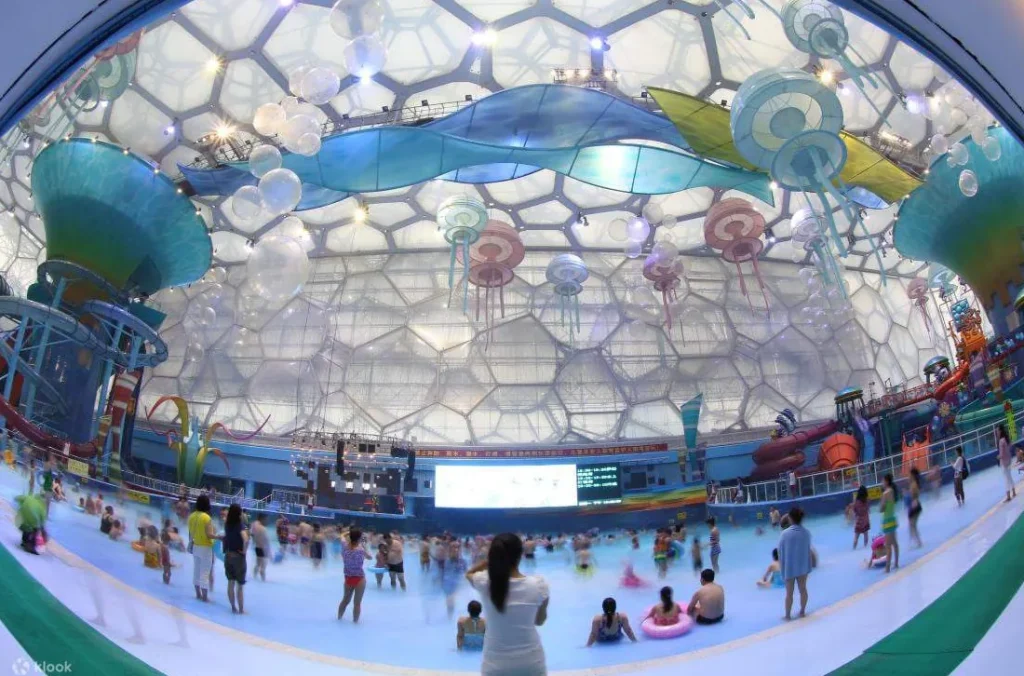
I chose the Water Cube Water Park in Olympic Park as my first stop. With Beijing’s midsummer temperatures soaring near 40°C, the fully indoor constant-temperature environment provides a complete escape from UV rays. Around 09:30 AM, I exited from Exit E of Olympic Park Station on Metro Line 8, and the iconic blue bubble building immediately came into view. This walk is about 800 meters; while not long, there is almost no shade along the way, so I suggest using a parasol, or you’ll be wilted before even entering the park.
The first thing to do upon entry is handle “finances.” Lockers here cost 20 Yuan and are non-refundable, and the park operates on a cashless basis. I loaded 300 Yuan onto my wristband, which serves as the “universal currency” inside for buying water, lunch, or renting secondary items. If you don’t spend it all, the system automatically refunds the balance to your original payment method upon exit.
When I brought my family last time, I noticed a detail: many people don’t bring towels to save trouble, only to find that renting one costs 30-50 Yuan for a very thin towel. My personal tip is to bring your own quick-dry large bath towel; it’s absorbent and lightweight. Also, if you usually wear contact lenses, be sure to switch to prescription goggles, as the strong water currents can easily wash contacts away.
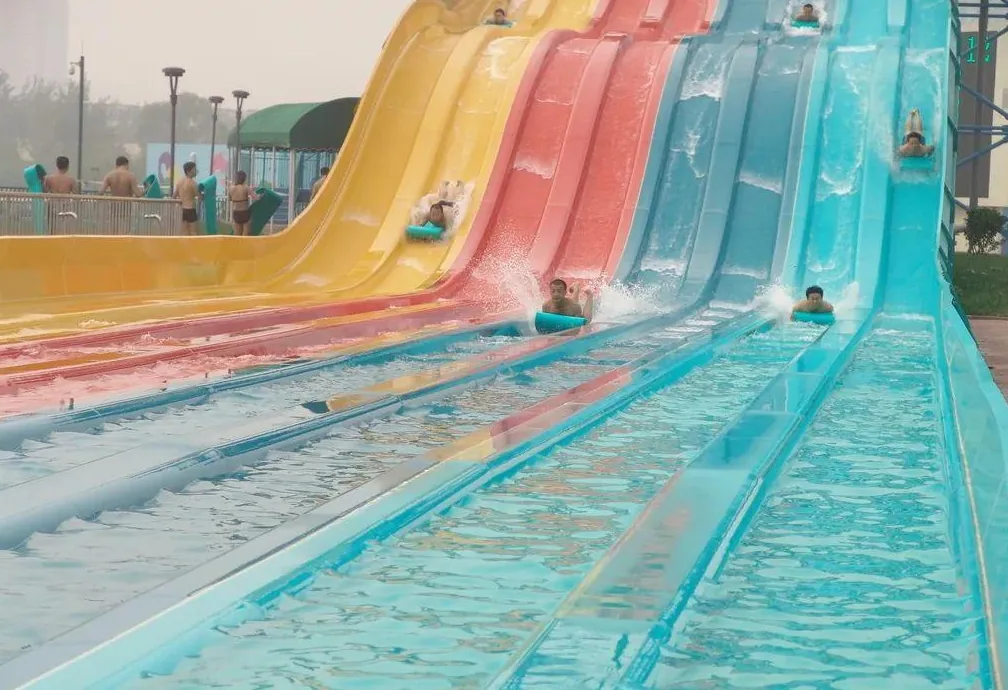
If you want to have the best time, the strategy is to “beat the clock.” The park officially opens at 10:00 AM, and I recommend heading straight for the Deep Sea Tornado (Big Trumpet) and Magic Vortex. These two attractions are the worst for queues; arriving an hour late could mean a 60-minute wait. The Deep Sea Tornado requires groups of four, and staff will weigh you; you cannot ride if individual or total weight limits are exceeded. The weightless sensation of sliding back and forth in that giant funnel is very real and is the most re-rideable attraction in the park.
- Essential Items Checklist: Bring high-density swimwear (slides cause friction, and common materials can be damaged), a waterproof phone pouch (must be leak-tested at home), and non-slip flip-flops (floors are slippery; walking barefoot is an easy way to fall).
- Dining Arrangements: There is a casual dining area on the second floor serving rice sets and noodles, with prices between 50-70 Yuan and average flavors.
- Showering Experience: Peak exit time is after 04:00 PM, and showers become very crowded. I usually go to shower half an hour early to avoid the queue. The showers provide basic toiletries, but if you are particular about your hair, it’s best to bring your own samples.
| Segment | Cost/Time Reference | Personal Insight |
|---|---|---|
| Ticket Booking | Adults approx. 200-260 Yuan | Must be bought a day in advance via the official mini-program; no paper tickets sold on-site. |
| Queuing | 10:00-11:30 | Golden hour; except for the Big Trumpet, other slides basically have no wait. |
| Wave Pool | Every half hour | Waves in the Crazy Tsunami area are quite large; children must wear life jackets, and standing in the back row is safer. |
| Dining Expenses | Approx. 65 Yuan per person | Try the 15 Yuan roasted sausage; it’s very efficient for restoring energy after swimming. |
| Exit Time | Around 16:30 | Exiting now perfectly aligns with dinner at the nearby Xin’ao Shopping Center without long lines. |
In the Crazy Tsunami wave pool, I noticed that every hour and half-hour, the music suddenly gets louder, and everyone surges toward the center of the pool. If you want to feel the sensation of being tossed into the air by waves, try to get closer to the deep area, but make sure to grip the buckles of your life jacket tightly. This physical cooling is much more comfortable than air conditioning and is the most authentic way to beat the heat in Beijing’s summer.
Day 2: Outdoor Rafting Trip at Baihewan, Huairou
To avoid morning peak congestion, I set off from the city promptly at 08:00 AM. Driving is the most convenient way to reach Baihewan. Take the Jingcheng Expressway north, exit at the Huairou toll, and merge onto the national highway. Entering the mountains, the scenery on Provincial Road S213 opens up, but don’t let your guard down; the mountain roads in Baihe Grand Canyon have very sharp and frequent curves, so you must keep a steady hand on the wheel. Reaching Qingshiling in Baihewan takes about two and a half hours. I suggest navigating to “Qingshiling Village,” which is not only a filming location for “Let the Bullets Fly” but also the stretch with the best scenery and longest rafting route.
Before rafting, be sure to spend 10 Yuan at a village stall for a water scoop or a large-capacity water gun. These are definitely not just kids’ toys; they are “survival gear” for rafting. Baihewan is a wetland rafting experience; while it lacks the thrill of massive vertical drops, there are many hidden rocks in the riverbed. Rafts often get stuck, and you’ll need the scoop for bracing or paddling to gain leverage.
At the boarding point, I saw many people brought selfie sticks for photos, but once the water fight started, their phones were basically ruined. My experience: Either lock your phone in the car or use two layers of waterproof bags. Furthermore, even if you are an expert swimmer, you must fasten all buttons on your life jacket. You will pass several small drops with fast currents; if the life jacket isn’t secured, it’s easy to slip out of the raft.
- Route Selection Tip: Stick to the 5-kilometer “Qingshiling” stretch. While there are rafting spots upstream, those channels are narrower with more weeds; the experience is far inferior to the Qingshiling route which offers full canyon views.
- Sun Protection Advice: The rafting takes about 1.5 to 2 hours with no shade on the water. Don’t rely solely on sunscreen, as it washes off instantly. I usually wear long pants and a long-sleeved river trekking shirt, and closed-toe river shoes are a must to protect toes from underwater rocks.
- Logistics Suggestion: While there are basic shower rooms at the finish line, the water pressure is low and only cold. I prefer to dry off with a towel at the car and change into spare clothes. Keep a pair of dry cloth shoes or sneakers in the car, as the sandals you wore will be soaking wet.
Around 01:00 PM is when you’ll be hungriest after rafting. I chose a well-regarded farmhouse by the river, and the main dish must be Huairou Rainbow Trout. These fish require high water quality and are caught fresh from ponds by the river. I suggest the “two-way” preparation: fish head and bones for soup, and the meat braised or grilled. When grilling, tell the owner to be generous with cumin and dried chili powder; that crispy texture paired with the mountain-style corn cakes makes for a very satisfying meal.
| Segment | Details | Cost & Insights |
|---|---|---|
| Driving Route | Jingcheng Expressway Exit 14 – National Highway – Qingshiling Village | Round-trip fuel + tolls approx. 150 Yuan; speed limits are 40-60, do not overtake. |
| Rafting Ticket | Approx. 120-150 Yuan/person on-site | Includes life jacket and raft rental; no deposit required, but don’t lose the wristband. |
| Dining | Rainbow trout charged by weight (approx. 35-50 Yuan/jin) | With two vegetable dishes and staples, it’s about 100 Yuan per person; transparent pricing. |
| Gear Advice | Must prepare a full set of change clothes (including underwear) | There is no such thing as “half-wet” in rafting; even without water fights, water in the raft will soak you. |
Around 03:00 PM, don’t rush back to the city after eating. There are many places to pull over along the banks of the Baihe Grand Canyon. I like to park in the shade and dip my feet in the river. The cultural atmosphere here is unique, with fully equipped fishing enthusiasts and students sketching under parasols. On the way back, if you have the energy, stop by Yanshan Heaven Pool; the mountain reservoir scenery is magnificent and a great spot for photos. Since the Jingcheng Expressway heading into Beijing gets congested around 06:00 PM, I suggest timing your return to avoid this or having dinner in Huairou before heading back.
Day 3: Ice Sports Practice at the National Speed Skating Oval
Around 10:00 AM, as I stepped into the National Speed Skating Oval (commonly known as the “Ice Ribbon”), the outside temperature was approaching 36°C, but inside it was a constant 10°C. This instant cooling is very intense; I recommend you must pack a hoodie and long pants in your bag before leaving. Even if you think you can handle the cold, sliding on the ice for long periods will cause the chill to climb from your ankles; short sleeves and shorts won’t last half an hour.
The ice here is Olympic-grade, using carbon dioxide transcritical refrigeration technology. In simple terms, the ice here is much harder and smoother than the common rinks you find in malls. While skating, I could clearly feel that the blades faced minimal resistance, allowing for very fast starts. But because the ice is hard, falling hurts more than at a regular rink.
I noticed a detail on-site: many beginners had to stop after less than two laps because the rented speed skates chafed their feet. My practical strategy: Bring an extra pair of thick sports socks. The skates provided are generally tight and made of hard material; thick socks not only fill gaps to reduce friction but also protect toes from freezing in the 10-degree temperature. Additionally, protective gear (helmet, knee pads, elbow pads) is mandatory and easy to rent on-site.
- Entry Process Tip: Book in advance via the “National Speed Skating Oval” WeChat mini-program and scan the code at entry. Don’t wait until the entrance to find the code, as summer signals can be unstable.
- Ice Maintenance Time: The ice is cleaned by a Zamboni every few hours. I suggest paying attention to the announcements and entering immediately after the cleaning ends. At that time, the ice is like a mirror, providing the smoothest skating feel.
- Storage & Supplies: There are self-service lockers charged per use. There are basically no full meals inside the venue, only vending machines selling water and simple snacks. I suggest bringing your own bottle of warm water; drinking cold water in a low-temperature environment is actually not comfortable.
At noon, after skating, your energy consumption will be high. I usually walk about ten minutes from the venue to the nearby Beichen Hui Shopping Center. The dining options there are very diverse, ranging from authentic Beijing Zhajiangmian to Western casual food, with average spending between 60-100 Yuan and a much more comfortable environment than inside the venue.
| Segment | Information | Personal Experience |
|---|---|---|
| Transport Guide | Lincuiqiao Station, Metro Line 8, Exit C | A walk of about 500 meters from the exit, the closest entrance to the venue. |
| Cost Details | Ticket + Skating (2 hours) approx. 120 Yuan | Includes skate rental; protective gear rental usually requires an extra 30 Yuan deposit or fee. |
| Pitfall Alert | Avoid weekends 14:00-16:00 | This is the peak time for individual visitors; the rink becomes overcrowded, making it hard to skate and increasing safety risks. |
| Recommended Photo Spot | Second-floor stands on the south side | Here you can capture the full view of the 22 “Ice Ribbons” intertwining; the sunlight coming through adds great texture. |
Around 03:00 PM, if you still have stamina, take a walk along the trails of the Olympic Forest Park. Since the “Ice Ribbon” is on the west side of the South Forest Park, you’ll see many professional runners. The vegetation coverage here is extremely high and surrounded by water systems; even in the afternoon, the shaded paths feel much cooler than the downtown area. I like to find a bench here to sit for a while and observe the unique Beijing summer cicadas and waterfront scenery.
Day 4: Liangma River Waterfront Leisure and Boating
I arranged the final day’s itinerary at the Liangma River, often called “Beijing’s Seine.” There is no entrance fee; it is a very open and relaxed urban waterfront living space. I usually arrive at the SOLANA (Blue Harbor) business district around 04:00 PM, when the sun is no longer piercing and the shimmering water surface looks most textured. I first find a window seat in a riverside cafe to watch kayaking club members practicing and the occasional mallard flying by. The charm of Liangma River is not in luxury, but in that urban atmosphere that manages to force a slow pace in fast-moving Beijing.
Starting from the SOLANA pier, walk west along the trail to the Yansha pier, totaling about 1.8 kilometers. This stretch is what I consider the essence of the entire river. Along the way, you will pass 24 bridges of various styles, each with a unique lighting design. I noticed that around 5 or 6 PM, many professional fishing enthusiasts and sketching students gather along the banks; this international and cross-cultural exchange is particularly evident in the Liangmaqiao area.
Before boarding, I noticed a detail that is easily overlooked: Liangma River cruises are divided into East, West, and Full lines. I highly recommend choosing the Full Line or specific segments that include the “Bogong Lock.” This is because as the boat passes through the lock, you will personally experience the water level rising and falling, which is very rare in an urban river tour. Moreover, the lock features not only a light show but also a short film about the history of Beijing’s water systems, making it a very rich experience.
- Cruise Booking Practicality: Tickets must be purchased via the “Liangma River International Wind Waterfront” official mini-program. I suggest booking the 19:30-20:00 time slot 2-3 days in advance. This period marks the transition from dusk to night, when the landscape lights of the office buildings along the bank light up one by one.
- Riverside Dining Options: High-quality restaurants line both sides of the river. If you prefer a Western atmosphere, the outdoor seating around the Kempinski is a top choice; if you like a lively scene, the waterfront dining street at SOLANA offers more Asian flavors.
- Transport Information: Do not try to find street parking in the Liangmaqiao area. It is extremely prone to traffic jams, and parking fees are very high. The most reliable way is to take Metro Line 10 to Liangmaqiao Station and walk less than 200 meters from Exit C to reach the riverbank.
Around 08:00 PM, as the boat slowly glides under the Liangma Bridge, you’ll see crowds waving from both banks. That interplay of light and shadow will make you temporarily forget you are in an inland city. I chose an Italian restaurant by the river for dinner; although spending is generally around 200-300 Yuan per person, sitting in that spot, feeling the cool summer night breeze, provides an irreplaceable sensory enjoyment.
| Segment | Specific Details | Cost & Personal Advice |
|---|---|---|
| Cruise Experience | Full line ticket approx. 168-218 Yuan/person | Voyage lasts about 45 minutes; choose an open-air seat for a clearer view for photos. |
| Walking Route | SOLANA Pier – Yansha Pier | A walk of about 30 minutes with excellent greenery and many stone benches for resting. |
| Avoid Crowds | Avoid Friday and Saturday nights if possible | These days are peak gathering times for nearby office workers after work, and the trails will be very crowded. |
| Dress Suggestion | Suggest wearing casual yet stylish clothes | This is a highly fashionable area of Beijing and a great place for photography. |
Near 09:00 PM, the night scene of Liangma River truly reaches its climax. If you still have energy, you can walk along the river all the way to the Sanlitun area. This psychological transition from natural quiet to urban bustle is my favorite way to end a summer day in Beijing. This four-day itinerary, from indoor freshness to outdoor coolness and finally this urban elegance, sees the nights of Liangma River bring a very decent conclusion to this water-themed journey.
Keep Reading
- Beijing 5-Day Panoramic Tour|Complete Guide to Three Major Heritage Sites + Two Major Theme Parks + Six Major Museums
- Beijing 6-Day Classic Tour|Day 1 Forbidden City + Temple of Heaven → Day 2 Great Wall Night Tour + Gubei Water Town Hot Springs
- 4-Day Beijing Winter Olympics Legacy Experience | Shougang Park Skiing + Ice Cube Skating + Olympic Village Tour Guide
- 4-Day Beijing Night Tour Route | Liangma River Cruise + Qianmen Night Market + Sanlitun Club & Bar Exploration Guide
- 5-Day Beijing Food Trip | Michelin Restaurants + Hutong Private Kitchens + Time-Honored Breakfast Spots Check-in Map






