



Day 1: Daytime Visit to Dafo Temple, Walking from Beijing Road
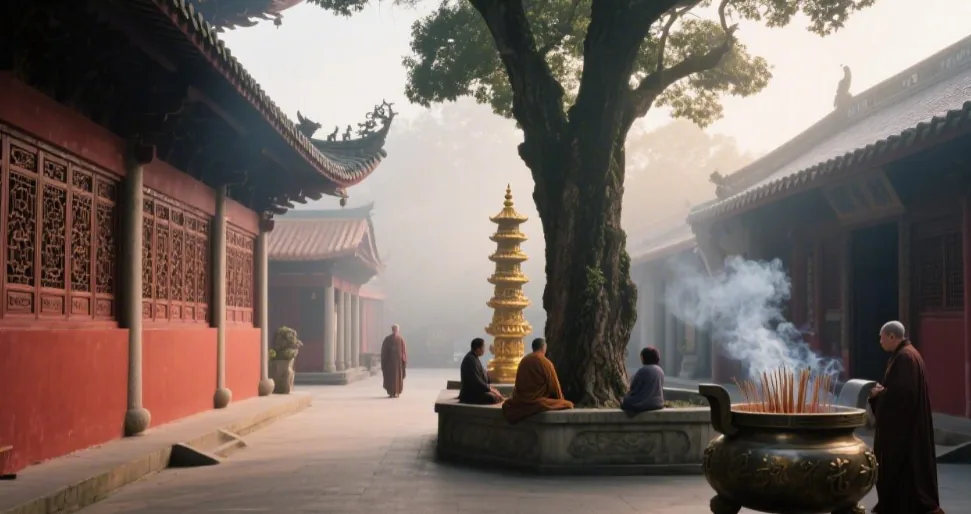
The hotel I stayed in was on a small street on the west side of Beijing Road; as soon as I stepped out and turned right for two minutes, I merged into the bustle of the main street. Around 9:00 am, I had a bowl of pig blood soup and smooth cloth-pull rice rolls at a roadside shop called “Jinxiang Food,” which was an authentic Guangzhou breakfast. Afterward, I was in no rush, so I strolled south along Beijing Road, passing several time-honored bakeries and smelling the aroma of freshly baked chicken biscuits. Near the copper kettle landmark of the “Beijing Road” pedestrian street, I turned into Huifu East Road, and the atmosphere changed instantly. On one side were lively eateries selling beef offal and milk tea; on the other side, after just a few steps, a complex of solemn classical buildings appeared beneath the glass curtain walls of high-rise buildings—that was Dafo Temple. This visual impact is interesting every time I see it.
No ticket is needed to enter the temple; just go in through the mountain gate. The first section is the Hall of the Heavenly Kings, which is relatively compact. Passing through it leads to the open main square, where the Great Buddha Hall stands right before your eyes. It is truly magnificent, especially in contrast with the surrounding modern buildings. As I walked closer, the hall doors were high and wide. Those three main Buddhas are cast in brass, sitting on high lotus pedestals, estimated to be 6 or 7 meters high. In the slightly dim hall, lit by candlelight and natural light, they glowed with a calm and warm luster, looking very imposing. The Arhat statues on both sides of the hall were not rigid clay sculptures; their expressions and postures varied—some in deep thought, others smiling—and the details of the clothing folds were very clear when viewed up close.
- Behind the main hall is a quiet courtyard housing a library and the “Vegetarian Pavillion.” You can enter the library to read for free, and it is very quiet.
- If you arrive in the morning, you might encounter monks chanting; the sound drifts from the hall and echoes in the courtyard, and that sense of resonance naturally makes one lighten their steps.
- The restrooms are on the first floor of the “Pujue Building” and are very clean, which is an important piece of information for tourists exploring the old city area.
I sat down on a side gallery to rest for about 20 minutes. The pillars cast clear shadows, and the wind chimes under the eaves occasionally made a “ding” sound. Watching the tourists—some looking up at the Buddha statues seriously, others guiding companions to find camera angles—the blue smoke from the incense burner rose straight up. Although located in a busy area, it is a small world with its own slow rhythm. Near noon, I decided to have lunch at the “Vegetarian Pavillion” in the temple. It’s a bit like a university cafeteria where you pick dishes with a tray. I ordered a Luo Han Zhai (Buddha’s Delight), a tea tree mushroom soup, and rice, costing a total of 36 yuan. The taste was a refreshing home-style cooking style, not oily, and felt very comfortable for the stomach. If you don’t eat in the temple, there are many choices back on Huifu East Road, ranging from clay pot rice to Southeast Asian cuisine.
| Project | My Specific Experience and Supplementary Details |
|---|---|
| Transportation & Route | Walking from Beijing Road is the top choice. I measured that from Exit E of “Beijing Road” Metro Station, it takes 12 minutes to walk to the mountain gate. The closer station is Exit D of “Gongyuanqian”; come out with your back to Grandbuy Department Store, walk about 200 meters along Zhongshan 4th Road and turn right into Xihu Road, then walk a few dozen meters to see it, taking about 5-7 minutes. Walking under the midday sun is not recommended; early morning or evening is more pleasant. |
| Sightseeing | Besides the brass Buddhas and Arhats in the hall, pay attention to the bronze tripod in front of the hall and the ceramic ridge sculptures on the roof; the craftsmanship is exquisite. The backyard is a pleasant surprise—almost empty, with a fish pond and several pots of lotus flowers, perfect for completely clearing your mind. |
| Experience & Observation | Around 10:00 am on weekdays is a small peak for tour groups; after noon, there are relatively fewer people. Silent photography is allowed inside the hall, but please be sure to turn off the flash. I saw some young people wanting to take photos with the Arhat statues and they were gently discouraged by staff; this should be noted. |
| Expense Record | Tickets and incense are free (donations are welcome). Vegetarian lunch was 36 yuan. Overall expenses were extremely low. There are also places inside the temple selling cultural products and blessing plaques; a blessing plaque costs 20 yuan, which is a voluntary purchase. |
Day 2: Starting at 6:00 pm, Night View of Dafo Temple
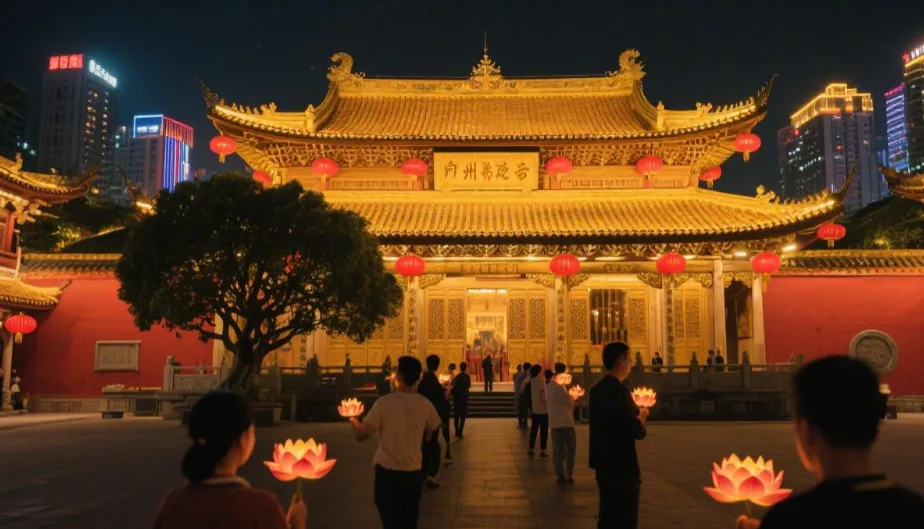
I walked to the temple square at about 5:50 pm. At this time, the sky was a hazy gray-blue, and the daytime heat was beginning to dissipate. The outline lights of the temple buildings had been turned on—a clean bright white that clearly traced the lines of the main hall and the flying eaves of the pavilions, though the buildings themselves still looked dusty gray and the details were not quite clear. There weren’t many people in the square, sitting in groups of twos and threes.
By 7:00 pm, the sky was completely dark, and the effect reached its peak. The entire architectural complex was golden all over; the lighting was very even, without any harsh dark corners or overexposed dead whites. The most amazing part was the rectangular pond in front of the hall; the water surface was as calm as an obsidian mirror, completely and symmetrically reflecting the magnificent halls, lanterns, and even the bronze bells hanging from the eaves. At this time, more people gathered in the square, and almost everyone was taking photos. There were professional photographers with tripods by the pond doing long exposures, while most tourists held up their phones, looking for angles to avoid the crowds.
- Best Angle Practice: The four corners of the pond are popular but crowded. I later found that standing at the midpoint of the pond’s long side (near the mountain gate side), squatting low, and using a wide-angle lens can capture both the full view of the building and the widest water reflection, while also cleverly using the nearby water as a foreground to hide some of the distant crowds.
- Atmospheric Change: During the day, the temple is solemn, filled with incense smoke and chanting. After nightfall, although the buildings themselves are more striking, the overall atmosphere becomes more public and quiet—a silence brought by the beauty, with only the sound of shutters and low exclamations of praise. Some local elderly people sat in the distance fanning themselves and watching quietly, and this scene itself became part of the view.
- Internal Opening Status: At night, the interior of the Great Buddha Hall is closed and cannot be visited. However, you can walk slowly along the outer corridors; the texture of the wood carvings and stone pillars under the lights feels more exquisite than during the day against the backdrop of the night.
I lingered in the square and under the corridors until nearly 8:00 pm. When I left the bright and brilliant square, I stepped right into the bustling atmosphere of the Huifu East Road food street. Just a moment ago it was a quiet pure land of Buddha; in the blink of an eye, I was surrounded by the heat of beef offal pots, the calling of numbers at milk tea shops, and the aroma of barbecue. This transition of extreme contrast, taking less than 3 minutes on foot, was the most memorable part of this experience for me.
| Project | My Specific Observation and Supplementary Details |
|---|---|
| Time & Rhythm | Arriving at 6:00 pm is an ideal choice; you can see the complete transition from sunset to the first lights. From 7:00 to 7:30 is the “golden half-hour” with the most beautiful lighting and darkest sky. After 8:00 pm, the crowd reaches its peak. Lights usually start to turn off after 9:00 pm, though the outline lights of the main building stay on longer. |
| Photography & Observation Tips | When shooting with a phone, it is recommended to lock focus and exposure to prevent flickering. The stone slabs by the pond might be wet, so watch your step. If you want to take portraits, it’s suggested to bring a small fill light, otherwise faces will be dark. Not everyone comes for photos; many citizens come here for cool air or a stroll, so please be courteous to each other. |
| Movement Linkage | After watching the night view, I highly recommend going to Huifu East Road. That night, I chose “Qiaomei Noodle House” to have Five-Treasure Wonton Noodles; it’s a time-honored brand with fair prices, a bowl of noodles for 20+ yuan. It only takes 5 minutes to walk there from the temple. If you want to explore more, Beijing Road Night Market and Wenming Road Tong Sui Street are also within a 10-minute walk. |
| Expense & Reminders | Night viewing is completely free. The whole process does not require entering the temple. The square and surrounding walkways are well-lit, but some courtyard paths inside the temple are dim, so watch your path when visiting. This is a purely visual and cultural experience; besides potential dining costs, there are no other expenses. |
Day 3: Full Day Blessing at Haichuang Temple, Arriving at 9:00 am
I specifically chose a weekday morning and took Metro Line 2 from Gongyuanqian Station towards Guangzhou South Railway Station, riding 4 stops to The 2nd Workers’ Cultural Palace. Coming out of Exit D, I was met with the marketplace atmosphere of the arcade streets, which felt completely different from the commercial feel of Beijing Road. I opened the navigation and walked west along Tongfu Middle Road, passing several old-fashioned barber shops and herbal tea stalls, turned right at the first major intersection into Nanhua Middle Road, and after walking less than a hundred meters, I could see a cluster of tall banyan trees and simple old gable walls. The north gate of Haichuang Temple was right by the road, quite inconspicuous. From the subway exit to the temple gate, I checked the time; it was 8 minutes.
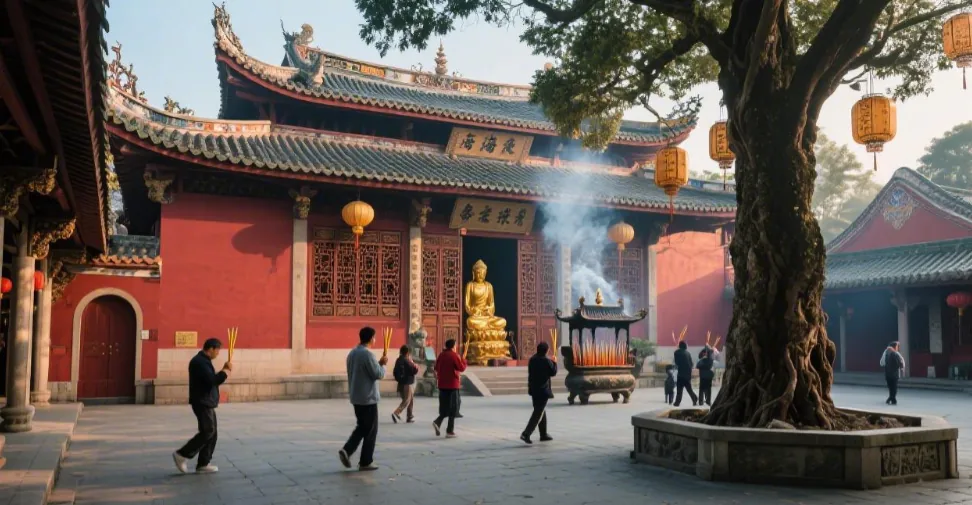
I first walked along the central axis. The Great Buddha Hall is majestic, but unlike the magnificence of Dafo Temple, the wooden structures and paintings here appear more ancient and even somewhat mottled, which actually gives a greater sense of history. The incense burner in front of the hall was full of incense, with blue smoke curling up. I didn’t rush to offer incense but instead went around to the Pagoda Hall on the side. What impressed me most was the “Tiger Turning its Head” stone; it was right on the lawn next to the Pagoda Hall, and without paying attention, it just looked like a large ordinary rock. But as I got closer and looked from a specific angle, the undulating lines indeed looked like a crouching tiger turning its head to look back; the form was very vivid. There was a simple text introduction nearby saying it was a relic from the Qing Dynasty.
- The Release Pond is a must-visit place; it is not on the central axis but on the east side of the temple. It is a large pond with slightly green water, and it is densely packed with turtles. They lie on the rocks and dead wood protruding from the water to sunbathe, stacked like pyramids, motionless. There was a master periodically throwing vegetable leaves into the pond, which was quite a sight.
- There are many cats in the temple; they are not afraid of people and lie or stroll lazily under the corridors and by the tree roots, adding a bit of vitality to this quiet space.
- “Shuzhai Restaurant” is near the Release Pond; it’s a simple single-story cafeteria. At noon, I ordered a bowl of fresh mushroom wonton noodles for 15 yuan. The wontons had a vegetarian filling with wood ear mushrooms and vegetables, and the broth was made from mushrooms and was very sweet. While eating, the other few tables were filled with temple volunteers or elderly regulars chatting in low-voiced Cantonese about family matters; the atmosphere felt very communal.
The afternoon was completely leisurely. I sat on a stone bench by the Release Pond for nearly two hours, just watching the turtles slowly paddle and compete for good sunbathing spots. A few local elderly people sat not far away, fanning themselves and chatting in Cantonese that I only half-understood—the content was mostly about prices, grandchildren, and health. Occasionally, monks walked by quickly, their robes fluttering. There was almost no tourist noise here, and time seemed to slow down. You can go to the back garden to see the rockeries and pavilions; it is more hidden and better for experiencing the feeling of “how deep the courtyard is.”
| Project | My Specific Experience and Supplementary Details |
|---|---|
| Transportation & Entrance | Exit D of “The 2nd Workers’ Cultural Palace” Station on Metro Line 2 is the most convenient. Come out and go straight, turn right at the intersection of “Qiankou Market” (Nanhua Middle Road), and you will soon see the north gate. If you see a busy vegetable market, it means you’re going the right way. The south gate (main gate) of the temple is on Tongfu Middle Road, but the north gate is closer to the subway. Tickets are 5 yuan, cash only, so be sure to prepare change in advance. |
| Sightseeing | The Great Buddha Hall, Hall of Heavenly Kings, and Pagoda Hall on the central axis are the main parts. The “Tiger Turning its Head” stone is on the lawn by the Pagoda Hall; remember to find the sign. The Release Pond on the east side and the surrounding gardens are the highlights, perfect for sitting quietly. The back garden is deeper with pavilion landscapes. |
| Experience & Observation | There are far more local worshippers and elderly people here than tourists. There are often Buddhist services in the morning with melodious chanting. It is quietest from noon to afternoon. Many places in the temple are practice and office areas with clear signs; please be careful not to intrude. The environment is extremely quiet; please naturally lower your voice when speaking. |
| Expense Record | Ticket (Incense-flower ticket): 5 yuan (cash). Wonton noodles at “Shuzhai Restaurant”: 15 yuan. No other consumption. This was the day with the lowest spending but the most inner peace gained in the five-day trip. |
Day 4: Nengren Temple Zen Experience, Combined with a Stroll on Baiyun Mountain
I set out from Gongyuanqian Station at 8:30 am and took Line 2 towards Jiahewanggang. I got off at “Baiyun Park” station and came out from Exit C. This is not the foot of the mountain; the surrounding area consists of modern buildings. I used a ride-hailing app at the roadside to call a car to “Baiyun Mountain Scenic Area South Gate (Yuntai Garden),” which cost about 12 yuan and took less than 10 minutes. If time permits, you can also transfer to a bus after exiting the subway, but calling a car is the easiest way to save your energy for climbing.
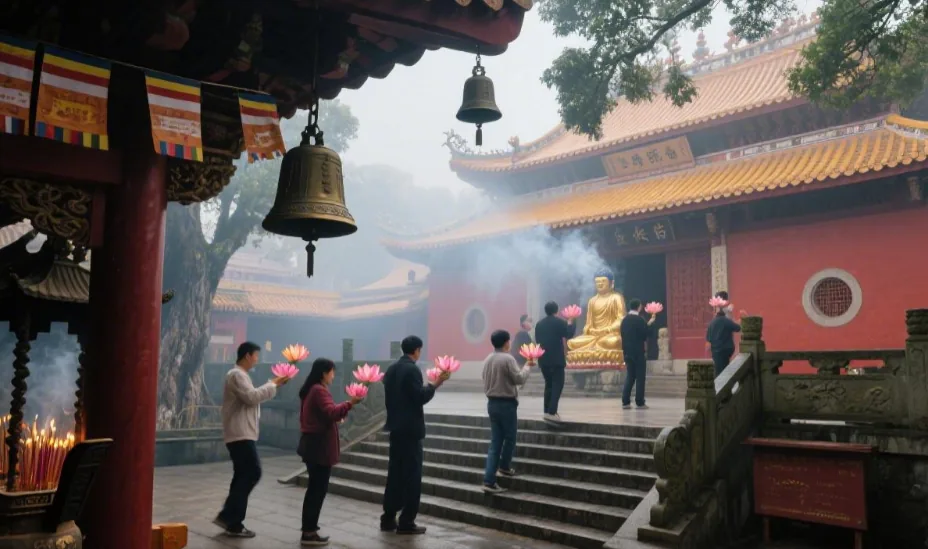
Turning into the fork, the atmosphere changed immediately. The openness of the main road was replaced by dense forests; stone steps meandered upward, and the clear sound of running water began to be heard. After a few dozen more steps, a simple stone arch-style mountain gate stood before me, with “Nengren Ancient Temple” written on it. Behind the gate was a long, steep flight of stone steps that seemed endless, plunging deep into the green shade. This scene at the entrance felt like a completely different world from the modernized Guangzhou at the foot of the mountain.
- Climbing Experience: This flight of stone steps is the official entrance to the temple, with about a hundred steps; it makes you a bit breathless. But with every step, you feel further away from the noise. On both sides of the steps is an intense green; ferns grow out of the rock cracks, and the air is misty with moisture.
- Temple Layout: Nengren Temple is built layer by layer according to the mountain slope. After passing through the mountain gate and the Hall of Heavenly Kings, there is a platform with the Great Buddha Hall. But its charm lies in the fact that you can continue to explore upward along the side steps; there are small scenes like Yuhong Pond, Ganlu Spring, and Hupao Spring above. Each level has different halls and courtyards shaded by giant old banyans and Bodhi trees, making it very deep and secluded.
- Feelings: The biggest characteristics here are “quiet” and “hidden.” There are far fewer worshippers than in city temples, and occasionally you can see monks walking quietly by. In a side courtyard, I saw a master sweeping fallen leaves; the “rustle” of the bamboo broom over the ground mixed with the chirping of unknown birds, creating a kind of quietness that has sound. Standing on a higher platform and looking back, one can only see layered flying eaves and lush greenery, making it impossible to imagine that the bustling city is just outside the mountain.
After visiting the temple, I returned the same way to the main road and continued toward the Peak Square. The road ahead had a steeper slope, but the scenery got better, with glimpses of the city outline between the trees. It took about another 40 minutes to walk to the Peak Square. The square has a wide view overlooking the city of Guangzhou; although there was some light fog that day, the feeling of having “Ram City” at my feet was still great. I really didn’t want to walk down the mountain anymore, so I bought a one-way cable car ticket (20 yuan) at the station next to the square and slowly slid down to Pugu at the foot of the mountain in about 10 minutes.
| Project | My Specific Experience and Supplementary Details |
|---|---|
| Transportation & Route Details | Subway + calling a car is the optimal solution. When calling a car, please specify “Yuntai Garden/Baiyun Mountain South Gate,” which is the main entrance. Ticket is 5 yuan, cash only, so be sure to prepare change in advance. After entering, walk along the main road toward “Mingchun Valley/Peak Square,” and turn left when you see the “Nengren Temple” indicator stone. |
| Temple Visit Tips | No separate ticket is required for Nengren Temple. There are multiple springs and ponds in the temple with very clear water. There is a tea house by Hupao Spring where you can make tea with spring water (for a fee). The whole temple tour takes 1 to 1.5 hours if you walk carefully. Some steps are steep, so it’s recommended to wear non-slip shoes. |
| Energy & Time Arrangement | My route (South Gate – walking to Nengren Temple – walking to Peak Square – cable car down) took a total of about 4 hours (including sightseeing and rest), covering a distance of about 6 km, which is moderate to easy intensity. If your energy is limited, you can choose a one-way battery car either up or down (about 20 yuan one-way; the station is near the Nengren Temple fork). |
| Expense Record | Baiyun Mountain ticket: 5 yuan (cash). One-way cable car down: 20 yuan (mobile payment allowed). Car ride: about 12 yuan. Brought my own water and snacks. Total about 37 yuan. Prices for water and food on the mountain are high, with a bottle of water costing 5-8 yuan, so bringing your own is suggested. |
Day 5: Departing from Hotel at 3:00 pm, Return Arrangements
After eating, I walked back to the hotel along the alley and saw an auntie selling freshly picked wampees and longans on the roadside, so I bought a small bag. Back in the room, I stuffed the last few clothes into the suitcase, leaned by the window to watch the busy street below for a while, and ate a few sweet wampees. Scenes from the first four days—the brilliant night view of Dafo Temple, the turtles all over Haichuang Temple, the stone steps and clear springs of Nengren Temple—flashed back in my mind like a movie. This trip had no tight schedule, but my heart felt very full.
- Going to Guangzhou South Railway Station (High-speed Rail): Staying near Beijing Road, the closest option is to walk to “Gongyuanqian” Metro Station and take Line 2 (towards Guangzhou South Railway Station). The whole journey takes about 50 minutes (including transfer and walking). Metro fare is 7 yuan. This is the most punctual way and is not affected by road conditions.
- Going to Baiyun Airport: Similarly, depart from “Gongyuanqian” station, take Line 2 (towards Jiahewanggang), get off at “Jiahewanggang” station, and transfer at the same station to the North Extension of Line 3 (towards Airport North) to go directly to the airport. The whole journey takes about 80 minutes with a fare of 8 yuan. Be sure to pay attention to the signs in the station to distinguish between trains going to Airport South (T1) or Airport North (T2).
I roughly calculated the expenses for these five days: accommodation (economy hotel) was the main part, averaging about 300 yuan per night, totaling 1200 yuan for four nights; eating was quite casual, including morning tea, simple meals, and night market snacks, averaging about 100 yuan per day, totaling 500 yuan; city transportation (metro, occasional ride-hailing) and attraction tickets (mainly 5 yuan for Baiyun Mountain and 5 yuan for Haichuang Temple) added up to less than 150 yuan. The total was about 1850 yuan. My biggest feeling is that the main expenses were on the practical experiences of “staying” and “eating,” while the most touching Zen atmosphere of temples and city strolls cost almost nothing.
| Project | My Specific Operations and Suggestions |
|---|---|
| Morning Tea Choice | You don’t necessarily have to go to popular shops with long queues. The “Silver Light Restaurant” I went to on Qiyi Road has many locals and authentic flavors. If you stay in the Beijing Road area, “Dim Dou Duck” and “Wing Wah Restaurant” are also good choices. The morning tea period (usually until 11:00 am) has the most complete dishes. |
| Luggage Storage | Most hotels provide free luggage storage service even after check-out. It’s recommended to confirm this in advance when booking or checking in. If the hotel doesn’t provide it, major metro stations or business districts might have paid storage lockers. |
| Transportation Choice | For going to the airport or South Station, the metro is absolutely the first choice—punctual and cheap. Departing at 3:00 pm reserves enough time for check-in or security (suggested 2 hours for the airport, 1 hour for South Station). Using the Guangzhou Metro code on WeChat or Alipay is very convenient. |
| Expense Review | Accommodation (economy): about 1200 yuan; Dining (including morning tea, main meals, snacks): about 500 yuan; Transportation & Tickets: <150 yuan. Total <1850 yuan. This is a trip focused on inner experience rather than material consumption; it’s very flexible and can be cheap or expensive. |
Keep Reading
- 5-Day Lingnan Private Garden Tour in Guangzhou | Yuyin Shanfang + Baomo Garden, Immersively Experience Cantonese Carved Beams and Painted Rafters
- 5-Day Historical Tour of Guangzhou | Museum of the Nanyue King + Sun Yat-sen Memorial Hall + Peasant Movement Institute, A Millennium-Old Pilgrimage to Yangcheng’s Historic Sites
- 4-Day Guangzhou Foodie Adventure | Xihua Road Snacks + Panxi Restaurant + Fangcun Banyan Tree Head, Foodie’s Hidden Local Food Map
- Guangzhou 4-Day Hiking Tour | Baiyun Mountain Crossing + Huolushan Forest Park + Niutou Mountain, Hardcore Off-Road Route for Outdoor Enthusiasts
- Guangzhou 5-Day Citywalk | Tianhe South Road No.1 + Tiyu Xilu Heng Street + Liede Village, Hidden Alley Treasures Behind the Prosperous CBD






