



Key pitfalls to avoid for a family trip to Yunnan: First, the climate is unpredictable. While Kunming enjoys spring-like weather year-round (15-25°C), the temperature difference between day and night in Shangri-La can exceed 15°C, requiring layered clothing. Second, the travel intensity is high. Attractions in Yunnan are scattered, with daily driving times often exceeding 4-6 hours; for those with children, it is recommended to schedule 1 relaxed day for every 2 days of travel. Third, regarding attraction selection, avoid high altitudes (e.g., Meili Snow Mountain > 3000 meters) to prevent altitude sickness. Prioritize well-developed areas like Dali and Lijiang, which offer better facilities for safety and comfort.
Climate Change and Altitude Sickness
The elevation span of popular tourist routes in Yunnan is enormous: Kunming is at 1900 meters, Dali at 2000 meters, Lijiang at 2400 meters, and Shangri-La exceeds 3300 meters. For every 1000 meters of ascent, oxygen content drops by 10% and temperature decreases by 6°C. At 3300 meters, oxygen levels are only 68% of those at sea level. Children have faster metabolisms, with breathing frequencies 20% higher than adults, making them highly susceptible to blood oxygen saturation falling below 90% in high-altitude environments. In Northwest Yunnan, the UV index frequently breaks 10, and diurnal temperature swings reach 15°C.
Blood Oxygen Monitoring Indicators
When taking a child to high altitudes, relying on visual cues like facial color is often too late; a fingertip pulse oximeter is the most objective “alarm.” In Kunming or Dali (elevation approx. 2000 meters), a child’s blood oxygen saturation (SpO2) typically stays between 93% and 96%. Once the journey reaches Shangri-La at 3300 meters, where oxygen levels are only 60% of sea level, the child’s heart rate will compensatorily increase to 110-130 beats per minute.
If the monitor shows a value below 88%, and the child exhibits blue lips, refusal to eat, or abnormal lethargy, it indicates the body is struggling to compensate. At this point, rest immediately and provide low-flow oxygen at 1-2 liters per minute. Usually, after 15 minutes of oxygen inhalation, blood oxygen can rise back above 92%. If the value continues to drop after oxygen or is accompanied by a severe dry cough, decisively retreat to lower altitudes like Lijiang.
- Warm Hands Before Testing: Cold hands and feet at high altitudes cause poor peripheral circulation, leading to readings 3-5 points lower than actual. Rub the child’s fingers warm before clipping the device to ensure accuracy.
- Measure While Still: Blood oxygen fluctuates instantly after a child runs, jumps, or cries. Let the child sit quietly for 3-5 minutes before measuring to get the most stable value.
- Compare with Baseline: Measure a “baseline value” at sea level before departure (usually 98%-99%). During the Yunnan trip, as long as the value is not more than 10% lower than the baseline, there is usually no need for excessive worry.
High-altitude hypoxia depends not only on values but also on respiratory rate. The normal breathing rate for a 3-5-year-old is about 20-25 times per minute. If you find the child breathing more than 35 times per minute while sitting still, even if blood oxygen is around 90%, it indicates significant lung pressure. This digital monitoring allows you to predict risks 2 hours before the child truly becomes distressed.
The period from 2 AM to 4 AM is a critical monitoring window. Because breathing becomes shallower during sleep, a child’s blood oxygen can easily experience a temporary dip. If values hover around 80%, even if the child doesn’t wake up, try adjusting the pillow height or providing trace oxygen to prevent deep hypoxia from causing cerebral edema.
For every 100 meters of ascent, atmospheric pressure drops by about 10 hPa. When ascending from the Lijiang Jade Dragon Snow Mountain cableway station (3356 meters) to Glacier Park (4506 meters), this 1150-meter gap causes blood oxygen to change drastically within 10 minutes. If you find the child’s value plunging from 90% to 75%, ignore how beautiful the scenery is and take the cable car down immediately.
- Nail Condition: Even children’s nail stickers can block infrared penetration, causing an error of 2%-4%. Ensure they are clean before measuring.
- PI Value Reference: Many oximeters show PI (Perfusion Index). If the value is below 4.0, peripheral circulation is too poor, making the blood oxygen reading unreliable.
- Heart Rate Sync: If heart rate breaks 150 bpm while blood oxygen drops, the heart is overworking—this is the body’s cry for help.
The low-oxygen environment at high altitude causes a compensatory increase in red blood cells, but this takes 3-5 days. During the first 48 hours in Lijiang, a child’s blood oxygen readings are the most unstable. Record values for morning, noon, and night; if the fluctuation exceeds 5%, it means the child has not yet adapted to the current altitude, and the schedule should be pushed back.
Many people only use oxygen canisters for a few puffs when the child feels unwell; this is actually ineffective. When blood oxygen is below 85%, continuous low-flow oxygen is needed until the oximeter reading stays stable at 90% or above for at least 20 minutes to allow the body’s acid-base balance to recover.
Descending in altitude is the fastest way to resolve low blood oxygen. Retreating from Shangri-La (3300 meters) to Dali (2000 meters), a 1300-meter drop, can increase oxygen partial pressure in the blood by about 20%. Usually, within 1 hour of descending, the child’s blood oxygen can rebound from the 80% range to around 94%, and their spirit will immediately improve.
The oximeter in a parent’s hand is like a cockpit instrument panel. Measure every 4 hours and record the data in a memo. If you find blood oxygen sliding at a rate of 1% per hour for three consecutive measurements, this is more dangerous than a sudden low score. It signals that the child’s stamina is being exhausted, and action (sugar, water, oxygen) must be taken before the value falls below 85%.
- Reading Delay: Civilian oximeters have a 5-10 second calculation delay. Don’t rush to read after clipping it on; wait for the waveform to stabilize.
- Light Interference: Under strong direct sunlight on snow mountains, measure away from the sun. Strong light can interfere with the sensor, leading to falsely high readings and a false sense of security.
- Battery Check: Low temperatures at high altitudes shorten lithium battery life by 30%. Low power decreases infrared generator output, causing erratic blood oxygen readings.
Temperature and UV Rays
In places with altitudes of 2,000 to 3,000 meters, UV intensity is 40% to 50% higher than at the seaside. For every 1000 meters gained, UV levels increase by about 12%. A child’s skin is only 1/3 as thick as an adult’s. Spending 20 minutes in the sun in Kunming (1900 meters) causes damage equivalent to an hour at sea level, easily leading to erythema.
Even if the forecast says cloudy, clouds cannot block 80% of long-wave UV (UVA). In Lijiang (2400 meters), the UV index (UVI) often jumps above 12, which is defined as “Extreme.” If parents only see a temperature of 20 degrees and think it’s cool, failing to apply sunscreen, the child’s face will surely peel by evening.
- Altitude-Temperature Ratio: For every 100 meters of elevation gain, the temperature drops an average of 0.6 degrees. If Dali Old Town (2000m) is 20 degrees, the top of Ximatan Cableway (3900m) will only be 8.6 degrees.
- Diurnal Data: Diurnal temperature variation in Yunnan hovers between 12 to 15 degrees year-round. It might be short-sleeve weather at 2 PM, but by 8 PM, it will drop below 10 degrees.
- Sunscreen Standards: You must choose SPF50+ and PA++++. Apply 2 mg per square centimeter of skin for it to be effective—about the size of a coin for the whole face.
Such drastic temperature changes are a test for a child’s respiratory tract. When the temperature drops to 5-8 degrees at night, cold air stimulates the bronchi, causing midnight coughing. In high-altitude areas like Shangri-La (3300 meters), the perceived temperature at dawn can even drop below zero. Wearing the wrong clothes here makes the probability of catching a cold or fever 3 times higher than usual, which can even trigger altitude sickness.
| City | Altitude | Peak UV | Noon Avg Temp | Dawn Avg Temp |
|---|---|---|---|---|
| Kunming | 1891m | 9-11 | 21°C | 9°C |
| Dali | 2090m | 10-12 | 20°C | 7°C |
| Lijiang | 2418m | 12-14 | 18°C | 5°C |
| Shangri-La | 3280m | 15+ | 13°C | -2°C |
Many parents like to put children in pure cotton undershirts because they are breathable, but this is a mistake in the highlands. Cotton stays wet once it absorbs sweat, and evaporation can strip away more than 20% of body heat. In the wind of 3000 meters, this heat loss is magnified. It’s better to switch to a polyester quick-dry shirt of about 150g, topped with a fleece-lined jacket.
- Hat Width: The sun hat brim must be wider than 7 cm. This covers 70% of the child’s face from direct light, reducing sunburn rates on the forehead and nose.
- Sunglasses Grade: Reflection from snow or lake surfaces is extremely strong. Choose Cat.3 polarized lenses with a light transmission rate between 8% and 18%, which can block 99% of UV rays.
- Reapplication Frequency: Children sweat a lot while playing outdoors, and sunscreen effectiveness decays by 30% every 2 hours. You must reapply every two hours.
When the sun sets behind the mountains, the temperature drops at a rate of 3 to 5 degrees per hour. Walking in Lijiang Old Town, moving from a sun-drenched stone road to a shaded alley can cause a perceived temperature difference of 8 degrees. This “hot and cold” alternation can trigger a child’s immune system, leading to a runny nose. Always keep a 200g lightweight down vest in your bag.
This “mountainous” climate also has extremely low humidity. Above 3000 meters in Yunnan, relative humidity is often below 25%. This acts like a natural pump, constantly drawing water from the child’s skin. Applying about 1.5 ml of high-efficiency moisturizer daily can reduce the risk of skin flaking by 10%.
- Eye Protection: Strong UV reaches the retina directly. Children under 5 have high lens transparency; inadequate protection increases the risk of retinal damage by 15%.
- Indoor Nighttime: If the hotel heating is set to 26 degrees, combined with dry mountain air, children may wake up with blood scabs in their noses. Placing a basin of water by the bed increases humidity by 10%.
- Physical Shielding: Wearing UPF50+ sun protection clothing is 2 times more effective than applying three layers of sunscreen, which is especially useful when climbing snow mountains.
As soon as the sun sets, wind speeds usually increase to 5 to 8 meters per second. In the valley terrain of Lijiang, valley winds can lower the perceived temperature by another 3 to 4 degrees. Avoid staying outdoors too long at this time; after 9 PM in Kunming or Dali, outdoor temperatures are basically below 10 degrees, which is a challenge for children used to air-conditioned rooms.
For every 1000 meters of ascent, the boiling point of water drops by 3.2 degrees. Bath water temperature should not exceed 40 degrees, as too hot water strips the skin’s lipid film faster. In Shangri-La, if a bath exceeds 15 minutes, the steam can deplete a significant amount of body oxygen, making the child feel faint.
- Sunscreen Dead Zones: The back of the neck, ear tips, and ankles have a sunburn rate as high as 85%. Don’t forget these areas when reapplying.
- Lip Care: Buy a lip balm containing beeswax. With the mountain wind, the probability of cracked and bleeding lips is 5 times higher than on the plains.
- Avoid Specific Times: 11 AM to 3 PM is the high-risk period when the UV Index (UVI) breaks 13. Try to keep children indoors during this time for wood carving or tie-dyeing.
The higher the altitude, the greater the temperature difference between sun and shade. In Pudacuo at 3300 meters, it might be 18 degrees in the sun but only 10 degrees in the shade. This extreme “microclimate” requires parents to dress and undress their children accordingly. Don’t find it troublesome; this is the data baseline for keeping a child from getting sick during high-altitude travel.
Energy Supplementation
Although the altitude of Kunming and Dali is only around 2000 meters, air humidity often falls below 25%. A 20 kg child’s breathing frequency is more than 1.5 times that of an adult; the water lost through breathing alone every day is equivalent to 2 bottles of 350 ml mineral water. If you don’t aggressively hydrate the child, the blood will thicken, oxygen-carrying capacity will drop by more than 10%, and altitude sickness will arrive early.
In Shangri-La at 3300 meters, the body’s basal metabolism will be 12% to 18% higher than at sea level to maintain body temperature and a normal heartbeat. Children will get hungry more easily and should be fed every 2 hours. But avoid heavy meat meals; digesting high protein consumes 20% more lung oxygen than digesting carbohydrates, making breathing more difficult.
- Flower Cakes: Contain about 35g of sugar per 100g. Walking for 1 hour at 3000 meters consumes energy equivalent to 1.8 hours at sea level; it is an excellent short-term “power bank.”
- Glucose Tubes: Choose 20ml specifications. When a child’s blood sugar drops below 4.0 mmol/L and they start to flag, drinking one tube works in 3 minutes to relieve heart palpitations.
- Oral Rehydration Salts III: Mix one packet with 250 ml of warm water. With a sodium concentration around 75 mmol/L, it is specifically designed to combat exhaustion from excessive sweating.
Hydrate with rhythm. Let the child take a few sips of 45-degree warm water every 40 minutes, rather than gulping 300 ml at once when extremely thirsty, which would instantly increase the heart’s burden.
Dinner should be kept to 70% full. In high-altitude environments, gastrointestinal motility slows down by 15% to 20%. If the child eats too much, blood will rush to aid digestion, causing brain blood oxygen to drop below the 90% safety line. Many children wake up crying at night due to shortness of breath, which is actually because a full stomach is pressing against the diaphragm.
For chocolate, choose 70% concentration; the flavanols can dilate blood vessels and increase microcirculation efficiency by 15%. Before taking a child up a snow mountain, give them two 10g small packages to withstand the energy gap of high-altitude cold for at least 20 minutes. These “calorie bombs” are more effective than regular meals at altitudes above 4000 meters.
- Breakfast Standard: 80g of oatmeal with a boiled egg—this slow-release sugar combo provides long-term energy for 4 hours.
- Afternoon Snack: About 150g of apple or orange. Vitamin C reduces oxidative damage to cells from altitude free radicals by 12%.
- Bedtime Supply: 100 ml of warm milk. The tryptophan helps the child sleep more deeply in low-oxygen environments, preventing low-oxygen insomnia.
Yak jerky, while a Yunnan specialty, is a high-hardness protein. For every 50g of jerky eaten, the intestines need 3 hours of continuous work; it is not suitable for eating while climbing or during long drives.
Water temperature must not be lower than 40 degrees. Atmospheric pressure is low at high altitudes, and drinking cold water causes 30% extra gastrointestinal muscle spasm consumption. Walking about 3 km in Dali Old Town consumes about 120 kcal for a child, equivalent to the energy of 2 medium-sized steamed buns.
Daily salt intake must be kept strictly below 5 grams. High-altitude environments already cause facial and foot swelling; too much salt causes the body to lock in more water. Tissue edema increases the heart’s circulatory load by 8%. Try to avoid instant noodles; the seasoning packet alone contains more than 4 grams of salt, and the child’s eyelids will surely be swollen the next day.
- B-Complex Vitamins: Supplementing a little daily can improve nerve conduction efficiency and reduce motion sickness during long drives by about 10%.
- Pure Hawthorn Strips: The organic acids in 20g of hawthorn can increase gastric motility by 10%, resolving vague chest tightness caused by indigestion.
- Electrolyte Powder: Drink once for every 500 meters of ascent to maintain the balance of cellular osmotic pressure.
Don’t give children large amounts of carbonated drinks at 3000 meters. Gas will expand by about 20% in the stomach, pressing against the diaphragm, making breathing harder and even causing vomiting.
Previously, a parent gave a child 500ml of cold cola on Jade Dragon Snow Mountain; the combination of CO2 expansion and low-oxygen pressure sent the child’s heart rate to 160 bpm. It’s better to switch to warm concentrated glucose water, 30 ml at a time, drunk in three small sips. This is more effective than any panacea.
After 8 PM, try not to let the child drink more than 150 ml of water. Midnight temperatures at high altitudes are usually around 5 degrees, and frequent trips to the bathroom make it extremely easy for a child to catch a cold. Once a cold is caught, the risk of high-altitude pulmonary edema jumps from a tiny fraction to about 3%, which is no joke.
High-altitude environments lead to a compensatory increase in hemoglobin, making iron consumption 15% higher than on the plains. Dinner can include about 60g of lean red meat or pig liver to help the child’s blood-making system “update” quickly. If you notice a child’s lip color darkening during play, check if sugar supply has cut off, besides providing oxygen.
- Sealed Fruit Puree: 90g per tube, choose ones rich in potassium to effectively prevent muscle soreness.
- Simple Rehydration: 1g of salt and 10g of sugar in 200ml of warm water is a rustic way to prevent emergency exhaustion.
- Cheese Sticks: High calcium and high calorie, 20g can sustain an hour of high-intensity physical activity.
For every 1000 meters of ascent, the boiling point of water drops by about 3 degrees. Above 3000 meters, water boils at around 90 degrees. When making formula or eating self-heating rice, let it sit for 5 minutes longer than usual. Otherwise, undercooked starch will cause bloating, which squeezes the lungs and reduces effective breathing by 5%.
Travel Intensity
Distances between popular cities in Yunnan are mostly over 150-200 km, and the altitude gap between Dali (2000 meters) and Shangri-La (3300 meters) is 1300 meters. Children’s physiological feedback to oxygen changes is 20% faster than adults’. It is recommended that daily driving not exceed 3 hours, walking be kept within 5 km, and indoor activities be arranged between 12:00-15:00 to avoid strong UV rays.
How to Shorten Travel Time
Kunming to Dali is about 330 km, and Dali to Lijiang is about 140 km. If you choose a bus for these distances, you’ll spend 5 hours and 2.5 hours on the highway. For children aged 3-6, sitting in a car for more than 2 hours sends the motion sickness rate from 10% to over 40%. Yunnan has many mountain roads; frequent curves and braking will cause strong nausea, leaving the child with no energy to play upon arrival.
The high-speed train is the most stable option. Kunming South to Dali Station takes only 1 hour and 57 minutes at the fastest, and second-class seats are 30% roomier than a car. Children can stand up and walk around, and bathroom access is unrestricted. This “dynamic rest” can reduce a child’s anxiety by 50%. It’s recommended to choose departures between 9 AM and 11 AM when children are most energetic; they can read picture books or eat snacks, and the trip will pass quickly.
- Time-Saving Tips:
- Call a taxi 20 minutes early: Traffic to the station in Kunming is common; allow 50 minutes to be safe.
- Choose window seats: Seats A and F offer views to distract the child and reduce fussiness from boredom.
- Station Transfer: Pre-book a ride-hailing car upon arrival instead of queuing for a taxi, which usually takes an extra 30 minutes.
If you must drive, average speeds on the Hangzhou-Ruili or Dali-Lijiang Highways are usually only 80-100 km/h. Road conditions in Yunnan are complex with dense tunnel clusters, some over 5 km long. In this enclosed environment, CO2 levels rise quickly. It’s recommended to stop at a service area for 15 minutes every 90 minutes of driving. Letting the child run around and breathe fresh air effectively prevents “power-down” meltdowns in the latter half of the trip.
| Travel Mode | Kunming-Dali (Duration) | Lijiang-Shangri-La (Duration) | Target Audience |
|---|---|---|---|
| High-speed Train | 2 hours | 1.2 hours | Families seeking efficiency and avoiding motion sickness |
| Private Car | 5 hours | 3.5 hours | Families wanting flexible stops and with lots of luggage |
| Shuttle Bus | 5.5 hours | 4 hours | Families with limited budget and high physical stamina |
On the road from Lijiang to Shangri-La, the altitude climbs steeply from 2400 meters to 3300 meters. Although this section is only about 170 km, it has steep slopes and sharp turns. If driving, avoid the old road and take the Xiang-Li Highway. Although it costs a few dozen yuan in tolls, it saves 1.5 hours of winding mountain roads. Saving dozens of turns is worth more than any price for a child’s stomach comfort.
Calculate “invisible time” for city transport too. From Dali Old Town to Longkan Wharf is about 5 km—a 1-hour walk but only 15 minutes by car. Don’t try to save those 20 yuan on short transfers. When traveling with a child, physical energy is the most expensive cost. Use the saved energy for cycling by Erhai Lake or feeding seagulls; the child’s positive memories will increase by over 70%.
- Details to Reduce Waiting:
- E-tickets: Buy online in advance to avoid 40-minute onsite queues.
- Off-peak Dining: Eat lunch at 11:30 and dinner at 17:30 to avoid 1-hour peak restaurant waits.
- Lighten the Load: Store luggage at the station or hotel; don’t wait for a car with suitcases at the gate, which drains parental patience.
When renting a car, choose one with more horsepower for stable speeds on mountain slopes. For EVs, check for charging piles; the gap could exceed 100 km between Dali and Lugu Lake. Detouring for charging can ruin a whole afternoon. For family trips, gas or hybrid cars have much higher fault tolerance than pure EVs, saving you the anxiety of finding charging points.
Many parents like staying far away for “tranquility,” but if it takes 40 minutes to reach an attraction, the round trip is nearly 1.5 hours. It’s better to stay within a 2 km radius of attractions or near transport hubs. Spending an extra 100 yuan on a room to get 1 hour more sleep is vital for a child’s immunity and mood. A well-rested child cries 60% less on the road.
- Screening Private Drivers:
- Non-smoking: Yunnan is dry; smoke lingers in cars and can trigger respiratory discomfort in children.
- Experienced: They can avoid roadwork, saving you 20% in meaningless traffic time.
- Safety Seats: On long mountain roads, safety seats aren’t just for safety; they keep the child stable and reduce fatigue from shaking.
Keep an eye on the “Estimated Time of Arrival.” In Yunnan, if the navigation says 3 hours, plan for 4. Children may need the bathroom, a bottle, or get distracted by a yak. Keep the schedule loose, leaving 30% redundancy for each leg. This sense of psychological “roominess” is the true secret to a relaxed trip with a child.
Ancient Town Walking
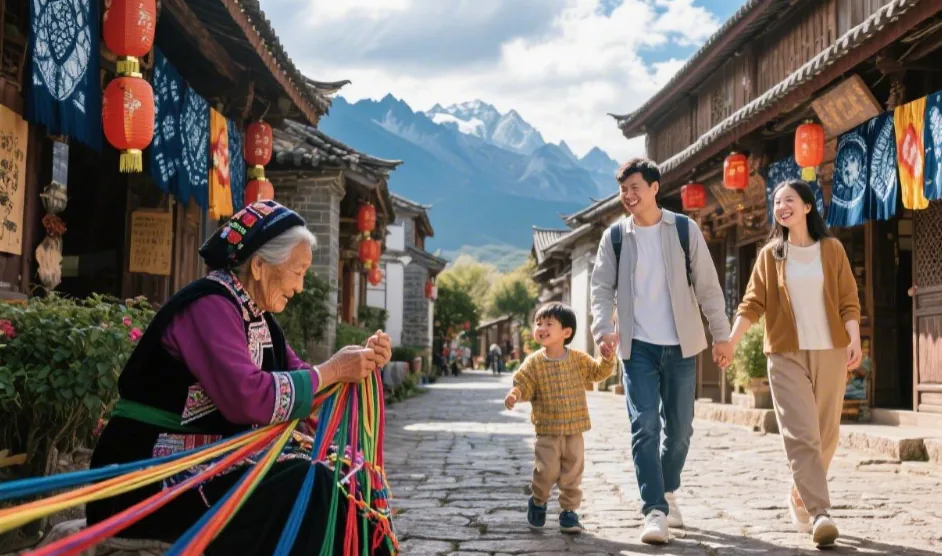
The streets of Dali and Lijiang Old Towns are paved with natural “Five-Flower Stones” about 20 cm thick. These stones have been walked on for centuries, making the surfaces uneven, with gaps between stones often 3 to 8 cm. If you use a lightweight umbrella stroller with wheels only 12 cm in diameter, the front wheels will get stuck every few meters, and you’ll constantly be bending over to lift the front.
In Lijiang Old Town, where the walking area exceeds 3 square kilometers, dragging suitcases to find an inn is a physical drain. Universal wheels on uneven stone slabs create noise over 80 dB, and the high-frequency vibration can loosen a suitcase’s bearings within 500 meters. Before booking, confirm the distance from the entrance; if it’s over 800 meters without a shuttle service, the moving pressure will be immense.
- Gear for Walking with Kids:
- Stroller: Choose one with wheels larger than 20 cm and spring suspension, otherwise the child will be uncomfortable after 30 minutes.
- Soles: Never wear sandals with flat soles; stone roads become 40% less grippy when wet, making it very easy to slip.
- Hip Seat: Suitable for children under 15 kg; it’s easier than a stroller in Lijiang’s alleyways full of steps.
- Sun Clothing: UV reflection in Yunnan is extremely high; even in the shade, reflected light can redden skin in 20 minutes.
To calculate: an adult takes about 1200 steps per kilometer, but a child under 5 with a shorter stride takes over 3500 steps. In the environment of Dali (2000m) and Lijiang (2400m), oxygen is 20% lower than on the plains. This causes a child to hit a physical wall and start crying to be carried after less than 1 hour of walking.
Temperatures in ancient towns fluctuate quickly. At 2 PM when the sun is strongest, the stone roads feel like 30 degrees. But by 6 PM at sunset, it drops to 15 degrees. If you walk all afternoon and get sweaty, being hit by the evening breeze increases the chance of a cold by 50%. A windproof jacket in your bag is a must.
| Ancient Town | Walking Difficulty | Step Frequency | Suggested Daily Steps |
|---|---|---|---|
| Dali Old Town | ★★★☆☆ | Low, mostly long slopes | Max 8000 steps |
| Lijiang Old Town | ★★★★★ | Extremely high, many narrow steps | Max 5000 steps |
| Xizhou Town | ★★☆☆☆ | Mostly flat, fewer gaps | Max 10000 steps |
Many parents like to explore between 11:00 and 15:00 under the sun. At this time, the UV index is often above 11, a level for extreme damage. Even with sunscreen, walking outdoors for over 1.5 hours causes skin water loss 3 times faster than indoors. If the child has peeling lips or dark yellow urine, dehydration has already affected their stamina.
It’s suggested to break walking time into fragments. 9 AM is quiet with weak sun, suitable for walking and seeing locals open shop. After lunch, you must find a courtyard to rest or return to the hotel for a 2-hour nap. Dryness in Yunnan slows recovery; ensuring over 10 hours of sleep daily is key to sustaining the next day’s trip.
- Survival Details for Ancient Towns:
- Hydration Frequency: Give water every 20 minutes, 50-100 ml each time; warm water relieves high-altitude heat better than cold drinks.
- Rest Spot Selection: Avoid crowded main streets; go into small alleys where air circulation is better and perceived oxygen levels are higher.
- Snack Pack: Carry high-calorie chocolate or cheese sticks; kids get cranky when blood sugar is low, and a sugar boost can buy 15 more minutes of walking.
On main roads like Fuxing Road in Dali, tens of thousands pass by every hour. Pushing a stroller or leading a child through crowds requires 70% of a parent’s energy for supervision, leading to faster physical fatigue. It’s recommended to limit activity to a 500-meter square area daily, leaving the rest of the time for cafes or tie-dye workshops.
Drainage ditches about 30 cm deep are common by the roads. Though some are covered, the gaps are large. While running on stone roads, children’s attention is easily drawn to shops; stepping into a gap causes 30% of family travel accidents. Always hold their hands and stay in the middle of the road.
Actually, there’s no need to complete a “must-see map” with a child. Changing the goal from “finishing this street” to “staying in a courtyard for an afternoon” saves your back and their legs. Since it’s a vacation, reducing intensity to 60% of a park stroll ensures everyone stays smiling.
Altitude and Energy Consumption
Taking the train from Kunming (1890m) to Lijiang (2418m) involves an ascent of over 500 meters. Atmospheric pressure drops accordingly, and oxygen is only 80% of the plains. For adults, it’s just a bit breathless, but children’s breathing is 25 to 30 times per minute—twice as fast as adults—with smaller lung capacity. Under low oxygen, their heartbeats increase 10% to 15%, meaning even sitting in a stroller, their basal metabolism is rapidly consuming energy.
In Shangri-La (3280m) or Jade Dragon Snow Mountain (4505m), oxygen drops to about 60% of sea level. Walking 100 meters here consumes energy equivalent to running 400 meters in a park in Shanghai or Beijing. If a child starts fussing or asking to be held after a few steps, it’s not because they are spoiled; it’s because their blood oxygen has fluctuated. A test might show it below 90%, and the body instinctively “refuses to move” for self-protection.
- Physical Signals of High-Altitude Fatigue:
- Nails and Lips: If they turn dark or purple, oxygen is insufficient; find a seat immediately.
- Quietness: If an active child suddenly becomes quiet, it’s usually the first sign of exhaustion.
- Limb Temperature: Blood prioritizes the heart and brain; cold hands and feet mean the body is working at full capacity against the altitude.
- Appetite Changes: Digestion blood flow decreases at high altitude; a child might only eat 60% of their usual lunch.
In places like Lijiang or Shangri-La, suggested daily walking should be under 3 km. If climbing or visiting places with many steps, cut this in half. Yunnan’s humidity is 25% to 35%—extremely dry. The combination of hypoxia and dryness means a child loses 50 ml more water per hour through breathing. Without hydration, blood viscosity increases and fatigue grows exponentially, which is why many kids start a fever halfway through.
| Altitude | Estimated Oxygen | Suggested Single Walk | Recovery Time Needed |
|---|---|---|---|
| 2000m (Dali) | 82% | 45-60 minutes | Rest 15 minutes |
| 2400m (Lijiang) | 78% | 30-40 minutes | Rest 20 minutes |
| 3300m (Shangri-La) | 70% | 15-20 minutes | Rest 30 minutes |
During ascent, stop for warm water and a 20-minute rest every 500 meters. Don’t fly or take the train directly to Shangri-La; transition in Dali or Lijiang for 2 days. This allows the child’s red blood cells to increase oxygen capacity. if you see frequent yawning or eye-rubbing at 3000m, it’s a sign of mild brain hypoxia; supplement with high-calorie food quickly.
Energy consumption is very fast at high altitudes. Keep 10% to 20% concentration glucose water or chocolate bars ready. Sugar relieves fatigue faster here. Observation shows that children who eat high-energy snacks every 20 minutes on Jade Dragon Snow Mountain have a 40% lower chance of altitude discomfort. Don’t wait for them to say they are hungry.
Many carry portable oxygen, but that’s a last resort. The best way to prevent headaches is to lower activity intensity. For example, at Erhai Lake, rent an e-scooter so the child can enjoy the view without walking in the sun. This “passive displacement” keeps the heart rate normal, saving energy for evening town interactions.
Sleep is also key for recovery. Low pressure at high altitude delays deep sleep (REM) by 30 to 50 minutes. 8 hours of sleep here feels like 6. Let the child go to bed 1 hour early in Yunnan. Use a humidifier to keep rooms above 50% humidity to reduce waking from dry airways.
If planning a long walk like Pudacuo in Shangri-La, rent an oxygen bag. Bagged oxygen pressure is steadier and easier for a child than canisters. Don’t let them scream or run during the walk; these actions create 3 to 5 times the oxygen demand of being still. Even chasing a pig for 10 meters might leave them unable to walk for the next half hour.
Temperature swings also drain energy. For every 100 meters of ascent, the temperature drops about 0.6 degrees. The difference between the mountain base and peak can be over 15 degrees. The body burns calories to maintain warmth. Use “onion-style” layering with a windproof outer shell. Wind-driven heat loss accelerates fatigue. Often, when a child is tired, they are actually shivering to produce heat without noticing.
In these high-altitude cities, don’t visit more than 2 attractions per day. A morning walk should be followed by an afternoon in a tea house or bookstore. Families who rush “Lijiang + Lashihai + Romance Park” in one day will find their kids on strike by day two. Above 3000m, slow is fast. Leaving 30% empty time for the child to daydream is the secret to keeping the trip on track.
Attraction Selection
Selection standard for family trips in Yunnan: 3000 meters is the physiological comfort boundary. For toddlers under 5, staying above 4000 meters for over 1 hour risks blood oxygen falling below 85%. Intercity travel should be under 3 hours. Dali-Lijiang trains take 1.5 hours, which is more efficient than cars. Adding intangible heritage interactions can reduce a child’s travel anxiety by 70%.
Altitude Balance
The comfort line for family trips is at 3000 meters. Children under 5 are over 2 times more sensitive to oxygen changes than adults. For every 1000 meters of ascent, the temperature drops by about 6 degrees. If a child usually lives on the plains with 98% blood oxygen, it may drop to 94% in Lijiang (2400m) and 80% at a snow mountain peak (4500m+).
Going to Jade Dragon Snow Mountain Glacier Park is not a great idea. At 4506 meters, oxygen is only 60% of the plains. A child’s heart rate will jump from 90 to 130 bpm. Adding 150 minutes of queueing for the cable car in the cold will exhaust their stamina and patience.
There are many low-altitude spots with great views around the snow mountain. These places have more air, so kids don’t turn red and gasp. Keeping the altitude below 3300 meters reduces altitude-related crying by 80%.
- Spruce Meadow: Altitude 3240 meters, with a flat 1200-meter forest boardwalk. It’s stroller-friendly and surrounded by forest with 3 times higher oxygen levels than the peak.
- Blue Moon Valley: Altitude 2800 meters, at the foot of the mountain. A 40-minute walk around the lake offers clear reflections of the mountain without hypoxia concerns.
- Yak Meadow: Altitude 3600 meters—nearly 1000 meters lower than Glacier Park. The open meadow offers views of the glacier that are better than looking at rocks on the peak.
Choose Dali Cangshan cableways carefully. The Ximatan line pulls you to 3900 meters in 20 minutes, which can cause severe ear pain in toddlers due to rapid pressure changes. Children can’t express this pain and may only cry.
The Gantong Cableway peaks at only 2600 meters, overlooking Dali and Erhai Lake. Pressure is low, and children can watch for squirrels. The Zhonghe Cableway uses open chairs and stays around 2500 meters, suitable for older, brave kids.
- Ximatan Cableway: Vertical drop over 1600 meters, peak near 4000 meters. Avoid unless the child is over 10 and very fit.
- Gantong Cableway: 15-minute ride to Qingbi Stream. The path has little elevation change, great for walks.
- Zhonghe Cableway: Over 1800 meters long. The chair design lets kids feel the mountain breeze at a moderate height.
In Shangri-La, altitudes jump above 3300 meters. The Shudu Lake boardwalk in Pudacuo is 3.3 km. Though flat, walking 1 hour here feels like 5 km at sea level. Paying 50 yuan for the 15-minute boat ride saves energy for seeing pigs and horses on the meadow.
The Napa Lake ring road is at 3270 meters. No climbing is needed; driving is easiest. Stop for 100 meters to take photos then rest in the car. This pace keeps blood oxygen above the 90% safety zone.
- Shika Snow Mountain: Peak is 4500 meters; not recommended for toddlers. Winds are often level 6, and it’s 10 degrees colder than the town.
- Songzanlin Monastery: Climbing to the halls involves 140+ steps, which feels like Everest at this height. Walking by Lamuyangtso Lake for reflections is better.
- Dukezong Old Town: The slope to the prayer wheel is steep. Let the child feed pigeons in Moonlight Square instead.
Resting also balances altitude effects. For every 100-meter ascent, the boiling point of water drops 0.3 degrees. Bath water in Shangri-La is only about 80 degrees. Baths over 15 minutes can cause dizziness as steam takes away oxygen.
The first 48 hours in Tibet are the adaptation period. No climbing projects. Drink warm water with glucose. A 600 ml oxygen bottle lasts 50 to 60 puffs at 3500m. 5 minutes of oxygen before sleep improves rest and lowers heart rate from 120 to under 100 bpm.
Avoid routes with huge altitude swings, like Lijiang to Lugu Lake, where peaks reach 3800 meters. Altitude fluctuates like a roller coaster over 4 hours. This causes vomiting. Stop for 10 minutes every 1.5 hours to adapt.
Kunming is 1890m and Dali is 2000m. Taking the 1.5-hour train to Dali and staying for 2 days allows hemoglobin to increase. Going to Lijiang and Shangri-La afterward drops the chance of altitude sickness from 50% to under 10%. This stepped approach is the “easy way” for kids.
Ancient Town Road Conditions
The Five-Flower Stone road in Lijiang’s Dayan Old Town consists of over 38,000 irregular slabs. Gaps are 3-5 cm wide and 2 cm deep. A stroller with plastic wheels will get stuck 2-3 times per meter. This shaking will distress a child, and within 15 minutes they will demand to be held.
City strollers with wheels smaller than 15 cm are useless. Choose “off-road” models with wheels over 25 cm and thick tires. Walking 500 meters in Dayan feels like 20 minutes on a high-vibration treadmill. Parents’ wrists will be too sore to hold chopsticks by the end of the day.
Dayan has 354 stone bridges. Many steps are 15 cm high. Pushing a 20-lb child in a 10-lb stroller means lifting 30 lbs frequently. Since 30% of the route involves lifting, it’s a physical strain for parents with back issues.
- Lijiang Qiyi Street: After 18:00, density is 4-6 people per square meter. Strollers must stick to the drainage ditches to move.
- Dali Fuxing Road: 1500 meters long. There’s a 15-meter altitude drop between north and south gates. Walking north is a slope that will make you pant in 20 minutes.
- Xizhou Town: Stones are flatter, but drainage ditches are 20 cm wide without covers. Kids can easily sprain ankles if they run.
- Shaxi Town: Red sandstone roads are soft and pitted. Friction drops 40% on rainy days; flat sneakers will slip.
Dali’s main roads are 10+ meters wide but often blocked by 1.2-meter wide delivery trikes. While dodging them, it’s easy to hit wooden stalls. Many stall umbrellas are below 1.6 meters; parents looking down at strollers often hit their foreheads.
Inn thresholds are another barrier. Naxi thresholds are over 20 cm high. Room floors are 10 cm higher than courtyards for rain protection. Crossing these 8-10 times a day with a heavy stroller is more pressure on knees than climbing stairs.
If your inn is deep in the town, dragging a 28-inch suitcase 300 meters on stone slabs wears down universal wheels 20 times faster. Cheap suitcases may break before you arrive. Paying 20-50 yuan for a local trike to carry luggage is recommended.
- Wheel Wear: Walking 1 km on stone slabs wears down 0.5 mm of rubber.
- Pushing Force: Pushing a stroller on stone slopes consumes 1.5 times more energy than flat roads.
- Step Frequency: In Lijiang, you’ll encounter steps needing a lift every 200 meters on average.
- Safe Distance: Ditches are 30 cm deep. Keep kids at least 0.5 meters away from the edge.
Dali’s Renmin Road has a noticeable slope that takes 25 minutes to walk. Some stones are polished and slippery as oil when wet. Wear hiking shoes. Since signs are above 2 meters, kids only see adults’ backs, and visual fatigue makes them want to stay in the stroller.
Baisha Old Town is “gentler.” The main street is only 800 meters. Cafes are every 50 meters for rests. Wooden floors inside are much steadier than the stones outside, making them great transit points.
Shuhe Old Town is half the size of Dayan. It’s bumpy, but crowds are only 40% of Dayan. You can walk in the middle without hitting people. the Sifang Square is large enough for kids to run safely and release energy.
- Carrier Alternative: Use a hip seat for babies under 1 to save 100% of stroller lifting trouble.
- Accommodation Location: Stay within 150 meters of the entrance to keep luggage moving under 3 minutes.
- Avoid Peaks: Walking before 10:00 is 2 times more efficient than at 16:00.
Moss occasionally grows in stone gaps. When wet from cleaners or rain at 8 AM, take small 30-cm steps for stability.
Lightweight strollers that can be carried on your back are most practical in Dali and Lijiang. Lifting it over a bridge is faster than two people struggling to carry it.
Natural Study
The CAS Xishuangbanna Tropical Botanical Garden covers 1125 hectares with 38 specialized gardens and over 1.3 million plant species. For kids, visit the 8 gardens in the West Zone. It’s a 2-km walk on flat paths; renting a 30-yuan electric scooter saves 80% of the legwork.
The Giant Water Lily pond in the West Zone is a must. Leaves can reach 2 meters in diameter. Kids under 50 lbs can sit on them as the vein structure spreads the weight. Here, seeing the “strangling phenomenon” where banyan trees kill others at heights of 30-50 meters is 10 times more impactful than textbooks.
At night, the “Night Tour” is the highlight. From May to October, thousands of fireflies fly. A guide takes you on a 1.5-km rainforest path to find stick insects with red flashlights. These insects are 10-20 cm long and look exactly like twigs.
- West Zone Tour: Takes 3 hours to see buttress roots and Upas trees; kids walk under 4000 steps.
- Night Adventure: Starts at 19:30 for 90 minutes. Use 10%+ DEET repellent every 20 minutes due to high mosquito density.
- Science Class: There are 50+ professional teachers. A 60-minute painting or specimen session helps kids remember 5-10 plant names.
After plants, see wild Asian elephants at Wild Elephant Valley. The 2.3-km boardwalk is 1.2 meters high for safety. About 300 wild elephants live here. 15:00 to 17:00 is the peak time for them to drink water.
If lucky, you’ll see a family of 10+ elephants. Calves are protected in the middle. Kids can feed rescued elephants 5-kg “elephant meals” of carrots and bananas for about 80 yuan. This is warmer than seeing them in cages.
| Study Spot | Observation | Suggested Stay | Interaction |
|---|---|---|---|
| CAS Botanical Garden | Water Lilies, Fireflies | 1 Day | Sitting on lilies, night insects |
| Wild Elephant Valley | Wild Elephants, Rainforest | 4 Hours | Boardwalk view, feeding |
| Chengjiang Fossil Museum | Cambrian Specimens | 3 Hours | 3D movies, touching models |
| Fuxian Lake | Grade I Water, White Sand | Half Day | Sand play, Kanglang fish |
Near Kunming, the Chengjiang Fossil Site Natural Museum is a must. It houses over 60,000 Cambrian specimens from 518 million years ago. The 3D theater restores battles between ancient creatures like Anomalocaris.
The museum stays at 24-26 degrees. It’s smarter to hide here than get sunburned between 12:00 and 15:00. The museum is at 2000m with little climbing. Walking the 21 halls is about 1500 meters in air conditioning, so kids stay calm.
Fuxian Lake is 15 minutes away. It’s 155 meters deep with Grade I water. You can see 12.5 meters deep in the sun. Moon Bay Park on the north shore has a 1-km fine white sand beach.
Kids can dig sand while parents rest under palms. You can see unique Kanglang fish, only 10 cm long. Eating Stone Pot Fish at 180 degrees by the lake teaches kids about ecology better than lectures.
- Kunming Haigeng Dam: From November to March, 40,000 Black-headed Gulls fly from Siberia. 5 yuan of bread lasts 1 hour for feeding.
- Feeding Tip: Hold bread for them to take or toss it. Wind is level 3 and it’s 15 degrees, very comfortable.
- Knowledge: These birds fly at 40 km/h. Count the black feathers on their wingtips to identify them.
For a highland lake, the Erhai Ecological Corridor is 46 km. Rent a covered four-wheel bike for 40-60 yuan/hour. Longkan to Caicun is a flat 4-meter wide path for bikes. You can see wild ducks and egrets in the wetlands.
Wetland study needs little prep. Use 10x binoculars to find “Water Lily Flowers” (Ottelia acuminata). These white flowers only grow in Grade I water and adjust their stems with water levels. Kids remember these real survival strategies forever.
Finally, gear: UV in Yunnan is 2 times higher than the plains. Use SPF50+ and reapply every two hours. Wear quick-dry long sleeves. Sandflies (biting midges) in the botanical garden are under 1 mm but cause itching for a week. Physical shielding beats chemical repellent.
Related Guides
- How to Travel in Yunnan Without Backtracking | Kunming, Dali, Lijiang, Xishuangbanna Itinerary & Pitfall Guide
- What to Know Before Going to Yunnan | Weather, Altitude, Routes & Common Pitfalls Explained
- Yunnan 6-Day Snow Mountain Secret Realm Tour | Jade Dragon Snow Mountain + Blue Moon Valley + Baisha Ancient Town, Packing Snow Peak Views, Light Hiking & Ancient Town Strolls All in One
- 4-Day Family-Friendly Yunnan Tour | Kunming Zoo + Dianchi Haigeng + Stone Forest, A Stress-Free Route Perfect for Kids
- 8-Day Deep Dive into Yunnan’s Mountains, Water & Ancient Towns | Dali + Shaxi + Lijiang, Slow-Paced Itinerary
Shangri-La — — Practical Data
Tickets & Booking
- Tiger Leaping Gorge (Shangri-La section, Upper Tiger Leaping): Adult CNY 45; ticket + round-trip sightseeing escalator (Pingbu Qingyun escalator) CNY 125[src]
Where to Stay · Room Type · Nearby
- Inside Dukezong Ancient Town | Room tip: Convenient for getting around, but vehicles cannot enter, so confirm with the guesthouse whether they carry luggage | Nearby add-ons: Great Buddha Temple, prayer wheel, Guishan Park, Moonlight Square[src]
- Along Napahai | Room tip: Good views and quiet, but far from the city | Nearby add-ons: Napahai Yila Grassland, Shika Snow Mountain[src]
Typical Climate & Packing (Past Years)
- January: -7 °C–9 °C °C, [Travel climate reference]
- February: -5 °C–11 °C °C
- March: -2 °C–14 °C °C
- April: 2 °C–17 °C °C
- May: 5 °C–19 °C °C, The meadow turns green again
- June: 8 °C–20 °C °C






