



Day 1: Arrival at Wulingyuan, First Glimpse of Autumn
Itinerary and Transportation: That time, I took the high-speed train from Changsha South Station to Zhangjiajie West Station. After getting off, I went directly to the West Station Passenger Center to transfer to the Wulingyuan Special Line Bus (1 shift per hour, fare 25, travel time 1 hour and 10 minutes), arriving at Wulingyuan Bus Station around 10:00 AM. Follow the signs out of the station for 5 minutes to the eco-bus station; this is closest to the Landmark Gate (Biaozhimen), which is convenient for entering the mountains the next day.
Accommodation Experience: I chose “Xibu Street Inn” near the Wulingyuan Landmark Gate, booking a twin room with a viewing balcony on the second floor (220/night including breakfast for two). The inn is a renovated old wooden building; the stairs are narrow but clean. The owner, a local Tujia person, took the initiative to show me the best viewing spot on the balcony—directly facing the remaining peaks outside the Landmark Gate. At 7:00 AM, you can see thin mist wrapping around the mountain peaks like gauze. The room has heating (mountain nights are already chilly in October), and the balcony is equipped with a small table and stools. I sat there in the evening drinking the home-roasted Berry Tea gifted by the owner, watching the distant peaks slowly turn from blue-gray to pale gold, which was much more comfortable than just dazing around inside the room.
Observing Autumn Around Baofeng Lake: After putting down my luggage and resting for half an hour, I went out at 2:00 PM towards Baofeng Lake. The walking path from the inn to the outer area of Baofeng Lake is about 1.2 km along a bluestone road, with a few scattered farmhouse restaurants on both sides. When I reached the lakeside, there was a moist scent of vegetation in the wind. I walked slowly along the shore towards Yingwozhai and found that the maples in mid-October were just starting to change—not in large red patches, but with a few clusters of light yellow and orange leaves appearing at the tips of the branches, like a palette corners accidentally overturned by someone. The lake surface was quite still, but the reflection only showed the silhouette of the mountains without fully “printing” the autumn colors yet; it will likely look better in another week when the leaves are completely yellow.
|
Item
|
Detailed Record
|
|---|---|
|
Inn Location
|
Diagonally opposite Wulingyuan Landmark Gate, 3 minutes walk to the eco-bus station
|
|
Room Facilities
|
Viewing balcony, heating, private bathroom, free parking provided (need to inform in advance)
|
|
Breakfast
|
Inn’s homemade mugwort cake + local eggs + millet porridge (filling)
|
|
Baofeng Lake Path
|
Approximately 2 km total, flat road with no steps, suitable for slow strolling and photography
|
Small Tip: When returning to the inn in the evening, don’t miss the roasted ciba (glutinous rice cake) stall at the entrance of Xibu Street (5/piece). The freshly pounded ciba is crispy outside and chewy inside; sprinkled with soybean powder and watched while the lanterns along the street light up, it is much more substantial than the overpriced snacks in the scenic areas. I bought two as a late-night snack that day; eating them warm made the mountain chill feel much less intense.
Day 2: Tianzi Mountain Colored Forest Core Area
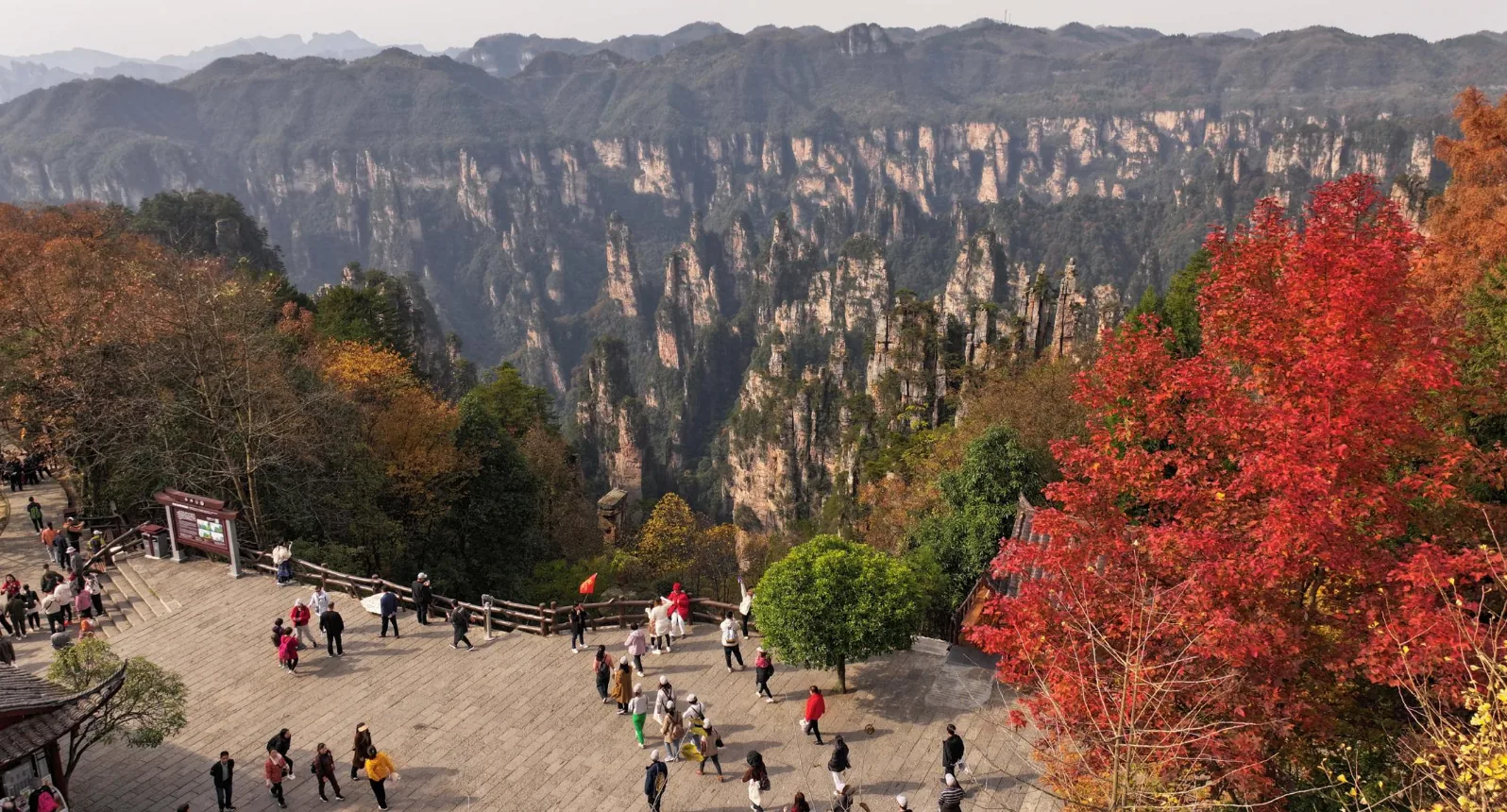
Itinerary and Transportation: Checked out of “Xibu Street Inn” at the Wulingyuan Landmark Gate at 7:30 AM, walked 3 minutes to the eco-bus station, and took the 7:50 AM first eco-bus to Tianzi Mountain (ticket included in the Forest Park combo ticket, 248/valid for 4 days). The ride takes about 40 minutes, arriving at the Tianzi Mountain Cable Car Lower Station at 8:30 AM. A one-way cable car ticket is 72/person (swipe ID card to enter), reaching the upper station in 8 minutes. The exit is the entrance to Helong Park.
- Route Implementation: After exiting the upper station, first visit Helong Park (the platform behind the bronze statue offers an open view), then walk along the bluestone path towards Yubi Peak (about 15 minutes), passing the “Fairy Scattering Flowers” viewing platform to take a panoramic shot; then proceed to Yubi Peak (focusing on the silhouette of the peak pointing southeast), and finally take the “Sky Field” (Kongzhong Tianyuan) trail (40 minutes round trip, flat with no steep slopes).
- Colored Forest Observation Details:
- Sweet Gum Trees are concentrated along the Yunqing Rock line (the right side of the trail from Helong Park to Yubi Peak). The leaves are palm-sized with caramel-colored curled edges, and the centers are mottled with red and yellow like an overturned palette. They will turn completely red in late October; currently, they are just half-red and half-green;
- Birch Forests are located 300 meters east of Tianzi Pavilion (turn left at the Sky Field fork). The trunks are straight, and most of the fallen leaves are golden yellow. When the wind blows, it looks like scattered gold; it is brightest at 10:00 AM when the sunlight shines obliquely.
- Photography Practice: Start shooting at 9:15 AM (2 hours after sunrise with front lighting). Use a polarizing filter to darken the sky and brighten the mountains while the mist has not yet dispersed. The best position for Yubi Peak is at the corner of the viewing platform railing (to avoid crowds), aligning the peak tip with the top right corner of the lens; for the Sky Field, walk to the wooden pavilion at the end of the trail to take a panorama, using a low angle to capture the peak forest supporting the golden fields.
|
Item
|
Detailed Record
|
|---|---|
|
Travel Time
|
Wulingyuan Landmark Gate → Tianzi Mountain Cable Car Lower Station (eco-bus 40 minutes), Cable Car Upper Station → Helong Park (2 minutes walk)
|
|
Colored Forest Location
|
Sweet Gum Trees: Right side of Yunqing Rock trail; Birch Forest: 300 meters from the fork east of Tianzi Pavilion
|
|
Photography Time
|
9:00-11:00 front lighting, colors are most saturated at 10:00 AM while mist lingers
|
|
Cost
|
Tianzi Mountain Cable Car 72 one-way, eco-bus free (included in ticket)
|
|
Pitfall Warnings
|
Yubi Peak viewing platform gets crowded after 10:00 AM; it is recommended to secure a spot before 9:30 AM; the Sky Field trail is slightly slippery after rain, wear non-slip shoes
|
|
Recommended Gear
|
Polarizing filter (enhances reflections), lightweight hiking shoes (many loose stones on trails), thermos (windy at the top, drink hot water)
|
Small Experience: At noon, I had self-heating rice (25/box) at the shop next to Helong Park, sitting on a stone bench watching the distant peaks edged with gold by the sun, with the scent of pine needles and decaying leaves in the wind. At 3:00 PM, I returned the same way to the cable car upper station. While descending, I looked back to photograph the peak forest dyed red by the setting sun (lucky to catch thin clouds this day, the light and shadow layers were richer than on a clear day). At 5:00 PM, I returned to the Wulingyuan Landmark Gate. The inn owner had kept a meal for me—Bacon Stir-fried with Bracken (the bacon was home-smoked, and the bracken was so tender it almost dripped water). Eating it with rice made me sweat, dispelling the mountain chill.
Key Note: The peak period for Tianzi Mountain’s colored forest is October 20th – November 5th, when the Sweet Gums are fully red and the Birch trees are at their most intense golden yellow. Don’t miss these two weeks if you want to capture the “color peak.” I came on October 18th this time, just in time for the Sweet Gums to start turning red and the Birches to just turn yellow, which was a “preview version” of autumn. I plan to come back in early November next time for the full splendor.
Day 3: Autumn Color Reflections at Baofeng Lake
Itinerary and Transportation: Checked out of “Xibu Street Inn” at the Wulingyuan Landmark Gate at 8:00 AM. The owner specifically reminded me that the first boat at Baofeng Lake has fewer people. Walk 15 minutes to the Baofeng Lake Scenic Area main gate (or take a motorcycle taxi for 8, 5 minutes). Scenic area ticket is 96/person (including boat ticket, 5 cheaper if booked online in advance). Arrive at the pier to exchange tickets at 9:20 AM, just in time for the 9:30 AM first boat.
- Cruise Experience: Choose the open-air seats on the second floor (the third row on the right side of the stern is best, no obstructions). The first boat had fewer than 10 passengers, so the second floor was almost empty. The boatman, Master Li, said this boat has “light as soft as gauze“; the sun had just climbed the mountain and wasn’t as glaring as at noon. As the boat moves, the wind comes from the valley carrying moisture, which is much more comfortable than an air-conditioned room.
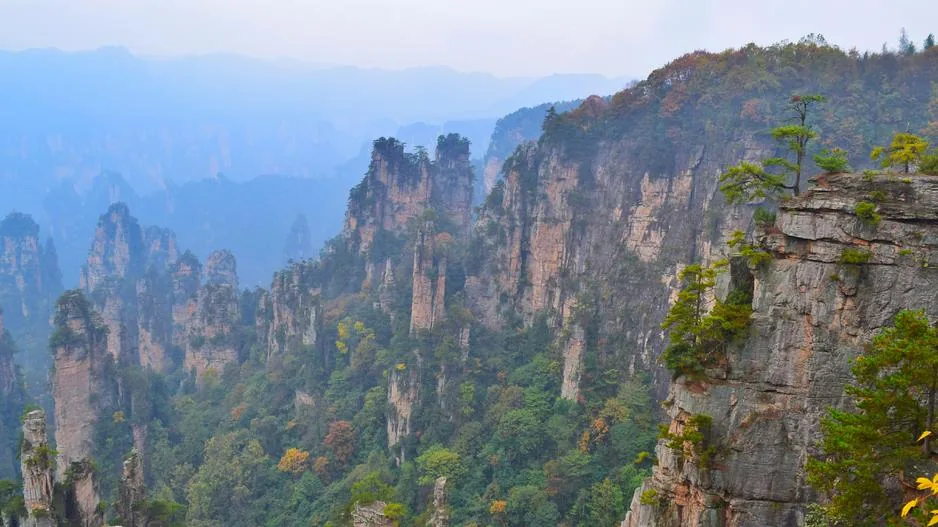
- Reflection Observation Points: The boat starts from the pier and sails along the north shore for 10 minutes to the Yingwozhai Pier (marked by a red wooden sign), where it must turn back—the moment of turning back is the best for photos: the Chinese tallow leaves on the left bank have turned completely red (deep red mixed with orange-red, like a burning fire), while a few ginkgo trees on the right bank have dropped half their yellow leaves. All of this is reflected in the brilliant emerald lake water; the red, yellow, blue, and green clash but aren’t messy, like an overturned paint can washed over by water. When it’s calm, even the shadows of the reeds on the shore are crystal clear.
- Baofeng Temple Nearby Activities: Get off the boat at 1:00 PM and walk 1.8 km northwest along the lakeside path to Baofeng Temple (free admission). The path is paved with bluestone and lined with wild chrysanthemums (blooming vigorously in October). The temple gate faces east; after entering the courtyard, the long corridor on the right side of the Great Buddha Hall is a great place to photograph the flying eaves and the autumn forest—under the red walls and flying eaves, a few sweet gum trees have just turned yellow, and the sunlight passing through the branches casts mottled shadows on the wall, like a living ancient painting. A sweeping monk in the temple said the temple was built in the Song Dynasty, and seeing “red walls contrasting with yellow leaves” in autumn is the most flavorful experience.
Case Study: While waiting for the turn-back at Yingwozhai Pier, I met Sister Chen carrying a telephoto lens camera; she comes every year to photograph the Baofeng Lake reflections. “The first boat is at 9:30 AM and the last boat is at 3:30 PM; the 10:30 AM boat in the middle has the most people, and the reflections are all shattered by the oars.” she also taught me to squat lower when photographing reflections to get the camera close to the water surface, which allows for a complete mirror image of the peak forest and clouds.
|
Item
|
Detailed Record
|
|---|---|
|
Transportation
|
15-minute walk from inn / 8 motorcycle taxi (5 minutes) to Baofeng Lake gate
|
|
Ticket & Boat
|
Combo ticket 96 (includes cruise, 91 if booked online), first boat at 9:30 AM
|
|
Boat Seating
|
Open-air seats on 2nd floor, 3rd row right side of stern (unobstructed view, less wind)
|
|
Best Reflection Point
|
When turning back at Yingwozhai Pier (red tallow leaves on left bank + yellow ginkgo on right bank, emerald water reflection)
|
|
Baofeng Temple Route
|
1.8 km walk northwest along lakeside path (bluestone road, wild chrysanthemums along the way)
|
|
Recommended Photo Spot
|
Long corridor on the right side of the Great Buddha Hall at Baofeng Temple (red walls and flying eaves + sweet gum yellow leaves in one frame)
|
|
Cost Reference
|
Ticket & boat 96, no cost for walking path, temple is free
|
|
Pitfall Warnings
|
Avoid boats between 10:30-14:00 (too many people and boats, shattered reflections); the Baofeng Temple corridor is backlit in the afternoon for photographing eaves
|
|
Recommended Gear
|
Polarizing filter (darkens water surface reflections), lightweight backpack (for water and snacks), folding seat cushion (few benches by the lake)
|
Food Diary: Had lunch at “Huguang Farmhouse” next to the Baofeng Lake pier. Ordered Stewed Local Chicken with Rock Ear (68, rock ear is a lichen gathered from the mountains; the soup is fresh and not fishy) and Stir-fried Fir Mushrooms (45, wild fir mushrooms are plump and tender in October), served with firewood rice (5). The owner said fir mushrooms should be stir-fried with minced garlic to remove the earthy smell; they were indeed more fragrant than those in city restaurants. After the meal, I packed two roasted sweet potatoes (3/each) as afternoon snacks; they were warm, sweet, and soft.
Small Experience: At 3:00 PM, I returned from Baofeng Temple to the pier via another lakeside path (near the “Baofeng Waterfall” attraction) and found a few clusters of Asters hidden in the autumn forest (pale purple petals, blooming in October), which I snapped a few photos of. At 4:00 PM, I took the last boat back. The setting sun dyed the lake water orange-red, and the shadows of the Chinese tallow trees grew very long, offering warmer light and shadow than the first boat in the morning. Back at the inn, the owner brought out homemade kiwi wine (slightly sweet, not strong), saying it felt better while looking at the reflection photos taken during the day.
Key Note: The autumn reflections at Baofeng Lake are most intense from late October to early November (tallows fully red, ginkgos golden yellow). If you want to capture the “cool and warm contrast,” don’t come before October 20th (leaves aren’t fully red). I came on October 25th this time; the tallows were just right, and the lake water was clear, so I timed it well.
Day 4: Distant Views of Yellow Stone Village (Huangshizhai) Autumn Forest
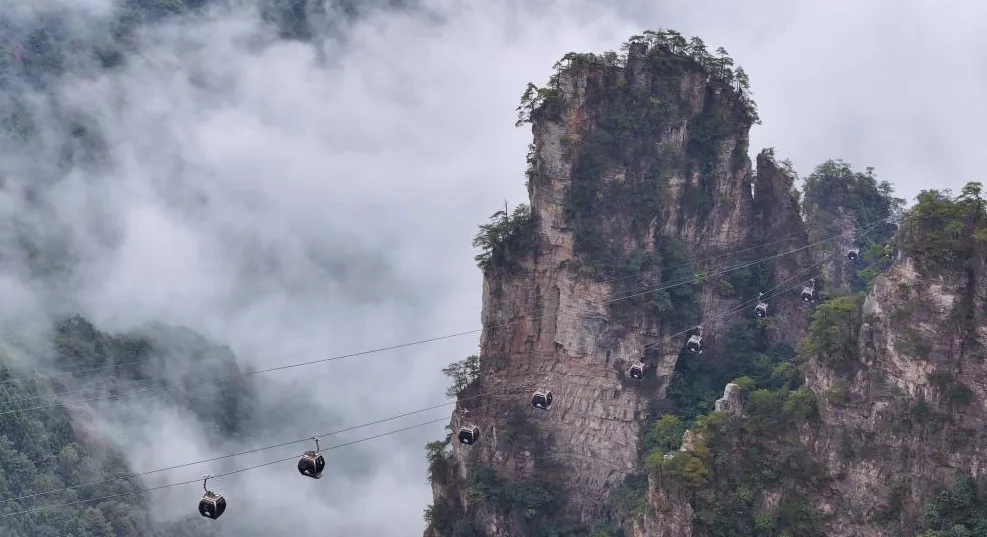
Itinerary and Transportation: Checked out of “Xibu Street Inn” at the Wulingyuan Landmark Gate at 7:00 AM. The owner specifically warned: “Arrive at the Huangshizhai Cable Car Lower Station before 8:00 AM to avoid the tour group crowds.” I walked 5 minutes to the eco-bus station and took the 7:20 AM first eco-bus to Huangshizhai (ticket included in the Forest Park combo ticket). The ride takes about 25 minutes, arriving at the Huangshizhai Cable Car Lower Station at 7:50 AM. A one-way cable car ticket is 65/person (swipe ID card to enter). It takes 8 minutes to go up the mountain; the exit is the start of the circular trail.
- Circular Trail Experience: After exiting the upper station, first pass through the Cedar Forest (straight trunks with needles changing from green to yellow, like wrapped in a layer of pale gold gauze). Walk 20 minutes to the “Monkey Commander Reviewing Troops” (Hou Shuai Dian Bing) viewing platform—several giant rocks stacked in the shape of a “general,” with a few red maples growing from the cracks, their palm-sized leaves as red as rouge; walk another 15 minutes to “Star Picking Platform” (elevation 1080m), which has iron railings at the edge; lean over to see the peak forest below with mist drifting at the bottom of the valley, like a white belt tied around the mountain.
- Panoramic Photography Practice: Arrive at Liuqi Pavilion at 9:00 AM (the end of the circular trail). Climb the three-story wooden staircase to the top floor and frame your shot towards the west (directly facing the continuous peak forest). At this time, the light shines obliquely, and the layered coloring of the peak forest is obvious: the Horsetail pines at low elevation are still deep green, the Sweet Gums at middle elevation are mottled with red and yellow (like an overturned palette), and the Smoke trees at high elevation have turned completely yellow (like scattered gold). From a distance, it truly looks like a giant palette. I used my phone to take a panorama, and zooming in reveals the details of the tree shadows on each peak.
|
Item
|
Detailed Record
|
|---|---|
|
Travel Time
|
5-minute walk from inn → eco-bus station → Huangshizhai Cable Car Lower Station (25 minutes eco-bus), 8 minutes by cable car
|
|
Cable Car Cost
|
65 one-way (swipe ID), 118 round trip (unnecessary, the descent trail is faster)
|
|
Trail Route
|
Circular Trail: Cable car upper station → Cedar Forest → Monkey Commander Reviewing Troops (20 minutes) → Star Picking Platform (15 minutes) → Liuqi Pavilion (10 minutes)
|
|
Photo Spots
|
3rd floor of Liuqi Pavilion facing west (front lighting 9:00-11:00), Star Picking Platform for bird’s-eye view of misty peaks
|
|
Forest Distribution
|
Cedar Forest (pale yellow needles), Monkey Commander (red maples in cracks), high-altitude Smoke trees (all yellow), mid-altitude Sweet Gums (mottled red/yellow)
|
|
Cost Reference
|
Cable car 65 one-way, eco-bus free, Liuqi Pavilion free
|
|
Pitfall Warnings
|
Don’t go up after 8:30 AM (tour groups will crowd the trails); Star Picking Platform is windy, wear a hat; the wooden stairs in Liuqi Pavilion are narrow, hold on tight
|
|
Recommended Gear
|
Lightweight hiking shoes (flat but long bluestone paths), polarizing filter (darkens sky to highlight peak colors), thermos (windy at top, drink hot water)
|
Return and Food Diary: Descend from Liuqi Pavilion at 11:30 AM (take the walking trail, about 40 minutes to the cable car lower station). The bluestone road has gentle slopes and no steep steps. I picked up a heart-shaped Smoke tree leaf along the way and pressed it into my notebook. After descending, take the eco-bus back to Wulingyuan Landmark Gate (arriving at 12:10 PM), and take a taxi for 15 to the city center (20-minute drive) to find the “Old Brand Rock Ear Stewed Local Chicken” shop (middle section of Renmin Road; the storefront is old but crowded). Ordered Stewed Local Chicken with Rock Ear (88/small portion; rock ear is mountain-gathered thin flakes, the soup is milky white and intensely fresh) and Stir-fried Wild Celery (32, tender stems with a bit of astringency that goes well with rice). 60 per person was very filling. The owner said the chicken is free-range and the rock ear must be soaked in advance and stewed for 3 hours to bring out the flavor; it was indeed more substantial than the scenic area restaurants.
Small Experience: After the meal, I met a local lady at the shop entrance. She said the autumn forest in Huangshizhai “turns red a week later than Tianzi Mountain,” and it is most beautiful in late October when the Smoke trees are completely yellow. I walked back rubbing my round belly, passing “Bubugao Supermarket” to buy a bag of wild dried kiwi (25/jin, sweet and sour with a good chew) as a souvenir. At 3:00 PM, I returned to the inn to pack my luggage. The owner handed me a note: “Next time you stay for more than three days, I’ll give you a 10% discount.”
Key Note: The best time for Huangshizhai’s autumn forest is October 25th – November 10th (Smoke trees fully yellow, Sweet Gums fully red). If you want to capture the “layered coloring,” don’t come before October 20th (leaves haven’t changed color). I came on October 28th this time; the Smoke trees were shining yellow and the Sweet Gums were evenly red, so I hit the “golden period.” The descent walking trail is more interesting than the cable car, allowing you to see the trees up close; it is recommended for those with enough stamina.
Keep Reading
- Zhangjiajie 4-Day Family Travel Guide | Take Kids to Easily Enjoy Cable Cars/Monkeys/Geology Class, Tired-Free Version for Traveling with Kids
- Zhangjiajie 5-Day Classic Route Planning
- Zhangjiajie 5-Day In-Depth Tour | Wulingyuan + Tianzi Mountain + Glass Skywalk, Unlock Natural Wonders and Cultural Charms
- Where should I live in Zhangjiajie City or Wulingyuan | Scenic area distance, transportation time and accommodation options
- Top 10 Must-Visit Attractions in Zhangjiajie | Classic Landmarks Loved by Travelers
Zhangjiajie National Forest Park — Practical Information
Tickets & Booking
- Zhangjiajie National Forest Park (Wulingyuan core scenic area) single ticket: Standard ticket year-round CNY 165 each, with optional CNY 3 insurance, valid 4 consecutive days; concession ticket year-round CNY 83 each. Per the Hunan Provincial Development and Reform Commission “Notice on Matters Concerning Ticket Prices of the Wulingyuan Core Scenic Area” (Xiang-Fa-Gai-Jia-Fei-Gui [2024] No. 977), effective from Jan 1, 2025, valid 5 years; advance booking required (Timed and site-specific reservation entry is used; visitors are encouraged to use the “Zhangjiajie One-Machine Tour” WeChat mini-program for real-name reservation tickets and fast ticket-check entry)[src]
Transport & Schedules
- Inside the Wulingyuan scenic area → The various sights | Scenic-area eco-bus (included in the combined ticket/separate purchase): Eco-buses inside the scenic area connect the various zones; the high-platform touring lines at Tianzi Mountain, Yuanjiajie and Yangjiajie operate one-way loops, so plan to avoid backtracking[src]
Where to Stay · Room Type · Nearby
- Wulingyuan district (near the ticket stations) | Reference price Guesthouses/chain hotels about CNY 150–500 per night (reference) | Room tip: Close to the ticket stations, good for entering the park early and multi-day visits (the ticket is valid 4 days); conven | Nearby add-ons: Golden Whip Stream, Huangshizhai, Yuanjiajie, Tianzi Mountain, Yangjiajie, Ten-Mile Gallery, Xibu Street[src]
- Zhangjiajie city (Tianmen Mountain cableway lower station/Dayong Ancient Town area) | Reference price About CNY 140–550 per night (reference) | Room tip: If you also visit Tianmen Mountain, staying in the city is closer (the lower station of the Tianmen Mountain cableway is | Nearby add-ons: Tianmen Mountain, Dayong Ancient Town, Nanmenkou, Tujia Folk Customs Park[src]
Typical Climate & Packing (Past Years)
- January: 2.6 °C–9.4 °C °C, Zhangjiajie has a humid subtropical monsoon climate, humid and rainy
- February: 4.5 °C–11.5 °C °C
- March: 7.8 °C–15.9 °C °C
- April: 13.4 °C–22.7 °C °C, Spring is cloudy and misty, with a higher chance of cloud seas
- May: 18.0 °C–27.2 °C °C
- June: 21.6 °C–30.2 °C °C, Relatively high rainfall; watch for rain gear and slippery surfaces






