



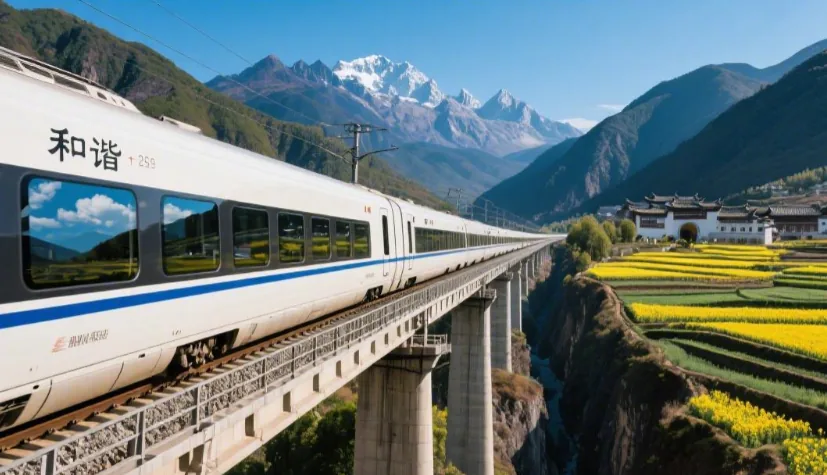
2026 Yunnan High-Speed Rail Guide: Kunming to Dali in 2 hours (approx. 145 RMB), to Lijiang in 3.5 hours (approx. 220 RMB).
High frequency of trains; it is recommended to purchase tickets via 12306 15 days in advance. Swipe your ID card for entry throughout the journey, whisking you quickly between Cangshan Erhai and Jade Dragon Snow Mountain!
Dali Station Connection Guide
In 2026, Dali Station averages over 130 arriving and departing bullet trains daily. The renovated new station building achieves a seamless transfer between the exit and the transportation hub.
The station is approximately 17 km from Dali Ancient City (35 minutes by car), 34 km from Xizhou (50 minutes by car), and 52 km from Shuanglang (65 minutes by car).
The scenic area direct bus waiting area is just 50 meters from the exit, with fares starting at 15 RMB; the B1 underground level is a dedicated area for taxis and ride-hailing services, featuring 400 social vehicle parking spaces.
Scenic Area Direct Bus
In 2026, the tourism distribution center is located 50 meters to the right of the Dali Station exit. The Dali Ancient City Line runs every 15 minutes, costs 15 RMB, and takes about 35 minutes to arrive;
The Shuanglang Line costs 40 RMB one way and takes approximately 70 minutes.
Direct buses support 12306 or on-site QR code ticket purchases. Most vehicles are 19-47 seat air-conditioned buses, and the luggage compartment can accommodate 28-inch suitcases. Drop-off points are distributed at the South Gate of the Ancient City, Three Pagodas, Xizhou, and main entrances of Shuanglang.
If you are heading to Dali Ancient City, the direct bus travels along Weishan Road, Nanjian Road, and Dalixian, avoiding the traffic lights of downtown Xiaguan and saving about 20 minutes compared to regular buses.
The operating hours of direct buses are synchronized with the high-speed rail schedule. The first bus usually starts at 07:30, and the last bus will dynamically extend based on late-night arriving trains. For passengers arriving after 23:00, “Night Direct Buses” are available on-site, with a small price increase of about 5 RMB, mainly delivering to the South and East Gate areas of Dali Ancient City.
Direct buses to Xizhou and Shuanglang take the Dali Expressway or Haidong Road.
In 2026, the route distribution is more detailed. The Xizhou direct bus stops near Zhengyimen, making it convenient for travelers to enter the center of Xizhou Ancient Town.
The Shuanglang line stops at the North Entrance of Shuanglang and the entrance of Dajianpang Village, with fares maintained at 35-40 RMB.
If you are heading to Ideal State (Santorini) on the east bank of Erhai or Wenbi Village, you can choose the Haidong Customized Line at the counter. These routes usually use 7-seater or 9-seater business vehicles, with a per-person cost between 25-30 RMB. Due to the steep slopes and many curves on Haidong Road, a professional driver connection is safer than hailing a car yourself.
Regarding ticket purchasing, the digital integration in 2026 is very high. Besides manual counters at the exit, passengers can book via mobile mini-programs or select “Rail + Bus” intermodal transport in the “Bus Ticket” module of the 12306 App. Passengers purchasing intermodal tickets enjoy priority boarding, and if the train is late, the direct bus will automatically reserve the seat and adjust the departure time.
Next to the direct bus platform, there is a service point called “Luggage Butler.” If you don’t want to drag heavy suitcases to explore Xizhou, you can pay 20-30 RMB to have your luggage delivered to your guesthouse in the Ancient City or Shuanglang.
Luggage is transported by specialized small vans and usually arrives at your room before 18:00.
This service has become a standard configuration at Dali Station in 2026, aiming to let tourists “get off the train and be free.”
| Route Name | Departure Frequency | Reference Fare | Estimated Duration | Main Stops |
|---|---|---|---|---|
| Dali Ancient City Line | 15-20 mins/trip | 15 RMB | 35-40 mins | South Gate, Cangshan Gate, Visitor Center |
| Xizhou Ancient Town Line | 30-40 mins/trip | 25 RMB | 50 mins | Xizhou Zhengyimen, Sifang Street Entrance |
| Shuanglang dedicated route | 60 mins/trip | 40 RMB | 75 mins | Shuanglang North Entrance, Dajianpang Village |
| Chongsheng Temple Three Pagodas Line | 40 mins/trip | 20 RMB | 45 mins | Three Pagodas Park Main Entrance |
Bus Route 8 is the established route connecting the railway station to the Ancient City. Although it has over 20 stops, the 3 RMB fare is highly advantageous.
If you are heading to the Haixi wetlands such as Caicun or Longkan, you can choose Customized Bus Route 2 or the Three Pagodas Line at the station square.
The direct bus area also features a transfer point for the Erhai Lake Sightseeing Bus.
This bus differs from point-to-point connections as it supports unlimited rides within 24 or 48 hours.
In 2026, the Erhai Lake Bus is divided into the Haixi Line (via Panxi, Xizhou) and the Haidong Line (via Ideal State, Xiaoputuo) departing from Dali Station.
For tourists arriving in Dali on the first day without a clear accommodation goal, purchasing a 58 RMB 24-hour Erhai Lake Bus ticket allows using Dali Station as a starting point to explore and get off whenever they see appealing scenery.
Note that during peak seasons (such as July to August and National Day), it is recommended to book direct buses 2 hours in advance online. Although on-site capacity is sufficient, peak waiting times may extend from the usual 5-10 minutes to over 25 minutes. Additionally, all direct buses are strictly prohibited from stopping outside designated areas. If your guesthouse is located deep within a village, it is recommended to get off at a main stop and transfer to a local mini-shuttle.
If you are heading towards Lijiang, although there is a high-speed rail from Dali to Lijiang, some tourists still choose the Dali-Lijiang Highway Express from Dali Station.
These shifts mainly serve travelers going to Shaxi Ancient Town in Jianchuan or Heqing.
In 2026, the Shaxi line departs from Dali Station with 4 fixed shifts daily, costing about 60-80 RMB.
Taxis and Ride-Hailing
After the expansion of Dali Station in 2026, the underground B1 level is divided into clearly functional transport distribution zones, where the Ride-hailing waiting area is in Zone A and the Taxi queue area is in Zone B.
After passing through the exit gates, passengers only need to follow the yellow (ride-hailing) or green (taxi) floor guidance lines for about 280 meters to reach the boarding point, with the entire process taking under 5 minutes.
Ride-hailing services at Dali Station in 2026 have integrated major aggregation platforms like Amap, Didi, and Cao Cao. The station has high-bandwidth 5G coverage, ensuring positioning accuracy within 3 meters.
Since Dali Station is located in the center of Xiaguan, ride-hailing capacity is extremely abundant, with an average pickup time of only 45 seconds during non-holiday periods.
When ordering, the App will indicate a specific parking space number (e.g., A1-A20). The driver will wait at the corresponding slot, so passengers don’t have to blindly search for license plates in a large parking lot.
- To Dali Ancient City (South/East Gate): Distance approx. 17.5 km, usually via Weishan Road to Dalixian. Ride-hailing prices during non-peak hours are between 42 RMB and 55 RMB, taking 35 minutes.
- To Xizhou Ancient Town: Distance approx. 34 km, mainly via Dalixian or National Highway 214. Estimated price 85 RMB to 110 RMB, taking about 50 minutes.
- To Shuanglang Ancient Town: Distance approx. 52 km, Dali Expressway is recommended. Ride-hailing price including highway tolls is about 140 RMB to 170 RMB, taking about 65 minutes.
- To Longkan Wharf/Caicun: Distance approx. 15-18 km. Estimated price 45 RMB to 60 RMB; this is the main choice for tourists watching the sunrise in the morning.
Regarding taxis, in 2026, all taxis operating in Dali City have been updated to new energy pure electric models.
Taxis execute government-guided pricing: Daytime (06:00-22:00) starting fare is 10 RMB/3 km, with 2 RMB per km thereafter; Nighttime (22:00-06:00) starting fare is adjusted to 12 RMB/3 km, with 2.4 RMB per km thereafter.
Due to the dedicated rapid taxi entry and exit lanes within the station, taxi replenishment in the queue area is usually faster than ride-hailing during sudden heavy rain or large-scale train delays.
The Dali Station B1 waiting area is equipped with intelligent monitoring and electronic fence systems, strictly prohibiting non-booked vehicles from staying in the ride-hailing area for more than 3 minutes.
You don’t need to haggle over prices outside the station; all fees are automatically calculated by the system based on real-time traffic, distance, and duration.
For passengers with large luggage, the waiting area is equipped with automatic ramps and luggage trolley storage points.
- Payment and Receipts: All taxis support QR code payments and can immediately issue receipts via in-car printers; ride-hailing issues electronic invoices via the App, sent to email in seconds.
- Peak Season Strategy: During the winter and summer peaks of 2026, from 14:00 to 17:00 when trains arrive frequently, the ride-hailing queue may exceed 50 people. At this time, it is suggested to choose Zone B taxis or go to the temporary pickup point 300 meters outside the station to save time.
- Luggage Surcharges: Dali City taxi regulations clearly state that normal-sized suitcases do not incur extra fees. If you encounter disguised requests for luggage fees or demands to cancel orders for offline transactions, you can call 12328 for transport service supervision.
- Highway Tolls: If choosing the highway to Shuanglang or Haidong, the generated tolls are borne by the passenger according to regulations, usually added manually by the driver during App settlement.
For long-distance cross-city needs, ride-hailing platforms in 2026 also provide a “Carpool” function, mainly for individual travelers going from Dali Station to Lijiang or Shaxi.
Carpool prices are usually 80-120 RMB per person, with drivers picking up passengers at designated carpool meeting points outside the station.
Self-Drive Car Rental
In 2026, a highly centralized car rental service cluster has formed around Dali Station, with over 60 large-scale rental companies within a 200 to 400-meter walk from the exit.
Since Dali Station’s B1 level and the ground parking lot of the station square are equipped with dedicated rental delivery zones, over 85% of orders achieve “in-station pickup and return.”
Travelers complete real-time authentication and license verification via the App before arrival. After exiting the station, they can unlock vehicles via mobile Bluetooth or NFC without going to a physical store for paperwork.
The digitalization of the rental process in 2026 covers the entire industry. Before delivery, vehicles are scanned by automated equipment to generate a 3D image archive. It is recommended to take a high-definition video of at least 45 seconds around the car when picking it up, focusing on wheel scratches, chassis front lips, and fine cracks on the windshield. This digital proof is the basis for insurance claims in 2026, saving about 70% of damage assessment time.
Regarding vehicle configuration, for the 140 km Erhai Lake circuit, the mainstream market models in 2026 have changed significantly.
Pure electric models like Wuling Bingo, BYD Yuan, and Tesla Model 3 have become the first choice due to energy costs of only 0.15 RMB per km, with daily rents fluctuating between 180 RMB and 350 RMB.
For tourists seeking a scenic experience, Dali Station rental points provide a large number of convertibles and rugged off-road vehicles, with daily rents usually between 450 RMB and 800 RMB.
Notably, Dali has fully implemented electronic fence management in 2026. Certain models will automatically speed-limit and issue warnings if they enter restricted areas like the ecological corridor.
Charging replenishment in 2026 no longer involves range anxiety. Supercharging stations are configured every 12 to 15 km along the Erhai Highway, and 12 large charging hubs are located within 3 km of Dali Station. Using a 120kW fast charger, lifting battery levels from 20% to 80% takes only 30 minutes. Currently, Dali’s charging fees adopt peak-valley pricing, with average prices between 0.8 RMB and 1.6 RMB/kWh. Most rental companies require a return battery level of no less than 20%, otherwise a service fee of about 1.5 times the missing electricity will be charged.
The Dali rental market in 2026 has popularized Full Coverage Plans (no deductible), with fees ranging from 50 RMB to 120 RMB/day.
This insurance covers minor scratches under 2000 RMB, glass breakage, and vehicle downtime loss fees.
Additionally, Dali Station supports one-way rentals; picking up a car in Dali and returning it in Lijiang usually incurs a dispatch fee of 350 RMB to 550 RMB, depending on the brand and the remoteness of the return location.
Traffic control details have become stricter in 2026. Most village sections of Haixi Road restrict entry for non-local license plate vehicles, and navigation systems will automatically avoid these areas. Although Haidong Road is beautiful, there are many sharp curves with drops exceeding 15 meters. It is recommended for novice drivers to enable L2 assisted driving and maintain speeds within the 40 to 60 km/h limit. The 2026 Dali traffic management platform achieves instant pushing of violations, which can be handled within the rental App.
Parking resources at Dali Station and major scenic areas have implemented smart scheduling.
Mobile mini-programs allow real-time viewing of remaining parking spaces in popular areas like the South Gate of Dali Ancient City, Longkan Wharf, and Xizhou Zhengyimen.
Standard parking fees for Dali scenic areas in 2026 are usually 5-8 RMB for the first hour, with 2 RMB per hour thereafter, and a 24-hour cap of 30-50 RMB.
When returning a car at Dali Station, entering a non-rental dedicated slot will incur an excess parking fee of up to 100 RMB daily.
It is recommended to navigate to the designated “Rental Return Garage Entrance” via the App before returning to ensure immediate bill settlement.
Lijiang Station Direct to Ancient City Guide
The total distance from Lijiang Station to the Ancient City area (Dayan Ancient Town) is about 8.5 km.
In 2026, Ride-hailing/Taxis are most recommended, taking about 18 minutes and costing 28-36 RMB. It is suggested to set the destination to “Zhongyi Market” to avoid many stone steps.
The second choice is the 105/104 Bus Line, with fares of 2-5 RMB. The departure interval has been shortened to 12 minutes, arriving in about 35 minutes.
If carrying large luggage, be sure to contact your guesthouse in advance and get off at the South Gate or Zhaoqing Village; the walk to your room usually does not exceed 300 meters.
Transportation Modes
After exiting Lijiang Station, tourists first face the Smart Shunting Plaza fully upgraded in 2026.
The station exit features a clear color-coded guidance system: the yellow area is the Ride-hailing waiting area, the green area is the Bus Hub, and the blue area is the Taxi boarding position.
According to traffic monitoring data from the second half of 2025, 11:30 to 14:20 daily is the peak period for high-speed rail arrivals, during which the average ride-hailing wait time is 14.5 minutes.
If choosing ride-hailing, the system will automatically assign you to one of four numbered pickup points, A1-A4.
The driving distance from Lijiang Station to the South Gate of the Ancient City (Zhongyi Market entrance) is about 8.2 km. Without traffic, it takes about 16 to 18 minutes.
2026 pricing standards show that basic ride-hailing fees fluctuate between 26 RMB and 34 RMB, while comfort vehicles range from 38 RMB to 50 RMB.
When setting your destination, avoid the vague landmark “Lijiang Ancient City.” You should precisely select “Zhongyi Market – Bus Stop” or “Ancient City South Gate Plaza.” The road at the Zhongyi Market entrance is a transition between asphalt and modern paving with a slope of less than 3 degrees, making it very suitable for dragging large suitcases over 24 inches. In contrast, if positioned at “Water Wheels” or “North Gate,” due to the 2026 traffic micro-circulation renovation in northern Lijiang, vehicles must detour via Yuxue Avenue, increasing the distance by about 2.4 km, and you’ll have to walk through the most crowded pedestrian areas with heavy items.
Taxi services in 2026 still maintain an 8 RMB starting fare (including 2 km), with a unit price of 1.8 RMB per km thereafter.
From the station, taxi drivers will choose Xianghe Road or Nankou Road based on real-time traffic.
Notably, the Lijiang Station Taxi Management Office has fully implemented “Itinerary Code Tracking” in 2026; after boarding, passengers receive a push message containing the driver’s ID and estimated cost.
For late-night arrivals (after 22:00), taxis charge a 20% night service fee. The total night cost from the station to the Baimalongtan area is approximately 42 RMB.
Compared to ride-hailing, the advantage of taxis is faster on-site dispatch; on rainy days or major holidays, dispatchers will prioritize double-shift taxis.
The efficiency of the bus system has been significantly improved in 2026. Tourism Special Line 105 is currently the most cost-effective choice, equipped with dedicated luggage racks. Line 105 starts from Lijiang Station and stops at only 3 main stations to reach the outskirts of the Ancient City. The fare is fixed at 5 RMB, supporting nationwide intercity bus cards and major scanning payments. Its actual running time is controlled within about 32 minutes, with intervals shortened to 10 minutes per trip during peaks. Additionally, Bus Route 4 (2 RMB fare) is the most frequent but has 18 stops and usually lacks luggage space, making it suitable for light-traveling short-distance tourists; the estimated time from the station to the North Gate is 45-55 minutes.
Currently, an “Express Luggage Delivery” counter is located to the right of the Lijiang Station exit. For 20-30 RMB per item, professional delivery personnel will send luggage to designated guesthouses within the Ancient City within 2 hours.
Tourists can travel light from the station and choose to walk or take Bus Route 18 to Baimalongtan on the west side of the Ancient City.
The stop for Route 18 is only about 400 meters from the back gate of Mufu Palace, and this section underwent landscape renovation in 2026.
This not only avoids the South Gate crowds but also enters higher-elevation viewpoints within the Ancient City, suitable for those staying near Lion Hill wanting to avoid low-lying noise.
A misconception about Lijiang Rail Transit Line 1 needs to be clarified. Although the line achieved full operation in 2025, its original design was to connect the Tourism Distribution Center with the Jade Dragon Snow Mountain Scenic Area. The nearest station for Rail Transit Line 1 is about 1.2 km from Lijiang Station, and its route does not pass through Dayan Ancient Town but extends north. Therefore, it is not an effective option for tourists going from the high-speed rail station to the Ancient City. It is recommended to stick to road transport tools upon arrival.
For tourists with special needs, Lijiang Station also provides shared electric car rental services in 2026.
The rental point is in the underground parking lot west of the exit, with models mostly being micro-cars with a range of over 300 km. Rent is charged by the minute, about 0.6 RMB per minute, with a deposit required (or credit-based waiver).
If you plan to stay in Lijiang for more than 3 days and live in hotels around the Ancient City (not inside), this provides high freedom for commuting between the station and city.
However, note that motor vehicles are strictly prohibited inside the Ancient City. After renting, you must park at Zhaoqing Road Parking Lot or the South Gate Underground Parking Lot, where daily caps in 2026 are usually 40-60 RMB.
Regarding luggage wheel wear, pay attention to the stone road materials in the Ancient City. In 2026, the main roads of Dayan Ancient Town were reinforced, but many side alleys still retain over 400-year-old Five-Flower Stones. This stone surface is uneven with large gaps; ordinary plastic swivel wheels are prone to breaking or severe wear after dragging more than 500 meters. It is recommended to use Smart Handcarts popularized in 2026 or contact guesthouses for specialized tricycles for secondary transport after arriving at the entrance. Official handling services at entrances charge 30-50 RMB per trip, carrying about 4 standard suitcases, with an average time of 10 minutes to the room.
Buses and Sightseeing Lines
The Lijiang Station bus hub in 2026 is located to the left of the station square (approx. 85 meters walk from the exit), featuring 12 platforms with waiting screen doors.
Sightseeing Line 105 is the fastest way to connect the station to the Ancient City. In 2026, it features 12-meter pure electric low-floor models with dedicated luggage racks in the middle.
From Lijiang Station, Line 105 travels mainly via Nankou Road and Xianghe Road, totaling about 8.5 km.
During non-peak hours (e.g., 08:00 to 10:00), one-way travel time is stable at 30 to 32 minutes.
The fare is 5 RMB, a flat rate. Departure intervals are 10 minutes during the 11:00 to 14:30 rail arrival peak and 15 to 20 minutes otherwise.
Upon entering the Ancient City outskirts, Line 105 stops at Zhongyi Market Station (SW Gate), Nanmenjie Station (South Gate), and Guchengkou Station (North Gate).
The 105 Line models deployed in 2026 have upgraded hardware, with each bus having 32 passenger seats and 4 sets of 28-inch suitcase fixation positions. Electronic guidance screens inside display the remaining stops and instantaneous crowd density at various Ancient City entrances. For tourists staying in the south of the Ancient City, getting off at Zhongyi Market is the shortest walk, usually only 120 meters on asphalt before entering the stone road area.
For tourists seeking extreme cost-effectiveness, Bus Route 4 is the most frequent choice, with operating hours from 06:30 to 22:00.
The fare for Route 4 is 2 RMB, supporting mobile flash pay and various virtual transit cards.
Since Route 4 serves many local commuters, its stops are dense, with 18 stops from Lijiang Station to the North Gate, including Minzhu Road and the City Hospital.
During heavy traffic from 17:00 to 19:00, the one-way duration may extend to 55 minutes.
Additionally, tourists staying on the west side (e.g., Mufu, Baimalongtan) should prioritize Bus Route 18.
After route adjustments in 2026, getting off at Baimalongtan Station allows entry via the West Gate, avoiding the heavy North Gate congestion. The walk to the Mufu back gate is about 420 meters with a slope under 5 degrees.
| Line Number | Fare (RMB) | 2026 Departure Interval | Number of Stops | Recommended Stop | Ancient City Coverage |
|---|---|---|---|---|---|
| 105 (Special Line) | 5.0 | 10-15 mins | 5 stops | Zhongyi Market/South Gate | South area, Mufu |
| 4 | 2.0 | 6-8 mins | 18 stops | Guchengkou (Water Wheels) | North Gate, Center area |
| 18 | 2.0 | 15 mins | 12 stops | Baimalongtan | West Gate, Lion Hill |
| 104 | 2.0 | 12 mins | 14 stops | City No.1 Middle School/Petrochemical | NE Gate, Wuyi Street |
In 2026, the Lijiang bus system fully popularized digital payment induction systems, with card response times shortened to under 0.5 seconds.
Passengers do not need physical cards; they can use NFC-enabled phones or major scanning tools.
For tourists with large luggage, the bus company implemented new standards in 2026: single items with a sum of three sides less than 160 cm can be carried free on Line 105; if too much luggage occupies the aisle, regular buses like Route 4 or 18 may have restrictions during peaks.
The station bus dispatch center has real-time screens in the second-floor lobby showing the estimated arrival time and carriage crowding level (Comfortable, Moderate, Crowded) for the next Line 105 or 4; it is suggested to observe these before deciding.
Bus Route 104 in 2026 is the alternative for heading to the east side of the Ancient City (Wuyi Street area). This route avoids the congestion of the main Minzhu Road by detouring through Changshui Road to the east. If your guesthouse is near Wuyi Street or Wenming Alley, getting off at “City No.1 Middle School” or “Petrochemical Station” will save about 600 meters of stone road walking compared to the North Gate. Route 104 operates every 12 minutes; as it doesn’t pass through the busiest commercial areas, its punctuality is usually 15% higher than Route 4.
In the colder month of February, the bus waiting area features transparent wind shields and vending machines.
If arriving late after 22:00, regular bus lines generally stop running. At this time, the bus hub switches to a Night Shuttle mode, usually every 30 minutes between the station and the Ancient City entrance.
The night shuttle fare is usually adjusted to 10 RMB and only stops at major transport nodes.
Explore Niche Stations Along the Way
In 2026, niche stations along the Kun-Da-Li-Xiang high-speed rail line average over 30 pairs of train stops daily.
Get off at Lufeng South Station; a 32 RMB ticket grants access to the original dinosaur fossil groups 10 km from the station;
Chuxiong Station receives over 15,000 passengers daily; take Bus Route 2 from the station for only 20 minutes to reach Yi Ren Ancient Town;
Xiangyun Station, as a Western Yunnan logistics node, has fares 25% lower than the destination Dali;
Xiaozhongdian Station, at an altitude of 3260 meters, is the geographic coordinate for photographing alpine flower seas.
Using the 12306 “Connecting Transfer” function, the cost of staying at a single station can be controlled under 50 RMB per person.
Lufeng South Station
In 2026, Lufeng South Station has about 35 pairs of daily stopping bullet trains. Travel time for G or D trains from Kunming South remains between 32 and 44 minutes.
Second-class fares are stable at 31 RMB to 38 RMB. The station building is about 3,000 square meters, and the plaza is equipped with green energy shuttle buses.
After exiting, tourists can use automatic navigation systems to go directly to World Dinosaur Valley, located about 10 km west of the station.
According to Q1 2026 traffic guides, ride-hailing fees are usually 25 RMB to 35 RMB, with a one-way trip of about 15 minutes.
The waiting hall has added 20 fast-charging piles and smart luggage lockers, charging 10 RMB to 20 RMB per 24 hours, suitable for travelers with suitcases over 20 inches.
Lufeng records Jurassic strata from 135 million to 180 million years ago. The “Lufengosaurus huenei” discovered here in 1938 was the first complete dinosaur skeleton found in the country; the geological structure is known as the Chuanjie Depression, providing a closed sedimentary environment for fossil preservation.
The scenic area is divided into Phase I Dinosaur Relics Park and Phase II Dinosaur Time Park, covering over 1 square kilometer.
The relics hall preserves over 70 complete dinosaur skeletons, with a density leading globally. Mounted dinosaurs range from 1 meter to over 20 meters in height.
In 2026, the hall introduced an AR augmented reality guide system. By scanning codes next to fossils, tourists can observe muscle reconstructions and activity simulations of species like Chuanjiesaurus anaensis.
The fossil burial site is 130 meters long and about 40 meters wide, showing a geological section of a large-scale mass death in the Middle-Late Jurassic.
The slope of the burial hall is about 25 degrees, allowing tourists to closely observe bone fragments not yet fully excavated from the strata. The in-situ display method reduces physical wear from fossil transport and preserves the original sequence of geological layers.
It is recommended to reserve more than 5 hours for the stay.
If departing from Kunming South at 9:20, arriving at Lufeng South at 9:55, you can enter the park by 10:20.
For lunch, try the local Heijing Salt Braised Chicken in the dining area, costing about 55 RMB per person.
Return to the station around 15:40 to catch the 16:15 train to Dali or Lijiang.
The Lufeng South platform is 450 meters long, accommodating 16-car large train sets.
In 2026, the station upgraded its smart broadcast system to precisely indicate carriage positions.
For photography enthusiasts, the red soil landscape around the station combined with the blue-white high-speed train is a great spot to capture industrial and natural harmony.
In 2026, Lufeng South Station achieved full automatic electronic ticket verification. The transfer passage is only 50 meters from the exit, shortening the movement path for split-ticket purchases, with average transfer times reduced to under 8 minutes.
Lufeng City sits at an altitude of about 1500 meters, with an average annual temperature of 16.2°C.
2026 weather monitoring shows that noon UV intensity in summer often stays at levels 8-10.
Since the Dinosaur Valley halls are over 15 meters high with strong ventilation, the perceived temperature is 2-3°C lower than outdoors even in hot months.
It is recommended to wear breathable long-sleeved clothing and carry sunscreen over SPF50.
If 12306 shows direct tickets to Dali are sold out, a combination of “Kunming South – Lufeng South” plus “Lufeng South – Dali” usually solves capacity issues.
After the 2026 schedule adjustment, the travel time from Lufeng South to Dali is about 70 minutes.
The Phase II Time Park includes a 40-meter vertical roller coaster and an immersive cinema. 2026 data shows that entering before 11 AM avoids about 40% of tour group traffic, improving efficiency for interactive facilities.
Platform 2 of Lufeng South Station is the spot to photograph trains entering during sunset.
Station dining includes Chuxiong Prefecture specialty areas where you can buy small packages of Ganba fungi or wild mushroom oil.
These items support on-site express shipping, so they don’t count towards carry-on weight.
Chuxiong Station
In 2026, Chuxiong Station serves as a central hub for the Kunming-Chuxiong-Dali-Lijiang High-Speed Railway, with over 65 pairs of daily bullet trains handling passenger business.
From Kunming South or Kunming Station, second-class fares stay between 65 RMB and 71 RMB, with travel time shortened to 46-58 minutes.
The station area is about 12,000 square meters, the waiting room holds 3,000 people, and the exit features a 24-hour smart tourism distribution counter.
Chuxiong City is at an altitude of about 1770 meters with an average temperature of 16 degrees; it is the first node on the Western Yunnan route with a significant elevation rise.
A 200-meter walk from the exit leads to the city bus hub. Routes 2, 9, and 10 radiate to major landmarks, costing 2 RMB one way and supporting nationwide transit cards and major mobile payments.
- Transfer Data: Station to Yi Ren Ancient Town is about 5.5 km, taxi fare approx. 12-16 RMB, taking 12 minutes.
- Facilities: Shared power bank availability is 100%. The west waiting hall features mobile office islands for business travelers with 5G-A network interfaces.
- Logistics: Luggage storage is charged by the hour: 2 RMB for small items, 5 RMB for large suitcases, with online locker reservation available.
The Chuxiong Prefecture Museum is in the city center, 4.5 km from the station, with over 12,000 artifacts.
It features four permanent halls: Paleontology, Historical Relics, Yi Costumes, and Folklore.
In 2026, the museum completed a digital upgrade. Visitors can wear lightweight MR devices to observe reconstructed performances of Spring and Autumn period chime bells excavated at Wanjia Dam.
Within 1 km of the museum, there are many restaurants offering authentic Yi cuisine, with prices about 20% lower than Kunming and over 30% lower than the popular Dali.
Taking the famous local mutton soup pot as an example, fresh skin-on mutton market price is about 85-100 RMB per catty. A two-person set in restaurants is usually 110-140 RMB, including a soup base, two specialty dips, and unlimited buckwheat cakes.
2026 weather data shows Chuxiong’s Q1 diurnal temperature range is often 12 to 15 degrees. Noon UV levels reach grade 9; even if it feels like 20 degrees, skin damage risk exists. Wearing UPF50+ physical sun protection is advised for outdoor activities.
The Ten-Month Solar Calendar Culture Park is a key coordinate for observing ancient Yi astronomy. The park covers about 500 mu, with 10 granite totem poles in the center. Each pole is about 10 meters high, precisely aligned with ancient calendar positions for observing winter/summer solstices and seasons. The park has no closed ticket restrictions; some science halls are free at specific times. In 2026, a starry sky projection field based on astronomical data was added, simulating how Yi ancestors determined months by observing the Big Dipper’s handle. Average stay is 2.5 hours, suitable as a short transit tour goal.
- Accommodation: Q1 2026 data shows high-standard business hotels in Chuxiong average 220-320 RMB, a significant advantage over Dali’s 600 RMB starting price for the same grade.
- Dining Prices: Chain coffee prices are usually 3-5 RMB lower than in first-tier cities.
- Seasonal Specialties: June to September is wild mushroom season. Wholesale prices at Chuxiong Nanhua market are typically over 25% lower than retail in Dali.
For efficiency-seeking travelers, since Chuxiong-originating trains to Dali and Lijiang increased in frequency in 2026, if direct tickets are sold out, you can buy a short-trip ticket to Chuxiong, enter the waiting hall via the blue transfer passage, and connect to a subsequent train 30 minutes later.
Station restrooms have sensor-based warm water, and the waiting area per-person space exceeds 4 square meters, much less crowded than hub stations.
In 2026, Chuxiong Station fully implemented “Sensationless Ticket Supplementing.” If a passenger decides to get off and play in Chuxiong, they simply scan a code at the exit gate to pay the current segment fare, without going to a manual window.
For photography enthusiasts, heading to Yi Ren Ancient Town between 17:00 and 18:30 is recommended.
The sunlight angle creates the strongest contrast with the town’s wooden architecture. Folklore performances usually start at 19:30, covering fire sacrifice rituals and Left-Foot Dance interaction.
2026 data shows that even in peak season, average dining costs in the town can be controlled at around 60 RMB.
Note that shared bikes in Chuxiong cover the route from the station to main attractions, costing 1.5 RMB for the first 15 minutes—the best choice for light-traveling individuals.
Xiangyun Station
In 2026, as the first important station upon entering Dali Prefecture on the Kun-Da-Li High-Speed Rail, Xiangyun Station has about 28 pairs of daily stopping trains.
The journey from Kunming Station is about 285 km, taking 95 to 115 minutes, with second-class fares between 86 RMB and 98 RMB.
Xiangyun Station is at 1990 meters with an average temperature of 14.7°C and a dry climate.
The station building is 4,992 square meters, featuring two platforms and four tracks.
The exit features a smart transport transfer center providing rural passenger buses to surrounding counties.
Xiangyun is the origin of the name “Yunnan” province. Its Yunnanyi was once a large post station on the Ancient Tea Horse Road, with over 700 years of history since the Yuan Dynasty. It features ancient post roads, streets, and temples totaling over 20,000 square meters.
After exiting, the main destination is Yunnanyi, about 22 km from the station.
You can choose direct buses or ride-hailing.
Q1 2026 traffic data: rural buses run every 40 minutes, 8 RMB one way, taking 45 minutes; ride-hailing/taxis cost 50-65 RMB, taking about 25 minutes.
Since Xiangyun is only 20 minutes from Dali Station, many travelers choose to get off at Xiangyun, store luggage for a half-day tour, and then take an evening train to Dali.
- Storage Data: The waiting hall has 3 sets of smart lockers; 24-inch suitcases cost 15 RMB per 12 hours, with real-time vacancy checking via mobile.
- Post Road Specs: Yunnanyi Ancient Street is about 1700 meters long with existing bluestone pavement 3 to 5 meters wide. Hoof prints 2 to 4 cm deep are visible, reflecting historical horse caravan loads.
- Museum Details: The Caravan Culture Museum covers about 1500 square meters with over 600 artifacts like saddles and bells. In 2026, 3D imaging was added to restore ancient logistics processes.
2026 weather monitoring shows Xiangyun has strong spring winds averaging 4-5. For outdoor exploration of ancient streets, wearing windproof goggles and dust masks is suggested. Also, at nearly 2000 meters, UV transmission is about 25% higher than at low altitudes.
Besides Tea Horse culture, Xiangyun carries important WWII history.
Near Yunnanyi are the “Hump Route” and General Chennault’s headquarters site.
Runway segments and stone rollers from that time are preserved.
According to 2026 renovation reports, the site exhibition area is about 1200 square meters, showing its logic as a military supply hub.
Entry is free, but some indoor halls close on Mondays.
Recommended visiting time is 10:00 to 15:00 for optimal light for architectural details.
| Item | Detail Data (2026) | Notes |
|---|---|---|
| 2nd Class Fare (from Kunming) | 86 – 98 RMB | Depends on train time |
| Taxi to Yunnanyi Cost | 50 – 65 RMB | One-way reference |
| Suggested Stay | 3 – 5 Hours | Covers street and museum |
| Average Dining Cost | 35 – 50 RMB | Recommend local clay pot series |
| UV Level | Grade 8 – 10 | Requires high-intensity protection |
At small eateries around Yunnanyi, a meal featuring local Xiangyun red pears or cured meats costs about 40 RMB per person.
Xiangyun’s specialty pickles and sauces are local specialties formed by water quality and high-altitude climate; station retail points offer vacuum packaging, usually 15-30 RMB per kg.
For time-pressed travelers, the station commercial area provides portable Xiangyun rice noodles for about 18 RMB, with service within 5 minutes.
In 2026, Xiangyun Station fully integrated into the “Yun on Transport” system. Travelers can book connection vehicles while on the train, reducing average wait time from 15 to 5 minutes. Station signage is fully digital, supporting multi-language guides and voice broadcasts.
Using 12306’s “Multi-ride Ticket,” frequent travelers between Kunming, Xiangyun, and Dali can get about a 15% discount.
For regular tourists, if unable to buy peak-time tickets to Dali, staying at Xiangyun and using the short-trip bullet trains every 20 minutes to supplement tickets to Dali is a common high-efficiency strategy to avoid crowds in 2026.
Related Guides
- Best Time to Visit Yunnan | Recommended Attractions & Itineraries for Each Season
- 2026 Yunnan Travel Attractions | Top 10 Must-Visit Destinations for First-Time Visitors to Yunnan
- Yunnan Travel Precautions 2026 | Essential Knowledge for Visiting Yunnan & High Altitude Sickness Prevention Guide
- 2026 Yunnan Independent Travel | Deep Travel Tips for Yunnan You’ll Regret Missing
- How Much Does It Cost to Travel to Yunnan in 2026 | Yunnan Travel Budget Breakdown & Latest Price Reference
Lijiang — — Practical Data
Tickets & Booking
- Lashihai Wetland Park: Adult ticket about CNY 29; ticket + boating + glass walkway CNY 50; Tea Horse Road horse-riding + lunch + transfer package about CNY 138–140[src]
Where to Stay · Room Type · Nearby
- Lijiang Old Town (Dayan) | Room tip: Guesthouses are concentrated and transport is convenient | Nearby add-ons: Sifang Street, Mu Mansion, Lion Hill Wangu Tower, Great Waterwheels[src]
- Shuhe Ancient Town | Room tip: Quieter and more secluded than the old town | Nearby add-ons: Shuhe residential building complex, Baisha Ancient Town[src]
Typical Climate & Packing (Past Years)
- January: 0.3 °C–14.0 °C °C, [1981–2010 climate averages, daily average 6.4 °C]
- February: 2.5 °C–15.0 °C °C
- March: 5.4 °C–17.3 °C °C
- April: 8.3 °C–20.2 °C °C
- May: 11.3 °C–22.9 °C °C
- June: 14.5 °C–24.1 °C °C, Rainy season






