



Day 1: Sightseeing Around the West Lake Scenic Area
I usually suggest to friends visiting Hangzhou for the first time that they must reserve their physical strength and energy for the classic East and South lines of West Lake on the first day. Before 9:00 AM, I will definitely arrive at Broken Bridge with Thawing Snow. Although there might not be snow in this season, Beishan Road is sparsely populated in the early morning. The sunlight filters through the tall plane trees and sprinkles on the lake surface; that kind of shimmering texture is something you cannot capture once the tour groups arrive. After crossing the Broken Bridge, I am used to jogging or strolling along the lakeside towards Solitary Hill. On the right is the lotus pond of Inner West Lake, and on the left is a group of historical Republic of China-era buildings. This visual impact of alternating between the old and the new is very strong.
Experience sharing: When taking photos at the Broken Bridge, don’t squeeze at the bridgehead. Walk west along Beishan Road for about 200 meters. The angle looking back at the Broken Bridge is more complete, and you can also include Baochu Pagoda in the composition, which is much wiser than crowding with people on the bridge.
After stepping into the Solitary Hill Scenic Area, I head straight for the Xiling Seal Art Society. It is known as the “Number One Seal Society in the World.” Although the mountain paths are winding, every step treads on the historical imprints of stone carvings and arches. I particularly recommend everyone climb to the Huayan Sutra Pagoda at the top of the hill; it is the best free observation point to overlook the Outer West Lake and Three Pools Mirroring the Moon, second only to Leifeng Pagoda. After descending, if you want to feel the style of old Hangzhou, you can sit in a sculling boat at the Zhongshan Park Pier. This slow-paced mode of transport is better than a speedboat for calming one’s mind.
For lunch, I generally avoid those famous but low-value-for-money restaurants on Bai Causeway. I’ll cross Solitary Hill Road to find the convenience window of Zhi Wei Guan in the nearby residential areas, or go to the small alleys near the Xiling Seal Art Society to order a fresh-fried Eel Noodle or Pian’erchuan. The noodle broth must be rich and paired with crunchy bamboo shoots; this is what a proper meal looks like in the eyes of old Hangzhou locals.
- Itinerary Details: Around 2:00 PM, I will start crossing Su Causeway from Kuahong Bridge. The Su Causeway is nearly 3 kilometers long from south to north, which is a test of physical strength. I suggest stopping at each of the six bridgeheads (Yingbo, Suolan, Wangshan, Yadi, Dongpu, Kuahong) because the lake layers seen from each bridge are different. Especially Yadi Bridge, which is an excellent spot for a distant view of the Su Causeway panorama and Leifeng Pagoda.
- Pitfall Tips: Shared bicycles are strictly prohibited on Su Causeway; you can only walk or take the scenic area’s electric sightseeing car. If you are with children or the elderly, wave down an electric bus as soon as you see one. The one-way price ranges from 10 to 40 Yuan, which can save a lot of energy for visiting Flower Harbor and Fish Viewing later.
- Human Interaction: Beside the Red Fish Pond in Flower Harbor and Fish Viewing, I often see local seniors practicing ground calligraphy or someone playing the Erhu under the long corridor. Staying here for half a day, feeding those huge koi, you will find that Hangzhou’s “slowness” comes from the bones and is not a performance for tourists.
As evening approaches, I choose to watch the sunset under Leifeng Pagoda. Leifeng Pagoda at Sunset is the most ritualistic of the Ten Scenes of West Lake. Although an entry ticket is required, standing on the balcony at the top of the tower, watching the sun gradually sink into the western ridge while the silhouette of the Qiantang River looms in the distance, the visual shock is absolutely worth the price. After descending the tower, I’ll stop by Jingci Temple opposite to strike the Nanping Evening Bell for 2 Yuan. When the heavy sound of the bell ripples through the valley, at that moment you will completely understand the “spirit of West Lake.”
| Suggested Time Period | Precise Location | Details | Remarks/Pitfalls |
|---|---|---|---|
| 08:30 – 10:00 | Broken Bridge, Beishan Road | Photograph the reflection of Baochu Pagoda | Avoid the tour group peak after 10:00 |
| 10:00 – 12:00 | Solitary Hill, Xiling Seal Art Society | Climb Huayan Sutra Pagoda to see the full lake | Free entry, flat shoes recommended |
| 12:00 – 13:30 | Solitary Hill Area | Try Pian’erchuan and Dongpo Pork | Avoid “internet-famous” shops in the front row of the lake |
| 14:00 – 16:30 | Full Su Causeway | Pass Yadi Bridge and Wangshan Bridge | Shared bikes prohibited, high physical exertion |
| 16:30 – 18:00 | Leifeng Pagoda, Jingci Temple | Watch sunset from tower balcony, listen to evening bell | Leifeng Pagoda elevators often have queues, stairs suggested |
After the first day’s itinerary, I suggest finding a tea house near Nanshan Road. The consumption here might be slightly higher, but looking at the lake view outside the window and ordering a pot of Shifeng Longjing tea to reflect on the day’s walking experience, this sense of relaxation is the best gift Hangzhou gives to travelers. When the lights on Nanshan Road turn on at night, the bars and small shops on both sides are very stylish, perfect for couples or friends to stroll back to the hotel.
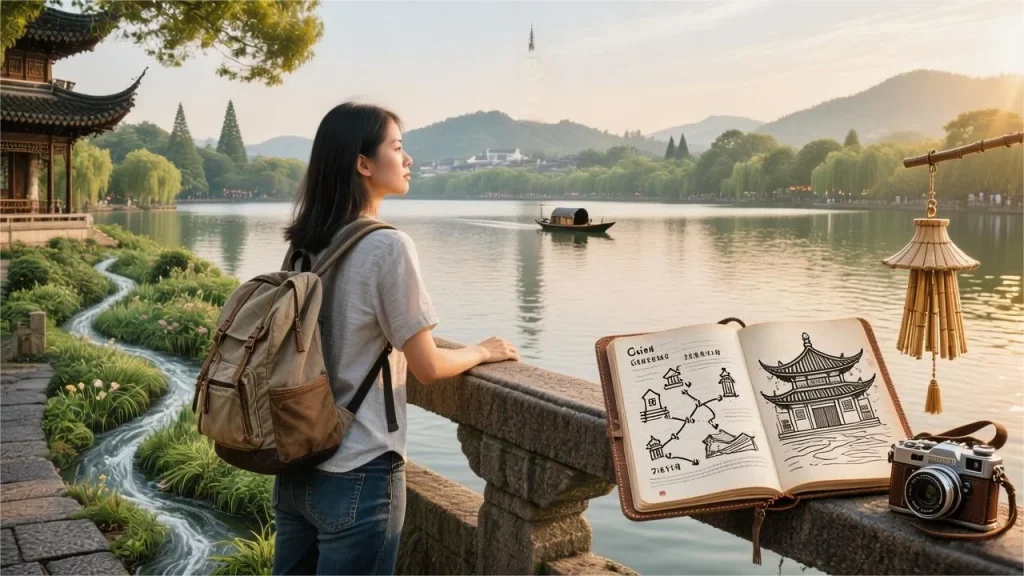
Day 2: Lingyin Blessings and Longjing Tea Garden Mountain Scenery
For today’s itinerary, I will take you completely away from the hustle and bustle of West Lake and dive into the mountains to the west. My personal experience is that you must arrive at the ticket gate of Lingyin Temple by 8:30 AM when the scenic area opens. At this time, the mountain mist hasn’t dissipated, and the Buddhist statues in the Feilaifeng Grottoes have a solemn sense of tranquility in the morning light. Many people rush to the Hall of the Great Hero, but I suggest you spend more time looking at the stone carvings of Feilaifeng, especially the Big-Bellied Maitreya Buddha; the detail is exquisite and it is a true artistic treasure of the Southern Song Dynasty.
Deep Suggestion: Bringing your own incense and candles is not allowed in Lingyin Temple; everyone is given three sticks of incense for free upon entry. If you want to ask for a fortune or buy an 18-seed bracelet at the Dharma Objects circulation point, I suggest going to the Medicine Buddha Hall or side halls deep within the temple, where there are fewer people and you can choose with a calmer mind.
Coming out of Lingyin Temple, I absolutely do not recommend taking the scenic area shuttle. I am used to walking Tianzhu Road, which is the famous “Upper Tianzhu” walking route. This road connects Lower Tianzhu (Fajing Temple), Middle Tianzhu (Fajing Temple), and Upper Tianzhu (Faxi Temple). Along the way are zen-style small shops and vegetarian restaurants run by local mountain residents; with luck, you can even see monks strolling by the stream. Walking this road, you will find that Hangzhou’s Buddhist culture is not floating in mid-air, but is actually growing between these old houses and tea gardens.
- Itinerary and Transport: Descending from Faxi Temple, take Bus 7 or a taxi at the entrance; over the hill is Meijiawu. This is the authentic production area for Longjing tea, with neat terraced tea gardens as far as the eye can see.
- Food Diary: The farmhouse dishes in Meijiawu are something I take friends to eat every time. You don’t need to look at a menu; go to the kitchen to see the fresh ingredients of the day. Boiled Salted Chicken is a must-order, with firm meat and crispy yellow skin; Longjing Shrimp emphasizes tenderness, with the tea aroma infused into the shrimp meat. If it’s spring, you can drink the most authentic new tea.
- Accommodation Experience: For these two days, I strongly recommend staying near Fengqi Road or West Lake Avenue. This belongs to the old city area; although there is a certain distance to Lingyin Temple, Metro Lines 1 and 2 intersect here. After returning to the hotel at night, you can walk to Hubin Yintai to see the fountain or find late-night snacks, which is very convenient.
In the afternoon, I will leave time for Yunqi Bamboo Path. This is my private “lung-cleansing” holy land, where the number of tourists is usually only one-third of that at Lingyin Temple. Upon entry, there is a straight ancient bamboo path with giant Liquidambar and Ginkgo trees blotting out the sun; the humidity is high enough to cool you down by 5 degrees instantly. I like sitting in the Wash-Heart Pavilion to listen to the sound of the bamboo waves; it’s a great place for spacing out. If your physical strength allows, you can climb the stone steps up; that is the hiking route to Meijiawu or Zhenji Temple, where you can see the most primitive mountain forest terrain of Hangzhou.
| Node | Activities | Estimated Cost | Precautions | |
|---|---|---|---|---|
| Early Morning | Feilaifeng, Lingyin Temple Blessings | 75 Yuan (Ticket + Incense) | Book in advance on the official account, avoid tour buses at 10:00 | |
| Around Noon | Faxi Temple Marriage Fortune, buy bracelets | 10 Yuan (Incense) | Faxi Temple vegetarian meals stop around 1:30 PM | |
| Lunchtime | Taste Longjing and local food in Meijiawu | 120 Yuan per person | Escape the lakeside noise and enter Hangzhou’s “Inner Mountain” area. I suggest setting your alarm earlier and arriving at the entrance of Lingyin Feilaifeng Scenic Area before 8:30 AM. Entering at this time helps you avoid the hundreds of large tour groups that follow. I usually pause in front of the Feilaifeng Grottoes first; those Southern Song statues scattered among moss and streams have a compassionate solemnity in the morning mist. After entering Lingyin Temple, don’t just squeeze with the crowds in the Hall of the Great Hero; I’ll detour to the Medicine Buddha Hall at the back to see that exquisite wooden carving group. |
- Time-saving Tip: The ticketing logic of Lingyin Temple is quite special. You need to buy the Feilaifeng Scenic Area ticket (45 Yuan) first, and after entering the area, buy the Lingyin Temple incense voucher (30 Yuan) separately. I always book in advance on my mobile, swipe my ID card to enter, and can be half an hour faster than those queuing at the window.
- Crowd-avoiding Route: After leaving Lingyin Temple, never squeeze onto those few-yuan-per-person scenic shuttle buses. I prefer to hike along Tianzhu Road, which is the “Upper Tianzhu” pilgrimage road the locals talk about. This road connects Fajing Temple of Lower Tianzhu, Fajing Temple of Middle Tianzhu, and Faxi Temple of Upper Tianzhu. Along the way are century-old camphor trees and well-arranged vegetarian restaurants. If you find too many people taking photos at Faxi Temple, I recommend you go to Fajing Temple. No ticket is required there; although the incense isn’t as thick, that sense of quiet cultivation is the true flavor of old Hangzhou.
- Food Diary: At noon, I will definitely take a taxi to Meijiawu, which is a Grade 1 protection zone for Longjing tea. I’m used to finding a farmhouse restaurant with a terrace facing the mountain tea hedges. The must-order is definitely the local Boiled Salted Chicken, with crispy skin and smooth meat, paired with a plate of Longjing Shrimp made with seasonal tea leaves. The tea farmers here usually recommend you buy tea; if you are not an expert, I suggest just eating, drinking tea, and feeling the mountain fragrance.
I have a habit when choosing a restaurant in Meijiawu, which is to see if there are many local license plates parked at the door. If the courtyard is filled with tables of local elderly people speaking the Hangzhou dialect, then the chicken soup and oil-braised bamboo shoots at this place are definitely authentic. Never go to those “internet-famous” restaurants decorated like palaces; the taste is often not as good as these residential courtyards.
I will leave the afternoon for the coolest place in all of Hangzhou—Yunqi Bamboo Path. This is my private “lung-cleansing” holy land. As soon as you enter the mountain gate, that refreshing coolness will make you instantly forget Hangzhou’s mugginess. I suggest following that blue stone road in the middle (which was the imperial road back then) all the way inside. Both sides of the road are lined with ancient firs as thick as a hug and emerald bamboo that blots out the sun.
| Segment | Coordinate Point | Deep Suggestion | Estimated Cost |
|---|---|---|---|
| Early Prayer | Lingyin Temple, Feilaifeng | Observe the wooden Shakyamuni statue behind the Hall of the Great Hero | 75 Yuan (Ticket + Incense voucher) |
| Zen Hiking | Tianzhu Road (Three Tianzhu) | Walk the small path by the Tianzhu stream, don’t take the main road | Free / Voluntary donation |
| Forest Lung-Cleansing | Yunqi Bamboo Path | Find that 1400-year-old ancient Liquidambar tree | 8 Yuan |
| Suggested Stay | Fengqi Road / West Lake Avenue | Close to Longxiangqiao, can walk to see the fountain by the lake at night | 400-800 Yuan / room |
Regarding accommodation, I still insist on recommending you stay in the Fengqi Road or West Lake Avenue area. You’ll be running in the mountains for these two days, so the physical exertion is high. Staying in these two areas, you’ll find the business district right outside the metro after coming down from the mountains. I usually return to the hotel in the evening for a short rest, then go downstairs to Hubin Yintai or Kerry Centre to find food. That transition from the quietness of the deep mountains to the urban prosperity is very interesting.
- Pitfall Reminder: If you encounter enthusiastic “guides” or “tea farmers” on Tianzhu Road inviting you to their homes for tea, be sure to decline politely. Real tea farmers are either in the fields or busy roasting tea at this time and don’t have time to solicit customers on the roadside.
- People and Culture: At Faxi Temple, you can observe the young people seeking Omamori and the elderly people kneeling in prayer; this overlapping of faith is a unique cultural landscape in Hangzhou. If you are lucky, you can also encounter newlyweds taking wedding photos in Yunqi Bamboo Path; the natural light and shadows here are the best filter.
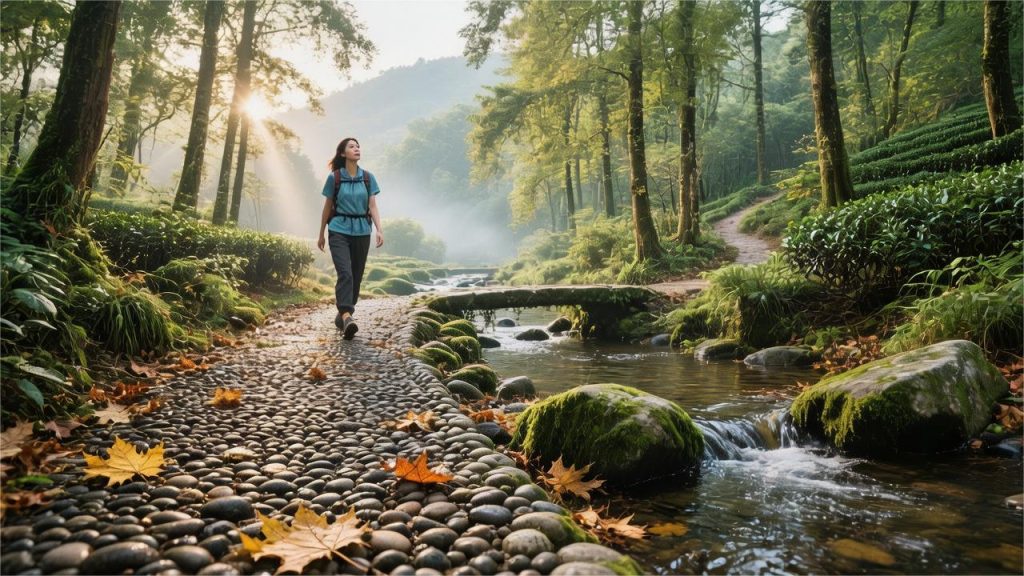
Day 3: Nine Creeks Meandering Through Misty Trees and the Return Journey by Qiantang River
For this last day, around 9:00 AM, I suggest starting from Longjing Village. Compared to walking up from the Nine Creeks sluice gate, going downstream from Longjing Village is much more labor-saving. This stretch is the famous Nine Creeks and Eighteen Gullies. The path along the way is not a boring asphalt road, but requires walking through stone steps in crystal-clear streams. If you are with children or want to get close to nature yourself, this is the most interesting wild place around West Lake.
- Itinerary Details: The hike is about four to five kilometers long in total, and walking while stopping takes about two hours. You will pass through large tea gardens and Metasequoia forests that blot out the sun. Especially at the turn of spring and summer, that tender green seems like it could drip water; if it’s late autumn, the red-through Metasequoias reflected in the streams have a strong visual impact. I suggest wearing a pair of non-slip hiking or sports shoes because the water-crossing stone steps are soaked in stream water for a long time and will have a small amount of moss on the surface.
- Pitfall Tips: There are many people soliciting tea-drinking in Longjing Village; I generally decline politely and walk deeper into the valley. Additionally, if you see people selling fishing nets by the stream, remember that the water there is very shallow and there aren’t actually any big fish; protecting the ecology is more meaningful than buying a plastic net.
Experience sharing: When you walk to the landmark emerald pool of “Nine Creeks Meandering Through Misty Trees,” don’t just check in at the big stone tablet. I am used to walking a few dozen meters along the small path on the right. There is an artificial small waterfall there; the sound of the water hitting the stones can drown out the surrounding noise. That is the most tranquil corner of this scenic area and the best spot to take “forest-style” blockbuster photos.
At noon, walking out of the Nine Creeks scenic area brings you to Zhijiang Road. I’ll choose to find a quiet restaurant near Yangmeiling. The dishes here are more refined than in Meijiawu; I recommend trying the Private Osmanthus Lotus Root or vegetarian dishes cooked with spring water. After eating, a taxi or bus ride of only about ten minutes will take you to Liuhe Pagoda (Six Harmonies Pagoda).
- Sight Details: Liuhe Pagoda is, in my opinion, the ancient building most worth climbing in Hangzhou. Its most unique feature is the “brick inside, wood outside” structure. From the outside it looks like thirteen stories, but inside there are actually only seven. Treading on the wooden stairs produces that heavy “creaking” sound, giving a very thick sense of history.
- Cultural Perspective: Standing on the balcony of the top floor of Liuhe Pagoda, you will see a landscape completely different from West Lake. Below is the wide and majestic Qiantang River, and in the distance are the Qiantang River Bridges, alternating between old and new. West Lake is a gentle “feminine beauty,” while the river view here is a type of “masculine vigor.” Watching the cargo ships coming and going on the river, you can truly feel Hangzhou’s confidence as a canal hub and a famous city in the Southeast.
| Segment | Location | Suggested Stay Time | Experience |
|---|---|---|---|
| Morning Hike | Longjing Village – Nine Creeks and Eighteen Gullies | 1.5 – 2 Hours | Crossing streams on stones, photographing Metasequoia forest, lung-cleansing |
| Landmark | Nine Creeks Meandering Through Misty Trees | 30 Minutes | Watch emerald pools, artificial waterfalls |
| Climb and View | Liuhe Pagoda | 1 Hour | Overlook Qiantang River panorama, study ancient architecture structure |
| Return Transfer | Hangzhou East Railway Station | Depart 1.5 hours in advance | Take Zhijiang Road to Qiushi Elevated Road; traffic is usually smoother |
If you need to catch a high-speed train around five or six in the afternoon, taking Zhijiang Road from Liuhe Pagoda to connect to the Qiushi Elevated Road is very convenient. This arrangement doesn’t involve backtracking and allows you to pack the three-dimensional sense of this city’s “mountains, lakes, and rivers” into your mind before leaving Hangzhou.
- Cost Review: The spending on the third day is relatively low. The Nine Creeks scenic area is completely free, and the entry plus climbing fee for Liuhe Pagoda is only thirty-some Yuan in total.
- People and Culture: While hiking in Nine Creeks, you might encounter many old Hangzhou locals with professional cameras photographing birds or insects; they know every tree here like the back of their hand. If you have a chance to chat with them, you can hear many stories about the vanished alleys of old Hangzhou, which is more exciting than any tour guide’s script.
Related Reading
- Hangzhou 3-Day Essential Tour | Ten Scenes of West Lake + Lingyin Temple Fortune Telling + Xiaohe Straight Street, Zero-Backtracking Nanny-Level Route
- How to choose the three cableways in Cangshan: the differences between Ximatan, Gantong and Zhonghe cableways
- Hangzhou 3-Day Spring Flower Viewing Tour | Prince Bay Tulips + Yuhu Bay Cherry Blossoms + Guo Manor Roses, Encountering the Most Beautiful Spring
- Hangzhou 4-Day Cycling & Hiking Route | Lake Loop Cycling + Jingshan Ancient Trail Hiking + Riverside Cherry Blossom Runway
- Hangzhou 4-Day In-Depth Tour | West Lake Loop + Xianghu Resort + Longyang Village Terraces, New Urban-Rural Combo Experience






