



Day 1: West Lake Island Cycling Route
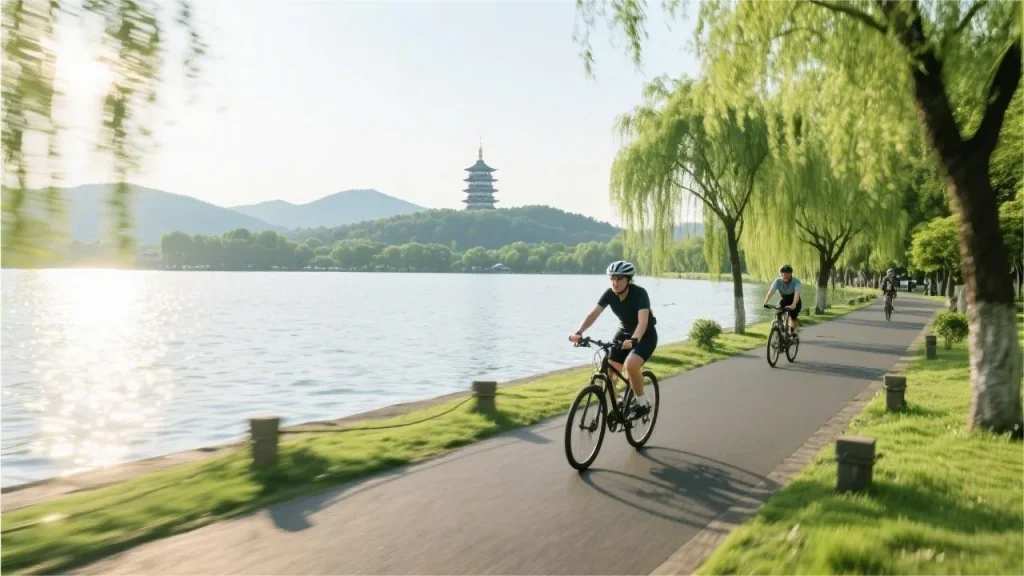
Cycling around the West Lake loop is my most recommended initiation ceremony for entering the city. I am used to starting from Beishan Road near the Broken Bridge, as the road here is wider than Hubin Road and effectively avoids the densest crowds on the pedestrian streets. During the ride, the Yangong Causeway section is the highlight of the entire route. There are six consecutive small arch bridges, giving you a noticeable sense of uphill and downhill undulation. The thrill of rushing down the slopes, combined with the sky-blotting plane trees on both sides, is very stress-relieving.
- Cycling Route and Transport: Although there are many bike rental shops in Hangzhou, I suggest using shared bikes. Return points in the West Lake scenic area are very dense, making it easy to stop and park whenever you want to explore an attraction on foot. Specific route: Broken Bridge — Bai Causeway — Gushan Road — Beishan Road — Yangong Causeway — Nanshan Road — Hubin Road. Here is a detail: Su Causeway is completely closed to bicycles on weekends and statutory holidays; security will stop you at the entrance. Therefore, Yangong Causeway is the only smooth choice, and its shade is thicker than Su Causeway’s, making it feel at least 3 degrees cooler in summer.
- Food Diary: For lunch, I recommend dining at private restaurants near Maojiabu, such as Longtangli or some farmhouse courtyards. If you are not fond of the traditional West Lake Vinegar Fish, I strongly suggest trying the Liye Lotus Seed and Spare Ribs Soup; the lotus seeds are soft and waxy, and the broth is extremely sweet. Additionally, Steamed Salted Pork with Bamboo Shoots and Dried Tofu (Yan Du Xian) is the soul of Jiangnan in spring; the bamboo shoots are incredibly crisp and tender, a flavor that industrialized restaurants cannot replicate.
- Attraction Pitfalls: When cycling on Nanshan Road, do not easily push your bike into “Orioles Singing in the Willows” (Liu Lang Wen Ying). The crowds are huge and the gravel paths make pushing a bike very difficult. Furthermore, there is no need to buy a ticket to enter Leifeng Pagoda. Taking photos from the entrance of Jingci Temple on Nanshan Road allows you to capture the full panorama of “Leifeng Pagoda at Sunset,” saving 40 Yuan in admission and avoiding the elevator queues.
The last time I took a friend on this route, the steepness of the bridges on Yangong Causeway meant the brake pads on some shared bikes were heavily worn, making downhills quite dangerous. I suggest you squeeze the brakes several times to check performance after picking up a bike. Especially for parents with children, be sure to control your speed on downhills; safety is the top priority.
- Time Schedule:
| Time Node | Activity Details | Experience Suggestions |
|---|---|---|
| 09:00 – 10:00 AM | Broken Bridge to Gushan Road | Try to start before 9:00 AM, otherwise Bai Causeway will be taken over by tour groups |
| 10:00 AM – 12:00 PM | In-depth cycling on Yangong Causeway | This is the most physically demanding part of the route; watch your breathing |
| 12:00 – 13:30 PM | Lunch at Maojiabu | Find shops with many local cars parked outside; the taste usually won’t go wrong |
| 13:30 – 15:30 PM | Nanshan Road Sycamore Avenue | This section is suitable for slow riding; the outer walls of the art museums are great for street photography |
| 15:30 – 16:30 PM | Return bike at Hubin | It’s best to return the bike before reaching Longxiangqiao, as the return points there are often full |
This route is approximately 15 kilometers long. Riding slowly while taking photos and resting takes about 6 hours. I suggest you wear a breathable long-sleeved shirt. Even with shade, the UV reflection by West Lake is still strong; physical sun protection is more effective than sunscreen.
Day 2: Hiking the Jingshan Ancient Path
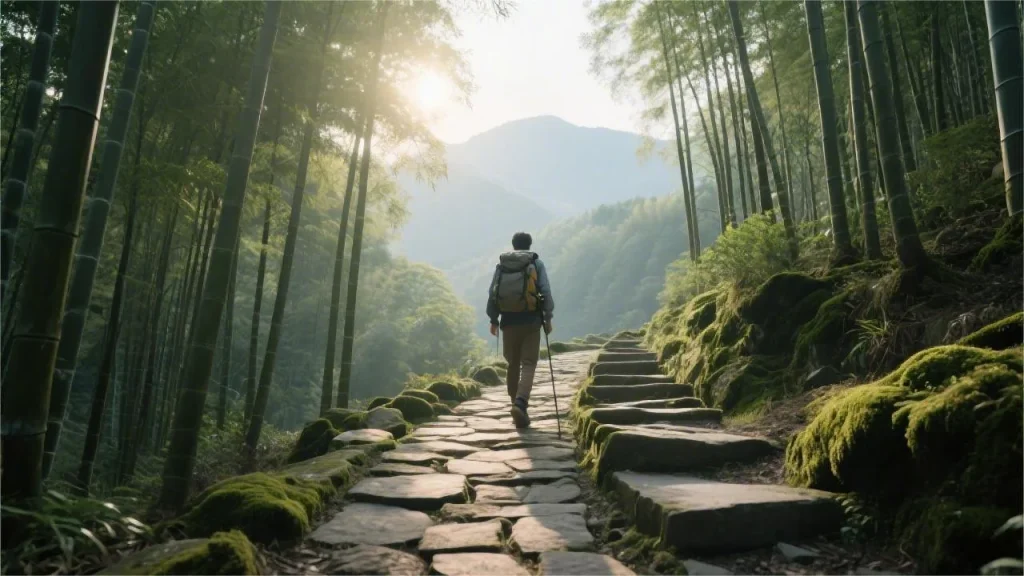
Going to Jingshan is not just to see the temple, but also to walk that ancient path with a thousand years of history. I suggest you try to depart in the morning, as Jingshan is located in Yuhang District, nearly 50 kilometers away from Hangzhou city center. The Jingshan Ancient Path is about 3 kilometers long, with the surface mainly paved with smooth bluestone slabs. Although the overall elevation gain is moderate, the dense steps along the way do require some knee strength and physical stamina. If possible, bringing a lightweight trekking pole will make the second half much easier for you.
- Itinerary and Transport: If you are driving, you can navigate to the “Jingshan Ancient Path Tongqiao Starting Point,” where there is a small outdoor parking lot. If choosing public transport, you can take a customized bus heading towards Jingshan at Wulinmen North, get off at Tongqiao Station, and walk a few minutes to see the prominent stone archway at the entrance of the ancient path. On weekends with good weather, it is recommended to arrive half an hour earlier to ensure you can find a parking spot.
- Attractions and Culture: Both sides of the ancient path are covered with vast bamboo seas characteristic of Jiangnan. Even in warmer seasons, walking among the bamboo allows you to feel a noticeable mountain breeze. Along the way, you will pass through the “Five Platforms of Entering Holiness” (Jin Sheng Wu Tan) in sequence, each with an ancient pavilion for resting. After reaching Jingshan Temple at the summit, you can intuitively feel the profound Song Dynasty aesthetics. Although the temple was rebuilt in modern times, the all-wood Tang and Song style architecture, combined with the Zen gardens, features extremely clean and sharp lines, making it easy to capture Zen-filled photos with the right light and shadow. This is also the birthplace of the Japanese Tea Ceremony; you can sit for a while in the temple’s tea room to experience the authentic Jingshan Tea Banquet culture.
- Food Diary and Costs: The ancient path hike itself is free, while entering Jingshan Temple requires purchasing an “Incense and Flower Voucher” for about 30 Yuan. For lunch, I highly recommend having a bowl of Double Mushroom Vegetarian Noodles in the temple’s vegetarian dining hall. The portions are generous, and the broth is simmered with fresh mushrooms, making it sweet and rich—the best choice for replenishing carbs and salt after sweating on the hike. If your companions feel exhausted on the way down, you can spend 10 Yuan for a scenic area shuttle bus ticket outside the temple and return to the Tongqiao starting point via the winding mountain road.
I have previously encountered tourists on the ancient path wearing flat shoes or even sandals to climb the mountain for the sake of lightness. The bluestone slabs often get a very thin layer of moss after morning dew or rain, which significantly reduces the friction of ordinary soles. Wearing a pair of hiking shoes or sneakers with anti-slip tread will make you much more stable when walking down the steps, protecting your ankles from injury.
| Itinerary Phase | Hiking and Sightseeing Details | Personal Experience Reference |
|---|---|---|
| 08:30 to 10:00 AM | Travel from the city to Tongqiao, Jingshan Town by car or self-drive | Check the customized bus timetable in advance to plan your departure time reasonably |
| From around 10:00 AM | Start climbing up the steps along the ancient path | Keep a steady pace; it is suggested to sit and drink water in the pavilions every half hour of climbing |
| Noon | Dine at the mountain-top vegetarian hall and stay briefly | The supply of vegetarian noodles is limited; it’s suggested to eat at the hall before visiting the main halls |
| 02:00 to 05:30 PM | Walk or take a bus back down after visiting the temple | If choosing to walk down, you can try walking sideways on the steps to reduce impact on the knee joints |
Day 3: Cycling on the Binjiang Cherry Blossom Track
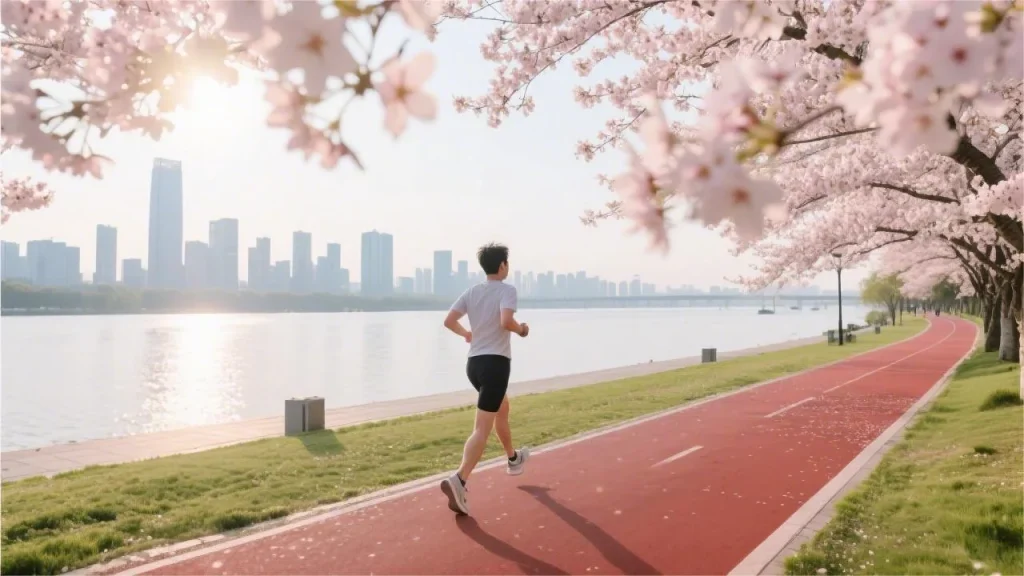
If you happen to arrive in Hangzhou during the spring breeze of late March, Wentao Road in Binjiang District is definitely worth half a day of your time. This route, which clings tightly to the Qiantang River embankment, offers an unobstructed view. My most enjoyable state of cycling is blowing in the river breeze, with the open river water surging with the tides on my left, and several kilometers of Somei Yoshino cherry blossoms stretching on my right. The road conditions here are excellent, making it perfect for a relaxing recovery ride after the physical exertion of the first two days.
- Itinerary and Transport: The track on Wentao Road is designed very humanely. The blue plastic track is dedicated to walking and running, while the red one is for bicycles, completely separating pedestrians and vehicles physically. I suggest finding a shared bike with gear-shifting capabilities near the King Qian Shooting the Tide Square (Qian Wang She Chao), because while it is flat along the river, a gear bike will save you a lot of effort when encountering occasional headwinds. Cycling westward, the sense of openness of the river surface changes continuously, and the double-deck structure of Fuxing Bridge serves as an excellent framing for photos under the sunset.
- Crossing the River and Attractions: In the second half of the journey, we need to head to the City Balcony on the north bank. When crossing Fuxing Bridge, you can cycle on the non-motorized lane; the approach bridge designed for pushing bikes up is not difficult. After reaching the other side, the City Balcony is an observation deck facing Qianjiang New City. Not only can you overlook the river view, but you can also enjoy the modern light show centered on the “Sun and Moon Shining Together” buildings after dark.
- Accommodation and Food: To facilitate this part of the itinerary, it is highly recommended to book a hotel in the Starlight Avenue commercial area of Binjiang District for the night. The accommodation hardware here is very new, and the biggest advantage is that you can enter the riverside track within a few steps of going downstairs. I am used to solving dinner at Starlight Avenue; there is a local restaurant that makes Drunken Crabs and Old Duck Stew very authentically. The duck meat is stewed until tender, and the rich broth effectively replenishes the energy consumed during the afternoon.
On weekends when cherry blossoms are in full bloom, shared bikes along Wentao Road will be in high demand. I suggest you find a bike and start riding from a subway station area about one block away from the river; otherwise, there is a high probability you will only find empty bike racks by the river. Additionally, the wind by the river is usually 2 to 3 levels stronger than in the city; even in spring, carrying a thin jacket with a tightenable collar is very necessary.
| Tour Stage | Cycling and Viewing Details | Personal Experience Supplement |
|---|---|---|
| Around 02:30 PM | Depart from King Qian Shooting the Tide Square and head west along the river | The light is sufficient now, cherry blossoms are at their most saturated colors, suitable for stopping to record anytime |
| Approaching 04:30 PM | Cross the Qiantang River via Fuxing Bridge | Wind on the bridge is strong; grip the handlebars firmly and watch out for oncoming electric bikes |
| One hour around sunset | Arrive at City Balcony and wait for the night view | Occupy a position on the second-level platform near the riverside railing for the clearest view |
| From dusk to 07:30 PM | Return to Starlight Avenue for dinner and rest | Light shows usually take place in the evening; watching it and then having dinner nearby is a perfect timing |
Day 4: Linking Urban Natural Landscapes
On the final day of the trip, we return completely to nature to visit Hangzhou’s true “green lung.” Nine Creeks and Eighteen Gullies is a personal hidden hiking route of mine for stress relief. The abundant water flow and mountain tea gardens here create a natural microclimate. I suggest you set the starting point to Jiuxi Road after breakfast, because walking up from here is an extremely gentle slope, where you can barely feel the elevation gain, making it the most effortless way to walk.
- Route and Transport Details: Take a taxi to near “Jiuxi Bus Station” and walk in along the Jiuxi Road main road. The Metasequoia trees on both sides of this road are very tall, and the light and shadow quality is excellent as the morning sun filters through. Continuing deeper leads to the “Jiuxi Meandering Through Misty Trees” area, where you can see a emerald green lake and a small waterfall. After viewing the lake, you officially enter the “Eighteen Gullies” section leading to Longjing Village.
- Practical Safety Matters: In this section of Nine Creeks and Eighteen Gullies, you will encounter several instances where you need to step on stones in the stream to cross. Although the scenic area has repaired some small stone bridges in recent years, many sections still retain original stepping stones. These stones are washed by the stream all year round, and the backs and sides are prone to slippery algae; be sure to keep your center of gravity low when crossing.
- People and Local Culture: After crossing the stream area, the terrain will gradually open up, leading to Longjing Village. Almost every household in the village grows tea. If you encounter enthusiastic villagers inviting you into their courtyards for tea and a rest, this is usually a commercial move to sell their own tea. If you don’t intend to spend money, just keep a smile and politely refuse; they won’t pester you much.
- Food Diary: For lunch, I recommend finding a farmhouse restaurant with a terrace in Longjing Village. Besides ordering a cup of mellow Quntizhong Longjing to quench your thirst, you must try the local Tea Fragrance Chicken for the main dish. The typical method here is to slow-stew a whole chicken in a clay pot with Longjing tea juice and spices; the chicken meat falls off the bone and carries a faint tea fragrance, making it a great accompaniment for rice.
I once took a friend through this water route. While stepping on stones to cross, the friend didn’t watch their step because they were looking for an angle to film a short video, and slipped into the stream. Although the water was shallow and only covered the ankles, after the shoes and socks were completely soaked, the subsequent two-hour hike became very miserable. I suggest you must put your phone in your pocket when crossing, look specifically for dry and flat stone centers, and step firmly before taking the next step.
| Hiking Phase | Landscapes and Activities Along the Route | Personal Experience Reference |
|---|---|---|
| Shortly after 09:00 AM | Enter from Jiuxi Road and visit Jiuxi Meandering Through Misty Trees | The light in the Metasequoia forest is softest in the morning, humidity is high, and the physical feel is most comfortable |
| Approaching Noon | Cross the Eighteen Gullies to reach Longjing Village | Mobile signals may temporarily weaken during this section, which is normal |
| 01:00 to 03:00 PM | Lunch in Longjing Village and stroll at the entrance of Shili Langdang | After eating, walk in the village’s tea garden paths; viewing the rolling tea mountains from a distance is enough, no need to force a climb to the top |
| After 03:30 PM | Pack luggage and head to the high-speed railway station or airport | Taking a taxi inside Longjing Village may require queuing; it is suggested to allow for a 20-minute lead time |
Keep Reading
- Hangzhou 4-Day In-Depth Tour | West Lake Loop + Xianghu Resort + Longyang Village Terraces, New Urban-Rural Combo Experience
- 3-Day Tour Around Hangzhou West Lake | Broken Bridge Snow Scene + Lingyin Temple + Nine Creeks and Eighteen Streams, Classic Jiangnan Route Without Backtracking
- Hangzhou 3-Day Essential Tour | Ten Scenes of West Lake + Lingyin Temple Fortune Telling + Xiaohe Straight Street, Zero-Backtracking Nanny-Level Route
- How to choose the three cableways in Cangshan: the differences between Ximatan, Gantong and Zhonghe cableways
- Hangzhou 3-Day Spring Flower Viewing Tour | Prince Bay Tulips + Yuhu Bay Cherry Blossoms + Guo Manor Roses, Encountering the Most Beautiful Spring






