



Day 1: Classic Scenic Tour Around West Lake
I suggest you reserve all your physical energy for the West Lake district on the first day, because although the scenery along this route is superb, it relies entirely on leg power. At 9:00 AM sharp, I arrive on time at Fengqi Road Station on Metro Line 1. This is the smoothest entrance to West Lake, avoiding the terrifying crowds at Longxiangqiao Station. Walking along Beishan Street for 5 minutes, you will see the Broken Bridge.
Many people just take a photo at the bridgehead and leave, but I prefer a slow walk on Bai Causeway. The view from Bai Causeway is excellent; on your left is the silhouette of Baoshi Mountain and Baochu Pagoda, and on your right is the open Outer Lake. Crossing Pinghu Qiuyue (Autumn Moon over the Peaceful Lake) to enter Guoshan (Solitary Hill), you’ll find the cultural soul of West Lake hidden here. I must recommend going to Xiling Seal Art Society. Climb the stone steps up to Sizhao Pavilion, where the crowd density is less than half of that at the Broken Bridge. You can overlook the Outer West Lake from here; that kind of garden layout leaning against mountains and waters is the true taste of old Hangzhou.
My personal pitfall warning: There are many boating docks behind Solitary Hill. Try to choose a hand-prowed boat (standard limit of 6 people). Although more expensive than electric boats, the boatman will take you into the hidden waters near Yanggong Causeway. Never buy those 10-yuan packs of fake “Longjing Crisp” near the Broken Bridge; they are full of artificial flavors. If you want snacks, go to the alleys behind to find century-old traditional brands.
Around 12:00 PM, I usually find a place to eat on Beishan Road near the Yue Fei Temple. Although this is a scenic area, there are several very high-quality Hangzhou cuisine restaurants hidden here. I suggest asking if the West Lake Vinegar Fish is made with Kaihua freshwater fish before ordering; if not, it’s better to switch to the more reliable Longjing Shrimp. At 1:30 PM, I grab a shared bike and start a sprint across Su Causeway. Su Causeway is nearly 3 kilometers long; walking it will exhaust the energy you need for the next two days on the very first day. After cycling to Huagang Guanyu (Flower Harbor and Fish Viewing), remember to stop and take the shortcut to the Red Fish Pond. There aren’t just a few red fish here, but thousands of them gathered together. Many people think watching fish is boring, but if you carefully observe the lattice windows and borrowed scenery here, you will find that Suzhou-style gardens are utilized to the extreme in Hangzhou.
At 3:30 PM, Leifeng Pagoda is a must-climb. This is the only place in the entire itinerary where I think the ticket price is worth it, because only by standing at the top of Leifeng Pagoda can you truly see the “panorama” of West Lake. If you are lucky enough to catch the sunset, the bells from the nearby Jingci Temple will ring—this is the famous “Evening Bell Ringing at Nanping Hill.” At 6:00 PM, I follow Nanshan Road back to the Hubin Business District. At this time, the Hubin Road Pedestrian Street is the most modern place in all of Hangzhou. You can have dinner here and catch a glimpse of the Musical Fountain. Although it only lasts a few minutes, the atmosphere of the fountain dancing to “The Butterfly Lovers” provides a perfect ending to your first day.
| Time Node | Transportation | Key Activities | Estimated Cost |
|---|---|---|---|
| 09:00 – 12:00 | Walking + Shared Bike | Photos at Broken Bridge, walk on Bai Causeway, stone carvings at Xiling Seal Art Society | 0 Yuan (Free) |
| 12:00 – 13:30 | Walking | Taste Longjing Shrimp and Congbaohui at Beishan Road | 80 – 120 Yuan per person |
| 13:30 – 15:30 | Shared Bike | Cycle Su Causeway, watch red fish at Flower Harbor | 1.5 Yuan (Bike fee) |
| 15:30 – 17:30 | Elevator up the Tower | Overlook West Lake from Leifeng Pagoda, see Three Pools Mirroring the Moon | 40 Yuan (Ticket) |
| After 18:00 | Walking | Hubin District, Musical Fountain, Longxiangqiao delicacies | Depends on shopping consumption |
- Accommodation Suggestion: I recommend staying near Fengqi Road or Wulin Square. These two places are not only close to West Lake but also have direct metro access to any transportation hub. Business hotels around Wulin Square offer great value, are more standardized than guesthouses in the scenic area, and have a rich variety of food delivery options.
- Traffic Details: The area around Hangzhou’s West Lake is very prone to traffic jams after 4:00 PM; taking a taxi then is basically a waste of time. Based on my experience, the Metro + Shared Bike combination is the most reliable. If traveling with elderly or children, consider the red sightseeing electric buses that circle the lake; they are charged by section and stop on demand.
- Cultural Tip: Walking along West Lake, you will see many old Hangzhou locals exercising or doing ground calligraphy. Pay attention to the couplets along the way, such as “The best place among lakes and mountains” at Xiling Seal Art Society. You only truly understand Hangzhou once you understand these characters.
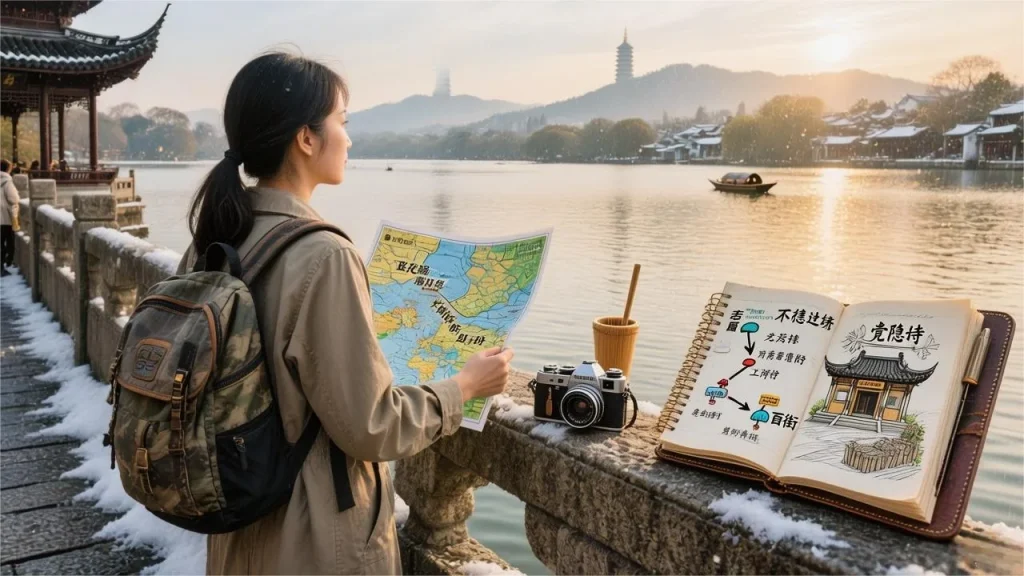
Day 2: Lingyin Blessings and Longjing Tea Plantation Route
I define the theme of this day as “Entering the Mountains.” The essence of Hangzhou is half in West Lake and the other half in the ancient temples and tea gardens surrounded by these mountains. At 8:00 AM sharp, I must appear at the ticket gate of the Feilaifeng (Peak Flown From Afar) Scenic Area. This timing isn’t to beat a rush, but to see Qinglin Cave and Lengquan Pavilion quietly before the tour groups’ loudspeakers arrive. I define the stone carvings of Feilaifeng as “landscape cultivation” because you transition from the prosperity of West Lake into the depths of Hangzhou. At 8:00 AM, you must already be standing at the Feilaifeng ticket gate.
Lingyin Road is the most congested road in Hangzhou; arrive half an hour late, and you might spend an hour watching falling leaves from inside a taxi. The first thing I do after entering the scenic area is not enter the temple, but look at the stone carvings of Feilaifeng. These Southern Song and Yuan Dynasty Buddhist statues carved into the rock face provide a sense of primitive shock that indoor statues cannot match. Then enter Lingyin Temple; I suggest taking three sticks of incense in front of the Hall of the Great Hero. Regarding fortune-telling, if Lingyin Temple is too crowded, I choose to walk or spend 10 Yuan on a sightseeing electric bus to Faxi Temple (Upper Tianzhu). Faxi Temple has many steps; taking a photo from the highest point looking down at the yellow walls, dark tiles, and layered mountain trees provides a powerful visual impact.
My true lesson for avoiding pitfalls: On the way to Lingyin Temple, if someone approaches you and asks if you’re here for fortune-telling, or offers to take you to a “local secret” tea farm, ignore them. These are mostly “hooks” for tea sales or illegal guides. Lingyin Temple and Faxi Temple both have official incense stations; there’s no need to buy outside. Additionally, fortune-telling at Faxi Temple is self-service; sincerity is what matters, so don’t be misled by strangers who offer to “interpret” your fortune.
At noon, I recommend having lunch on Lingyin Branch Road. If you want to experience local specialties, Lingyin Temple’s vegetarian noodles are the top choice, especially the Arhat Vegetarian Noodles. The noodles are chewy, and the broth is full of the umami of mushrooms, costing only around 10 or 20 Yuan. Around 1:30 PM, I suggest you leave the crowds and take a taxi or bus to Wuguitan (Turtle Pond). This is my “private reserve” in Hangzhou; even during the October golden week, it remains quiet enough to hear birds chirping. The essence of Wuguitan lies in its wild charm; you can walk along the wooden planks by the water to see reeds and stone bridges. The sculling boats here are more worth taking than those in the main West Lake area; the boatman will take you through the bridge holes of Yanggong Causeway, providing a sense of tranquility deep in the water town that is true Jiangnan.
After 3:30 PM, the sunlight begins to soften, making it the best time to visit Longjing Village to see the tea gardens. You can follow Longjing Road all the way into the mountains, with neat rows of tea hedges on both sides. I don’t choose to drink tea at the homes of the touting farmers at the village entrance; instead, I climb up the mountain a bit to find a tea house with a wide view and clearly marked prices. Order a pot of that year’s Quntizhong West Lake Longjing; although it might cost over 100 Yuan, sitting among the tea mountains, feeling the mountain breeze, and looking at the distant city skyline makes this money well-spent.
| Node | Suggested Transport | Experience | Remarks |
|---|---|---|---|
| 08:00 AM | Taxi / Bus 7 | Feilaifeng Grottoes, Lingyin Temple blessings | Must arrive early to avoid Lingyin Road traffic |
| 10:30 AM | Footpath / Shuttle | Faxi Temple photo spots, marriage fortune-telling | The vegetarian cakes here are also delicious |
| 12:00 PM | Walking | Vegetarian noodles at Shili Songzhi or Qingxin | Avoid restaurants touting tea on the roadside |
| 2:00 PM | Taxi | Walk at Wuguitan, watch sculling boats | The most peaceful spot in western Hangzhou |
| 4:00 PM | Walking / Bike | Climb Longjing tea mountains, watch sunset over tea rows | Find tea houses with clear pricing, refuse touts |
- Food Notes: When in Longjing Village, you must try the Tea Fragrance Chicken. It’s not just stewed chicken; it has a subtle tea flavor and the meat is tender. Also, the viral Omamori (charms) at the entrance of Faxi Temple make great souvenirs; each has a different meaning, so pick one you like.
- Expense Details: Feilaifeng ticket is 45 Yuan, Lingyin Temple incense fee is 30 Yuan, Faxi Temple is 10 Yuan, and Wuguitan is free. The main expenses today will be tea and dining, with a per capita budget of 200-300 Yuan for a very comfortable trip.
- People and Culture: Hangzhou’s temple culture is more than just religion; it’s a lifestyle. You’ll see many young people slowing down here. Don’t rush; sit for a while in the corridors of Faxi Temple and observe that unique fusion of ancient and modern.
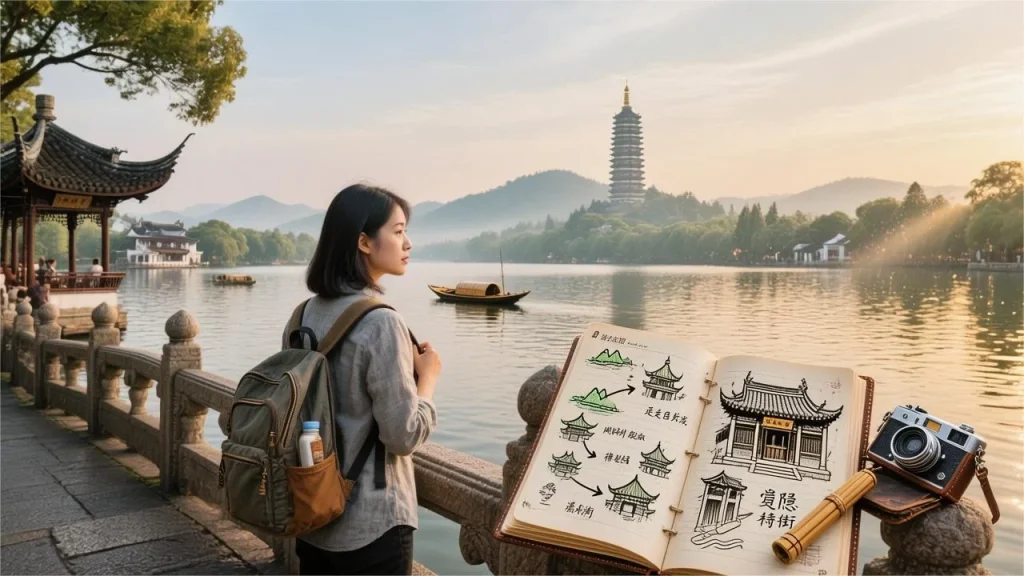
Day 3: Canal Culture and Old Hangzhou Market Life
If West Lake is the “face” of Hangzhou, then the Grand Canal is the city’s “lining.” On the last day, I usually avoid the noisy scenic spots to experience the most authentic local life. Around 9:30 AM, I suggest you take a taxi or Metro Line 5 to Gongchen Bridge. Standing on the top of the bridge looking north, you can feel the busy traffic of the Beijing-Hangzhou Grand Canal as a golden waterway. Qiaoxi Straight Street is a place I highly recommend; it’s more than just a commercial street, as it preserves a large number of modern industrial relics. I always go to see the China Knives, Scissors and Swords Museum and the Fan Museum. These museums are free, and the details are handled exceptionally well. You can see how a pair of Zhang Xiaoquan scissors is forged through 72 processes, which is much more interesting than just looking at scenery.
My true experience suggestion: When visiting the museums, remember to watch the live demonstrations by the old craftsmen. Many people just glance at the display cases and leave, but the drafts and semi-finished products scattered on the workbenches are the essence. I suggest you leave the last day for the Grand Canal; there is no exquisite decoration like West Lake here, but more of the real water town life. At 9:30 AM, I am standing on Gongchen Bridge right on time. This three-arch stone bridge is the landmark of the southernmost end of the Grand Canal. Standing at the top, you can see cargo ships full of goods slowly passing through the bridge arch. The sense of industrial-era heritage is very shocking. The Qiaoxi Straight Street on the west side is a historical district, but I most recommend those few free museums. I personally like the China Knives, Scissors and Swords Museum and the Umbrella Museum most. They contain not only exquisite objects but also demonstrate the production processes of Hangzhou Zhang Xiaoquan scissors and West Lake silk umbrellas. Instead of a cursory look, watching the masters demonstrate the craftsmanship live will give you a deeper understanding of Hangzhou’s artisanal heritage.
My true suggestion: Many people spend a lot of money on large canal cruise ships, but I recommend the Canal Water Bus Line 1, which costs only a few Yuan. Starting from the Gongchen Bridge pier and following the current south, the banks are lined with staggered houses and weeping willows. This perspective captures the meaning of “houses leaning against the river” better than walking on the shore.
By 11:30 AM, I walk along the canal path to Xiaohe Straight Street. This is my favorite neighborhood in Hangzhou, where many old neighbors still live in white-walled, black-tiled houses. I enter a riverside private restaurant at random and order Oil-Exploded Shrimp and a bowl of authentic Pian’erchuan noodles. The shells of the shrimp are crispy enough to chew, and the potherb mustard and bamboo shoots in the noodles are incredibly fresh. Sitting by the window, with the quietly flowing river less than two meters away, that feeling of slow life comes out instantly. Starting at 1:30 PM, I give my time to the creative shops here. Xiaohe Straight Street has many handmade workshops where you can try tie-dyeing or pottery yourself. Compared to the commercial feel of the West Lake scenic area, the shop owners here are mostly casual, acting more like they are managing a lifestyle.
Around 3:00 PM, I arrive at Xiangji Temple. This temple is very special as it is one of the few copper-built temples in China. The eaves, pillars, and even decorative details are cast in copper. When the sunset hits the copper walls, it emits a deep golden glow, creating a strong sense of solemnity. This is also a famous place for vegetarian food; if you didn’t eat enough at lunch, the vegetarian meal at Xiangji Temple is also excellent. After 4:30 PM, my trip is basically complete. There is a metro station less than ten minutes’ walk from Xiangji Temple, or you can take a taxi to Hangzhou East Railway Station, which takes about half an hour if there’s no traffic.
I have organized the expenses for this three-day trip into a table, which you can adjust according to your spending habits. Hangzhou’s public services are very good, and in fact, many of the best landscapes are free.
| Expense Item | Estimated Amount | Remarks |
|---|---|---|
| Scenic Tickets | Approx. 125 Yuan | Includes Feilaifeng, Lingyin, Leifeng Pagoda, Faxi Temple |
| Transportation | 80 – 100 Yuan | Includes Metro, Water Bus, Shared Bikes, and a few taxis |
| Dining | 500 – 600 Yuan | Includes Hangzhou cuisine, temple noodles, Longjing tea tasting |
| Accommodation (3 nights) | 600 – 1200 Yuan | Depends on hotel grade; suggested near business districts |
| Total Budget | Approx. 1300 – 2000 Yuan | Excludes major transport to/from Hangzhou |
- Accommodation Suggestion: Many people struggle between staying by West Lake or the canal. My experience is to choose Fengqi Road or Wulin Square. This is the center of Hangzhou; whether walking to the Broken Bridge or taking the metro to Gongchen Bridge, everything is within a 20-minute life circle. Moreover, there are many shopping malls nearby, making it extremely convenient to get late-night snacks or buy souvenirs.
- Pitfall Tips: When taking photos on Xiaohe Straight Street, remember not to be loud, as many elderly people still live in those houses. Also, the prices of cafes along the canal vary greatly; check the price list before entering. As for those “Silk Factory Outlets” recommended by tour bus guides, resolutely do not go; true silk traditional brands are all in the large shopping malls in the city center.
You May Also Like
- How to choose the three cableways in Cangshan: the differences between Ximatan, Gantong and Zhonghe cableways
- Hangzhou 3-Day Spring Flower Viewing Tour | Prince Bay Tulips + Yuhu Bay Cherry Blossoms + Guo Manor Roses, Encountering the Most Beautiful Spring
- Hangzhou 4-Day Cycling & Hiking Route | Lake Loop Cycling + Jingshan Ancient Trail Hiking + Riverside Cherry Blossom Runway
- Hangzhou 4-Day In-Depth Tour | West Lake Loop + Xianghu Resort + Longyang Village Terraces, New Urban-Rural Combo Experience
- 3-Day Tour Around Hangzhou West Lake | Broken Bridge Snow Scene + Lingyin Temple + Nine Creeks and Eighteen Streams, Classic Jiangnan Route Without Backtracking
Longji Rice Terraces — — Practical Data
Transport & Schedules
- Guilin city → Longji Rice Terraces (Jinkeng Dazhai) | Shared car/direct shuttle: A shared car from the city about CNY 50 per person round trip, about 1.5 h; the Jinkeng terraces direct shuttle from Guilin city about CNY 368, from Yangshuo county town about CNY 328 (OTA t[src]
Where to Stay · Room Type · Nearby
- Ping’an village / Jinkeng Dazhai (guesthouses in the village) | Room tip: Jinkeng Dazhai has a more spectacular view; to see the terraces at sunrise/sea of clouds, stay in the village | Nearby add-ons: Jinkeng terraces, Ping’an Zhuang terraces, Huangluo Red Yao village, Ancient Zhuang village[src]






