



Day 1: Prince Bay Tulip Flower Sea Tour
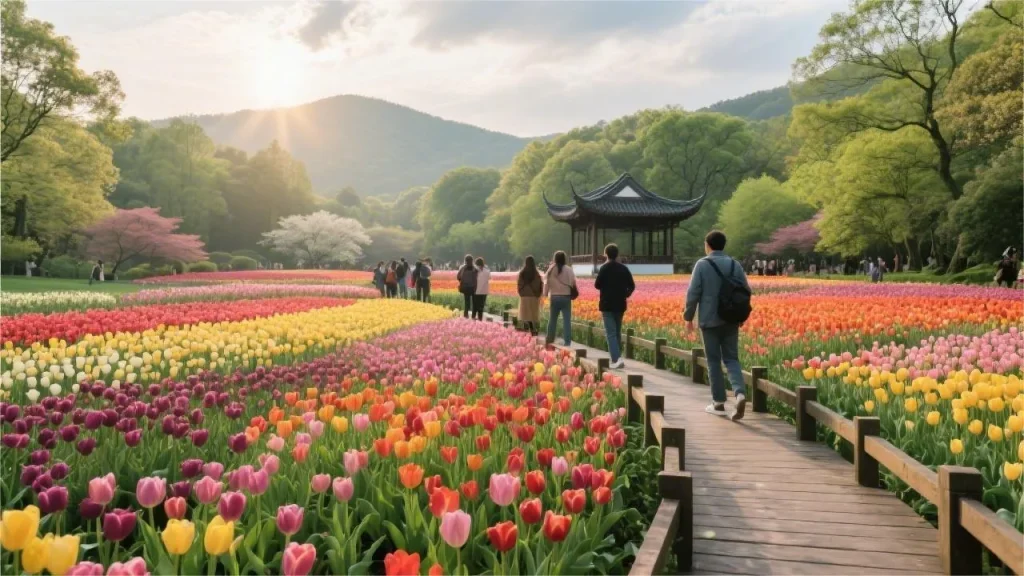
The tulips at Prince Bay are indeed the most worthwhile natural landscape to see in Hangzhou during the spring. The flowers here are not only planted with high density, but are also naturally distributed along gentle slopes and winding waterways, creating a rich visual hierarchy of varying heights. My personal practical experience is that if you want to capture clean shots without a cluttered background of crowds, arriving at the park gate before 8:00 AM is a non-negotiable bottom line. Once past 9:00 AM, the main lawn and the boardwalks around the waterscape basically become overcrowded, making it hard to find a complete composition angle.
- Itinerary and Transport Arrangements: During the spring flower exhibition, strict one-way traffic control is implemented on the roads around Prince Bay. I strongly suggest you take a taxi to the south entrance of Su Causeway or the Jingci Temple opposite, and then walk a few hundred meters. If you plan to go by shared bike, please note that the return points along Nanshan Road are often full during the morning peak, which may prevent you from successfully locking and returning the bike. After entering the park, do not linger too long in the entrance passage; head straight to the Wangshanping area, where the tulip varieties are most concentrated and the colors are the most vibrant.
- Composition and Sightseeing Details: In the Wangshanping and Big Windmill lawn area, I suggest you squat down as much as possible and use the reflection of the stream water as a foreground for your photos. This not only increases the transparency of the image but also uses the natural height of the flower clusters to block out distant tourists. Walking further along the waterway, you will reach the Zhulianbi Waterfall. In spring, the early cherry blossoms here usually bloom at the same time as the tulips. The pale pink cherry blossom branches drooping over the bright tulips create the most brilliant natural photo spot for color contrast in the entire park.
- Local Food Diary: After finishing your tour at noon, try not to buy overpriced sausages or fast food snacks inside the park. After exiting from the Nanshan Road gate, you can walk a few hundred meters toward Hupao Road, where several old shops specializing in Hangzhou-style noodles are hidden. Order a bowl of freshly cooked Pian’erchuan. During early spring, the topping will feature extremely tender spring bamboo shoots. The broth is clear and delicious, making it a perfect energy supplement after a morning of hiking.
I previously met a few friends who brought a full set of photography gear specifically to take portraits, but because they couldn’t get up early, they didn’t enter the park until nearly noon. As a result, when they reached the Big Windmill lawn, they found every flower cluster surrounded by people queuing for photos, and the light had become very harsh. In the end, they could only spend the whole time pointing their cameras at the sky or close-ups of flowers, completely unable to capture the depth of a grand scene. Getting up early on this route is the best guarantee for great photos.
| Tour Progress | Detailed Tips | Personal Advice |
|---|---|---|
| Around 8:00 AM | Arrive at the park gate and verify identity for entry | Book your entry slot in advance through the official booking channel; during the flower exhibition, on-site availability cannot be guaranteed |
| 8:30 to 10:30 AM | Concentrated tour of Wangshanping and the Big Windmill lawn | Take advantage of the soft morning light and side-backlighting to prioritize large-scale flower sea panoramas |
| Approaching 11:00 AM | Explore the area around Zhulianbi Waterfall along the waterway | The water mist around the waterfall is heavy, and the stone paths can be slippery; watch your step while walking |
| Noon | Leave the park and head toward Hupao Road for lunch | There are many tourists along Nanshan Road; walking toward Hupao Road to find a place to eat offers a better experience |
Day 2: Cherry Blossom Seeking at Yuhu Bay and Turtle Pond
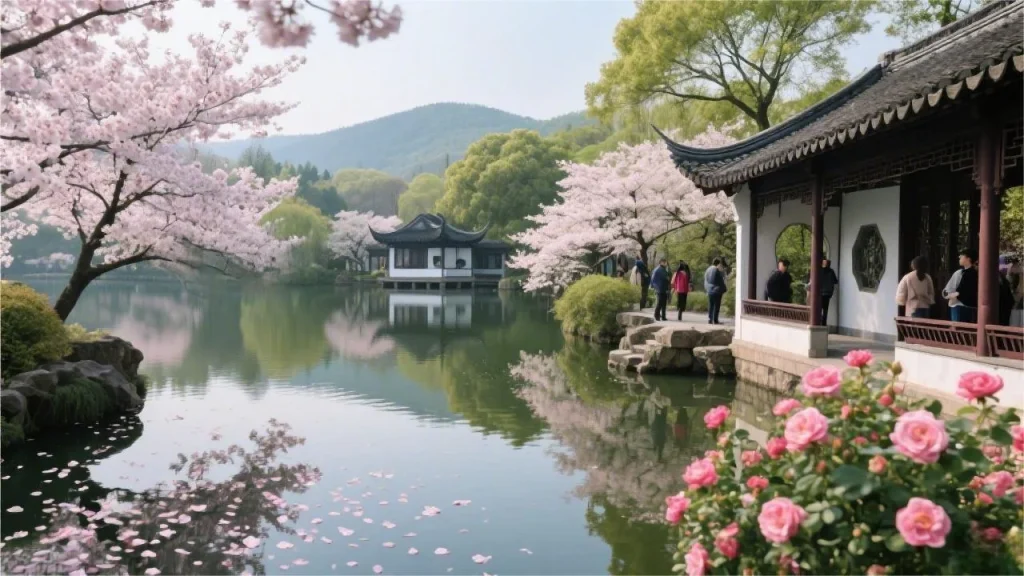
If you feel that the cherry blossom crowds at Bai Causeway are suffocating, then Yuhu Bay is the “safe harbor” I have prepared for you. This place is more like a quiet Song Dynasty landscape painting, and it is my personally favorite corner of Hangzhou. The cherry blossoms here are mainly late-blooming varieties (such as Green Cherry and Puxian Elephant), with layered and lush flowers ranging from pale pink to pure white. Paired with wooden corridors and stone bridges, it has an indescribable gentleness.
- Attractions and Sightseeing Details: I suggest you must spend more time at Jihong Bridge. It is a wooden covered bridge with great ancient charm. When the cherry blossoms are in full bloom, you don’t need to crowd onto the lawn; stand in the corridor and observe the blossoms through the various lattice windows. The reflections on the water and the distant Leifeng Pagoda form an excellent geometric composition. The adjacent Turtle Pond (Wugui Tan) is the highlight; the cherry trees here grow almost touching the water, with low-hanging branches. If you are lucky enough to see a sculling boat passing by, the cinematic feel is maximized.
- Itinerary and Pitfall Avoidance: The paths in this area are quite fragmented, and many small trails lead to unknown tea houses or small hills. Although the climbing is not tiring, it is very easy to lose your direction and end up walking unnecessary distances. My personal experience is to always walk along the water after entering the scenic area and avoid turning into uphill concrete roads. Also, the ecological environment here is excellent and the vegetation is very lush; I recommend wearing light-colored sportswear. Not only does it look better against the pink and white cherry blossom background, but it also helps prevent insect bites near dense grass.
- People and Life Culture: Near Turtle Pond, you will find many Hangzhou locals sitting by the water with tea sets for half a day. There is none of the hustle and bustle of commercial scenic areas, but rather the living atmosphere of old Hangzhou. If your schedule is not rushed, I highly recommend sitting for a while near the thatched huts by the water to listen to the wind blowing through the bamboo forest and cherry trees.
- Food Diary: At noon, you can slowly walk to the nearby Maojiabu. The level of farmhouse cooking in this area is consistent and prices are transparent. Besides the Pian’erchuan I mentioned before, you can also try the Soy-sauce Duck or Stir-fried Malantou (Indian Aster), which are essential fresh flavors on Hangzhou’s spring dining tables.
The last time I brought my family here, I thought the wooden signposts along the road looked nice and just pointed in a direction. As a result, I led everyone into a dense thicket where no one goes, and we had to backtrack.
I previously saw many tourists on Jihong Bridge intentionally shaking the flower branches to create a “falling petals” effect. Actually, it’s not necessary at all. The river breeze at Yuhu Bay is quite strong; just standing still for five minutes will naturally see petals floating onto the water surface. By protecting these low-hanging branches, later travelers can see the most natural “cherry blossom waterfront.”
| Tour Stage | Activity Details | Personal Experience Supplement |
|---|---|---|
| Around 9:00 AM | Arrive at the Bapanling Road entrance and start the Yuhu Bay stroll | Suggest taking a taxi or a local bus to the “Chishanbu” stop and walking in |
| 9:00 to 11:00 AM | Photography at Jihong Bridge and waterfront viewing | Try to find branches drooping to the water surface, using the distant Leifeng Pagoda as a background |
| 11:00 AM to 12:30 PM | Go deep into the interior of the Turtle Pond cherry blossom forest | The lawn here is perfect for sitting, but please protect the vegetation and do not step on the flower beds |
| Before 2:00 PM | Lunch at Maojiabu and end the morning itinerary | Try to arrive at the restaurant before 12:30 PM, otherwise popular shops may require a wait |
This part of the journey is about 4 kilometers, and with stops and photos, it feels very relaxed. I suggest you wear a pair of water-resistant and non-slip soft-soled shoes, as some waterfront paths at Turtle Pond can be damp in the morning, and the bluestone pavement occasionally becomes slippery.
Day 3: Guo Villa Rose Exhibition and Classical Garden Stroll
The final stop of the itinerary is usually arranged at Guo Villa. As one of the most well-preserved Qing Dynasty private classical gardens remaining in Hangzhou, Guo Villa does not cover a large area, but its spatial layout is extremely exquisite. During the spring rose exhibition every year, the entire garden is carefully arranged by horticulturists into a bonsai garden with high Oriental aesthetics, where the flowers and ancient architecture merge seamlessly.
- Attraction Details and Cultural Atmosphere: The roses in Guo Villa are not planted in large, crude patches like in parks, but are cleverly combined with the garden’s rockeries, Lake Tai stones, lattice windows, and corridors. You will see tree rose bonsai cultivated over many years, as well as climbing roses growing along the white walls and black tiles. The cultural atmosphere here is very thick. On weekday mornings, you can often see old Hangzhou locals carrying birdcages, sitting under the corridors with a cup of tea and a newspaper, showing a true and relaxed state of local life.
- Accommodation Experience and Transport Connection: Since it is the last day of the trip, if you need to leave Hangzhou in the afternoon or evening, I strongly suggest arranging your hotel near Yangong Causeway the night before. The mornings here are extremely quiet, and the air is constantly filled with a rich scent of greenery. Moreover, the route from here to Hangzhou East Station or Hangzhou Railway Station is relatively smooth. After breakfast, you can slowly walk along the shaded path of Yangong Causeway to the main gate of Guo Villa, treating it as a morning oxygen-absorbing warm-up.
- Price Reference and In-depth Experience: Guo Villa requires an admission ticket, but the price is modest compared with many man-made attractions in the city, and it lets you sit for an afternoon blowing in the lake breeze at a private garden on the West Lake shore. I strongly recommend you walk to the innermost Chengfeng Yaoyue Pavilion. It is a terrace clinging to the West Lake water surface. Order a pot of Longjing Green Tea; right across is the vast and misty Su Causeway. This is the best spot in the entire garden to enjoy the grand view of West Lake.
I often see first-time travelers being fascinated by the bonsai in the front yard as soon as they enter, spending a lot of time taking photos around the rockeries. Actually, the essence of Guo Villa gets more open as you go further in, while the space in the front yard is relatively cramped. My suggestion is to walk straight through the “Xiangxue Fenchun” exhibition area as soon as you enter the garden while there aren’t many tourists in the morning. Go first to the lakeside Chengfeng Yaoyue Pavilion to grab a bamboo lounge chair position by the fence. After finishing the most transparent lake scenery photography, then turn back to slowly appreciate those rare rose bonsai. This way, the experience will be much better.
| Itinerary Phase | Sightseeing and Experience Highlights | Personal Experience Supplement |
|---|---|---|
| Around 9:30 AM | Stroll from Yangong Causeway to Guo Villa in the morning light | The ancient trees along the way are towering, with mottled light and shadows, perfect for a morning walk |
| 10:00 to 11:30 AM | Focus on appreciating the “Xiangxue Fenchun” courtyard rose exhibition area | Suggest finding lattice windows with openwork carved patterns to use as a foreground for close-ups of roses, which is very typical of Jiangnan charm |
| Approaching 12:30 PM | Tea tasting and lake viewing on the terrace of Chengfeng Yaoyue Pavilion | The terrace is windy; although the spring sun is bright, you still need to pay attention to staying warm while sitting for a long time to avoid catching a cold |
| After 1:30 PM | Leave the garden via the side gate and enter Quyuan Fenghe for lunch | Exiting from the side gate leads directly to the Quyuan Fenghe scenic area, where there are many established restaurants; after lunch, you can pack your luggage and prepare to leave Hangzhou |
This three-day spring flower-viewing route is arranged at a relatively loose pace and does not require too much physical exertion, but it has high requirements for your color sensitivity and photography composition. Additionally, remember to bring a power bank with sufficient capacity, because there are simply too many moments of spring worth capturing with your shutter along this journey.
Related Guides
- Hangzhou 4-Day Cycling & Hiking Route | Lake Loop Cycling + Jingshan Ancient Trail Hiking + Riverside Cherry Blossom Runway
- Hangzhou 4-Day In-Depth Tour | West Lake Loop + Xianghu Resort + Longyang Village Terraces, New Urban-Rural Combo Experience
- 3-Day Tour Around Hangzhou West Lake | Broken Bridge Snow Scene + Lingyin Temple + Nine Creeks and Eighteen Streams, Classic Jiangnan Route Without Backtracking
- Hangzhou 3-Day Essential Tour | Ten Scenes of West Lake + Lingyin Temple Fortune Telling + Xiaohe Straight Street, Zero-Backtracking Nanny-Level Route
- How to choose the three cableways in Cangshan: the differences between Ximatan, Gantong and Zhonghe cableways






