



Day 1: West Lake Classics and Cultural Hiking Route (08:00 – 18:00)
I am used to arriving at the Broken Bridge before 8:00 AM. At this time, tour groups have not yet swarmed in, and there is usually a lingering thin mist on the lake surface. Taking this route, I deliberately avoided the Su Causeway, which is crowded all day long, and chose the area around Solitary Hill and Beishan Road, which has a stronger cultural atmosphere. In the morning, the weeping willows on both sides of the Bai Causeway sway gently, and the light is very soft. It is the most suitable time for a slow walk and to record the initial impression of West Lake.
- Route: Broken Bridge – Bai Causeway – Autumn Moon over the Peaceful Lake – Solitary Hill (Zhejiang Provincial Museum) – Xiling Seal Art Society – Zhongshan Park Pier – Three Pools Mirroring the Moon (Lake Island) – Flower Harbor and Fish Viewing – Leifeng Pagoda.
Approaching 10:00 AM, walking to the end of the Bai Causeway brings you to the Autumn Moon over the Peaceful Lake and the Solitary Hill area. This place not only has beautiful scenery but also a deep cultural heritage. Although the Zhejiang Provincial Museum (Solitary Hill Branch) is not large, the Celadon Hall and Lacquerware Hall are well worth spending over half an hour looking at closely. Right next to the museum is the Xiling Seal Art Society.
Many tourists only take a quick look at the Baitang Hall at the entrance of the Xiling Seal Art Society and then leave, which is a great pity. I strongly recommend climbing the stone steps, passing through layers of cliff stone carvings and bamboo forests, and reaching the top near the Huayan Sutra Pagoda. There is a hidden, excellent viewing platform half-concealed by trees. Not only are there very few people, but it also offers a superb bird’s-eye view of the Autumn Moon over the Peaceful Lake on West Lake.
By lunchtime, finding food near Solitary Hill is a natural choice. Lou Wai Lou is indeed famous, but if you want a quieter environment and more solid flavors, I usually go to several old-fashioned established brands within walking distance. I specifically ordered West Lake Vinegar Fish. Nowadays, many sophisticated restaurants have improved the fish species, abandoning the grass carp with its heavy earthy smell and replacing it with Kaihua freshwater fish. The fish meat is firm in the mouth, and the sweet and sour glaze is perfectly coated. The taste experience is much better than in previous years.
Around 1:30 PM, take a boat at the Zhongshan Park Pier. There are many types of cruise boats on West Lake. I usually buy a regular painted boat ticket that includes admission to the Lake Island. It takes about 20 minutes to reach the Three Pools Mirroring the Moon. The island is actually a “lake within an island, island within a lake” structure in a ” field ” shape. When you reach the southern observation deck, don’t forget to take out a prepared 1-Yuan banknote and find the right angle to take a photo with the three stone towers on the lake.
When leaving the island, the cruise boat offers several piers for you to choose from. I recommend taking the boat to the Flower Harbor and Fish Viewing Pier. After disembarking around 3:00 or 4:00 PM, follow the garden paths of Flower Harbor and Fish Viewing to the south. The landscaping of the Peony Pavilion and the Red Fish Pond is well-arranged, offering much richer visual layers compared to the straight Su Causeway.
Crossing through Flower Harbor and Fish Viewing, it takes less than 20 minutes to walk to the final stop of the day: Leifeng Pagoda. Arriving before sunset is ideal. The infrastructure of the Leifeng Pagoda scenic area is very complete, with escalators at the entrance leading directly to the base and an elevator inside the tower reaching the top, which consumes little physical energy. Standing on the corridor of the upper level of Leifeng Pagoda, you can clearly see the eaves of Jingci Temple and the full panorama of the southern West Lake line. When the afterglow of the sunset sprinkles on the lake, it is the best moment for photography.
| Tour Stage | Specific Location | Activities and Experience Details | Tour Advice |
|---|---|---|---|
| Morning Clarity | Broken Bridge and Bai Causeway | Hiking along the lake, feeling the morning water and weeping willows | Go early to avoid peak crowds; the light is suitable for landscape photography |
| Near Noon | Solitary Hill and Xiling Seal Art Society | Visit the Provincial Museum, explore the culture of seal carving | Be sure to climb to the top of Xiling Seal Art Society to find the hidden viewing angle |
| Afternoon Excursion | Three Pools Mirroring the Moon | Take a boat tour and walk around the Lake Island | Carry a 1-Yuan banknote for a real-scene comparison photo |
| Sunset Evening | Leifeng Pagoda | Take the elevator up the tower to overlook the southern line and sunset | Check the sunset time in advance and reserve 30 minutes for queuing |
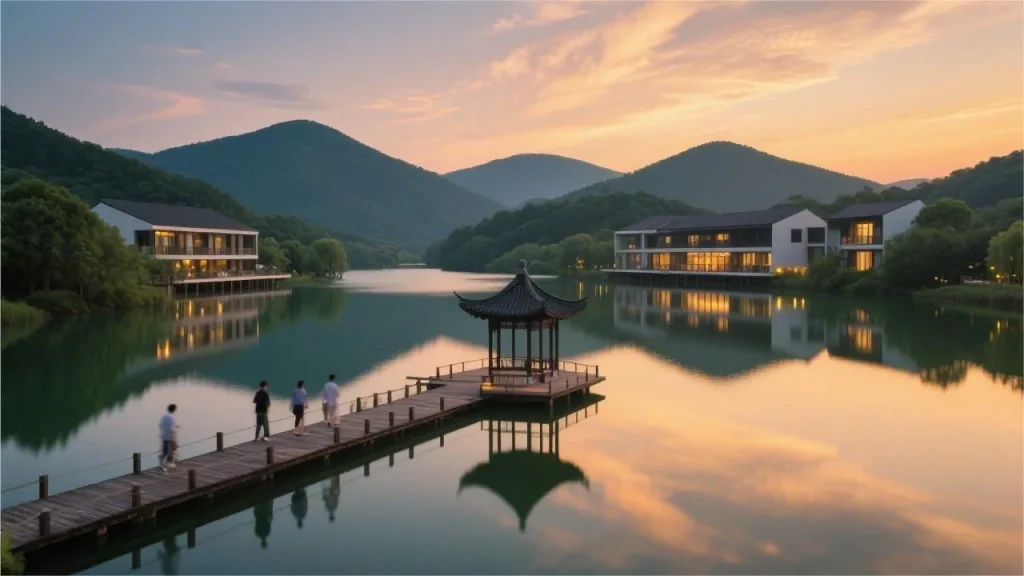
Day 2: West Lake Mountains, Tea Gardens, and Quiet Ancient Paths (08:30 – 17:30)
On this day, I will take you to the “back side” of West Lake. If you haven’t been to Longjing and Jiuxi, you haven’t seen the real green of Hangzhou. Compared to the lake and mountain views of the first day, this day is more about forest hiking and tea culture experience. The roads are mainly bluestone and dirt paths, which have certain requirements for knees and physical strength.
- Route Arrangement: Longjing Village – Shili Langdang (partial section) – Nine Creeks and Eighteen Gullies – Nine Creeks Meandering Through Misty Trees – Yunqi Bamboo Path.
At 8:30 AM, I suggest taking a taxi or a bus to the deepest part of Longjing Village. This is the production area of West Lake Longjing tea, and as far as the eye can see, there are terraced tea gardens. Climbing the stone steps behind the village leads to the famous Shili Langdang. This section of the road is the central ridge line of the West Lake mountains, and the view is extremely open, with West Lake on one side and the Qiantang River on the other. However, there are many steps in this section, so slow walking is recommended. You can see the pavilion on the ridge after about 40 minutes.
Although there is a commercial atmosphere in Longjing Village, as long as you find the right place, the experience is not bad. For lunch, I found a farmhouse courtyard near the stream.
The Longjing Shrimp here uses fresh hand-peeled river shrimp, with a very thin starch coating and a faint tea aroma. Pair it with a bowl of Pian’erchuan, where the potherb mustard and bamboo shoots provide freshness. Regarding buying tea, I have an experience: the women enthusiastically inviting you to their houses for tea often sell tea of varying quality and inflated prices. If you really want to buy some as a gift, you must go to a professional tea farm with the word “Shifeng” or a formal business license and ask for a live comparison tasting.
Around 12:30 PM, I started walking down from Longjing Village towards Nine Creeks and Eighteen Gullies. This part of the road is the most comfortable of the day. The stream crosses the road. Although some crossing stones have been built, in the rainy season, the water level will still submerge the soles of your shoes.
The ecology here is excellent, and the air humidity remains above 70% all year round. It is not only cool but also high in negative oxygen ions. At the end of the Nine Creeks and Eighteen Gullies is Nine Creeks Meandering Through Misty Trees, which features an iconic small red pavilion and an artificial waterfall. It is one of the New Twenty Scenes of West Lake. If you come in autumn, the red maples here are stunning.
The final stop is Yunqi Bamboo Path. Walking from Nine Creeks Meandering Through Misty Trees to Yunqi Bamboo Path requires crossing a small hill and takes about 40 minutes. Those with average physical strength are advised to call a car at the Nine Creeks exit. Although the ticket for Yunqi Bamboo Path is only 8 Yuan, the landscape is very high-end. The bamboo forest here reaches into the clouds and blots out the sun.
My favorite thing here are the scattered thousand-year-old trees, each with its own ID number. The cinematic feel comes not just from the bamboo forest, but also from the tranquility of deep mountain ancient temples. Walking by the Wash-Heart Pavilion, you can hear the rustling of bamboo leaves in the wind, an experience that the bustling downtown can never provide.
| Tour Period | Location and Coordinates | Hiking Intensity and Terrain | Experience and Advice |
|---|---|---|---|
| 08:30-11:30 | Longjing Village and Shili Langdang | Moderate, many steps | Overlook the tea garden panorama and see the Qiantang River at the ridge line |
| 11:30-13:30 | Longjing Village Farmhouse | Rest and Stay | Avoid roadside solicitation; taste authentic Pian’erchuan and Longjing Shrimp |
| 13:30-15:30 | Nine Creeks and Eighteen Gullies | Low, gentle downhill | Walk along the stream; watch for slippery rocks; wear non-slip shoes |
| 16:00-17:30 | Yunqi Bamboo Path | Low, mainly flat roads | Look for the thousand-year-old Liquidambar tree; capture the sense of seclusion |
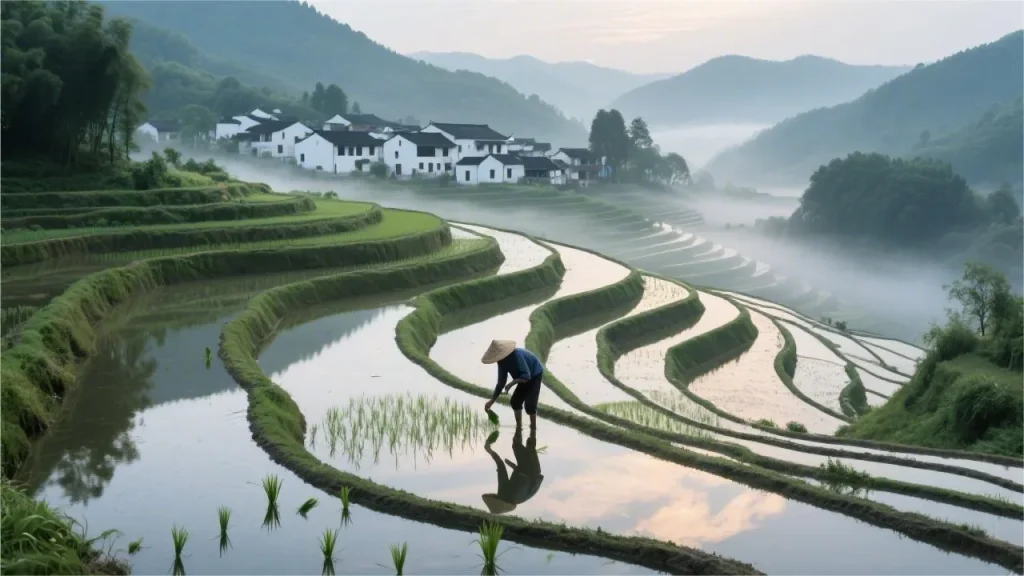
Day 3: Xianghu Natural Scenery and Historical Exploration (09:00 – 18:00)
Many out-of-town tourists only know West Lake, but I personally prefer Xianghu. The lake surface of Xianghu is more open than West Lake, and most importantly, it lacks that shoulder-to-shoulder cramped feeling. As the “back garden” of Xiaoshan people, the air here is filled with a relaxed civic atmosphere.
- Full Day Route: Kuahuqiao Site Museum – Xianghu Phase I Cruise – Xiasun Cultural Village – Yuewang Tower – Xianghu Phase III Flower Sea – Lake Cycling.
At 9:00 AM, my first stop is the Kuahuqiao Site Museum. The shape of this museum is like a small boat, which is very well-designed. Here, I suggest you leave most of your time for the oldest dugout canoe in the world. It lies quietly in the original site pit below ground level and has existed for 8000 years. Looking at the charred carbonization marks, you can really feel the breath of ancestors living by the lake. This museum is free, but you need to book in advance on the official WeChat account, otherwise it is easy to be denied entry due to flow limits.
After visiting the museum, you can walk to the pier in a few minutes. The Xianghu Phase I cruise has the best view. I suggest choosing an antique painted boat, which costs about 60 Yuan per ticket. Sailing in the center of the lake, you can see the stretching ridge lines in the distance. The embankments here have fewer traces of artificial carving than West Lake and are more natural. If you are with children or friends, I would recommend renting a self-drive small electric boat. Although more expensive, the freedom is very high, and you can stop in the center of the lake to feel the breeze.
For lunch, I chose to rest at Xiasun Cultural Village. This is a group of retro buildings with white walls and black tiles. I walked into a farmhouse restaurant along the lake and ordered Xiaoshan Dried Radish with Pork and local river fish. The crispness of Xiaoshan dried radish is famous, and the savory flavor after fermentation is very good with rice. After lunch, you can walk around the ancestral halls and old houses in the cultural village. The reinforcement and restoration of ancient buildings here is very professional, preserving the original wooden frame structure.
After 2:00 PM, I challenged the climb to the Yuewang Tower. Xianghu was the ancient battlefield of the Wu-Yue struggle, where King Goujian of Yue once stationed troops. The process of climbing the Yuewang Tower is a bit taxing on the legs, but when you stand at the top overlooking the entire “gourd-shaped” panorama of Xianghu, you will feel it was all worth it. That grand feeling of surveying the landscape is something a ground perspective cannot provide.
Xianghu Phase III has been a new favorite in recent years, with a huge area. I specifically went to see the flower sea. If it’s spring, there are fields of poppies and cosmos; if it’s autumn, there are brilliant sunflowers. Key point: Phase III is about 20 kilometers long, so do not try to hike it. I rented a shared bike at a rental point near the museum and cycled along the rainbow track.
Here is a pitfall tip from my experience: public transportation coverage in Xianghu is not as dense as in the city, especially in the Phase III area. If you miss the last bus, waiting for a Didi might take a long time. I suggest moving towards the crowded areas of Phase I or II around 5:30 PM.
| Time Span | Location | Experience Depth | Practical Advice |
|---|---|---|---|
| 09:00 – 11:30 | Kuahuqiao Museum | 8000-year-old dugout canoe, prehistoric culture | Must book in advance; air conditioning is strong, watch the temperature difference |
| 11:30 – 14:00 | Xiasun Cultural Village | Huizhou architecture, authentic Xiaoshan farmhouse food | Recommend trying local river fish; lakeside seats have an excellent view |
| 14:00 – 16:00 | Yuewang Tower | Mountain view, Wu-Yue history education | Steep steps; wear sports shoes; it’s windy at the top, stay warm |
| 16:00 – 18:00 | Xianghu Phase III Greenway | Seasonal flower sea, rainbow track cycling | Be sure to rent a bike; the flower sea area is perfect for portraits |
After a full day at Xianghu, although the amount of exercise is not small, the tranquility of avoiding the hustle and bustle is really healing.
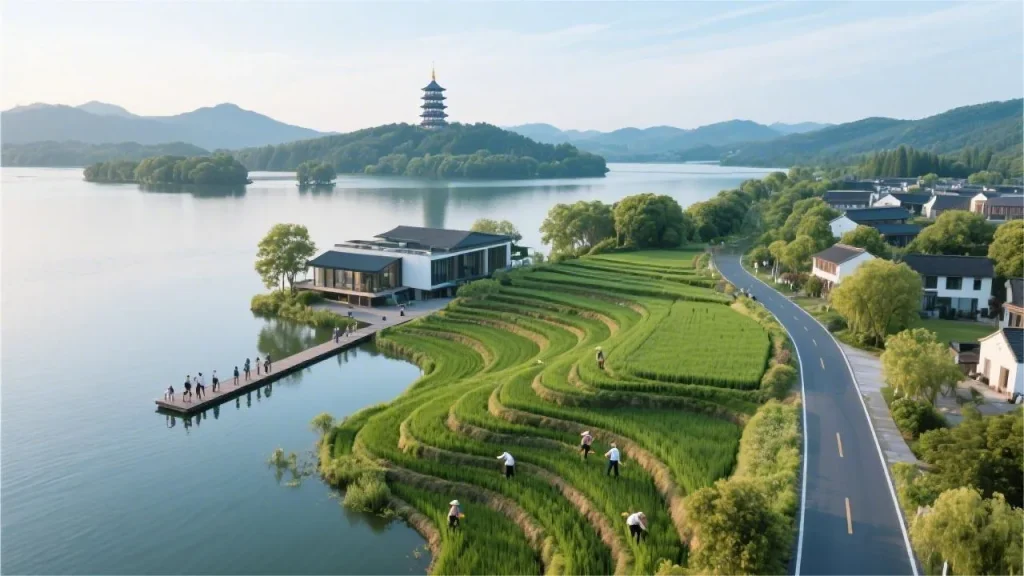
Day 4: Longyang Village Terrace Scenery and Rural Experience (08:00 – 16:00)
On the last day, I will take everyone deep into Longyang Village in Lin’an. This is Hangzhou’s true “suburban secret.” If you are already tired of the delicacy of West Lake, the rugged and original farming aesthetics of Longyang Village will definitely amaze you. Especially if you like landscape photography, the lines of the terraces are stunning under morning and evening light.
- Route Arrangement: Hangzhou City – Hanghui Expressway – Longyang Village Observation Deck – Terrace Path Hike – Farmhouse Lunch – Free Stroll in the Village.
Depart at 8:00 AM sharp. Driving from the city to Longyang Village in Lin’an takes about 1.5 to 2 hours. After passing Lin’an city, the road conditions change from wide asphalt to winding mountain roads.
My Driving Reminder: Although the mountain roads are well-paved, there are many hairpin turns and some sections are narrow, requiring space when passing cars. I do not recommend novice drivers practice here. If you are renting a car, be sure to check the brake performance. You will pass several nameless small observation decks along the way; if you see cedar forests, you can stop briefly by the roadside; it’s the prelude to entering Longyang Village.
Around 10:00 AM, when the car reaches the mountainside, the panorama of Longyang Village’s terraces will come into view. I didn’t rush into the village but navigated to the main observation deck at a higher altitude. Looking down from here, hundreds of layers of terraces pour down with the mountain slope. In spring, when the terraces are filled with water, they look like broken mirrors embedded in the mountains; in autumn, it’s golden everywhere.
I walked down the stone paths between the fields. The paths here are not as smooth as those at West Lake, and some places still carry the fragrance of soil, which is very wild. Walking among the terraces, you will meet villagers working. The pace here is extremely slow, and the air smells of dried straw and soil. This pure rural quality cannot be found in over-developed scenic areas.
At 12:00 PM, I chose to take you deep into Longyang Village in Lin’an. This is Hangzhou’s true “suburban secret.” If you are tired of perfectly trimmed gardens and want to see nature’s most original lines, the terraces here will definitely not disappoint you. Since it hasn’t undergone large-scale tourism development, it preserves a very pure farming culture.
- Schedule: Hangzhou City – Longyang Village Observation Deck – Terrace Path Hike – Farmhouse Lunch – Village Ancient Building Walk – Return.
At 8:00 AM sharp, I set off from Hangzhou city. The distance to Longyang Village is about 80 kilometers, but because the second half involves many mountain roads, you should reserve 1.5 to 2 hours for the drive.
Here is a very important driving reminder: After navigating to Longyang Village, the last few kilometers of the road are very narrow, some parts only enough for one car to pass, requiring great patience when meeting cars. If you are a novice driver, I suggest contacting local car rental services with drivers. But as long as you get through this, when you see the terraces sprawling over the mountains outside the window, the visual impact will make all the fatigue vanish.
Arrive at the village entrance around 10:00 AM. I didn’t stay at the low point but walked up the village road to the observation deck. The terraces in Longyang are characterized by steep slopes and deep drops, with layers of ridges winding with the mountains like the pulsing heartbeat of the earth.
The sense of seasons here is very strong. If it’s April or May, the terraces are filled with water, looking like broken mirrors in the sun; if it’s September or October, it’s golden everywhere. Walking on the narrow ridges, I can see villagers still working in the most traditional way. The soil here is very special, not only suitable for rice but also an excellent production area for high-mountain vegetables.
At 12:00 PM, I found a very simple-looking farmhouse for lunch. Farmhouse dishes in Longyang Village don’t have the fancy presentation of those by West Lake, but the freshness of ingredients is unbeatable.
I ordered a plate of Leisun Stir-fried with Pork. Lin’an is the “hometown of bamboo in China.” Since the bamboo shoots here grow at high altitudes, the fibers are very fine, and the taste is sweet and without dregs. Another must-order is Local Chicken Soup, which is from free-range chickens raised by the villagers. Only a little salt and ginger are added, and the stewed soup has a thick layer of golden chicken oil on top. One sip is full of freshness. This meal costs about 60-80 Yuan per person, and the prices are very honest.
In the two hours after lunch, I like to stroll among the old houses in the village. The houses are mostly rammed earth or brick-wood structures, with mottled walls and a sense of aged texture. I met several elderly people sitting at their doors sunbathing; they couldn’t even understand standard Mandarin well, but their simple smiles were very infectious.
I must start the journey back to Hangzhou before 4:00 PM.
- Pitfall Advice: Since Longyang Village is in the deep mountains, the light in the mountains will dim rapidly after 4:30 PM, and coupled with the large temperature difference, mountain roads are prone to fog. For safety reasons, absolutely do not wait until dark to descend the mountain.
| Node | Recommended Time | Activity | Precautions |
|---|---|---|---|
| Depart City | 08:00 – 10:00 | Pass through Lin’an city and enter mountain roads | Check fuel level; gas stations are rare in the mountains |
| Terrace Photography | 10:00 – 12:00 | Hike to the highest observation deck for a panorama | Recommend bringing a wide-angle lens; watch for slippery ridges |
| Rural Lunch | 12:00 – 14:00 | Experience farmhouse cooking and taste high-mountain vegetables | Recommend trying local Leisun and Tianmu Mountain sweet potatoes |
| Return Time | 14:00 – 16:00 | Stroll through the ancient village and start the descent | Be sure to leave the mountain road section before dark |
This four-day itinerary transitions from bustling cultural landscapes to quiet natural mountains, and it can be said that the soul of Hangzhou has been thoroughly explored.
Related Guides
- 3-Day Tour Around Hangzhou West Lake | Broken Bridge Snow Scene + Lingyin Temple + Nine Creeks and Eighteen Streams, Classic Jiangnan Route Without Backtracking
- Hangzhou 3-Day Essential Tour | Ten Scenes of West Lake + Lingyin Temple Fortune Telling + Xiaohe Straight Street, Zero-Backtracking Nanny-Level Route
- How to choose the three cableways in Cangshan: the differences between Ximatan, Gantong and Zhonghe cableways
- Hangzhou 3-Day Spring Flower Viewing Tour | Prince Bay Tulips + Yuhu Bay Cherry Blossoms + Guo Manor Roses, Encountering the Most Beautiful Spring
- Hangzhou 4-Day Cycling & Hiking Route | Lake Loop Cycling + Jingshan Ancient Trail Hiking + Riverside Cherry Blossom Runway






