



Day 1: Deep Experience in Shawan Ancient Town
At 9:00 sharp, I took Metro Line 3 from Kecun Station towards Tianhe Coach Terminal and rode seven stops to Shiqiao Station. Exiting from Exit B and turning right for fifty meters leads to the bus terminus. The platform for the Pan 67 bus is at the very end; I arrived just in time for the 9:25 bus, which runs every ten minutes and is quite punctual. Most passengers were local grandmothers carrying freshly bought vegetables. I asked them which ginger milk curd shop in Shawan was the most authentic, and a lady in a blue cotton shirt pointed out the window: “Get off at the next intersection; Qinfangyuan on the left has been open for thirty years.”
- Arrived at the main street of the ancient town around 9:00 am and headed straight for Liugeng Hall (He Clan Ancestral Hall) at the entrance.
- Turned into Anning West Street at 10:30 am to see the oyster shell wall house clusters.
- Had authentic snacks at Qinfangyuan at 12:15 pm.
- Entered Sanren Hall at 2:00 pm to listen to Cantonese music performances.
- Visited the brick carving screen wall at Anning Square at 3:30 pm.
- Strolled through Yuxugong Alley at 5:00 pm to photograph the sunset.
The porch of Liugeng Hall reveals great attention to detail; the post-and-beam structure of the Lingnan ancestral hall from the Qing Dynasty remains untouched. I looked up at the beam frame of the main hall, where the wood-carved characters of “The Six Kingdoms’ Grand Investiture of the Chancellor” had clear helmet scales. One general holding an order flag still had a faint red tint of the original painting on his cheeks. An old man guarding the hall saw me looking closely and took the initiative to say: “This beam dates back to the Xianfeng era. The wood selected is Kun Dian wood (Ironwood), which is resistant even to insect infestation.” Walking two hundred meters west from Liugeng Hall is Anning West Street. The oyster shell walls are concentrated in the section from “Renrang Gongju” to the “Former Residence of He Shaoxia.” I reached out and touched them; moss was stuck in the uneven gaps of the oyster shells, and smelling them up close revealed a salty fishy scent of dried sea breeze. A few clumps of wild mint grew at the base of the old house walls.
At noon, I sat down in Qinfangyuan and ordered the signature Shawan Ginger Milk Curd and freshly wrapped Fish Skin Dumplings. The ginger milk curd is made to order; the landlady ladles a spoonful of ginger juice into a porcelain bowl and then pours in boiling water buffalo milk. I watched as the milky white liquid instantly solidified into a trembling form. It tasted slightly spicy with a milky aroma, and the temperature was perfect without burning the mouth. A basket of six fish skin dumplings had skin so thin it was translucent. Biting in revealed whole fresh shrimp mixed with minced water chestnut. Dipped in the ginger and onion soy sauce provided by the shop, it was incredibly delicious.
At 2:00 pm, I wandered into Sanren Hall and heard the ensemble of Gaohu, Yangqin, and Qinqin playing “Rain Hitting the Plantains.” The person playing the Gaohu was an old man in a white undershirt; his hair was gray but his fingers flew. A faint scent of dried tangerine peel drifted through the hall—dried citrus peels were piled in bamboo baskets in the corner. I took a small stool and sat nearby to listen for a while. When the old man took a break, he chatted with me: “My father taught me this tune; he used to play strings in teahouses. No one listens anymore, so us old buddies just gather together.”
The brick carving screen wall of Anning Square is behind the “Zhennan Tower.” I squatted down to look closely at the Qilin Sending a Son pattern. The Qilin’s eyeballs were inlaid with black glazed porcelain pieces, and its claws stepped on auspicious clouds. There were actual indentations resembling fingerprints in the stone gaps—the old man said these were left by craftsmen during carving over a hundred years ago. At 5:40 pm, I entered Yuxugong Alley. The blue flagstones were glowing under the sunset like they were dusted with gold powder. A family was drying tangerine peels at their door; the golden peels mixed with the gray of the old walls looked very atmospheric in photos.
|
Expenses for the Day
|
|
|---|---|
|
Transportation
|
Metro 3 + Pan 67 Bus 2 + Return Bus 3 = ¥8
|
|
Dining
|
Qinfangyuan Ginger Milk 12 + Fish Skin Dumplings 15 + Sampan Porridge 18 = ¥45
|
|
Others
|
None (Liugeng Hall is free, music in Sanren Hall is free)
|
Tips: The last Pan 67 bus is at 18:30, so don’t stay too late and miss it; the ginger milk curd from Qinfangyuan should be eaten hot, as it solidifies too much after five minutes; don’t pick at the oyster shell walls on Anning West Street, as some loose shells can cut your hands.
Walking through the day, the most comfortable thing was not rushing. Following the rhythm of the locals, listening to the old man’s stories, and watching the grandmothers drying tangerine peels was much more interesting than just taking “check-in” photos. The beauty of Shawan lies in these old times wrapped in the atmosphere of daily life.
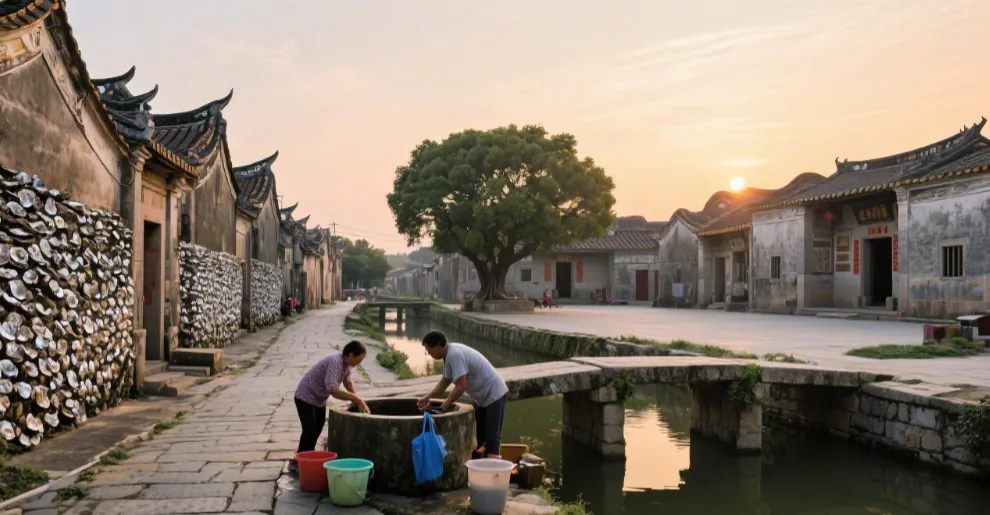
Day 2: Cultural Stroll in Daling Village
At 8:30 am, I took Metro Line 3 from Tiyu Xilu Station (towards Panyu Square) and rode six stops to Shiqiao Station. Exiting from Exit A and turning left through the underpass, I saw the sign for “Shiqiao Coach Station.” The platform for the Pan 92 bus is next to the third pillar on the east side of the station. I arrived just past 9:00 am and waited fifteen minutes for the bus—the driver leaned out the window and said: “This bus detours through Shawan; it’s slower but steady.” The journey indeed took forty minutes, passing through farmland and fish ponds, with the fresh scent of rice leaves drifting through the window gaps.
- Arrived at Daling Village stop around 9:50 am and walked three hundred meters along “Daling Road.”
- Reached Longjin Bridge at 10:10 am, touching the indentations on the stone steps and watching the koi in the Feng Shui pond.
- Climbed the Wenchang Pagoda at 10:30 am to overlook the village’s comb-style layout.
- Entered Xianzong Ancestral Hall at 11:00 am to see the oyster shell gate tower.
- Had firewood-braised goose at a grandmother’s house at the village entrance at 12:30 pm.
- Walked along the lotus pond boardwalk at 2:00 pm to see the wok-ear walls of the Chen Clan Ancestral Hall.
- Took the Pan 92 bus back at 4:00 pm and met an old man selling wampee fruit.
The stone steps of Longjin Bridge have been worn down by a hundred years of soles, creating indentations half a finger deep. I counted twenty-three steps in the steepest middle section, each bearing marks of varying depths. Water lilies floated on the Feng Shui pond under the bridge, and a group of orange koi gathered by the bridge piers. At the sight of shadows, they scattered. A child in a red vest was feeding them bread crumbs, and the fish swarmed over, splashing his trouser legs. The Wenchang Pagoda on the opposite bank has five stories. The handrails of the wooden stairs were a bit shaky. Leaning on the railing at the top floor, I saw the village houses arranged like the teeth of a comb, with blue-tiled roofs connecting into a vast expanse. A main alley in the middle leads directly to the pond at the end of the village—it is indeed a “comb-style layout.” The wind blew through the alley mouth, feeling very cool.
The oyster shell gate tower of Xianzong Ancestral Hall was the most shocking. Tens of thousands of palm-sized oyster shells were glued into an arch shape with yellow clay. The inner side of the shells still carried the salt frost from the seawater of those years. Looking closely, several stalks of foxtail grass sprouted from the gaps, their tassels swaying in the wind. At the joints between shells, one could feel the fingerprint marks left by the craftsmen when they applied the clay. The old man guarding the gate said: “This wall was built nearly two hundred years ago and hasn’t collapsed even during typhoons. Oyster shells are breathable, making the house warm in winter and cool in summer.”
Asking for directions at the village entrance at noon, a grandmother with a bamboo basket pointed to her courtyard: “Just eat at my place; I just braised some goose, and the flowering cabbage was just picked from the field.” Her stove was a firewood stove built of adobe. In the large iron pot, the goose meat was bubbling, and the sauce was bright red with a hint of caramel color. The grandmother said she used Chu Hou paste and rock sugar to slow-stew it for two hours. The meat on the goose leg fell off the bone at a touch; the skin was sticky and the meat tender. The accompanying flowering cabbage stalks were crunchy and the leaves sweet, carrying the scent of morning dew. While serving rice, she chatted: “This goose was raised for eight months, free-roaming by the pond eating grass seeds; it’s much more fragrant than those fed with fodder.”
In the afternoon, I walked along the lotus pond boardwalk made of old wooden planks that creaked underfoot. The wok-ear walls of the Chen Clan Ancestral Hall by the water were two stories high, curving up like the two wings of an ancient official’s hat. The gray-carved Qilin on top of the walls had its mouth open, its eyes inlaid with green glazed porcelain pieces and its claws stepping on an embroidered ball. Although the colors had faded, the lines remained sharp. There was a “Jinshi” (successful candidate in the highest imperial examination) plaque at the entrance of the ancestral hall with cracks in the wooden frame. The grandmother said this was earned by an ancestor of the Chen family in the Qing Dynasty.
At 4:00 pm, I took the Pan 92 bus back from the station under the banyan tree at the end of the village. While waiting for the bus, I met an old man selling wampee fruit. His bamboo basket was piled with golden fruits. He handed me two: “Grown at home, sweet and sour to relieve greasiness, two yuan a jin.” I bought half a jin and counted them along the way. The seeds were tiny and the flesh thick, with a honey-like aroma within the sourness, much fresher than those bought at the supermarket.
At the entrance of Xianzong Ancestral Hall, I saw two elementary school students sketching the patterns of the oyster shell gate tower in their notebooks. A girl with a ponytail looked up and asked me: “Sister, look, does the curve of this shell look like a sea wave?” I squatted down to look at her drawing; her pencil lines brought the uneven texture of the shells to life. She said her teacher’s assignment was to “draw the old objects in the village.”
|
Expenses for the Day
|
|
|---|---|
|
Transportation
|
Metro 3 + Pan 92 Bus (Go 2 + Return 2) = ¥7
|
|
Dining
|
Grandmother’s Firewood Braised Goose (half) 60 + Cabbage 10 + Rice 2 = ¥72
|
|
Others
|
Wampee Fruit 2 (half a jin)
|
Tips: The Pan 92 bus runs about once an hour (first bus 7:30, last bus 18:00), and the return interval is slightly longer; it is suggested to return before 12:00 or wait for the bus after 16:00. Photos are not allowed inside Xianzong Ancestral Hall; just look at the entrance. The wooden planks of the lotus pond boardwalk are slippery, so wear non-slip shoes.
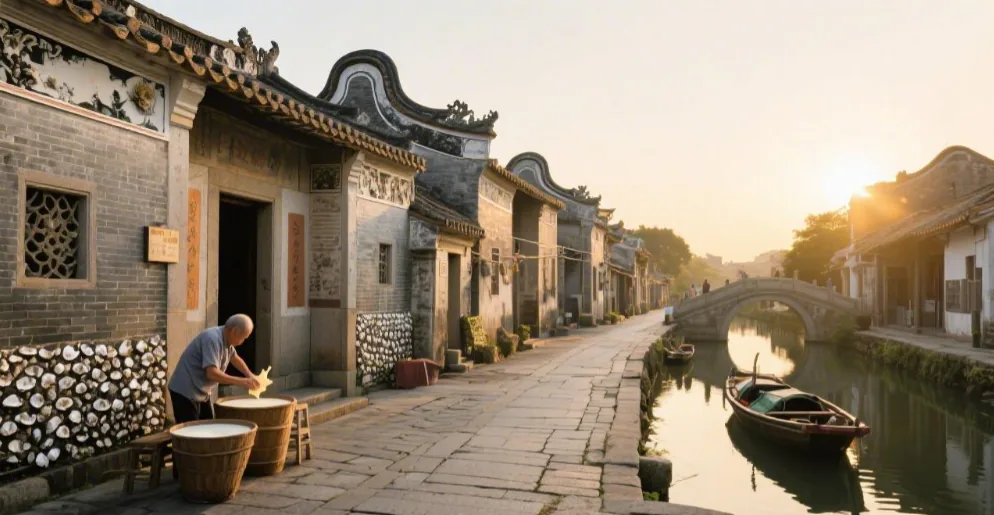
Day 3: Architectural Pilgrimage in Langtou Ancient Village
At 9:00 sharp, I took Metro Line 3 from Jiahewanggang Station towards Airport North and rode four stops to Gaozeng Station. The transfer signs in the station were not very obvious; follow the “Bus Connection” arrow and exit from Exit D to the ground level. Turn right for twenty meters to reach the 714 bus station, looking for the “To Tanbu” sign on the front of the bus. I arrived at 9:50 am and waited eight minutes for the bus. The driver said this bus runs every half hour, so don’t miss it. The journey took forty minutes, passing vegetable fields and fish ponds, with the bitter scent of banana leaves drifting through the window gaps. I arrived punctually at the Langtou Village stop at 10:30 am.
- Got off at 10:30 am and walked five hundred meters along “Langtou Avenue” to enter the village.
- Visited the stone foundations and scroll-patterned floor tiles of Chunyangtai Academy at 10:40 am.
- Navigated Qingyun Alley at 11:00 am to measure its width and feel the draft.
- Had Snail Stir-fried with Perilla at a farmhouse at the village entrance at 12:30 pm.
- Viewed the imperial decree inscriptions on the Langxi Decree-Receiving Archway at 1:30 pm.
- Observed the ash carving “Guo Ziyi’s Birthday Celebration” at Jimoy Lou at 2:30 pm.
- Took the 714 bus back at 16:30 (last bus at 17:20).
Chunyangtai Academy is at the east end of the village, leaving only a ring of foundation stones laid with blue stone strips. I squatted down to touch the stone surface; an indentation seemed to be the mark of a stone stool from those days. The remaining scroll-patterned floor tiles were laid at the edge of the foundation, carved with the appearance of an unfolding scroll. The patterns were worn smooth by footsteps, and the corners still had faint traces of light blue pigment. I imagined students a hundred years ago holding books and reading aloud here in the morning, the stone slabs warmed by the sun and the inkstones resting on the tiles, the scent of ink mixing with the chirping of cicadas.
Walking west from the academy, I had to turn sideways when entering Qingyun Alley. I measured it with my steps; it was indeed 1.2 meters wide, with high walls on both sides reaching three stories high. Stonecrop grew in the gaps between the blue bricks. The noon sun was fierce and it was sweaty outside the alley, but as soon as I entered, a draft “whooshed” through, feeling cool against my back. The moss at the base of the walls was damp. A family was sitting on bamboo chairs at the alley mouth to enjoy the cool air. An old man said: “This alley is more comfortable than an air-conditioned room in summer; the wind blows from the village head to the village end without stopping.”
Lunch was at “Langtou Farmhouse” at the village entrance, where longan trees grew in the courtyard. The owner said the perilla was freshly picked. I ordered the Snail Stir-fried with Perilla; the sauce was thick when it was served and had a charred aroma (later I learned it was the “Wok Hei” from stir-frying garlic). The snail meat was firm; one suction revealed the spicy aroma of perilla and the sweetness of the snail. It was served with a bowl of mung bean soup to relieve greasiness. The landlady said: “The snails were caught from the pond, the perilla is homegrown, and no MSG was added.”
At 1:30 pm, I went to see the Langxi Decree-Receiving Archway at the crossroads at the west end of the village. It is a stone structure with four pillars and three rooms, with “Imperial Decree” carved on the architrave. The inscription was in regular script, recording the achievements of the Huang father and son in the Ming Dynasty for relieving disasters and donating to schools. There were signs of weathering between the lines, but the four characters for “The Emperor’s Vast Grace” were still clear. The old man guarding the archway said: “This archway has stood for over four hundred years. It was almost demolished during the Cultural Revolution, but the village elders saved it by covering the inscriptions with mud.”
Jimoy Lou is at the corner of the gable wall. The three-story-high wok-ear walls curved up, and the ash carving “Guo Ziyi’s Birthday Celebration” on top of the walls was the most amazing. I looked up and counted; there were indeed over thirty characters. Guo Ziyi sat in the middle with children and grandchildren on both sides holding gifts. Even the fingers of the musicians playing flutes were posed. The folds of the robes were as fine as hair, molded with lime mixed with mineral pigments. Although they had faded to light ocher, traces of cinnabar red on official robes and stone-blue on the headgear remained. There was a repaired section of ash carving at the base of the wall where the joint between new and old materials was obvious, like a patch on an old painting.
At 16:30, I walked to the bus station at the village entrance and waited ten minutes for the 714 bus. The driver said the last bus is at 17:20, so don’t be late. On the way back, I flipped through the photos on my phone; the wind in Qingyun Alley, the ash carvings of Jimoy Lou, and the perilla snails at the farmhouse all carried a warm sense of old pages.
|
Architectural Observation Points
|
|
|---|---|
|
Wok-Ear Wall
|
The ends of the gable wall rise like official hats, serving as firebreaks and symbolizing fame (visible at Jimoy Lou)
|
|
Oyster Shell Wall
|
Walls built with oyster shells, using local materials to prevent moisture (remnants in the old warehouse in the west of the village)
|
|
Ash Carving Craft
|
Molding with lime and mineral pigments (cinnabar, stone-blue), sun-resistant but afraid of rain (example: ash carvings on Jimoy Lou)
|
|
Expenses for the Day
|
|
|---|---|
|
Transportation
|
Metro 4 + 714 Bus (Go 2 + Return 2) = ¥8
|
|
Dining
|
Snail Stir-fried with Perilla 48 + Mung Bean Soup 8 + Rice 2 = ¥58
|
|
Others
|
None (Archway and Jimoy Lou are free)
|
Tips: Don’t take the 714 bus in the wrong direction towards Tanbu (the opposite direction goes to Huadu District); Qingyun Alley is narrow, so don’t walk side-by-side; don’t touch the ash carvings, as the dust can irritate the skin; arrive at the station ten minutes before the last bus to avoid missing it.
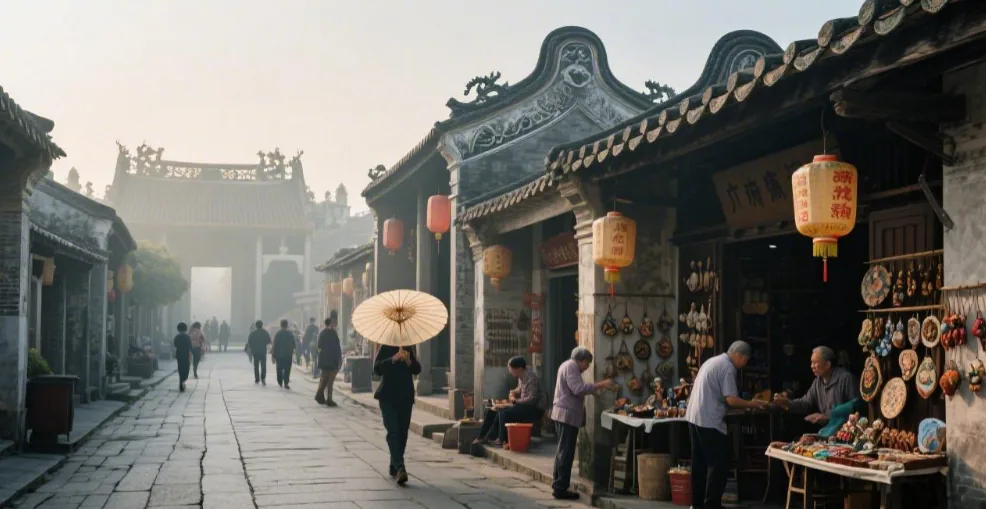
Day 4: Flexible Adjustments and Return
After 9:00 am, I went back to Shawan Ancient Town with my camera to photograph the corners I didn’t see clearly on the first day. Under the oyster shell wall diagonally opposite “Renrang Gongju” on Anning West Street, I suddenly noticed a circular protrusion the size of a coin embedded in a brick gap under the slanted sunlight. I picked it out with my fingernail—it was actually a “Guangxu Tongbao” coin from the Qing Dynasty. The edges were worn bright, but the four characters for “Guangxu Tongbao” were still legible. It must have been accidentally dropped by a craftsman when building the wall over a hundred years ago.
Then I went to Langtou Village to revisit Chunyangtai Academy. This time I squatted by the stone foundation to search carefully and found half a wooden plaque fragment at the base of the broken east wall. The lacquer was peeling and mottled, but the four large incised characters for “Inheritance of Poetry and Propriety” still retained a faint golden background color, with burn marks at the corners. The old man guarding the courtyard said: “This plaque used to hang in the main hall. It was smashed during the ‘Four Olds’ campaign, and this piece was all that was left, which I secretly hid.”
- Photographed Shawan oyster shell walls around 9:00 am and found the Qing Dynasty “Guangxu Tongbao” coin at the corner.
- Revisited Chunyangtai Academy in Langtou Village at 10:30 am and found half of the “Inheritance of Poetry and Propriety” plaque fragment.
- Had Dace Fish Noodles in Shiqiao Old Street near noon.
- Departed Guangzhou flexibly according to the high-speed train time in the afternoon, reserving 1 hour for return transportation.
At noon, I had my last ancient town flavor at “Keung Kee Noodle Shop” in Shiqiao Old Street. This shop has been open for twenty years. The owner’s hand-rolled Dace Fish Noodles had a milky white soup base made by simmering dace bones for three hours. The topping was handmade fish paste. I watched as the owner scraped minced dace meat from the cutting board with a iron spoon and threw it into the soup in clumps. When cooked, they felt elastic when picked up, and biting in revealed only fish meat fiber without flour. Dipped in the ginger puree and soy sauce provided by the shop, it was so fresh that I finished all the soup. The accompanying vegetable was water spinach, with crunchy stalks and tender leaves, carrying the “Wok Hei.”
Seeing that my high-speed train ticket was for 4:20 pm, I took Metro Line 2 directly to Guangzhou South Railway Station from the city area. I arrived specifically one hour early to handle security and find the gate leisurely. Last time in another city, I almost lost my shoe running to the metro station to catch a train, so I learned my lesson. Before leaving Guangzhou, I bought a box of Chicken Biscuits at a convenience store in the station. The wrapping paper was printed with “Shawan Specialty,” taking a bit of the ancient town flavor with me.
While photographing the oyster shell walls in Shawan, I met an old man carrying a tripod. He said he came every week to photograph the same wall: “Look at the moss at the base of the wall; it’s deep green in the rainy season and yellowish in the dry season, just like a living calendar.” He taught me how to photograph the texture of oyster shells against the light, saying “When light hits the shells, it can show the saltiness of the seawater from those years.”
|
Expense Overview
|
|
|---|---|
|
Transportation
|
Four-day total for bus + metro ¥70 (including Day 4 Metro Line 2 round trip ¥6)
|
|
Dining
|
Daily average ¥100 (Day 4 Dace Noodles 28 + Chicken Biscuits 15 = ¥43)
|
|
Tickets
|
All free (only donated ¥5 when listening to music at Shawan Sanren Hall)
|
|
Summary of Experience
|
|
|---|---|
|
Wear Soft-Soled Shoes
|
The edges of blue flagstone roads can be painful. I wore sneakers for four days and didn’t get blisters (don’t be like me wearing flat shoes on the first day; walking 20,000 steps made my feet hurt)
|
|
Ancestral Halls Close on Mondays
|
Shawan Liugeng Hall and Langtou Jimoy Lou are closed on Mondays; check opening times before going (going on Tuesday worked perfectly for me)
|
|
Bring an Empty Water Bottle
|
There are direct drinking water taps near ancestral halls and public toilets (there is one at the entrance of Xianzong Ancestral Hall in Daling Village; the grandmother even reminded me to “boil it before drinking”)
|
|
Chat with the Elderly
|
The old man playing Gaohu in Shawan Sanren Hall and the old man guarding the archway in Langtou both told exclusive stories (more vivid than guide scripts)
|
Tips: Choosing the metro for return transportation is the most stable; Metro Line 2 goes directly to Guangzhou South Railway Station from the city area. Eat Dace Fish Noodles in the morning, as they are often sold out by the afternoon. Bring a small cloth bag for specialties; don’t use plastic bags (Chicken Biscuits are easily crushed).
Keep Reading
- Yunnan Yubeng Trekking Thunder Avoidance | Gear List + Fitness Requirements + Mountain Entry Precautions, Pure Dry Goods Share
- Yunnan Homestay Lightning Protection Guide | Dali Erhai & Lijiang Ancient Town, How to Choose the Best Value View Rooms
- Yunnan Altitude Sickness Survival Guide | Shangri-La/Yubeng/Jade Dragon Snow Mountain, Medication Prep + Rhodiola Rosea Review
- 2026 Yunnan Travel Pitfall Guide | Avoid These 10 “Influencer Traps”, Even Locals Are Shaking Their Heads
- Yunnan Travel Clothing Guide | Spring, Summer, Autumn & Winter Weather Analysis & Packing List
Dali —: Numbers to Check
Tickets & Booking
- Xizhou Ancient Town: Free; Yan Family Residence about CNY 18, Yan Family Courtyard Museum about CNY 21–30; Xizhou wheat-field mini-train CNY 35; no booking required[src]
- Shuanglang Ancient Town: Free; Nanzhao Customs Island about CNY 50–56; no booking required[src]
- Erhai cruise: About CNY 142 per person (the Greater Shuanglang line one way and other ticket types)[src]
Transport & Schedules
- Dali station → Kunming South station | EMU: E.g., D8784/D8781: Dali departs 15:40–Kunming South terminates 18:22, 2 h 42 min total, 356 km; stops at Yunnanyi, Chuxiong, Guangtong North, Lufeng South, Kunming[src]
Where to Stay · Room Type · Nearby
- Dali Ancient Town | Reference price Moderate range (mostly OTA guesthouses) | Room tip: Convenient for food, lodging and transport, suitable for a first visit to Dali | Nearby add-ons: Chongsheng Temple Three Pagodas, Renmin Road night market, Cangshan Gantong cableway[src]
- Shuanglang Ancient Town | Reference price On the high side (lake-view guesthouses) | Room tip: Right by Erhai with a good view but relatively inconvenient transport | Nearby add-ons: Nanzhao Customs Island, Yuji Island[src]
Typical Climate & Packing (Past Years)
- January: 2 °C–16 °C °C, [Travel climate reference]
- February: 4 °C–18 °C °C
- March: 6 °C–21 °C °C
- April: 9 °C–24 °C °C
- May: 12 °C–25 °C °C
- June: 15 °C–25 °C °C, Rainy season






