



Day 1: Full-Day Experience at Xinghai Concert Hall
Starting from my hotel near Zhujiang New Town, the journey to Xinghai Concert Hall was unexpectedly smooth. Taking Metro Line 2 toward Guangzhou South Railway Station, I got off at Haixinsha Station. Here is a detail: there are two exits, A and APM, so don’t take the wrong one. Exit A leads straight to the ground, and as soon as you come up, the huge silver roof known as “Double Carp Holding a Pearl” hits your vision without any obstruction. When the weather is clear, the curves of the roof reflect the sky, framing a perfect starting point for photos with the nearby Canton Tower. If you take the APM exit, you will enter an underground commercial area; although it connects, it lacks the sense of ceremony of seeing the full architectural panorama for the first time.
At exactly 10:00 am, I checked in at the “Visitor Reception Desk” on the west side of the concert hall. Here is a key point: you must, absolutely must, book the guided tour in advance on the official “Xinghai Concert Hall” WeChat official account. Slots usually open three days in advance, with one session each in the morning and afternoon, and the number of people per session is limited. I paid 80 yuan this time, and there were seven or eight other music lovers in the same group. Our guide was a senior staff member of the concert hall, who explained not just the history, but more importantly, the secrets of architectural acoustics.
This hands-on experience and explanation were completely worth the ticket price. The tour route also included the historical gallery of the concert hall and a rehearsal hall, taking about an hour in total with a wealth of information.
For lunch, I chose to stay inside the concert hall. “Ripples Cafe” on the first floor is the only option; the environment is quiet, and through the full-length glass curtain wall, you can see the lush greenery of Ersha Island. I ordered a classic Bolognese pasta and an iced Americano, spending a total of 78 yuan. The taste was as expected—standard fast-food quality—but the tranquility and the view are things you can’t get at restaurants outside. Many people who finish the morning tour rest here, flipping through newly purchased program booklets, creating a great atmosphere.
I gave my entire afternoon to the Music Information Center inside the concert hall. Located on the second floor, it is a treasure often overlooked by people rushing to see performances. It is open for free, but you need to store your bags. The interior space is not large, but the layout is very warm:
-
In several listening booths, a large number of live recordings of past classic performances at Xinghai Concert Hall are displayed, which you can listen to for free by putting on headphones. I found a Mahler symphony conducted by Long Yu with the Guangzhou Symphony Orchestra; the sound quality of the archive is extremely well-preserved.
-
On the walls and in glass cases, many precious score manuscript replicas and historical programs are exhibited. I flipped through a yellowed program from February 1998, the first “Opening Season” after the hall’s completion, printed with the lineup and ticket prices of the time, giving a strong sense of the era.
-
The person in charge of the center is a gentle old gentleman; seeing my interest, he chatted with me for a few minutes about the changes in the Guangzhou Symphony Orchestra over the years. This casual interaction gave the cold building a sense of warmth.
In the evening, I took a walk along the river, waiting for the highlight of the night—the season concert of the Guangzhou Symphony Orchestra. To write a comparison, I specifically bought two tickets for different seats through official channels. One was for Row 3, Zone B on the second floor (priced at 480 yuan), and the other was for the side of Zone E on the first floor (priced at 280 yuan). My plan was to verify the second-floor ticket first, listen to the first half, come out during the intermission, and then enter the first-floor area with the other ticket (this required prior communication with and permission from the staff). This “cheating” style experience gave me a profound understanding of the phrase “the seat is the second instrument”:
|
Seating Area
|
Ticket Price
|
Listening Experience
|
Suitable Sections
|
Personal Evaluation
|
|---|---|---|---|---|
|
Row 3, Zone B, 2nd Floor
|
480 yuan
|
The sound fusion is extremely high; the entire orchestra feels like a complete, three-dimensional sonic texture wrapping around you. The string section is particularly delicate and dense, with woodwind sounds clearly and transparently embedded within.
|
Overall balance, especially suitable for classical and romantic symphonic works
|
Highly recommended. This is one of the areas that best reflects the hall’s top-tier acoustic design, offering great value for money.
|
|
Side of Zone E, 1st Floor
|
280 yuan
|
The sound directionality is very strong; instruments close to the stage (such as the first violins and brass) have great impact, but details of the sound from the other side (such as cellos and double basses) are lost, and the overall balance is slightly weaker.
|
Pursuing sharp details of specific instruments (e.g., the piano in a piano concerto)
|
Consider if the budget is limited, but it is not the best spot for full-scale listening.
|
The concert ended near 10:00 pm, and the night view of the Pearl River was brilliant as I walked back to Haixinsha Metro Station. This whole day, from rational acoustic exploration to emotional musical immersion, Xinghai Concert Hall gave me a nearly perfect “deeply analytical” first visit with its rigorous physical structure and warm human service. If you also want to come, I have two suggestions: try to book a paid guided tour, as it will completely change the way you “hear” music; and, if your budget allows, prioritize the front rows of the second-floor balcony.
Day 2: Guangzhou Opera House Itinerary
Today’s goal is to dive into the Guangzhou Opera House and experience its two signature theaters, “one large and one small.” I didn’t choose the metro; I specifically took the bus. Leaving my hotel on Tiyu West Road, I walked about 200 meters to the People’s Daily South China Branch Station and waited for a No. 407 bus. This route runs along Huangpu Avenue West; when passing the elevated bridge of the South China Expressway, you can see the two giant, grey-black “Twin Pebbles” buildings from a special angle, giving a sense of a future city wonder. After getting off at Tianhe Station, walk back a few dozen meters and cross through the underground passage of Huacheng Square. There are clear signs all the way, and it takes about five minutes to enter the Opera House from the B1 level. This route is practical as it avoids the sun in summer.
Once you enter the lobby on the first floor, I suggest you don’t rush to find the theater entrance. Spend a few minutes standing in front of that tens-of-meters-high giant glass curtain wall. The morning sun, cut by the skyscrapers of Zhujiang New Town, shines through the slanted glass, forming strong geometric light spots on the fair-faced concrete walls and floors. The rough texture of the concrete, the cold smoothness of the glass, and the flow of light intertwine; the building itself is a massive site-specific art installation. Many visitors pass by in a hurry, missing this free, dynamic visual opening.
At exactly 2:00 pm, I watched an avant-garde play at the Experimental Theatre. This theater is a completely different world from yesterday’s concert hall at Xinghai. It is a standard “black box theater” with a pitch-black interior and movable tiered seating that can be reconfigured for each play. For today’s performance, the audience seats were arranged in a “U” shape, surrounding the central performance area on three sides.
For dinner, for convenience, I settled it at the “Huacheng Hui” food area in the basement level of Huacheng Square. There are many choices here; I found a stall specializing in clay pot rice and ordered a yellow eel and preserved meat clay pot rice with a double-boiled soup, spending a total of 56 yuan. The rice is cooked to order and takes about fifteen minutes; the rice crust is fragrant and crispy, and the eel is tender, representing a standard Cantonese flavor. It only takes five minutes to walk back to the Opera House after eating, so the timing is perfect.
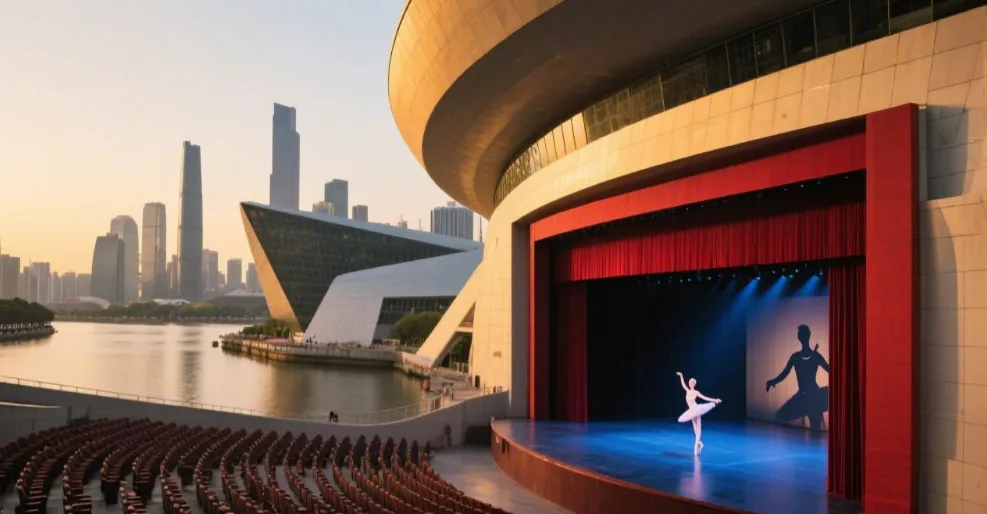
The highlight of the evening is a ballet in the Opera Hall. If the Experimental Theatre is about “closeness,” the Opera Hall is about “change.” I bought Seat 22, Row 15 in the Stalls (priced at 680 yuan), which is roughly the golden ratio point of the audience area. One scene during the performance impressed me deeply: one second it was a flat court ball floor, and the next, a mirror-covered slope rose silently from the center of the stage, where the dancer completed a segment of weightless solo dance. Throughout the entire process of lifting and shifting, I only saw the stage “magically” transforming; I could hear almost no noise from motors or gears. This ultimate silence ensures the purity of the music and the continuity of the audience’s emotions, reflecting the top-tier stage machinery level of the theater.
Based on my experience, especially for watching dance, here are my seating tips for the Opera Hall:
|
Seating Area
|
Price Range (For this show)
|
Viewing Experience
|
Target Audience/Demand
|
|---|---|---|---|
|
Rows 10-20, Center of Stalls
|
580-880 yuan
|
The absolute balance point of vision and hearing. You can clearly see every point of the dancer’s toes and subtle changes in facial expressions, while the orchestra’s sound is full and balanced.
|
Deep-dive audiences seeking the best comprehensive experience with a sufficient budget.
|
|
Balcony (Front Rows), 1st Floor
|
380-580 yuan
|
A god-like perspective overlooking the whole scene. Especially suitable for watching complex changes in group dance formations, with a strong sense of geometric beauty. However, facial expression details will be blurred.
|
Audiences who prefer composition and overall stage visuals, or repeat viewers.
|
|
First 5 Rows or Sides of Stalls
|
280-480 yuan
|
Strong sense of presence with potential visual blind spots. You need to look up in the first few rows, and side views might miss stage movements on the other side.
|
Budget-conscious viewers or those seeking the “sense of breathing” from the actors.
|
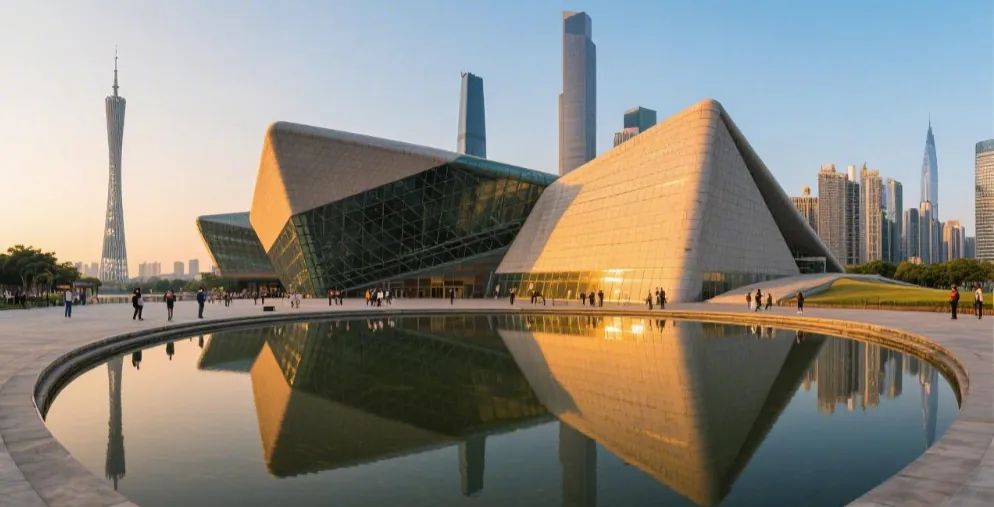
The show ended after 10:00 pm. I walked out from the west gate of the Opera House instead of returning the same way to the metro station. This was a correct decision—the west gate faces an open viewing platform. At 11:00 pm, the lights inside and outside the building were still on. I held up my phone and easily captured a picture like this: the foreground is the Opera House’s sharp-lined concrete walls and the warm yellow light glowing from within, the midground is the ripples of light reflected on the water, and the background is exactly the colorful Canton Tower and the skyscraper clusters of the Zhujiang New Town central axis. This spot requires no photography skills; a quick snap is a classic night view covering Guangzhou’s modern landmarks.
Day 3: Friendship Theatre Activity Plan
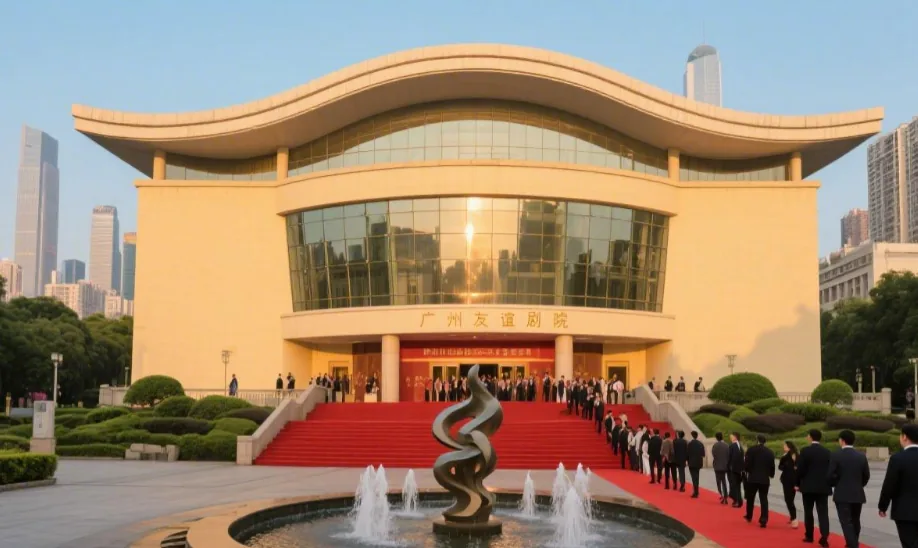
Today’s destination is the Friendship Theatre, and I decided to change my mode of transport—walking. In the afternoon, after leaving the Sun Yat-sen Memorial Hall, I didn’t head for the metro station but turned into Jiefang North Road on the west side of the Memorial Hall, then into Panfu Road. This route completely avoided the traffic of the main roads. I passed through an old neighborhood full of life: roadside were lush old banyan trees, and beneath them were arcade buildings with occasional convenience stores and herbal tea shops; the air was filled with the aroma of double-boiled soup and a faint damp smell. After walking for about fifteen minutes, when I saw a solemn Soviet-style building, I knew I had arrived.
The Friendship Theatre was built in the last century, and its aura is completely different from the modern venues I visited in the previous two days. Looking closer, the weight of time becomes clearer:
-
Before the tall porch are wide steps; the marble material has developed a warm luster in the middle after years of being trodden on.
-
The red star logo above the entrance and the decorative lines of the cement reliefs are typical symbols of architecture from that era.
-
Entering the lobby, underfoot is terrazzo flooring, and overhead is a simple plaster ceiling; the lights are not bright but exude a unique steadiness and tranquility of old-school theaters. There are no cool light shows here; all designs point to one goal: letting the audience quiet down and prepare to enter the world on stage.
Tonight, I am watching the classic Cantonese opera “Princess Cheung Ping.” The Friendship Theatre is indeed a major center for local opera performances, and the ticket prices are much more affordable than the previous two venues. I bought the ticket three days in advance through the theater’s WeChat official account: Row 15, Seat 27 in the Stalls, right in the center, for only 180 yuan. The ticket pickup was at a simple wooden window on the right side of the entrance; the staff was a friendly auntie who handed me the ticket and said casually, “Tonight this play is something good.”
The fifteen-minute intermission is a great time to observe theater culture. Many audience members around me looked like regulars:
-
Several gray-haired aunties took thermos cups out of cloth bags and discussed the performance of a certain singing passage just now.
-
Two old men in the corridor smoked while discussing: “This time the lead male actor, that ‘body turn’ movement, how can it be as elegant as Ding Fan’s in the old days?”
-
There were no people queuing to look at their phones in the restrooms; everyone seemed still immersed in the plot.
This atmosphere makes you feel that watching a play is not a one-time cultural consumption, but a familiar and anticipated fixed chapter in their lives.
The show ended after 10:00 pm. I came out from the north gate of the theater, and instead of heading toward the main road, I turned into the dimly lit neighborhood alleys behind the theater. The residential area quieted down at night, with only a few small shops still lit. Guided by memory and a bit of scent, I found “Liang Jie Stews” in a branch lane of Panfu Road. It’s just a family-run shop with several giant stew pots at the door, emitting white steam.
I ordered a bowl of coconut stewed silky chicken for 23 yuan. The lady boss took the piping hot stew pot out of the steamer and placed it on the small table in front of me. Lifting the coconut lid, a sweet steam hit my nose. The soup was very clear, with a pure sweetness from the coconut and the freshness of the stewed chicken, with no sense of MSG at all. The silky chicken meat was stewed until tender and fell off the bone with a light scrape of the spoon. While drinking the warm soup, the lingering sounds of the opera on stage just now seemed to still echo in my ears; this seamless transition from the extreme of stage art to the stability of marketplace food and drink made me truly touch the quality at the heart of Guangzhou—art is part of life, and life itself is the most profound art.
Finally, if you also plan to come to watch a play, here is a small tip for seating:
|
Floor/Area |
Approximate Price Range |
Experience Features & Suggestions |
|---|---|---|
|
Rows 10-20, Center of Stalls |
150-250 yuan |
Best balance of sound and perspective. The vocals are focused, and you can see the actors’ expressions and movements clearly; it’s the top choice for value. |
|
Front Rows of 2nd Floor |
80-150 yuan |
Panoramic view, sound is slightly scattered but fine. Suitable for those who want to see the overall stage movements and group scenes, choose this if the budget is limited. |
|
First 3 Rows or Last Few Rows of Stalls |
180 yuan / 120 yuan |
Choose with caution. You need to look up significantly in the front rows, which strains the neck; the last few rows are near the exits, often disturbed by people moving, and lose the most sound detail. |
Day 4: Free Exploration & Art Retrospective
On the last day, I deliberately didn’t set an alarm. When I woke up, it was almost ten, and the sky was the thin overcast common in Guangzhou during spring. It felt good not to be in a rush. I packed my luggage and stored it at the hotel, then took the metro back to Ersha Island. Passing through Xinghai Concert Hall, I walked to the large lawn backed by the river.
The atmosphere here is different from the brilliant night. The morning sun filtered through the clouds, softly sprinkling down. Some people were jogging, parents were flying kites with their children, and I found a bench under a large tree to sit down. Closing my eyes, the sounds that had filled my ears over the last few days started to play back automatically: the silk-like smooth wrapping of the strings in Xinghai Concert Hall, the breathing of actors within reach in the Experimental Theatre, the aged yet round throat tones of the Cantonese opera leads in Friendship Theatre. They intertwined to form a memory map of this city’s sounds. I just spaced out for almost an hour, doing nothing, just letting those sounds slowly settle and categorize in my heart, like organizing a precious collection of auditory specimens.
In the afternoon, I strolled to the Guangdong Museum of Art just a few steps away. I was just browsing, but unexpectedly ran into a contemporary sound art exhibition called “Sonic Overlays” on the third floor. It was like a custom surprise for my trip. There were no traditional paintings in the exhibition, but instead, installations that required wearing headphones or entering specific sound fields.
-
One work called “Rain Shelter”—I walked into a small space enclosed with transparent plastic sheets, containing several old buckets. Rain sounds began to play in the headphones, starting far away and getting closer, eventually turning into the roar of heavy rain hitting the roof. Amazingly, the water surface in the buckets before me really started to ripple, caused by hidden vibrators. The visual “stillness” and auditory “motion” created a wonderful illusion.
-
Another interactive installation let you hum into an old telephone receiver, and the system would transform your voice in real-time into a patch of abstract jumping light spots projected on the wall.
This exhibition completely broke my inherent perception of “sound.” If the first three days I spent in professional concert halls listening to perfectly presented “results” that were precisely controlled, then here, I came into contact with “processes” of sound as a raw material—how it is deconstructed, woven, and related to space and vision. This unexpected stop perfectly added a modern and reflective footnote to my “listening” themed trip.
If you have the energy and time after reading this, I suggest you go and explore these two old city areas, which hide another kind of art ecology:
-
Shamian Island: Come out from Exit E of Huangsha Metro Station and cross the pedestrian bridge. Scattered among the old concession buildings here are some small galleries and art studios. For example, “In Arcade” focuses on printmaking, where you can see the artist’s manual printing process. The artistic atmosphere here is quiet and carries historical traces.
-
Yongqing Fang: An old town redevelopment area by the Lizhiwan Canal, it’s more lively. Besides check-in spots like “Zhongshuge” and “Vintage Store,” you can pay attention to some independent spaces in the alleys. Last time I went, I found a small music bar called “Rolling Stone” in an inconspicuous second floor, which has live performances by local independent bands several nights a week, with a very casual atmosphere.
Practical Advice: Transportation, Time, and Performance Tips
After moving around these few days, I have roughly figured out the transportation between the main performance venues in Guangzhou. My advice is: choose a hotel along Metro Line 1 or Line 2, and you will thank me. Stations like Gongyuanqian, Martyrs’ Park, and Tiyu West Road are all within a 30-minute metro ride to any theater, which is very convenient. Here are the specific practical details:
Regarding ticket purchases, here is a summary of my “differentiated ticket-buying strategies” table:
|
Theater
|
Main Official Channels (Most reliable)
|
Best Timing for Buying/Snagging Tickets
|
Special Offers & Tips
|
|---|---|---|---|
|
Xinghai Concert Hall
|
WeChat account “Xinghai Concert Hall Ticketing Center”
|
At 10:00 am on the day tickets go on sale. Popular performances (e.g., famous symphonies, piano solos) require waiting.
|
1. With a valid student ID, you can buy student tickets at the box office window on the day of the performance, often at 50% off, but quantities are limited.
2. There are regular public welfare performances like “Music Afternoon Tea” with very low ticket prices; follow the WeChat account for updates. |
|
Guangzhou Opera House
|
Official website or WeChat account “Guangzhou Opera House”
|
Follow the “Performance Schedule” on the website 1 month in advance. 3 days to 1 week before tickets go on sale, members usually have priority purchasing rights.
|
1. Some non-popular performances have “Early Bird Tickets” with a discount of about 20% if purchased within the first week after sale begins.
2. 1 hour before the show starts, sometimes a small amount of low-priced “last-minute tickets” are released at the box office, so you can try your luck. |
|
Friendship Theatre
|
WeChat account “Guangzhou Friendship Theatre”
|
No need to snag tickets; just buy 1-2 weeks before the show. Popular operas can be slightly earlier.
|
1. Ticket prices are affordable, with year-round senior tickets and member discounts.
2. Multiple channels available; you can also buy on Damai or Maoyan, but the official account sometimes has exclusive packages. |
Regarding time arrangements, I have a painful lesson to share:
Don’t arrive just in time. Arrive inside the theater at least 30 minutes in advance—this is the baseline. These 30 minutes are for: queuing to pick up tickets (online purchases need to be exchanged for physical tickets at machines or windows), storing backpacks and coats (concert halls usually don’t allow large bags inside), going to the restroom (intermission queues are very long), picking up free program booklets (which have musical piece and actor introductions, great for “previewing”), and then sitting down quietly.
Regarding clothing and equipment, here are a few easily overlooked points:
-
Clothing: There is a large temperature difference between indoors and outdoors in Guangzhou. Air conditioning in theaters is very strong, especially at Xinghai and the Opera House; I felt the temperature was around 22°C. A comfortable light jacket or shawl is a life-saver. As long as your clothes are clean and tidy, just avoid overly casual outfits like flip-flops or vests.
-
Silence: Before the show starts, be sure to set your phone to silent (not vibrate). The sound of vibration on wooden armrests or seats is also startling. Unwrap any plastic packaging or candy wrappers in advance, as any rustling will be amplified during the performance.
-
Photos and Recording: This is a red line. The vast majority of classical music, drama, and dance performances strictly forbid filming and recording. The theater will repeatedly remind you via broadcast and screens, and staff will also use laser pointers to warn you. Don’t take chances. The only time filming might be allowed is during the curtain call after the performance, but observe the on-site prompts and others’ actions first. A pair of binoculars is far more useful than a phone for seeing the dancers’ expressions and musicians’ fingers, elevating the experience to another level.
Related Reading
- Guangzhou 5-Day Temple Zen Journey | Night View of Dafo Temple + Haizhuang Temple + Nengren Temple, A Tranquil Blessing Trip in a Bustling Metropolis
- 5-Day Lingnan Private Garden Tour in Guangzhou | Yuyin Shanfang + Baomo Garden, Immersively Experience Cantonese Carved Beams and Painted Rafters
- 5-Day Historical Tour of Guangzhou | Museum of the Nanyue King + Sun Yat-sen Memorial Hall + Peasant Movement Institute, A Millennium-Old Pilgrimage to Yangcheng’s Historic Sites
- 4-Day Guangzhou Foodie Adventure | Xihua Road Snacks + Panxi Restaurant + Fangcun Banyan Tree Head, Foodie’s Hidden Local Food Map
- Guangzhou 4-Day Hiking Tour | Baiyun Mountain Crossing + Huolushan Forest Park + Niutou Mountain, Hardcore Off-Road Route for Outdoor Enthusiasts






