



Day 1: Cycling the Bio-Island Greenway
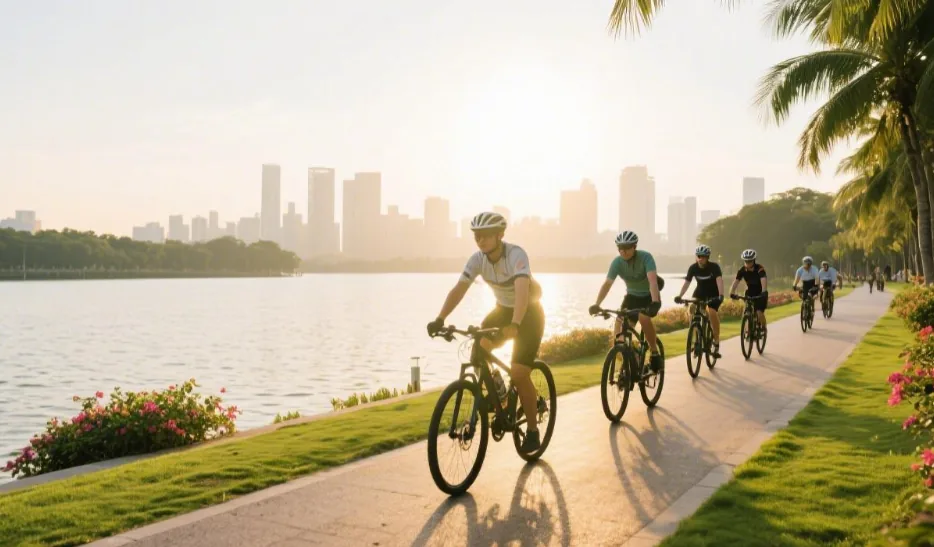
This morning, I intentionally avoided the morning rush hour and caught Metro Line 4 around 8:30. Heading south on this line, the carriage wasn’t crowded, which was quite comfortable. Coming out of Exit C of “Higher Education Mega Center South” station, I was greeted by a burst of fresh air, a completely different feel from the city center. I used my phone map to navigate to “Shuimo Garden” and followed the path; it was about a ten-minute walk. This route passes through some small roads inside the University Town, flanked by college campuses. It’s very quiet, and you can see students in small groups.
- Coming out of Exit C of “Higher Education Mega Center South,” there is a shared bike parking area on the left with plenty of bikes. However, I don’t recommend unlocking one here because you still have to cross the road to reach the Shuimo Garden entrance; walking there is more relaxed.
- I suggest setting your navigation destination precisely to “Bio-Island · Shuimo Garden Southeast Gate.” This is the most accurate location, and the entrance is right at the starting point of the island’s loop greenway.
Walking into Shuimo Garden, you can immediately see the stylishly designed entrance. The greenway and the motor vehicle lanes are completely separated by a green belt, which instantly provides a great sense of security. A row of shared bikes was parked nearby; I picked a Meituan bike with a suitable seat height and well-inflated tires. A quick tip: using the Meituan app often offers affordable monthly cycling passes. After checking the brakes and the bell, I set off punctually at 9:00.
My route was simple: ride clockwise around the outer perimeter of the island. Officially called “Outer Ring Road,” just stick to the red plastic greenway and you definitely won’t get lost. The total distance is a standard 15 km. I didn’t ride fast, stopping to take photos whenever I saw good scenery, spending a total of about three hours.
Below are my personal feelings regarding each section of the road:
|
Section
|
Landscape and Road Details
|
My Personal Experience and Discoveries
|
|---|---|---|
|
South Section (Start – Lansheng Garden)
|
The view is completely unobstructed. The wide Pearl River Back Channel allows you to clearly see the buildings in Panyu on the opposite bank. The greenway is as flat as a mirror.
|
This is the windiest part of the journey. With the whistling river breeze, it’s very cool to ride here in summer, but make sure to secure your hat. There is a small platform near Lansheng Garden that serves as an excellent photo spot. There’s an automated vending machine nearby where I bought a bottle of water at the same price as outside.
|
|
West Section
|
Entering the R&D area of Bio-Island, modern glass curtain wall buildings stand tall. The greenway meanders through well-maintained green belts with dense shade.
|
It suddenly becomes very quiet; you hardly bump into anyone else, only the sound of birds and your own breathing. The sunlight filters through the leaves, creating dappled shadows on the ground, so it’s not hot at all. This section is perfect for immersive cycling, where you can clearly hear the rustle of tires against the ground.
|
|
North Section (Near Diecui Garden)
|
The terrain begins to fluctuate with a few gentle slopes and small curves. The greenery shifts to a more layered garden landscape with small ponds and pavilions.
|
This is the only part of the trip where you can feel your leg muscles working differently. Riding up a few small slopes is quite fun and not boring. You can walk a bit further into Diecui Garden; it’s very serene and has restrooms.
|
|
East Section (Returning to Start)
|
Returning to the riverside, the perspective shifts eastward. You can see the Sun Yat-sen University pier and the “SYU No. 1” research vessel, with cargo ships and cruise boats weaving across the river.
|
In terms of distance, I felt closer to the city here. By the time I reached this point, my body was fully warmed up, and the river breeze felt particularly refreshing. Seeing the architecture of Shuimo Garden meant I had just completed a perfect circle.
|
At around 12:00 pm, I parked the bike back at the original spot in Shuimo Garden and settled the payment on my phone. For lunch, I headed straight to “Beigang Village” in the University Town—the absolute center of the student food universe in Guangzhou University Town. It’s only a ten-minute walk from Shuimo Garden. Inside, crisscrossing alleys are filled with a dizzying array of snack shops, fast food joints, and milk tea shops.
Based on my memory of previous guides, I found a small shop called “Chaoshan Original Flavor Soup Rice.” The shop isn’t big but was packed with students. I ordered a signature pig organ soup rice for 25 yuan. It arrived in a large clay pot; the broth had a rich pepper flavor and was loaded with a generous amount of pig liver, small intestines, and lean meat, served with a big bowl of rice. After a morning of cycling, eating such a warm, soupy meal was incredibly satisfying. If you don’t like offal, they also offer pig organ wolfberry soup and chicken soup options.
After lunch, I took a walk in Beigang Village to digest. Then I found a quiet cafe—I forgot the name, but it’s right next to GoGo New World. I ordered an Americano and sat there for the whole afternoon. Watching young students coming and going outside, flipping through the photos on my phone, and charging my devices, I gathered my strength for the next day’s long-distance ride.
Day 2: Haizhu Lake Loop Cycling
When I woke up the second day, the sky was just starting to turn gray. Thinking about moving from University Town to Haizhu Lake, I set an alarm for 8:50. After washing up and going downstairs, I found a Meituan bike near Exit D of Higher Education Mega Center South station—I had tried them the day before, and the tire pressure here is generally sufficient. I used the app to unlock the bike in advance and checked if the brakes were working and the bell was ringing; this is my habit every time I use a shared bike, as safety comes first.
- I set the navigation to “cycling mode” and searched for “Haizhu Lake North Square Parking Lot” as the destination. Don’t just type “Haizhu Lake,” as it might lead you to a side gate and waste time.
- Go west from Higher Education Mega Center South station, turn right at the first intersection onto Xinjiao Road. You will see signs for “Bio-Island Direction” on the road; just follow the arrows.
I set off just after 9:00, heading west along Xinjiao Road. This road is a side road of the city’s main artery; the non-motorized vehicle lane is marked clearly enough, but you have to pay attention to details:
Approaching 10:00, I saw the blue “Haizhu Lake Park” sign from a distance; turning in leads to the North Square parking lot. The parking spot is on the east side of the square, marked with clear white lines for the “Shared Bike Parking Area.” I parked and locked the bike, then took a photo of the lake—at that time, the sun was just rising, and a thin mist floated over the water, looking like a mirror that hadn’t been wiped clean.
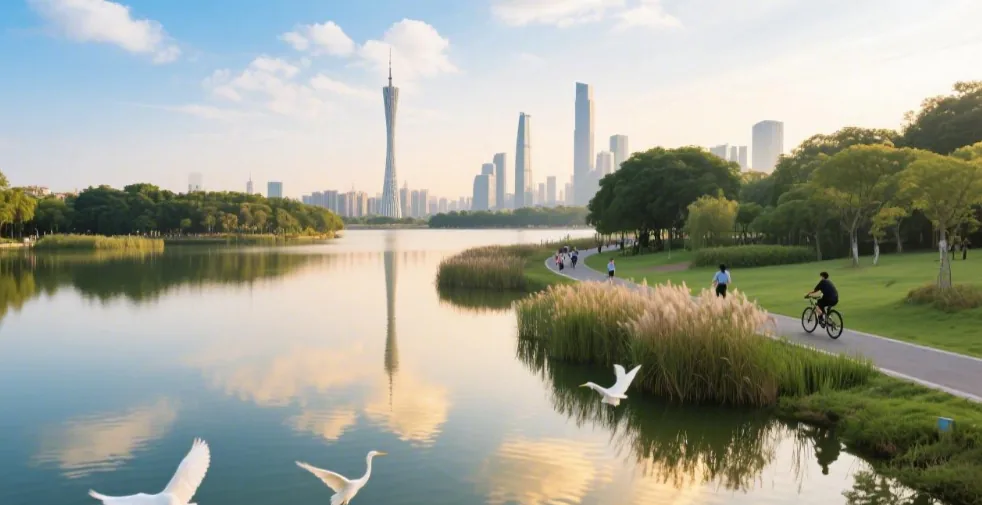
Cycling is not allowed inside Haizhu Lake, so I walked in from the North Gate. The park is open for free, and on the right as you enter is a wetland science board stating that there are over twenty species of birds here, including Little Egrets and Night Herons. Walking deeper along the wooden boardwalk, I indeed heard “quacking” sounds and looked up to see a few Little Egrets standing on one leg in the shallows; they didn’t fly away even as I approached, probably used to tourists. At the viewing platform, the view suddenly opened up—across the lake, it directly faces the Canton Tower (Slim Waist). The tip of the tower happened to poke through a gap in the clouds, making it look less oppressive than when viewed from the city center. You could also see the outlines of the East Tower and West Tower nearby, standing like three giants side-by-side.
After an hour of wandering, my stomach started to growl. Turning right outside the North Gate, across the street is “Qingxin Chicken Shatian Pigeon Restaurant.” It’s not a big shop but carries a “China Famous Snack” plaque. It was busy at lunchtime but didn’t require a queue. I ordered the signature roasted pigeon for 48 yuan each. When the waiter brought it out, it was still sizzling with oil; the skin was so crispy you could hear a “crunch” sound. Biting into it, the meat inside was so tender the juices flowed, and even the marrow was flavorful. It was served with plum sauce to cut the richness. I finished a whole pigeon by myself and left half a bowl of rice untouched—the pigeon meat was too filling.
At 1:00 pm, I went back to the parking spot to get a bike and began the actual loop around the lake. The route is North Square → Guangzhou Avenue South → Xinjiao Middle Road → Guangzhou Avenue South → back to North Square, totaling 10 km. This greenway is dedicated, paved with red asphalt, and separated from the motor vehicle lane by a green belt, making the ride very stable.
|
Cycling Section
|
Landscape Details and Personal Experience
|
|---|---|
|
Guangzhou Avenue South Section
|
Riding along the west bank of the lake, you can see lotus ponds (blooming beautifully in summer). Occasionally, a cleaning boat passes by, the ripples breaking the reflections.
|
|
Xinjiao Middle Road Section
|
Turning to the south bank of the lake, the view here is more open. You can simultaneously see the Slim Waist and the “Lake Center Island” in the middle of the lake, which looks like a green bun with its lush trees.
|
|
Return to Guangzhou Avenue South Section
|
Riding along the east bank, I passed a lawn where many parents were flying kites with their children. A kite string drifted in front of my eyes and almost got tangled in the handlebars; I squeezed the brakes quickly.
|
Returning to the start around 3:00, my phone record showed I had ridden 18 km (including the 8 km from University Town). The most interesting thing about this day was the “viewing the city across the lake” perspective. Landmarks that I usually look up at from high-rise buildings became embellishments of the lake view here, which was quite fresh.
In the evening, I found a guesthouse near University Town to stay in. When the owner heard I had been cycling all day, he specially swapped me for a softer mattress—it seems this route is indeed taxing on the legs, but it was worth it.
Day 3: Connecting Ride: From Haizhu Lake to Baiyun Lake
Starting from near Haizhu Lake at 9:00 sharp, I adjusted the shared bike seat to hip height—my back was a bit sore from cycling the previous day, so this was more comfortable. I set the navigation to “cycling mode” and the destination precisely to “Baiyun Lake Park East Gate.” The app automatically avoided truck-restricted roads, saving me from detours. I checked the weather before leaving: cloudy, not much wind, suitable for long-distance cycling.
- After picking up a bike at the Haizhu Lake North Square parking spot, I first rode along Guangzhou Avenue South to warm up. Only after confirming the bell and brakes were working did I dare to stay close to the main road.
- Passing the “Luoxi Bridge Foot” bus stop, I grabbed a bottle of electrolyte water. I expected to ride 20 km today, so keeping up with hydration was essential.
Today’s route was Guangzhou Avenue South → Hedong Bridge → Fangcun Avenue Middle → Zhujiang Bridge → Zengcha Road → Shisha Road, totaling about 20 km. Once I started riding, I realized the “strong sense of exploration” came from the different local vibes hidden in each segment. I rode slowly, watching and taking photos, taking nearly five hours.
I remember crossing the Hedong Bridge; the “Pedestrian/Non-motorized Vehicle” sign on the approach bridge was hidden behind an advertisement. Turning into the dedicated lane following the arrow, the vibration of the bridge surface suddenly became noticeable. Large trucks thundered past me, making the bridge sway slightly. I quickly stuck to the inner side and held the handlebars firmly. Fortunately, there was a viewing platform in the middle of the bridge where I stopped to take a panoramic photo of the Pearl River: a few sand barges floated on the river, and the shadows of the arcade buildings on both banks were long in the sun, much more vivid than on the map.
|
Section
|
Road Details and Personal Experience
|
|---|---|
|
Crossing Hedong Bridge
|
The approach bridge wound through two curves before getting on the bridge. You must keep a close eye on the “Non-motorized Vehicle” signs, otherwise you might end up in the motor vehicle lane. The view on the bridge is wide, but there are many large vehicles and the vibration is significant; I suggest wearing gloves for cushioning.
|
|
Fangcun to Jinshazhou
|
Riding along the north bank of the Pearl River Back Channel, I passed through Fangcun Old Street: under the arcade buildings, people were selling starfruit and guava in bamboo baskets, and old ladies sat at their doors peeling water caltrops. The air had a salty river breeze mixed with fruit fragrance. The non-motorized lane here is narrow, so you have to dodge electric scooters.
|
|
Crossing Zhujiang Bridge
|
Another cross-river bridge. The non-motorized lane only accommodates one bike, and there are often electric scooters going the wrong way, so you must ring the bell in advance to signal. In the middle of the bridge, you can see the railway tracks, with green trains occasionally clattering past.
|
|
Entering Shijing Area
|
After Zengcha Road, the traffic became noticeably lighter. The banyan trees along the road formed a continuous canopy, and the sunlight leaking through looked like scattered gold powder. Shisha Road is straight, making the ride much lighter and lifting my mood.
|
Approaching 11:00, I got hungry. I searched for “Jinshazhou Food” on the navigation, and the Jinbo Tiandi mall popped up; reviews said parking was easy and dining options were plentiful. I parked the bike in the shared bike area at the mall entrance and took the elevator to the fourth floor to find “Chuan Ji Chao Fa” beef hotpot. For about 80 yuan per person, you can have rib eye, chuck flap, and beef brisket pot. The broth is made from beef bones; have a bowl before cooking the meat—it’s incredibly fresh. The rib eye takes only 8 seconds to cook; dip it in satay sauce with some celery bits for a milky fragrance. The brisket was stewed until tender, even the tendons melted. I rested for forty minutes after eating, charging my phone and stretching my thighs before I had the strength to continue.
After 1:00 pm, I got back on the road. At 2:30, I finally saw the blue-and-white “Baiyun Lake Park” sign. I strongly suggest entering from the “East Gate”—it has a grand entrance and a shared bike parking area right at the door, so you don’t have to carry your bike looking for an entrance. Arriving around 3:00, I returned the bike and walked into the park. When looking for accommodation, I asked a security guard who recommended Lavande Hotel (Baiyun Lake Branch).
It was just a short taxi ride away. The hotel lobby had a lavender scent, and the front desk said a king room was 320 yuan per night, including breakfast for two. The room was clean, the mattress had just the right firmness, and I could see the trees by the lake from the window. After dropping off my luggage, I took a walk by the lake. The sunset dyed the water orange-red, and there were people fishing in the distance. Only then did I feel the day’s exhaustion was worth it.
Day 4: Deep Exploration of Baiyun Lake Park
I didn’t set an alarm and woke up at 8:30. The birds outside were chirping busily—the bed at Lavande Hotel is indeed comfortable; I fell asleep as soon as my head hit the pillow last night. I had a free breakfast in the restaurant: the millet porridge was thick, served with a dish of pickled radish and half a tea egg. I felt refreshed after eating. I checked out at 9:30 and called an express car via a ride-hailing app. From the hotel to the East Gate of Baiyun Lake is less than three kilometers, and the fare was 11 yuan. The driver said, “I come to this lake often. You can ride bikes inside; it’s more free than Haizhu Lake.”
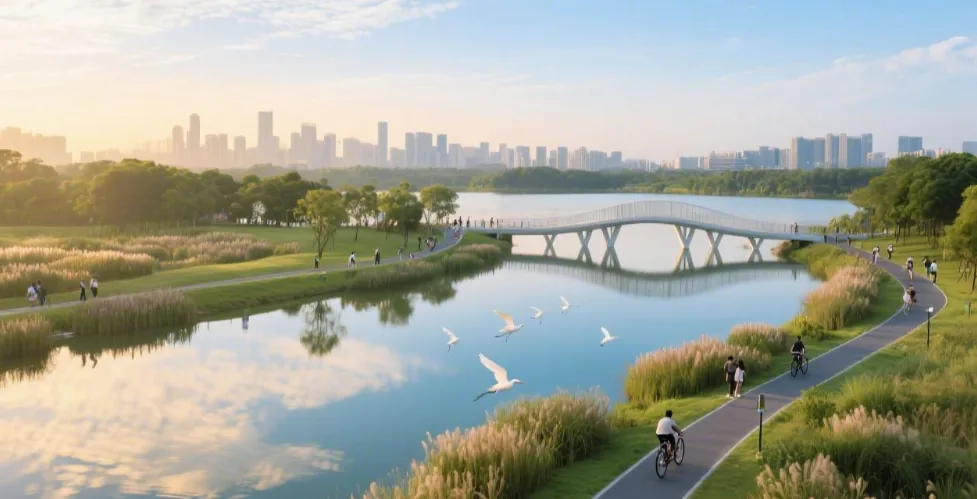
I arrived at the East Gate at 10:00 sharp. Shared bikes were piled like mountains at the entrance. I picked a Hello bike, lowered the seat by two notches (my knees were a bit tight after yesterday), checked that the tire pressure was normal and the bell was loud, and then scanned the code to unlock it. The park allows bicycles inside. The red asphalt track is like a ribbon embedded by the lake; signs read “Loop Greenway, total length 8 km.” I decided to ride counter-clockwise—this way, I would hit the Ferris wheel first, which is better for photos in the front light.
- There is a rental point right on the right as you enter the East Gate, but shared bikes are more flexible as you can park them anywhere.
- There are trash cans and rest benches every five hundred meters along the track, so you don’t have to carry things around looking for a place to rest.
Once I started riding, I realized how big this lake really is. The red asphalt track has a moderate hardness, and the tires made no noise on it. It was shaded all the way, so it wasn’t hot even in summer. I rode slowly and stopped whenever I saw something interesting: large patches of reeds rustling in the wind; a lotus pond (unfortunately not in bloom), with leaves spread out like a green carpet; occasionally, fishermen sat on small stools, their rods as still as statues. One loop recorded 8.2 km on my phone and took three and a half hours—I stopped six times for photos and twice to stretch my thighs.
The park hides several must-see check-in points, which I noted down in order:
|
Check-in Point
|
Location and Details
|
My Experience and Recommendations
|
|---|---|---|
|
Ferris Wheel
|
Midway along the loop toward the west; rusty but the frame is intact.
|
Although it doesn’t spin anymore, looking up to take a photo frames it against the blue sky and tree shadows, looking like the ruins aesthetic in movies. It looks best when shot around 3:00 pm when the light is slanted and shadows are longest.
|
|
West Lake Island
|
Ride 500 meters north from the Ferris wheel; requires climbing 28 stone steps to get on the island.
|
The island is small, with a hexagonal pavilion at the top. It offers a 360-degree unobstructed lake view; you can see the arched East Gate and the distant foothills of Baiyun Mountain. The stone steps are a bit steep, so wearing sneakers is safer.
|
|
Wanxia Pavilion
|
At the end of the eastern loop, built by the water.
|
The pavilion faces west. Come at 4:30 pm to grab a spot and wait for the sunset to turn the water golden red. It’s more immersive than viewing the tower across the lake at Haizhu Lake. There are stone tables inside where you can sit and have tea (bring your own cup).
|
I got hungry at noon. There are three convenience stores in the park. The first one is near the Ferris wheel, selling mineral water for 3 yuan, roasted sausages for 5 yuan, and fish balls for 6 yuan a skewer. I bought a sausage to tide me over; the sweet chili sauce was quite tasty. The second one is at the entrance to West Lake Island, selling boxed mung bean paste; the chilled one for 4 yuan really helped cool me down. But don’t expect a proper restaurant; there isn’t even a bowl of hot noodle soup. If you want a good meal, you have to go outside.
After 3:00 pm, I parked the bike near Wanxia Pavilion and sat on the grass by the lake watching people fly kites. Most were local families: dads running with the reels, moms holding children and shouting “higher, higher,” and kids chasing the kite tails with laughter flying even higher than the kites. An old man brought two birdcages with thrushes and hung them on tree branches. The birdsong mixed with the hum of kite strings felt very grounding—this is completely different from the serenity of Bio-Island and the “photo-op” vibe of Haizhu Lake. Baiyun Lake is like an open backyard where anyone can come to catch their breath.
At 5:00 pm, I cycled out of the East Gate and took a taxi to Shijing International Plaza two kilometers away. The fourth floor is full of restaurants. I chose a place called “Hakka Village” because reviews said the “portions are generous and the value is high.” I ordered stuffed tofu, mui choy with braised pork, and garlic choi sum for about 60 yuan per person. The stuffed tofu was crispy on the outside and tender on the inside, having soaked up the meat filling’s gravy. The braised pork was rich but not greasy, and the mui choy underneath was savory and great with rice. The choi sum was stir-fried until crisp and full of wok hei. I packed half of the braised pork as a midnight snack and took a 21-yuan taxi back to the hotel.
Day 5: Concluding Ride: Returning to the City from Baiyun Lake
At 9:00 sharp, I checked out of Lavande Hotel and left my suitcase at the front desk—I’d have to come back for it after cycling anyway. The walk to the East Gate of Baiyun Lake took less than five minutes. Shared bikes were piled up at the door. I picked a Qingju bike, adjusted the seat for a long ride, squeezed the brakes to ensure they were responsive, and scanned the code. As I unlocked it, I checked the navigation: the destination was set to “Guangzhou Railway Station Friendship Store,” and the route was planned as “Baiyun Lake East Gate → Shitan West Road → Xiwan Road → Huanshi West Road → Railway Station.”
- I bought a bottle of iced black tea at a convenience store before starting. The forecast was 32 degrees today; riding in the old city would definitely be hot.
- I turned on “cycling mode” on the navigation, which automatically flagged “dense electric scooter areas” and specifically warned me to “slow down and observe” on Xiwan Road.
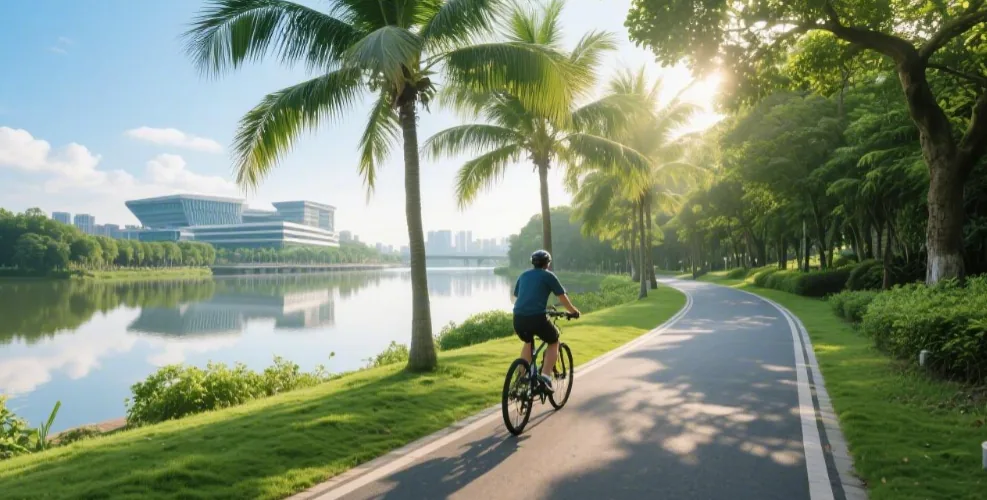
I officially set off at 9:10, riding north along Shitan West Road. This road is newly built; the non-motorized lane is over three meters wide and separated from the motorized lane by a guardrail. The ride was quite smooth. I saw trucks going in and out of logistics parks along the way, and the air had a faint smell of diesel. After about forty minutes of riding, at the Xiwan Road intersection, the navigation prompted “entering the old city, watch out for electric scooters.”
|
Cycling Section
|
Road Details and Personal Experience
|
|---|---|
|
Shitan West Road
|
The road surface is flat. The traffic mainly consists of trucks and private cars. The non-motorized lane is empty, allowing for a steady pace. There are signs for “Xiwan Road Market” along the way, bringing the aroma of roasted meats.
|
|
Xiwan Road
|
Things change from here: the road narrows to two lanes, with electric scooters, bicycles, and pedestrians mixed together. Old ladies push vegetable carts occupying half the path, and delivery riders on electric bikes zoom past. I kept ringing the bell and stayed to the right. My eyes had to watch the front, the mirrors, and the roadside all at once; my concentration was highly focused.
|
|
Huanshi West Road
|
After passing “Xicun” Metro Station, the traffic eased slightly. I could see the signs for “Guangzhou Railway Station.” This section has roadside trees providing shade, so it wasn’t that hot. Occasionally, tour buses pulled over, with travelers dragging suitcases getting off.
|
|
Destination: Friendship Store
|
I arrived around 11:00. There is a dedicated shared bike parking area in front of the store, making it very easy to return the bike. Standing at the door, I could see the railway station’s clock tower, and the broadcast announced “passengers for train GXX, please proceed to ticket check.” I felt the grounding sense of returning to the city’s heart.
|
After returning the bike, I happened to be hungry. Right next to the Friendship Store is “Ducheng Fast Food.” I ordered a 25-yuan “Char Siu Rice Set”: a portion of rice, three or four pieces of semi-fat char siu, a small dish of green vegetables, and a bowl of daily soup. The char siu was perfectly sweet and savory, the fat part wasn’t greasy, and the soup was winter melon and barley water, very cooling. This fast food place is frequented by locals; the service is fast and there’s no waiting. After eating and paying, I calculated that the food expenses for these five days were well-controlled.
I didn’t want to cycle anymore after lunch, so I entered Guangzhou Railway Station nearby and took Metro Line 2 directly to Guangzhou South Railway Station. Metro Line 2 from “Guangzhou Railway Station” to “Guangzhou South Railway Station” is 8 stops, taking 25 minutes, and the fare is 5 yuan. The carriage wasn’t crowded. I leaned against the handrail and thought back over these five days: the river breeze of Bio-Island, the tower shadow at Haizhu Lake, the sunset at Baiyun Lake, and the “beep beep” of electric scooters in the old city—all have become fragments of my memory.
The sun was intense when I came out of South Station. This cycling trip wasn’t about speed; I just followed the pulse of the water systems and wandered slowly, exploring both the “green lungs” and “old streets” of Guangzhou.
Related Guides
- Guangzhou 4-Day Music & Theater Tour | Xinghai Concert Hall + Guangzhou Opera House + Friendship Theatre, A Visual & Auditory Journey of Elegant Art and Supreme Acoustics
- Guangzhou 5-Day Temple Zen Journey | Night View of Dafo Temple + Haizhuang Temple + Nengren Temple, A Tranquil Blessing Trip in a Bustling Metropolis
- 5-Day Lingnan Private Garden Tour in Guangzhou | Yuyin Shanfang + Baomo Garden, Immersively Experience Cantonese Carved Beams and Painted Rafters
- 5-Day Historical Tour of Guangzhou | Museum of the Nanyue King + Sun Yat-sen Memorial Hall + Peasant Movement Institute, A Millennium-Old Pilgrimage to Yangcheng’s Historic Sites
- 4-Day Guangzhou Foodie Adventure | Xihua Road Snacks + Panxi Restaurant + Fangcun Banyan Tree Head, Foodie’s Hidden Local Food Map






