



Day 1: Arrival in Kunming → City Stroll & Eat (Dianchi Lake/Cuihu Lake)
I arrived at Kunming South Railway Station last Saturday on High-speed Train G2856—departing from home at 8:30 AM and arriving punctually at 11:00 AM. The carriage was filled with groups of aunties carrying flower cakes and taking photos of the terraced fields outside the window. Someone struck up a conversation with me: “Where are you heading, girl? Kunming’s rice noodles must be the ‘Small Pot’ (Xiaoguo) style to be authentic,” and I instantly felt the relaxed vibe of the trip.
I didn’t dare wander aimlessly after exiting. Following the “Bus Hub” sign on the wall, I turned right and took an escalator to the underground bus station. The self-service ticket machine at the entrance was a bit slow, but a volunteer in a red vest helped me select “Bus 59” and reminded me, “This bus goes to Haigeng Dam, it takes 40 minutes and costs 2 yuan.” Actually, you can also search for “Kunming Bus” on Alipay to scan the QR code, which is what I did later for Bus 24 to avoid carrying change.
“Haigeng Dam”: The Air is Filled with the Salty Scent of Dianchi
Bus 59 is a double-decker. I specifically chose a window seat on the second floor—along the way, I could see the reed beds by the shore swaying in the wind, and grandpas in straw hats sitting by the bank fishing for tilapia. The fishing floats stayed still in the water, but they looked quite leisurely. Getting off at Haigeng Dam Station, I was greeted by the scent of lake water. The wooden planks extended into the center of Dianchi Lake, where many people were feeding seagulls:
- It’s busiest in winter (November to March). You can buy a transparent bag of breadcrumbs for 1 yuan. If you crumble it and toss it into the air, the gulls will “whoosh” down to grab it. A brave one even landed directly on the railing and rubbed the back of my hand with its red beak—it felt cool;
- In summer, you can sit on the benches and look at the distant Xishan Sleeping Beauty Mountain. The silhouette looks like a girl lying on her back, and even the breeze carries the coolness of the lake. A couple taking wedding photos sat next to me; the bride’s white veil was blown up by the wind, and the photographer shouted, “Smile naturally, the background is Dianchi!”There’s a roasted tofu stall by the dam. The owner is an uncle in a blue cloth apron. The tofu is roasted until the skin is crispy and the inside is soft and tender. Dipped in his special sweet and spicy sauce (the sweetness from brown sugar and the spice from millet chili), it’s 1 yuan per skewer. I squatted by the walkway and ate 10 skewers. The uncle said with a smile, “Slow down, girl, no one’s competing with you.” He also told me, “These gulls have feelings for us; they come every year. If you come in winter, you can see how they scramble for food.”
“Cuihu + Yunnan Ethnic Village”: An Ethnic Museum Hidden in the City
From Haigeng Dam, I took Bus 24 to Cuihu—a single-decker green bus, 5 stops away, and the fare was still 2 yuan. Walking south for 5 minutes after getting off, you can see the vermilion gates of Cuihu Park. The lake water is as green as emerald, with tourists rowing boats, oars splashing water onto the roots of willow trees along the shore.
Right next to the park is the Yunnan Ethnic Village. The stone archway at the entrance is carved with totems of 26 ethnic groups. I bought a 90-yuan ticket to go in, just in time for the 14:00 Dai Water Splashing Festival performance:
- The performers wore brocade tube skirts with silver ornaments hanging from their waists, scooping water from the pool with silver bowls to splash each other. Tourists joined in too. I got soaked by a child in a floral dress. A Bai auntie next to me laughed and said, “You’ve been touched by blessings; this year will definitely be smooth”;
- The Bai Tie-Dye Workshop in the village is a must-visit—the master sat on a wooden stool and taught me how to tie the cloth: first, scrunch the white cloth into a ball, wrap it tightly with cotton thread, and then soak it in the indigo dye vat for 20 minutes. I chose a pattern with white flowers on a blue background, which cost 20 yuan. The owner said, “Pick it up in three days, or I can mail it to you, cash on delivery for postage.”There was also a Yi Torch Festival scene display. The room was set up with a fire pit, copper kettles, and embroidered tapestries. The guide said, “We Yi people dance the Left Foot Dance for the New Year, and the torches are lit for three days and three nights.” I touched the tie-dye tapestry on the wall; the texture was rugged and carried a botanical scent.
Accommodation: A “Landing Spot” near Kunming Station, More Down-to-Earth than a Hotel
At night, I stayed at the Home Inn Selected near Kunming Station—it’s only a 10-minute walk to the station, so I didn’t have to drag my suitcase for a long distance. The room wasn’t big, but it was very clean: the sheets were light gray without wrinkles; the hot water in the bathroom came quickly, and the hairdryer was actually a Dyson (I was pleasantly surprised); the window faced the station square, where I could see late-returning passengers dragging their suitcases under the dim yellow lights, giving it a real sense of life.
The owner was a lady in a floral dress. When I checked out at the front desk, she told me, “For tomorrow’s high-speed train tickets to Dali, book 3 days in advance on 12306. The G-series trains around 9:00 are not crowded. My daughter took a late train last time and almost couldn’t get a seat.” She also tucked a map of the Zhuanxin Farmers’ Market into my hand, saying, “The bridge-crossing noodles there are delicious, 15 yuan a bowl, and the flower cakes are freshly baked with a rich rose filling.”

Day 2: Kunming → Dali (High-Speed Rail + City Transfer)
I had booked Train G2841 the night before (departing Kunming Station at 7:28). I headed to the station munching on Jiahua rose flower cakes bought from the convenience store downstairs (10 yuan/box, the rose filling is sweet and soothing). I entered the waiting hall directly by scanning my ID—an auntie in the next seat was carrying a large bag of freshly roasted Erkuai. Seeing me staring, she broke half and pressed it into my hand: “It’s hot, eat it wrapped with a fried dough stick; it’s better than train food.”
The train was a Fuxing model with enough legroom to stretch out. I chose a window seat and watched the scenery change from vegetable plots in the Kunming suburbs to the forests of Chuxiong, and then to continuous karst landforms with cacti sprouting from rock crevices. I arrived at Dali Station exactly at 11:00 AM. Following the “Bus/Long-distance Coach” fluorescent sign down the escalator, the B1 level was the bus hub. The electronic screen scrolled: “Bus 8 (Dali Station – Ancient City South Gate) Next Departure 11:15.”
A guy in a black T-shirt approached me on the platform: “Hey beautiful, take my car. 30 yuan to the South Gate of the Ancient City, direct delivery.” I smiled and pointed at the Bus 8 sign: “The bus is 2 yuan and takes 40 minutes. Your fare is enough for me to eat two bowls of Cold Chicken Rice Noodles.” He hummed and turned to find other customers.
Bus 8 is a blue-and-white “Dali Tourism Line,” covered with photos of Erhai scenery. I dropped two 1-yuan coins, and the driver nodded through the rearview mirror: “Sit tight, we’re crossing the Xier River Bridge ahead.” As the bus moved, the wind poured in through the window, and I could smell the pine needles of Cangshan Mountain—on the opposite hillside were fields of rapeseed flowers (it was March then), golden yellow as if the mountain was coated in honey. An old lady in a tie-dye dress was on the bus, holding a bamboo basket filled with freshly picked cherries. Seeing me staring, she handed one over: “Very sweet. They sell them expensive in the Ancient City. If you go there, buy from my grandson, 10 yuan per jin.”
40 minutes later, I arrived at the Ancient City South Gate Station. Looking up upon getting off, I saw the gray brick gate tower of the Ancient City, with “Dali Ancient City” inscribed in gold on the lintel. The bluestone road was a bit slippery, so I walked holding onto the wall. An auntie selling Rushan (dairy fans) shouted: “Girl, want a roasted Rushan? 5 yuan a skewer, brushed with rose jam.” I bought one; it was roasted crispy, and the rose jam was sweet with a hint of sourness, stretching into threads with every bite.
First, I climbed Wuhua Tower—the stairs are paved with old bluestone, showing signs of wear on every step, with wooden handrails installed alongside. It took 12 minutes to climb. The top floor platform was surrounded by white marble railings, offering a view of the entire Ancient City: Fuxing Road looked like a silver ribbon cutting through the black-tiled roofs. Tourists walked with backpacks, local aunties swayed with vegetable baskets, and the spire of Hongsheng Temple Pagoda could be seen in the distance, piercing the blue sky. A girl in Bai tie-dye held up her camera and shouted: “Sister, help me take a photo!” I pressed the shutter for her, and she smiled: “Thanks! I’m going to post this on Moments to get more people to come to Dali.”
Coming down from Wuhua Tower, I walked towards Renmin Road—this road is the “soul” of the Ancient City, lined with low old houses with tie-dye fabrics, silver bracelets, and handmade soaps at the doors. I slipped into a small shop called “Lanyran Xiaozhu.” The owner was a Bai auntie wearing a silver hairpin. Seeing me look at the tie-dye square scarves, she picked up a blue one with white flowers: “10 yuan. It’s a small scarf, can be used as a neckerchief or a hand towel.” She taught me how to tie it: “Fold the cloth into a triangle, wrap it once around your neck, and pull the two ends tight across each other so it won’t slip.” I tried it, and it indeed made my neck look slender. The auntie clapped and laughed: “We Bai girls all tied it like this when we were little.”
Looking for food in the evening, I walked along Renmin Road towards the South Gate and saw the wooden sign for Zaihuishou Cold Chicken Rice Noodles—the queue stretched from the shop to the alley entrance. I waited 15 minutes with my number. The owner brought a bowl piled with shredded cold chicken, crushed peanuts, mint, and cilantro. The noodles were handmade and so smooth they made a slurping sound. The cold chicken was sliced thin and dipped in oil-splashed chili flakes on the table (fragrant but not dry, with a hint of garlic). I took a mouthful; the broth was made from local chicken, so fresh I drank two gulps. A guy at the next table told me: “I took a bus from Lijiang just to eat here; it’s much more authentic than the noodles in Lijiang.” I nodded, added another spoonful of soup, and drank even the green onions at the bottom of the bowl.
Practical Tips of the Day (Personal Anti-Trap)
- High-speed Train Check-in: Kunming Station Gate A12 has fewer people; scan your ID to enter directly without queuing;
- Avoid Illegal Cabs: There are touts in black T-shirts at the Dali Station exit; ignore them and look for the blue “Bus Hub” signs;
- Bus 8: The last bus is at 19:00, don’t miss it; you can use the “Dali Bus” code on Alipay, no need for change;
- Ancient City Walking: Bluestone roads are slippery; it is recommended to wear sneakers, not high heels—I saw a girl in stilettos fall and scrape her knee.

Day 3: Dali Ancient City → Shuanglang (Erhai Loop Day Trip)
I had a warm bowl of “Duan Gongzi Pea Porridge” at a stall at the North Gate of the Ancient City (5 yuan, served with a crispy fried dough stick). Then, following the owner’s directions for 50 meters, I found the Dali Tourism Service Center—the blue sign featured scenery of Cangshan and Erhai, with a promotional stand for the “Erhai Loop Line” at the door. At the ticket window on the left, the electronic screen showed 3 tickets left for “8:30 Dali – Shuanglang.” I handed over 100 yuan, the auntie gave me 70 yuan back and said, “The bus is right at the door, departing in 5 minutes, remember to wear your seatbelt.”
“By Bus to Shuanglang”: A Slow-Motion Scene of Cangshan and Erhai
The bus departed punctually at 8:35. I chose a window seat—next to me was a Chengdu auntie with a child, clutching a bag of oranges, saying, “I’ll give you some when we get to Xizhou.” As the bus left the Ancient City, the willow buds were just sprouting, and the air smelled of grass mixed with rice fields. Passing Xizhou Ancient Town at 9:10, the bus stopped for 2 minutes. I hopped off and bought a Xizhou Baba (sweet flavor, 5 yuan): the crispy crust flaked into my hand, and the inside was full of rose filling, sweet but not cloying. The Chengdu auntie leaned over and asked, “Where did you buy that? I want to get one for my grandson.”
We arrived at Shuanglang at 11:00 AM sharp. Walking into the ancient town, moss was embedded in the cracks of the bluestone road, and the scent of Rushan wafted from the shops. Arriving at the Yuji Island Pier, I paid 25 yuan for a ticket and followed the crowd onto the island. The island is small, and the wooden walkway takes only 10 minutes to circle, but the exterior of Yang Liping’s Sun Palace is great for photos—white walls covered in bougainvillea, rattan lounge chairs in the courtyard, and sunlight filtering through the leaves. I took a photo at the door with the blue of Erhai as the background, no filter needed.
There was a Bai auntie on the island selling coconuts for 10 yuan each with a thick straw: “Just opened, very sweet!” I sat under a coconut tree drinking coconut water, looking at the distant Cangshan Mountain—the clouds were so low they seemed to fall into the lake, and the rice fields at the foot of the mountain shimmered with green light.
“Shuanglang → Wase”: Quiet Time on the Erhai West Line
At 2:00 PM, I went to the bus station in the center of Shuanglang Ancient Town to wait for the bus to Wase—a handwritten timetable was posted on the sign, “Shuanglang – Wase” every 1 hour, 10 yuan. After waiting 10 minutes, a green minibus rattled over, and the driver shouted out the window: “Going? Wase!” I got on, and he played Bai “Dabenqu” music, the melody as slow as the Erhai breeze.
Not long after starting, the scenery of the Erhai West Line exploded: the water surface changed from light blue to deep blue, like a piece of crumpled silk; the water grass near the shore swayed with the current, and occasionally fishermen cast nets from small boats, the net weights hitting the water with small splashes. I rolled the window all the way down; the wind blew in with moisture, my hair flew up, and even my breath felt salty.
40 minutes later, I arrived at Wase Town. Walking 5 minutes towards the sea, I saw Little Putuo—actually a tiny island the size of a palm, with red-roofed houses nestled among green trees and a few tour boats moored at the shore. I stood on the rocks by the shore to take a photo: Little Putuo was in the center, Erhai behind it, and the sunset dyed the water orange-red, casting long shadows. A grandpa selling roasted corn nearby shouted: “Girl, 5 yuan a cob, sweet corn!” I took it; the kernels were so plump they almost fell off, roasted fragrant and full of sweet juice with every bite.
“Skyline Living”: The Bustle of a Seaside Restaurant
In the evening, I went to Skyline Living Restaurant in Shuanglang—right by the sea, with rattan chairs on the terrace facing Erhai. The menu was handwritten in wobbly script. I ordered Steamed Erhai Fish (30 yuan), Stir-fried Local Water Spinach (15 yuan), and Rice Noodle Soup (10 yuan).
The fish arrived steaming hot, with a few slits in the body, topped with shredded ginger, scallions, and soy sauce. The meat was so tender it melted in the mouth without any fishy smell. The water spinach was grown by the owner himself, with crunchy stems and sweet leaves, carrying a hint of pleasant bitterness. The rice noodle soup was made from local chicken broth, sprinkled with green onions, so fresh I drank half a bowl.
The owner was an uncle in a floral shirt, bringing over tea: “The fish was caught this morning, fresh enough?” I nodded, and he laughed, “Next time you come, I’ll save a 3-jin one for you, steamed is best!” Tourists at the next table were chatting: “It’s half the price of the scenic area restaurants in Lijiang, and tastes better!”
Avoidance & Practical Tips of the Day
- Transportation: Illegal cabs at the Shuanglang Ancient Town entrance will charge 50 yuan to go to Wase; just take the bus for 10 yuan, don’t be fooled;
- Yuji Island: No need to buy a combo ticket; just buy the single 25-yuan entry. The island is small, 1 hour is enough;
- Little Putuo Photos: The light is best around 4:00 PM; the sunset will dye the island and Erhai golden;
- Dining: Go to Skyline Living Restaurant early, or you’ll have to queue. Terrace seats offer a sunset view; don’t sit inside.
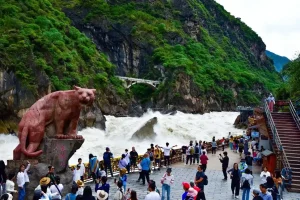
Day 4: Dali → Lijiang (Direct Bus + Ancient City Commute)
In the morning, I had a warm bowl of “A’niang Pea Porridge” at the South Gate of the Ancient City—5 yuan, the porridge was thick and topped with a handful of crispy fried soybeans, served with a fresh fried dough stick (2 yuan). A’niang stirred it with a spoon: “Eat slowly, it’s hot.” After eating, I followed her directions for 10 minutes to the Bus C26 stop and squeezed onto a light green minibus (2 yuan) heading to Xiaguan Passenger Station. The bus was packed with local uncles carrying woven bags and young girls with cameras. I stood by a window, watching the rice fields change from emerald green to golden yellow. Occasionally, Bai aunties with bamboo baskets sold roasted potatoes, shouting “Hot ones, 5 yuan each.” I bought one; the skin was charred and the inside soft, with an earthy fragrance.
“Xiaguan → Lijiang Bus”: A “Mobile Little Theater” on a Minibus
40 minutes later, I arrived at Xiaguan Passenger Station—as soon as I got off, I smelled instant noodles. The hall was lined with faded plastic chairs, and many people were clutching tickets. I went straight to the “Xiaguan – Lijiang” ticket window. The screen showed 5 tickets left for the 8:00 bus. I handed 100 yuan to the auntie in a blue uniform, and she gave me 40 yuan back: “The bus is the third one at the door, blue body, departing at 8:00 sharp, don’t miss it.”
After boarding, I found it was a minibus with a bit tight legroom. Next to me sat a mother with a 3-year-old child who was clutching a dirty teddy bear and staring at my water bottle. I pulled out some orange candies from my bag and gave them to her. The mother smiled and said, “My kid just loves sweets, thank you.” The bus drove steadily along the Erhai East Line, offering a view of the distant Cangshan Mountain and villages with rising hearth smoke. We arrived at Lijiang Passenger Station at 11:30 AM sharp. I massaged my slightly numb legs and got off. The sun was heating my shoulders, so I hurried to the bus stop.
“Passenger Station → Ancient City”: The “Slow Motion” of Bus 18
Waiting at the Bus 18 stop, an auntie selling fruit nearby held up an orange and shouted: “Girl, just bought, very sweet, 5 yuan a jin.” I bought one; the juice splashed on my hands when I peeled it. One bite was crisp, sweet with a hint of sourness, quenching my thirst. The bus arrived at 11:40, a red minibus, 2 yuan. The driver played Naxi “Wedding Vow,” the melody as light as the Ancient City breeze.
As the bus entered the Ancient City, I could see the silhouette of Lion Mountain in the distance, with Wangu Tower shimmering on the peak. Getting off at the Ancient City North Gate Station, I looked up at the gray brick gate with “Dayan Ancient City” inscribed on it. Tourists dragged suitcases on the bluestone road, the wheels making a crisp sound. I walked up the alley to find the “Lijiang Shuhe Meisu” I booked—it was in a small lane at the foot of Lion Mountain. The storefront was small with a wooden sign. The owner, a young guy in jeans, took my luggage and smiled: “The room is on the 3rd floor, you can see the whole view of the Ancient City by opening the window, here’s the key.”
“Homestay Experience”: A “Secret Viewpoint” on Lion Mountain
The room was small but very clean: a Naxi brocade depicting snow mountains and grasslands hung on the wall; the bed had light blue checkered sheets without wrinkles; under the window were the roofs of the Ancient City, with a few houseleeks growing on the tiles, swaying in the wind. Waking up at 7:00 AM, there was no noise from Sifang Street, only birds chirping outside. I sat on the small chair by the window, eating the flower cake (rose filling, sweet but not cloying) and hot milk provided by the homestay, watching tourists slowly explore below—some taking photos of roofs, some squatting to feed cats. It was very comfortable.
“Dinner”: The “Cured Ribs World” of No. 88 Snack Shop
In the evening, I followed the alley towards the North Gate and saw the wooden sign for No. 88 Snack Shop—red cloth curtains hung at the door, with several wooden tables inside. The owner was simmering soup at the stove, the fragrance wafting through the whole alley. I sat down and ordered a Cured Pork Ribs Hotpot (average 60 yuan).
When the pot was served, it was piled with cured pork ribs, bright red and stewed tender. One bite was salty and savory, the meat easily tearing off the bone. The accompanying potatoes were soft and had soaked up the broth, sandy with every bite; the radish was sliced thick and cooked until translucent and sweet. The broth was made from pork bones and chicken racks simmered for 3 hours. I took a sip; it was so fresh my eyebrows almost fell off. I drank three bowls in a row.
The next table had a guy from Sichuan, shirtless and chatting with the owner: “I’ve been to Lijiang three times, and I only recognize your cured ribs; they’re much fresher than those influencer shops!” The owner wiped his hands and laughed: “They are all collected from the countryside this morning, never frozen, very fresh.” I added another piece of potato, simmering it in the soup until it was saturated before eating.
Avoidance & Practical Tips of the Day
- Xiaguan Passenger Station: Don’t take the illegal cabs at the door; they will charge 30 yuan to the Ancient City. Better take Bus 18 for 2 yuan, 20 minutes;
- Bus 18: The last bus is at 20:00, don’t miss it. You can use the “Lijiang Bus” code on Alipay, no need for change;
- Homestay Selection: Homestays on Lion Mountain offer views from the window and are quiet in the morning compared to Sifang Street. Choose a room with a small window where you can sit and look at the view;
- Cured Pork Ribs Hotpot: Go to Shop No. 88 early, as they might sell out. Broth refills are free, remember to have a few more bowls.
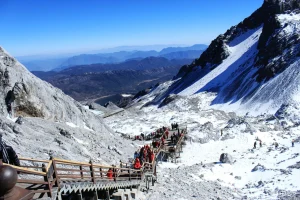
Day 5: Lijiang → Jade Dragon Snow Mountain (Bus Line + Return)
I had stuffed an oxygen bottle (10 yuan/bottle, bought at an Ancient City pharmacy) and a rented down jacket (50 yuan/day, arranged by the inn owner) into my backpack the night before. I got up at 6:50 AM—“A’dan’s Baba Shop” downstairs had just opened its steamer. I bought two Salted Egg Yolk Babas (3 yuan each), with the oil oozing from the yolk, and a cup of hot soy milk (2 yuan). I ate while walking to the South Gate of the Ancient City.
“By Special Line to the Snow Mountain”: 1.5 Hours of “Mountain Prelude”
At 7:15, I arrived at the Jade Dragon Snow Mountain Special Line stop at the Ancient City South Gate. The screen showed the first bus at 7:30. I found a window seat. Three or four tourists with hiking poles were already on the bus. An auntie next to me took photos of the morning mist: “Look, is that snow on the peak?” As the bus moved, the mist cleared, and the white peaks of Jade Dragon Snow Mountain appeared, looking like ice cream embedded in the blue sky.
The driver was a local and stopped once on the way: “Ahead is Ganhaizi; you can get off and take a few photos for free.” I followed the crowd. The meadow was wet with dew, and the snow mountain was reflected in the shallow water. I wiped the baba crumbs off my pants and squatted to photograph the reflection—the wind messed up my hair, but it felt totally worth it.
“Blue Moon Valley + Glacier Cableway”: “Blue and White” at the Mountain Foot
At 10:00 AM sharp, I arrived at the Visitor Center and rushed to the Blue Moon Valley electric cart station—the queue wasn’t long. I bought a 10-yuan ticket and boarded a small green cart. The driver wore sunglasses and shouted while driving: “Look to the right! That’s Baishui River; the water is blue-green, like emerald!”
Entering Blue Moon Valley, I almost screamed—the lake water really looked like the color of shattered glass, with sunlight shining through, shimmering with blue, green, and turquoise lights. Low shrubs grew on the meadows by the shore, and occasionally yaks lowered their heads to drink. I walked along the wooden path. An auntie in Tibetan robes sold handmade shawls (30 yuan each), saying “this is yak wool, very warm.” I bought one and draped it over my down jacket to block the wind.
After exploring for 1 hour, I went to the Glacier Cableway ticket office—I had snatched a combo ticket (entry fee + cableway + eco-bus for 240 yuan) 3 days in advance on the “Lijiang Tourism Group” WeChat account. There were only a few tickets left on-site; luckily I got mine. On the cableway, the gondola slowly climbed from dense fir forests to exposed rocks and then to white snow slopes. At the 4680m viewing platform, I leaned on the railing panting—the wind hurt my face, and the oxygen tube froze stiff. I took a breath of oxygen and looked up: the glacier at the peak glowed with blue light, like frozen waves.
My friend next to me was as pale as paper, squatting on the ground: “I have altitude sickness…” An uncle selling glucose handed over a cup: “10 yuan, drink it to ease up.” She took two sips before slowly standing up: “I almost cried just now, thought I was going to end here.” I laughed and patted her shoulder, and took a photo of her wrapped in the down jacket with the oxygen mask—with the whole snow mountain as the background, it felt very “victorious.”
“Return Trip”: A Bit of Panic Catching the Last Bus
At 4:00 PM, I came down from the viewing platform, took the electric cart back to the Visitor Center, and bought a can of Snow Mountain brand mineral water (5 yuan) with Jade Dragon Snow Mountain printed on the bottle. Then I waited for the special line bus back—the last bus was at 17:30. I checked my phone, 17:10, and hurried to the platform.
The bus wasn’t crowded. The driver played Naxi “Moon Mu.” I leaned against the window, watching the sunset dye the snow mountain orange-red. Back at the South Gate of the Ancient City at 5:30, I bought a roasted Erkuai (5 yuan) wrapped with fried potatoes and sweet bean sauce, eating as I walked back to the inn. The owner saw me: “Went? Saw the glacier?” I nodded and pulled out the handmade shawl: “Look at this, yak wool, very warm.”

Day 6: Lijiang → Shuhe Ancient Town (Bus vs. Walking Comparison)
In the morning, I had a bowl of Shredded Chicken Cold Rice Noodles at Zhongyi Market—10 yuan, the noodles were so smooth they slurped easily, and the chicken was shredded thin, topped with sour vinegar and oil chili, served with crisp pickled radishes. One bite and yesterday’s fatigue vanished. After eating, I walked from the market towards the North Gate and saw the blue-and-white sign for Bus 11. Feeling the two coins in my pocket, I made a spontaneous decision to go to Shuhe—I was getting a bit tired of the bustle of Dayan and wanted to find a place that was “half a beat slower.”
“By Bus to Shuhe”: A 15-Minute Mobile Scenic Line
While waiting, an old lady in a tie-dye skirt clutching a bunch of mugwort chatted with me: “Going to Shuhe, girl? Bus 11 is fast, 15 minutes. My granddaughter took this bus last week to buy flower cakes.” The bus arrived, a green minibus with dark blue seats and a “Civilized Travel” sticker on the coin box. I dropped 2 yuan and took a window seat—as soon as it started, the breeze from the Yu River poured in. The river was so clear you could see the pebbles at the bottom. The willow buds on the bank were covered in morning dew, rustling against the window. Several local aunties were on the bus with bamboo baskets of vegetables, chatting excitedly: “Vegetables in Shuhe are 30% cheaper than in Dayan. I go every day to grab fresh strawberries!”
“First Impression of Shuhe”: A Town a Bit “Softer” than Dayan
15 minutes later, I arrived at Shuhe Ancient Town Station. Looking up upon getting off, I saw Sifang Street—it’s a circle smaller than Dayan’s, with bluestone roads so narrow they only fit two people side-by-side. It was lined with low old houses, herbal stalls, and tie-dye fabrics. Even the tourists’ noise seemed filtered, leaving only the grandpa selling herbs shouting: “Wild mushrooms, fresh ones!” I walked towards Jiuding Dragon Pool, passing a stall selling freshly roasted flower cakes. Earth-yellow paper boxes were piled in bamboo baskets, and the rose fragrance wafted far. An auntie in a blue apron wiped her hands and offered a sample: “Just baked, won’t get hard even when cold. The rose filling was just picked this morning.” I took a bite; the crust flaked into my palm, and the rose filling was so thick it flowed out, sweet but not cloying, with the freshness of morning dew.
“Jiuding Dragon Pool”: An “Emerald” You Can Touch
The Dragon Pool is small, but the water is as clear as an emerald dipped in a spring. You can see the moss on the pebbles at the bottom and a few goldfishes swimming with their tails swaying. The willows by the pool drooped to the water surface, and when the wind blew, the branches dipped into the water, drawing small circles on the back of my hand. I squatted on a rock by the pool, and just as I wanted to touch the water, a little goldfish “whooshed” over and touched my fingertip—it was cool, like the breeze in Shuhe. A little girl in Bai clothes nearby was feeding the fish with biscuit crumbs, shouting in a milky voice: “Little fish, little fish, eat sweet biscuits!” Her grandma sat on a nearby stone bench and laughed: “Slow down, don’t fall into the pool.”
“Walking Comparison”: A 40-Minute “Bustling Stroll”
In the afternoon, I planned to return to Dayan. A friend said, “Why not take the path through Yuhe Square? There are silver shops along the way.” So I started from Yuhe Square in Shuhe and wandered towards Dayan—on the way, I first encountered an “Old Silversmith” shop. The owner sat at the door hammering silver pieces, the “ding-dong” sound much better than the songs in the Ancient City bars. I picked a plain silver bracelet for 80 yuan. As the owner was polishing it, he looked up and said: “You truly like it, girl; take it for 50 yuan, and I’ll give you a small silver pendant.” The bracelet was engraved with tiny Dongba characters and felt cool on the wrist, like the temperature of Shuhe.
Continuing the walk, the small shops along the way were like opening blind boxes: the owner of a handmade soap shop simmered soap with lavender and roses, the scent as faint as the wind; an auntie selling Naxi shawls had brocade embroidered with the Dongba character for “Auspicious”; and there were baskets of fresh strawberries, bright red and 10 yuan a jin. I bought a jin and ate as I walked, the sweet juice staining my lips. With the breeze blowing, even my breath smelled of strawberries.
“Two Ways”: Each with its Own “Little Happiness”
| Travel Method | Time | Cost | Most Touching Detail | Small Reminder |
|---|---|---|---|---|
| Bus 11 | 15 minutes | 2 yuan | Seeing the morning mist on Yu River, hearing local aunties talk about “Shuhe strawberries are ripe,” arriving directly at the town center | Departs every 5 minutes, last bus at 19:00; walk 5 minutes to Sifang Street, don’t get lost |
| Walking (Yuhe Square → Dayan) | 40 minutes | 0 yuan | Bargaining for a silver bracelet with a free pendant, smelling the lavender soap, eating strawberries for 10 yuan a jin | Wear sneakers! There are small slopes; watch your step, bluestone is a bit slippery |
You May Also Like
- For Students Yunnan 5-Day Budget Travel Guide | Hostels + Carpooling + Local Cuisine, Average 800 RMB per Person for an Awesome Trip
- Lijiang 5-Day Intangible Cultural Heritage Tour | Dongba Script + Naxi Ancient Music + Baisha Murals + Handmade Paper Making, Exclusive Route for Culture Enthusiasts
- Dali 6-Day Cultural Experience | Tie-Dye + Silverware + Bai Ethnic Three-Course Tea + Three Courtyards One Screen Wall, Deeply Feel Intangible Cultural Heritage
- Xishuangbanna 4-Day Dai Cuisine Guide | Gaozhuang Starlight Night Market + Man Ting Park + Dai Garden Water Splashing Festival, Tropical Food Map
- Yunnan 8-Day Self-Driving Route | Kunming-Dali-Lijiang-Lugu Lake, All Costs Including Highway Tolls + Fuel Fees + Parking Fees Calculated Clearly
Kunming — — Key Facts
Tickets & Booking
- Jiuxiang scenic area: Main ticket about CNY 98; grand package about CNY 189–234 (including cableway/glass slide/Earth’s Core Exploration and other items)[src]
Transport & Schedules
- Kunming South station → Jianshui station / Xishuangbanna station | High-speed rail: Kunming–Xishuangbanna high-speed rail about 3.5–4 h, second class about CNY 178–237, 30+ departures daily on average; Kunming South–Jianshui about 2 h, second class about CNY 56–75[src]
Where to Stay · Room Type · Nearby
- Near Kunming station | Reference price Budget hotel about CNY 101 per night (OTA) | Room tip: Suitable for a short stay and catching trains | Nearby add-ons: Yunnan Ethnic Village, toward Dianchi[src]
- Near Cuihu Park | Reference price Budget hotel about CNY 102 per night (OTA) | Room tip: Many characteristic guesthouses/hotels, near the old streets | Nearby add-ons: Cuihu, Yunnan Military Academy, Kunming Old Street[src]
Typical Climate & Packing (Past Years)
- January: 3 °C–17 °C °C, [Travel climate reference] Gull season
- February: 5 °C–19 °C °C
- March: 7 °C–22 °C °C
- April: 11 °C–25 °C °C
- May: 14 °C–26 °C °C
- June: 17 °C–26 °C °C, Rainy season






