



Day 1 (Arrival Day): Wandering the Ancient Town & Encountering Dongba Characters
Landing at Sanyi Airport at 8 PM, I first bumped into a cloud of sweet fragrance from flower cakes—an elderly lady at a nearby stall was wrapping freshly baked cakes in straw paper, with sesame seeds leaking through the gaps. I took a ride-hailing car; the driver was a Naxi uncle wearing a faded blue cotton shirt, speaking with the characteristic soft accent of the Old Town: “First time here, lass? The streams in the ancient town flow down from the Jade Dragon Snow Mountain. Tonight, sleep to the sound of water; it’s more effective than an alarm clock.” Passing the intersection of Shuhe Ancient Town, the streetlights made the bluestone road shine. The uncle pointed to a stall selling roasted Erkuai at the alley entrance: “Try it tomorrow morning; it’s cleaner than the ones in the Old Town.” It took 40 minutes to reach the town, costing 85 yuan. My wallet still held an orange-flavored fruit candy he tucked in.
Following the location sent in advance by Auntie Yue, I found “Naxi Xiaozhu.” Paper lanterns hung in the alley at the end of Wuyi Street, with the Dongba character for “Welcome” scribbled in red ink. Auntie wore a navy blue batik apron, holding a cup of Pu’er tea with rose: “Have some tea first. The room is on the second floor; the stairs are steep, take it slow.” The old elm door opened with a creak, revealing a Naxi tapestry on the wall—red background with black patterns, embroidered with two phoenixes. The wooden lattice windows were carved with delicate plum blossoms, overlooking a stream flowing through the town—the water so clear you could see the pebbles at the bottom, with occasional small crucian carp swaying their tails. The water splashed “ding-dong, ding-dong,” like someone tapping a bamboo tube. The handmade wool blanket on the bed was light gray, soft as a cloud, with the Dongba character for “Blessing” embroidered on the corner. Auntie Yue said, “I learned this from an auntie in the village last year; the stitches are coarse, don’t mind it.”
Breakfast was served at a small square table in the courtyard. Auntie Yue brought Lijiang Baba straight from the charcoal stove—the crust so crispy it flaked off, biting into a piping hot sesame filling that was sweet but not cloying. It was paired with a bowl of Xidoufen (pea porridge) sprinkled with Sichuan peppercorn powder; the bean aroma wrapped in the numbness of the peppercorns made my stomach tremble with warmth. I ate two pieces in a row. Auntie Yue smiled and patted the back of my hand: “Slow down, there’s more in the pot; take some for the road later.”
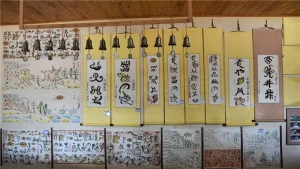
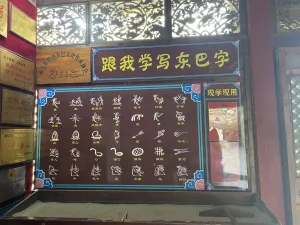
At 2:30 PM, I strolled to the Dongba Culture Museum. The roads in the ancient town are winding, and it took 10 minutes of following navigation to arrive. The entrance was an old wooden door with the Dongba character for “Explore” carved on the lintel. Pushing it open, it felt cool inside with a scent of pine smoke. The first showcase was “The Living Fossil of Dongba Script”: a cow’s shoulder blade was displayed, carved with three symbols—”three peaks rising” for “mountain,” identical to the silhouette of the distant Jade Dragon Snow Mountain; “curved loops” for “water,” like the ripples in the alley’s stream; and “fire” written on a prayer flag, the black characters on red cloth looking like leaping flames. The guide was a girl in pink and blue Naxi attire with a ponytail, pointing at the display: “In the past, priests recorded dates using these symbols—wedding blessings were written on Dongba paper to hang from rafters, and when elders passed, the funeral orations were also written in Dongba script to be read to the ancestors; they would receive them.”
Next was a 15-minute short film, dubbed in original Dongba language with Chinese subtitles. In the film, a priest wearing a high crown used a wolf-hair brush dipped in pine smoke ink to write blessings on light brown Dongba paper—the texture of the paper was clear, and the brushstrokes left fuzzy edges like old Xuan paper. The priest said: “Dongba paper can last for a thousand years; scriptures from the past can still be understood today.” The film ended with children following the priest to learn how to write “mountain”—the wobbly symbols made several people in the hall laugh.
Exiting the hall to the backyard, there were several paper mulberry trees with trunks so thick it would take two people to hug them. The gray-brown bark was covered in cracks. Auntie Yue happened to be drying Dongba paper in the yard; seeing me, she picked up a piece of bark and handed it over: “Feel it, it’s rough, right? It needs to be soaked for three days and three nights, then pounded into pulp with a wooden mallet before it can become paper.” I pinched the bark; the texture was like an old person’s palm, slightly itchy against my hand. On the nearby stone table lay freshly made paper, so thin it was translucent, revealing the fibers inside. Auntie Yue said: “My grandfather started making this paper, and now I’m teaching my grandson; it cannot be broken.”
At 5 PM, I went out for a stroll, walking south along Wuyi Street. The stone road was a bit hard on the feet, but it echoed “dong dong” as I stepped. I met an old lady dressed in “Pi Xing Dai Yue” (Stars and Moon) attire: stars embroidered on her shoulders and a moon on her back, with silver ornaments clinking and shining in the sunset. She sat on a small stool in front of a bamboo tray piled high with flower cakes, some crust flaking off. I approached: “Grandma, how much for a cake?” She looked up, the wrinkles at the corners of her eyes bunching into flowers: “3.5 each, rose filling, grown in my own yard, fresh.” She wrapped it in newspaper and handed it to me, some flour still clinging to the paper corners. One bite, and the layers of pastry combined with the rose filling for a pure sweetness, without the cloying taste of industrial essences.
Passing a small tea house at an alley entrance, the aroma of Pu’er tea wafted out, so I sat for a while. The boss was a middle-aged man in a navy T-shirt who brewed me a cup of Tuocha: “This year’s spring tea, give it a try.” The tea liquor was red like amber, tasting sweet in the throat with a hint of woody fragrance. The boss pointed to a photo on the wall: “That’s my dad. He used to follow the horse caravans to Lhasa, carrying this kind of tea.” The old man in the photo wore a sheepskin coat, holding a Tuocha with a simple, honest smile.
Returning to the guesthouse at night, the sound of the stream was louder. Lying on the wool blanket, I touched the Dongba script notebook by my pillow—a gift from Auntie Yue with “Lijiang” embroidered on the cover. The moon rose outside, reflecting in the stream like scattered silver. The day’s fatigue vanished, leaving only the sweetness of the flower cake and the centuries of warmth hidden within the Dongba characters.
Small Tip: There is a trial writing area next to the Dongba paper display in the museum. I wrote “Hello” with a wolf-hair brush; the strokes were wobbly, but the guide said “that is the flavor of handwriting; machine-printed things lack spirit”—if you want to try it, remember to bring a pen, it’s free.
Daily Expense List (Today Only):
| Item | Details | Cost (Yuan) |
|---|---|---|
| Transport | Taxi from airport | 85 |
| Accommodation | Naxi Xiaozhu 1 night | 220 |
| Dining | Breakfast (Baba + Xidoufen) + Dinner (Flower cake + Tuocha) | 35 + 20 = 55 |
| Other | Dongba paper trial writing (Free) | 0 |
| Daily Total | 360 |
Before bed, Auntie Yue knocked on my door and handed me a box of handmade brown sugar: “When you go to the paper workshop tomorrow, put a piece in when soaking the mulberry bark; it will make the paper more supple.” The sugar wrapper was batik with white flowers on a blue background. Holding the sugar and listening to the stream outside, I suddenly felt—intangible heritage isn’t a glass case in a museum; it’s the tea handed over by Auntie Yue, the old lady’s flower cakes, the texture of the mulberry tree, and the ordinary lives hidden within the Dongba script.
Day 2: Listening to Ancient Music & Sitting by Old Artists to Transcribe Scores
Waking up at 7:30 AM rubbing my eyes, Auntie Yue had already set up a small table under the pear tree in the yard—Xidoufen brewed in an earthen jar was steaming, topped with pickles and fried soybeans. She handed me chopsticks: “Line your stomach first. The ancient music concert lasts two hours; you need warmth in your stomach to sit through it.” I crouched under the pear tree to eat; the richness of the bean powder mingled with the scent of pear blossoms, and the wind carried the morning chill of the ancient town. I wrapped myself in the navy blue woolen sweater Auntie Yue gave me and headed out.
The road to the Dayan Naxi Ancient Music Association followed the bluestone path at the foot of Lion Mountain. Along the way, I met an auntie selling soy milk, her bamboo insulation bucket covered with a cotton sleeve, shouting at me, “Lass, do you want hot soy milk?” I bought a cup, sweet, in a glass jar with a string, shaking it as I walked, the warmth spreading in my palm. The concert was in an old courtyard house with a peeling lacquered wooden sign above the door reading “Dayan Naxi Ancient Music Association”—I had booked a third-row center seat a week in advance for 150 yuan. Master Li said, “This spot lets you see every old artist’s fingers clearly.”
Pushing open the wooden picket gate, pots of orchids in the courtyard gave off a faint fragrance. The theater was a converted main hall with old photos on the walls: artists in long robes holding Erhus against the backdrop of Jade Dragon Snow Mountain. I sat down; the wooden chair was a bit hard, but I could smell a faint scent of sandalwood in the air—I later learned that the old artists are accustomed to burning a stick of incense backstage to “greet the Ancestral Master.”
The opening bell rang, and seven elderly artists filed onto the stage. A grandpa in a navy blue buttoned robe blew the “Bobo” (a bamboo double-pipe instrument), his cheeks bulging like he had two walnuts inside. The sound drifted from the bamboo tubes like wind through a distant pine forest, carrying the bitterness of pine needles. The grandma playing the Pipa sat at the far end; her finger joints were swollen like small buns, yet she pressed the strings with precision. As the melody flowed, I suddenly remembered the lullabies my own grandma sang while waving a cattail fan—it was so soft it could squeeze out water. The guide whispered: “Baisha Fine Music is the ‘funeral music’ of the Naxi people. In the past, when someone died, the band would play for three days and three nights; now it has been adapted into a performance, but the flavor remains.”
During the Dongjing Music segment, the tone of the Erhu suddenly deepened, like water-soaked cotton thread. The guide added via microphone: “This tune was passed down from Jiangsu during the Ming and Qing Dynasties; it was originally the ‘Shuimo Tune’ of Kunqu Opera, but the Naxi people adapted it, adding the vibrato of mountain songs—it’s like kneading the rain of Jiangnan into the snow-water of Jade Dragon Snow Mountain.” I stared at the grandma playing the Erhu: her instrument’s sound box was covered in dark brown snakeskin with an oily sheen, and the neck had several shallow notches, likely scratched by a naughty grandson. Her Pipa lay on her lap, its body polished bright, with a cup of warm tea beside it; the cup had a crack, an old item used for decades.
During the Shanpo Yang excerpt, the grandma playing the Erhu suddenly stopped and took a handkerchief from her breast to wipe her sweat—it was blue cloth embroidered with a lotus, likely made by her late husband. She wiped slowly, her fingertips brushing the wrinkles on her forehead. When she looked up again, there was still a smile in her eyes: “I’m old; my palms sweat easily.” The grandpa next to her handed over a towel made from her grandson’s school uniform fabric; she took it, folded it neatly, repositioned her Erhu, and the strings sounded again—deeper and warmer than before.
At 2 PM, I followed Master Li toward Zhongyi Alley on Guangyi Street. Moss grew in the bluestone cracks, making it slippery, and old houses on both sides hung red lanterns, some with open doors wafting the scent of cured meat stewed with potatoes. Grandpa He’s house was at the end of the alley, with two pots of roses in full bloom by the door. He was crouching on the steps watering flowers, wearing a faded navy blue cloth shirt and round-framed reading glasses.
“You’re here? Come in and sit.” Grandpa He stood up and rubbed his hands on his trousers—I noticed his pant legs were stained with mud, probably from tending the pear tree in the yard. The pear tree was so thick it took two people to hug it; there was a deep knife scar on the trunk. He touched the scar and laughed: “I cut this tree 50 years ago; it’s perfect for making an Erhu neck, sturdier than anything bought.”
In the main hall, a piece of calligraphy reading “Music to Forget Sorrows” hung on the wall, and an old tea set was on the table. Grandpa He took an Erhu from a drawer; the knife mark on the neck was still there, and the snakeskin was new: “Collected this skin from the countryside last year; it had to dry for half a month before use.” He set up the Erhu, tuned the strings, and suddenly began to sing: “The world was chaotic like an egg, Pangu split it in half, Nüwa pinched clay to make humans…” His voice was husky with the retroflex sounds of the Naxi language. The lyrics “Where do we come from” pulled at the softest part of my heart.
After singing, he took a tin box from the top of a wardrobe. Opening the lid, inside were stacks of old music scores—the deckle-edged paper was yellowed like books dried for years, with curled corners and red ink annotations: “Winter of 1985, passed from Master He Zhigao, recorded by He Zhiqiang.” “This is my master’s handwriting,” Grandpa He wiped the score with his sleeve, “I didn’t dare touch it for fear of damaging it.” He found a piece of newspaper, wrapped the scores, and handed them to me: “You take them. When you want to listen, find someone who can play the Erhu—this score is more precious than my life.”
As I left, Grandpa He stuffed a handful of dried jasmine into my hand: “Go back and steep this in tea; it’s very fragrant, more authentic than the tea sold in the Old Town.” The jasmine was in a small cloth bag, carrying the warmth of the sun; holding it, even the wind felt sweet.
Back at the guesthouse in the evening, I spread the scores on the table, touching the red annotations, and suddenly thought of Grandpa He’s eyes—bright like the stars of Jade Dragon Snow Mountain, containing a lifetime of music. Auntie Yue brought Lijiang Baba, saying, “You’ve been running around half the day, eat something hot.” Biting into the Baba and looking at the shadows of the pear tree outside, I finally understood: intangible heritage isn’t a glass case in a museum; it’s the pilled cuffs of an old artist, the notches on a fiddle neck, the jasmine handed over, and the warm days they guard with their lives.
Daily Expense List:
- Transport: Taxi from guesthouse to concert 10
- Tickets & Experience: Dayan Naxi Ancient Music Concert ticket 150
- Dining: Xidoufen + Soy milk + Afternoon tea 25 + 15 = 40
- Other: Jasmine flowers from Grandpa He 0
- Daily Total: 205
Day 3: Baisha Murals & Touching the Fusion of Ethnic Groups
At 8 AM, I waited for the No. 6 bus at the North Gate station. It was an old green bus with palm-sized patches of peeling paint. The driver, wearing a peaked cap, shouted as he opened the door, “Going to Baisha? I saved the last empty seat for you!” I dropped 5 yuan in coins and found a window seat—outside were fields of corn, the wind rustling the leaves. Occasionally, I saw Naxi old ladies with bamboo baskets on their backs and silver hairpins in their hair, their pace as slow as crushed sunlight. 40 minutes later, I arrived at Baisha Ancient Town. Stepping off, I smelled butter tea; an old woman by the road held a copper pot, shouting, “Want some hot tea? 5 yuan is enough.”
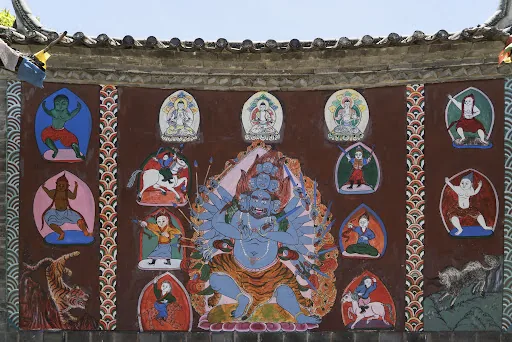
The Baisha Murals Museum is in the town center with a red facade and a gold-on-black sign. The old woman at the tea stall insisted on giving me a roasted Erkuai: “Eat this first; the display halls inside are chilly.” I bought a 30 yuan ticket. The light in the first hall was dim, with large murals on the walls—Avalokitesvara’s Universal Gate was the most touching: Avalokitesvara stood on a nine-grade lotus throne, her sari painted in mineral blue like the melted water of Jade Dragon Snow Mountain. Surrounding her were women seeking children (bellies painted round), sick elders (leaning on canes with brows furrowed), and lost children (clutching their clothes and crying)—the guide was a Naxi girl in a pink skirt, pointing at the vase by Avalokitesvara’s feet: “These paintings are not ‘Gods’; they are the hopes of the common people. In the past, if someone was infertile, they came to pray to Avalokitesvara; the painters would paint them into the mural, saying, ‘If Avalokitesvara sees you, she will hear you’.”
Turning the corner was the Romance of the Three Kingdoms mural. Liu Bei in the “Oath of the Peach Garden” had a red face, just like in Han paintings, but his clothes were embroidered with the Dongba character for “Blessing”; Guan Yu’s Green Dragon Crescent Blade was carved with a Tibetan auspicious knot. “This is the mark of the Ancient Tea Horse Road,” the guide said. “Baisha was once a transit station on the Yunnan-Tibet line. Han people brought tea, Tibetans brought furs, and Naxi people were the middlemen. Even the murals blend the three cultures—look at this knot on the blade; Tibetans understand it, Han people understand it, and everyone feels a sense of belonging.”
At noon, I left the museum. The jelly stall at the entrance was crowded. The auntie wore a blue apron and used a copper ladle to pile the jelly like a small mountain. I ordered Jidou (chickpea) jelly, and she added a spoonful of chili oil (red as fire), crushed peanuts (crispy as can be), and sesame seeds (fragrant enough to tickle the nose). The jelly was slippery; the first bite was spicy enough to make my nose sweat, followed by the clear bitterness of the chickpeas, and finally the peanut aroma—the auntie wiped her hands and smiled: “These chickpeas are grown on the back mountain of Baisha, ground finer than those in the Old Town. If you like them, take some raw ones tomorrow to cook at home.”
At 2 PM, Xiao Yang, recommended by the guesthouse auntie, arrived: ponytail, white T-shirt, canvas bag. She said, “My grandfather was a temple painter; I can draw a bit too.” She took me to an old house behind the main street, where foxtail grass grew in the stone cracks. Walking to a gable wall, she pointed at a painting: “Painted in the Qing Dynasty, peonies and the character ‘Blessing’, made with lime water and red soil. Look at this ‘Blessing’ character; there are small bats hidden in the strokes—Naxi people say bats are ‘blessing babies’, and if they are hidden in the character, the blessing won’t escape.” The peony on the wall was peeling, but the curve of the petals remained, like someone had gently touched them, leaving a trace of tenderness.
Xiao Yang took us into the “Fuxing Hao” old tea house, with “Century-old Tea House” carved on the lintel. The boss was a stout man in a navy blue shirt who slapped his thigh upon seeing us: “Xiao Yang’s friends? Come, drink the Pu’er I’ve hidden!” He brought out a coarse ceramic pot and poured amber-red tea—tea stalks settled at the bottom with a few floating leaves. “Traded by Tibetan merchants 50 years ago,” the boss said, wiping the pot. “Back then, they carried tea on horses for three months to reach Baisha to trade for our salt and furs. This tea has been stored for 50 years; it’s mellower than new tea, taste it.” The tea was sweet with an aged aroma, warming my throat like a hot stone—the boss said: “In the past, caravan leaders would squat here for a bowl when they were tired, resting enough before heading back out.”
As we left the tea house, Xiao Yang pointed to a stone tablet at the base of a wall: “This was erected in the Qing Dynasty, carved with ‘Baisha Section of the Ancient Tea Horse Road’. Look at the characters: there’s Han, Tibetan, and Naxi Dongba script—the road under our feet was once walked by all ethnic groups together.” The smell of cured meat from a nearby restaurant wafted in. Touching the characters on the tablet, I suddenly felt that the Avalokitesvara, Liu Bei, and Guan Yu in the paintings, as well as the painters, merchants, and caravan leaders, had never left—they were hidden in the pigments of the murals, the spiciness of the jelly, and the sweetness of the tea, waiting for future generations to come and touch their warmth.
Xiao Yang’s Tip: “Don’t touch the murals in the museum; the lime water paintings flake easily. The Pu’er in the old tea house is very strong; if your stomach is sensitive, drink less and pair it with a piece of osmanthus cake.”
| Item | Details | Cost (Yuan) |
|---|---|---|
| Transport | No. 6 bus from Old Town to Baisha | 5 |
| Ticket | Baisha Murals Museum | 30 |
| Dining | Jidou Jelly + Osmanthus Cake | 5 + 10 = 15 |
| Guided Tour | Xiao Yang’s private guide | 100 |
| Tea | Trial pack from the boss | 0 |
| Daily Total | 150 |
Day 4: Papermaking & Handcrafting Paper that Lasts a Thousand Years
At 8:30 AM, I hailed a taxi at the town entrance. The driver was a local from Yulong County wearing a faded T-shirt. Seeing me carrying a small cloth bag, he said, “Going to the papermaking workshop in Yuhu Village? That place is remote; I’ll take a shortcut, be there in 40 minutes.” Rolling down the window, the wind carried the scent of green grass—fields of corn lined the road with pale yellow tassels at the top. The white peak of Jade Dragon Snow Mountain emerged from the clouds. The driver said, “Yuhu Village is an old Naxi village. Master He’s workshop is at the west end; you’ll smell the drying mulberry bark and know it.”
The fare was 50 yuan. The driver dropped me under an old locust tree at the village entrance and pointed to a red door at the end of the alley: “That’s it, Master He is waiting for you.” Pushing open the door, the bluestone courtyard was neatly laid out. Half-man-high piles of mulberry bark stood by the wall—yellow-brown, still stained with soil, smelling of sun-dried herbs like a meadow after a full day of sun. Master He, in a navy blue coarse cloth shirt with pant legs rolled up to his knees revealing old scars, was crouching to flip the bark—seeing me, he stood up and rubbed his hands on his pants: “Just in time, lass. The bark soaked for three days has just ‘woken up’; I’ll teach you how to pound the pulp.”
He stuffed a handful of soaked mulberry bark into my hand: “Feel it first; it’s soft like soaked wood-ear fungus. If it’s not soaked through, it won’t pound well.” I pinched it; it was indeed soft, fibers tangling around my fingers. He picked up a wooden mallet from the wall—solid wood handle, head wrapped in iron—and handed it to me: “Pound evenly, like kneading dough.” I swung the mallet down with a “dong,” the bark split, fibers scattered, splashing my sleeves. Master He corrected me with a smile: “Keep your wrist heavy, don’t use brute force—look, like this.” His movement was like Tai Chi, slow and steady. The bark slowly turned into fine pulp, like melted chocolate, wafting a faint woody scent.
Next was paper lifting—the job that tests wrist strength the most. Master He brought out a rectangular bamboo screen, the bamboo strips woven tightly with edges polished bright: “This screen was passed down from my grandfather; it’s been used for 60 years.” He taught me to hold both ends of the screen, dip it into the pulp pool at an angle, and lift the wrist gently to let the pulp coat the screen evenly. “Slowly, don’t shake,” he said. My first try, as soon as I lifted the screen, my hand shook, half the pulp “hualā” leaked out, leaving a big hole. My face flushed, but Master He laughed: “The first time I lifted paper at 16, I broke a whole basketful. My master scolded me, saying ‘your hands are looser than a sieve’.” He held my hand and guided me through it again: “Lighten your breath, keep your eyes on the screen, feel the weight of the pulp sticking to it.” This time I held my breath and lifted slowly—a complete sheet of paper floated on the screen, its edges still carrying fine fibers like a newborn’s skin. Master He nodded: “You did it! This counts as your ‘debut piece’.”
After lifting, he peeled the paper off and put it in a press for five minutes to squeeze out excess water. Then he led me to the drying racks in the yard—many semi-dry sheets were already hanging on hemp ropes, swaying in the wind like white clouds. “Pressed paper needs to dry for a full afternoon,” he said. “The sun can’t be too fierce, or the paper will be brittle; it can’t be too cloudy either, or it won’t dry.”
At 5 PM, I held the paper Master He handed me. The moment my fingertips touched it, the warmth of the sun-dried herbs rushed over. The paper was light beige with fine fiber textures, feeling rough like old bark but sturdier than ordinary paper. Master He pinched a corner: “This can last a thousand years—Dongba paper is made from mulberry bark with long fibers and great toughness. Naxi scriptures were written on this, and they don’t rot even after being buried for centuries. Go back and write something; when you’re old and flip through it, you’ll still smell today’s sun.”
I looked down at the paper; sunlight passed through the fibers, revealing fine spots of light. On the nearby table were Dongba paper notebooks made by Master He, with the Dongba character for “Blessing” embroidered on the cover for 20 yuan each. I bought one and opened it; the blank pages inside carried the same herbal scent—this wasn’t ordinary paper; it was something I made with my own hands, a warm “intangible heritage” connecting past and present.
Master He’s “Secret”: “Select bark from trees over ten years old, soak for three days, pound seven times, and lift the paper slowly—papermaking isn’t about speed; it’s about who is ‘wholehearted’.”
Day 5: Picking Souvenirs & Putting Culture in Your Pocket
At 7 AM, I spread a felt mat under the pear tree in the guesthouse courtyard—Auntie Yue said “to write Dongba script, you must sit steadily, like the old priests.” She brought a small stool and held a wolf-hair brush: “Learn ‘Hello’ first; in Naxi it’s ‘Naxi Sou’, which looks like two people waving.” She held my hand, the brush tip dipped in pine smoke ink: “Keep your wrist light; when drawing ‘Person’, the stroke should curve like the strap of a Naxi woman’s cape.” I tried to write; the first stroke wobbled like an earthworm. Auntie Yue laughed: “It’s okay. The first time I wrote ‘Thank you’, I drew ‘Hand’ like a chicken claw.” She took out a crumpled piece of Dongba practice paper covered in crooked symbols she wrote when she was young: “Look, I learned this at 30, and now I teach my grandson, and he still complains my writing is ugly.”
After writing, Auntie Yue took two pieces of paper from a drawer—one smooth as printer paper, one rough with fiber textures. “Feel them; machine-made paper is slippery like tile; handmade paper has ‘spirit’,” she held both up to the light. “Look at the handmade paper; you can see the fine fibers interlaced like the snow line of Jade Dragon Snow Mountain; machine paper has nothing, the light passes through evenly.” She stuffed the handmade paper into my hand: “When you buy Dongba paper in the future, feel it and then light it; don’t get cheated by the ‘heritage products’ in tourist areas.”
For lunch, I had sticky rice Baba made by Auntie Yue, filled with homemade red bean paste; I packed some for afternoon tea. At 2 PM, I headed to Qiyi Street. The bluestone road was baked hot by the sun, and the scent of Michelia flowers drifted from a flower peddler’s basket. The Dongba Workshop was at a street corner, with a wooden sign reading “He Zhiqiang’s Apprentice Studio”—the owner was a young man in a navy blue batik shirt named Ajie, the grand-apprentice of Grandpa He.
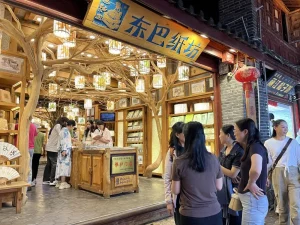
Pushing open the door, freshly made Dongba paper was drying in the yard, light yellow like a layer of sun. Ajie wiped the pulp from his hands: “These were all dried this morning, still carrying the scent of Jade Dragon Snow Mountain.” He led me through the shop: shelves held Dongba paper lanterns (with silhouettes of Naxi myths), bookmarks (carved with the Dongba character for “Blessing”), and notebooks (covers with hand-written “Lijiang” in Dongba script). I opened a notebook; the fiber texture was clear, feeling rougher than ordinary notebooks but with a herbal fragrance. “This paper is supplied by Master He’s workshop,” Ajie said. “The village aunties soak the bark, pound the pulp, and dry the paper every morning; we just make the finished products—no middlemen, so it’s half the price of souvenir shops in the Old Town.”
I chose a notebook with “Lijiang” embroidered on the cover (20 yuan) and picked an ancient music CD (15 yuan)—Ajie played it in the stereo for a trial: the crisp sound of the Bobo, the soft notes of the Pipa, and the deep rhythm of the Erhu, as if the stage of the Dayan Ancient Music Association had been moved here. “I recorded this last week,” Ajie said. “The vibrato of the old artists cannot be captured by machines; listen to it when you go back, and it will remind you of the sound of Master He pounding paper this morning.”
At 5:30 PM, I took a taxi to the airport. The driver was the same one who took me to Yuhu Village yesterday. Seeing my souvenir bag, he said, “Bought Dongba paper? Take it back and write a letter to a friend; it has more warmth than WeChat.” Rolling down the window, the wind carried the scent of osmanthus—the trees were in bloom, tiny golden flowers falling onto the engine hood. I looked at the approaching Jade Dragon Snow Mountain, its snow line glowing in the sun, and suddenly thought of the fragments of these past few days: the water splashed on Master He’s face while pounding paper, the shaking wrist of the old artist playing Erhu, the silhouette of the Naxi woman weaving in the mural, and the warmth in Auntie Yue’s hand as she taught me to write Dongba script.
At the airport, I tucked the Dongba notebook into my checked luggage—a piece of mulberry bark from Yuhu Village was still tucked between the pages, rough against my hand. The auntie at the counter asked, “What is this?” I smiled and said, “It’s culture, to be preserved.”
| Category | Details | Cost (Yuan) |
|---|---|---|
| Accommodation | 4 nights guesthouse (220/night) | 880 |
| Dining | 50-60 per day | 240 |
| Tickets & Experience | Museum + Ancient Music + Papermaking | 280 |
| Transport | Bus + Taxi | 185 |
| Souvenirs | Notebook + CD + Sticky Rice Baba | 35 + 10 = 45 |
| Total | 1625 |
As the plane took off, I looked at the clouds and remembered Grandpa He’s words: “This craft has been passed down for three generations; I hope you can remember it too.” Actually, I wanted to say, it’s not that I remembered it—it’s that these hands, these sounds, and this paper have sewn their days into mine—just like the Dongba paper I made; the warmth of the sun will stay on it, and no matter how many years pass, it can still be felt.
On this trip to Lijiang, I didn’t take many photos or visit many viral spots, but I put the most “living” culture into my pocket:
- It’s the mulberry bark tucked in the notebook,
- It’s the vibrato of the old artists on the CD,
- It’s the Dongba characters Auntie Yue taught me,
- It’s Master He saying “when you’re old and flip through it.
Related Guides
- Dali 6-Day Cultural Experience | Tie-Dye + Silverware + Bai Ethnic Three-Course Tea + Three Courtyards One Screen Wall, Deeply Feel Intangible Cultural Heritage
- Xishuangbanna 4-Day Dai Cuisine Guide | Gaozhuang Starlight Night Market + Man Ting Park + Dai Garden Water Splashing Festival, Tropical Food Map
- Yunnan 8-Day Self-Driving Route | Kunming-Dali-Lijiang-Lugu Lake, All Costs Including Highway Tolls + Fuel Fees + Parking Fees Calculated Clearly
- Yubeng 7-Day Hiking Guide | Sacred Waterfall Line + Ice Lake Line + Sacred Lake Line, Progressive Route from Novice to Experienced Trekkers
- Tengchong 3-Day Food + Hot Springs|Dajiujia + Xidoufen + Tuguo Zi, Soak in Hot Springs While Eating Authentic Snacks
Lijiang — — Practical Data
Tickets & Booking
- Jade Dragon Snow Mountain Yak Meadow cableway: Official figure CNY 65 per person (round trip); advance booking required (Same mini-program as above)[src]
- Baisha murals / Baisha Ancient Town: Baisha murals ticket: null (no official single-ticket price found); OTA has a “Jade Dragon Snow Mountain + Baisha murals + Dongba Valley + Yushui Village and others” combined ticket about CNY 218[src]
- Lashihai Wetland Park: Adult ticket about CNY 29; ticket + boating + glass walkway CNY 50; Tea Horse Road horse-riding + lunch + transfer package about CNY 138–140[src]
Transport & Schedules
- Lijiang Old Town → Jade Dragon Snow Mountain | Bus/direct shuttle: Bus 101 about CNY 15 per person (outbound 7:00–16:00, return 7:00–17:20); old-town round-trip direct shuttle about CNY 41[src]
Where to Stay · Room Type · Nearby
- Lijiang Old Town (Dayan) | Room tip: Guesthouses are concentrated and transport is convenient | Nearby add-ons: Sifang Street, Mu Mansion, Lion Hill Wangu Tower, Great Waterwheels[src]
- Shuhe Ancient Town | Room tip: Quieter and more secluded than the old town | Nearby add-ons: Shuhe residential building complex, Baisha Ancient Town[src]
Typical Climate & Packing (Past Years)
- January: 0.3 °C–14.0 °C °C, [1981–2010 climate averages, daily average 6.4 °C]
- February: 2.5 °C–15.0 °C °C
- March: 5.4 °C–17.3 °C °C
- April: 8.3 °C–20.2 °C °C
- May: 11.3 °C–22.9 °C °C
- June: 14.5 °C–24.1 °C °C, Rainy season






