



Day 1: Kunming Gathering → Dianchi Lake → Yunnan University → Stay in Kunming
I stepped into Kunming Station last Saturday morning at 8:50 sharp. As I exited the gate, a gust of wind carrying the scent of grass hit me—this is the temperature Yunnan should have, unlike my hometown where cold winds start blowing in October. Squeezing onto Metro Line 2 during the morning rush hour, an auntie next to me was carrying freshly bought Jiahua flower cakes. The greaseproof paper bag oozed a sweet fragrance that drifted throughout the carriage. After a 40-minute ride to Dianchi Station, I exited with a 4-yuan fare and rented a shared bike by the roadside (2-yuan deposit, refunded upon scanning the code at the destination). Riding along the road by Dianchi Lake, the wind blew my hair into a mess, but I saw swaying figures all over the distant embankment—the seagull season at Haigeng Dam has arrived.
Approaching them, I found several small stalls on the embankment selling “gull food.” A large bag of corn kernels and dried small fish cost 10 yuan, which lasted ten times longer than the breadcrumbs I brought. I squatted by the railing, pinched a corn kernel, and held it out. Immediately, a black-headed gull flapped its wings and landed, its sharp beak precisely pecking away the corn. The cool sensation traveled from my palm to my elbow, making me flinch, but it tilted its head to look at me before fluttering toward the lake, kicking up small splashes of water. A child in a school uniform nearby held up a biscuit and shouted, “Sister, look! This gull is standing on my hat!” I looked up and indeed saw a seagull perched steadily on the rim of the child’s baseball cap, its orange-yellow claws gripping the edge like a flying ornament.
At 2 PM, I took Bus 4 from Dianchi to Yunnan University (1 yuan, with Yunnan folk songs playing on the broadcast). My first reaction upon entering the old campus gate was—how can it be so fragrant? Osmanthus trees on both sides of the road had dropped golden petals like fine gold dust all over the ground. It felt soft to step on, and even my breath was wrapped in the sweet scent of osmanthus. Walking along the “Ginkgo Road” toward Huize Hall, the leaves of the two rows of ginkgo trees had turned completely yellow, as if someone had crushed the sun and hung it on the branches. When the wind blew, the leaves spiraled down. I caught several while standing under the trees and tucked them into the notebook I carried, wanting to bring them back as the first “specimen” of this trip. Huize Hall is an old building of Yunnan University; the stone lions at the door had worn ears from years of touching. Pushing the door open, I found a small garden planted with magnolia trees. A few students sat on stone benches clutching books, the sunlight filtering through the leaves onto their textbooks, making even the sound of turning pages very soft.
Around 6 PM, I arrived at The Hump Hostel, located in Zhongxiao Alley right next to Kunming Station. The storefront featured a dark brown wooden sign, but pushing the door open felt like walking into someone’s living room—on the wall hung a star trail photo the owner took at Meili Snow Mountain, and two cats curled up on the sofa, tilting their heads to rub against my pant legs when they saw me. The owner was an uncle wearing round-rimmed glasses, speaking Yunnan dialect with a Zhaotong accent: “First time here, little girl? Going to Dali tomorrow? I’ve found a driver for you who is a Dali local. Carpooling is 200 yuan, leaving at 8 AM sharp. Taking the Hangrui Expressway saves 1 hour, and you can see the sunset over Fuxian Lake along the way.” He fished out a cup of warm Pu’er tea from under the counter and handed it to me: “Drink some tea first to warm up your body if you get thirsty on the road.” My room was on the 3rd floor. The wall at the stair corner was covered with sticky notes left by tourists; some said “bringing parents to feed seagulls next time,” and some drew a simple sketch of a gull food bag. I dropped my luggage and went to the public kitchen to cook a pack of instant noodles with a braised egg (5 yuan, braised by the owner himself; the egg white was so bouncy it could spring back). Holding the noodle bowl, I sat on a rattan chair on the balcony—Kunming’s night view was pale blue, with a few lights twinkling on distant skyscrapers. The fragrance of Qiguo (steam pot) chicken soup from the neighboring “Jianxinyuan” drifted in the wind. I slurped my noodles, feeling even my hair strands relax.
Before bed, I flipped through the driver’s contact info given by the owner. The note said “the driver will save a window seat for you to see Erhai Lake.” Suddenly, I looked forward to tomorrow’s journey—it turns out a good start begins with a bowl of hot instant noodles and a “reliable” recommendation.
“The last Metro Line 2 at Kunming Station is at 11:30 PM, so don’t worry about missing it; gull food stalls at Dianchi are concentrated within 50 meters of the Haigeng Dam entrance, 10 yuan lets you feed them all afternoon; the sunlight on Yunnan University’s Ginkgo Road is best at 3 PM, so photos won’t come out dark.” — These tips from the Hump Hostel owner’s handwritten note were recorded on the first line of my phone’s memo.
Daily Expense List
| Item | Cost | Remarks | |
|---|---|---|---|
| Kunming Station → Dianchi Metro | 4 yuan | Line 2, 8 stops | |
| Shared Bike | 2 yuan | Refundable deposit | |
| Gull Food | 10 yuan | Stall recommended by the owner, fresh | |
| Yunnan University → Hump Hostel Bus | 1 yuan | Bus 4, 2 stops | |
| Hostel Accommodation | 50 yuan | Lower bunk, breakfast included (pea porridge) | |
| Instant Noodles + Braised Egg | 8 yuan | Solved in the public kitchen | |
| Total | 25 yuan | — |
Day 2: Carpool to Dali → Dali Ancient City → Eat Roasted Rushan on Renmin Road → Stay in Dali
At 7:50 AM, clutching the boarding code sent by the driver, I squeezed into that light blue business van at Kunming South Passenger Station. The driver wore a navy blue hoodie, with the trunk piled with boxes of mineral water and flower cakes. He looked up and smiled: “Sit in the front, little girl, so you can see Fuxian Lake.” After 40 minutes of driving, the blue of Fuxian Lake crashed into the window, the water surface looking like a spread of shattered mirrors. I hurriedly took out my phone to take photos. The driver chimed in: “There’s an ancient city under this lake; go diving when you have time.” Arriving at the South Gate of Dali Ancient City at 10:15 AM sharp, the driver helped pull my backpack out of the trunk: “Walk up 50 meters and there’s a hostel; I’ve brought people there before, the owner is nice.”
The hostel in Dali is called “Yu’anli,” located in an old alley in the middle of Renmin Road. A bronze bell hung on the wooden door, and upon entering, I first smelled sun-dried quilts. The receptionist was a girl with a ponytail who handed over the key after scanning my ID: “Room 302, lower bunk. Your roommate is a girl from Guangxi who arrived yesterday; she went to eat Rushan (dairy fans).” The room wasn’t large, with two bunk beds. The lower bunk I slept in had light blue checkered sheets, and a small sun doodle left by the previous occupant remained by the pillow. I dropped my bags and ran out—the roasted Rushan stall is the third one at the alley entrance on Renmin Road. Under a blue cloth shed stood an aluminum roasting tray. The auntie wore a navy cotton apron with sun-brightened spots on the back of her hands. Seeing me, she flipped the bamboo skewer holding the Rushan: “Want rose jam? Homemade.” When she handed it over, the Rushan was still dripping with jam. One bite, and the outer layer was crispy enough to flake, while the rose jam inside was sweetly moist with a fresh, slightly bitter rose aftertaste. I ate two in a row, with jam on the corner of my mouth. The auntie smiled and handed me a crumpled tissue: “Slow down, little girl, no one’s competing with you.”
At 2 PM, I went to climb Wuhua Tower. The wooden stairs creaked as I stepped on them, the handrails polished bright as if touched for hundreds of years. Reaching the top floor and pushing the door open, the wind carrying the life and bustle of the ancient city surged in—the black-tiled roofs connected into a vast expanse, tie-dye fabrics hung to dry on utility poles, and the distant Cangshan Mountain floated with a few clouds like freshly shredded cotton. The tie-dye shop owner downstairs wore a tie-dye apron and was dyeing a piece of blue cloth. The indigo dye in the bucket bubbled as he looked up: “Want a handkerchief? Hand-tied, every pattern is different.” I picked one with small daisies for 10 yuan. He wrapped it in old newspaper with thread ends still showing; it felt a bit rough but was much warmer than those smooth “souvenirs” sold in tourist areas.
Returning to the hostel at 7 PM, a girl from Hunan in a denim jacket was already sitting on the sofa in the common area. “Are you going to Xizhou too?” she asked, biting her chopsticks, with half a Xizhou Baba (flatbread) in front of her. I nodded, and she immediately called the owner: “Bring another one! We’ll share.” The Baba the owner brought was still hot, the crust so crispy it flaked, and the inside was rose filling, with sweet syrup flowing down my fingers. The two of us shared it for only 8 yuan, saving half the price compared to buying separately. The girl said she was carpooling to Shuanglang tomorrow: “I checked, we’re in the same car. The driver said he can give you a lift.” Munching on the Baba, I watched the streetlights come on. Pedestrians in the ancient city gradually thinned out. The stall selling roasted Ersi at the alley entrance wafted a fragrance. An auntie in the next seat was knitting a sweater; the ball of yarn rolled to my feet. I picked it up and handed it over, and she smiled and said, “Thank you, little girl, this yarn was sent by my kid from home.”
Before bed, I organized my camera and found it filled with photos—the blue of Fuxian Lake, the sunset at Wuhua Tower, the rose jam on the Rushan, and the daisies on the tie-dye handkerchief. Lying in bed, I could still hear the auntie’s cries as she packed up her stall downstairs. The wind blew through the window, carrying the scent of osmanthus. Tomorrow I’m going to tour around Erhai Lake. I placed my sunscreen and hat by the bed, thinking about what dress to wear tomorrow, and slowly fell asleep.
“Choose the roasted Rushan stalls on Renmin Road with the ‘freshly roasted’ sign; the auntie’s rose jam is freshly made in the morning; the stairs of Wuhua Tower are a bit steep, flat shoes are steadier; ask about tastes before sharing meals at the hostel—the Hunan girl loves spicy food, and I brought sugar garlic which paired perfectly with her Baba.” — This “Dali Day 1 Tip” I recorded on my phone later became conversation fodder with the girl.
Day 3: Carpool around Erhai → Xizhou Ancient Town → Sunset at Shuanglang → Stay in Shuanglang
At 8:40 AM, I got into the Mitsubishi Outlander carpool driven by the driver. The driver was a local Bai youth from Dali named A’peng, wearing a navy tie-dye T-shirt, with a box of freshly picked jasmine on the passenger seat that smelled sweet and clear. “Little girl, sit in the back row for a panoramic view of Erhai.” He rubbed his hands and started the car. The rice fields outside receded, with morning dew still condensing on the leaves, sparkling like silver dust. After 40 minutes of driving to Xizhou, A’peng parked across the street: “There’s a queue for Yang Shunbao’s Baba. I’ll go buy a cup of pea porridge, you go first.”
The bluestone road in Xizhou Ancient Town was polished bright from being stepped on. The blue cloth sign of Yang Shunbao’s Crispy Baba hung on an old locust tree at the alley entrance. An old woman wearing an indigo apron was kneading dough on a board, and the crust in the oil pan was “sizzling.” I squeezed to the window: “Salt and pepper filling, add sesame!” The old woman looked up and smiled: “Little girl knows her stuff, freshly fried, very hot.” My fingertips flinched from the heat when I took the Baba. I blew on it and took a bite—the outer crust was so crispy it flaked, while the inner core was soft and wrapped in sesame aroma; the salt and pepper perfectly balanced the sweetness. I finished it at the alley entrance with sesame on the corner of my mouth. A little girl in an ethnic dress nearby stared at me: “Sister, your Baba is sweeter than mine!” Her mother smiled and handed over a tissue: “We’ve been eating this Baba since we were kids.”
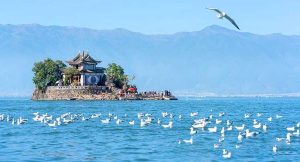
At 10:30 AM, A’peng picked me up and drove toward Shuanglang. Passing Caicun Pier, he stopped for a while: “Want to go down and catch the breeze? It’s free.” I stepped onto the wooden pier. The water of Erhai was as blue as if it had been dipped in pigment. Waves hit the rocks, splashing small water droplets. An old man was fishing, his basket containing two small crucian carp. Seeing me, he shook them: “Want some? I’ll give them to you for soup.” I hurriedly shook my head: “Keep them for yourself, Grandpa.”
At 12:30 PM, we arrived at Shuanglang. A’peng dropped me off in front of the “Erhai Story” Cafe—a wooden sign hung on the beam of an old house. Inside was a small window seat with a view of the entire Erhai Lake. I ordered a hot Americano (25 yuan; A’peng said their beans are fragrant) and sat down to wait for the sunset. Starting from 2 PM, the color of Erhai slowly changed—first pale blue, like freshly steeped tea; then lake blue, like glass marbles from childhood; and around 4 PM, as the sun sank behind the mountains, the clouds were dyed orange-red. The shimmering gold on the water surface grew brighter and brighter, until even my coffee cup reflected a patch of orange light. I took over 20 photos with my phone. My fingers were stiff from the cold, but I wouldn’t put it down—an auntie at the next table leaned over: “Girl, your angle is good; the photos I took earlier were all full of passersby.” She helped me take a photo of “Coffee Cup + Erhai Sunset,” which I later set as my WeChat Moments cover.
At 5:30 PM, I returned to the hostel. “Shuanglang Tinghai Xiaozhu” was in a seaside alley. The owner was a Bai girl wearing a silver bracelet who led me to my room: “Room 301, the window faces Erhai directly. You can hear the waves at night.” The room wasn’t large, with photos of Erhai on the walls. Opening the window brought in the sea breeze, making the wind chimes by the bed tinkle. At 7 PM, I sat by the window eating instant noodles—the hostel common area provided free barley tea, so I brewed a cup and watched Erhai after sunset while holding my bowl. Stars began to brighten like diamonds scattered in the water. A fellow traveler from the next room knocked on my door: “Want to go for a walk on the beach? I just bought some roasted potatoes.” We walked along the coastline, waves hitting our ankles with a cool sensation. she told me: “I met an old boatman here last year who taught me to recognize the constellations of Erhai. I’ll take you to ask him tomorrow.”
Lying in bed, the sound of waves was like a lullaby. I touched the jasmine by my pillow (given to me by A’peng in the morning), smelled the faint fragrance, and quickly fell asleep—even my dreams were blue, like the water of Erhai.
“Go early for Yang Shunbao’s Baba; they are sold out after 3 PM; choose a window seat for the sunset in Shuanglang and don’t squeeze onto the beach—too many people to take good photos; fishermen sell fish outside Tinghai Xiaozhu’s window in the morning; go pick some if you want it fresh.” — These “Erhai Day 1 Tips” handwritten by A’peng were posted by me on the hostel message board.
Daily Expense List
| Item | Cost | Remarks | |
|---|---|---|---|
| Kunming → Dali Carpool | 100 yuan | Diankexing platform, includes A’peng’s recommendation | |
| Yang Shunbao’s Crispy Baba | 6 yuan | Salt and pepper filling, with sesame | |
| Pea Porridge (Treated by A’peng) | 0 yuan | Driver’s thoughtful gesture | |
| Hot Americano | 25 yuan | Erhai Story Cafe, freshly ground beans | |
| Tinghai Xiaozhu Accommodation | 60 yuan | Window room, includes free barley tea | |
| Shared Roasted Potatoes | 3 yuan | Brought by a fellow traveler, saved half | |
| Total | 94 yuan | — |

Day 4: Carpool to Lijiang → Lijiang Ancient City → Mu Mansion → Stay in Lijiang
At 9:15 AM, clutching the tangerine handed to me by A’jie, I got into the carpool. He was an experienced driver on the Dali-Lijiang line, driving a silver-gray Wuling Hongguang. A box of home-grown kumquats sat on the passenger seat, smelling refreshingly sour. “Little girl, sit in the back. The mountain roads are curvy, so hold onto the handle.” He turned the key, and the car headed northwest. The rice fields outside slowly turned into layered terraces, with morning dew still on the leaves, reflecting sunlight like scattered diamonds.
The drive took 3 hours, and at 12:05 PM sharp, we stopped at the South Gate of Lijiang Ancient City. A’jie helped me take my backpack from the trunk: “Walk up 100 meters and there’s a stall selling chickpea jelly. I have to change shifts soon, so explore on your own.” I thanked him and headed into the ancient city—the bluestone of Sifang Street was polished bright. Both sides were lined with Naxi wooden old houses, with plum blossoms and peonies carved on the doors and windows. Bamboo baskets stood by the doors, containing freshly dug arrowhead and muddy small radishes. At an alley entrance, a grandpa in navy Naxi clothing was selling sugar paintings. A copper pot simmered with syrup. He used a spoon to scoop some and drew a butterfly on a stone slab. The syrup cooled and hardened, and the grandpa lifted it with a bamboo skewer: “5 yuan, very sweet.” I took a bite; the syrup was so crispy it flaked, with a faint scent of sugarcane.
At 2 PM, I went to Mu Mansion. The original ticket price was 40 yuan. I showed my student ID, and the ticket lady smiled as she tore a half-price ticket: “20 yuan. Go in and explore slowly. There are koi in the garden, don’t feed them too much.” The plaque above the door of Mu Mansion read “Loyalty and Righteousness,” inscribed by Xu Xiake; the handwriting was a bit blurred but carried a sense of weight. Entering felt like walking into a miniature Forbidden City—the pillars in the main hall required two people to hug them. Two dragons playing with a pearl were carved on the beams; the paint was peeling in some places, but it looked even more ancient. In the garden behind was a small pond with a few lotus leaves floating on the surface. A group of red koi squeezed under the lotus leaves to fight for food. I squatted by the pond and threw a grain of fish food; they flapped and jumped, splashing water all over my pant legs. The rockery was piled with Taihu stones, with several cacti growing in the cracks, blooming with small yellow flowers. The guide said these stones were transported by the owner of Mu Mansion from Jiangnan, taking three years to pile up.
At 6 PM, I returned to Dayan Ancient Town. The hostel was called “Yunqi,” located in an alley on Wuyi Street. The storefront was wooden, with two red lanterns hanging. Entering, I first smelled sun-dried quilts. The receptionist was a Naxi girl with braided hair named A’yi, who smiled while scanning my ID: “Room 303. Your roommate is a girl from Sichuan who arrived yesterday; she went to Sifang Street to buy flower cakes.” The room wasn’t large, with two bunk beds. The upper bunk I slept in had linen sheets that smelled of sunlight, and a copy of “Naxi Epic” lay by the pillow; the cover was a bit old but very neatly kept.
At 7:30 PM, I went downstairs. A’yi was sitting on the sofa in the common area munching on a flower cake. Seeing me, she waved: “Freshly baked, rose filling, try it.” The owner brought over a plate. The crust was so crispy it flaked, and inside was full of rose filling. Red rose jam flowed out, carrying the fragrance of fresh roses, sweet but not cloying. I took a bite; the crust melted in my mouth, and the sweetness of the rose filling wrapped around the aroma of the crust. I almost ate three in a row, but A’yi smilingly stopped me: “Save one for breakfast tomorrow, or you’ll be too full to sleep tonight.” A girl from Sichuan nearby leaned over: “I just bought five boxes to send home. Do you want two? 10 yuan each, fresher than the supermarket ones.” I quickly bought two boxes, packed in foam boxes. A’yi helped me seal them: “The courier will come to pick them up tomorrow morning, so they’ll make it.”
Lying in bed at night, I heard the sound of Naxi ancient music from outside. The melodious Erhu sound drifted in, wrapped in the bustle of the ancient city. I touched the “Naxi Epic” by my pillow, thinking of the sugar painting I ate today, the koi at Mu Mansion, and the fragrance of the flower cakes. I felt that even my breathing had turned sweet—it turns out the slowness of Lijiang is hidden in every bluestone and every smile.
“Don’t feed the koi at Mu Mansion bread, it will spoil the water; choose freshly baked flower cakes in the ancient city and check the master’s timing of putting them in the oven; Yunqi Hostel has free red bean soup in the common area, they boil it at night, so remember to have some.” — These “Lijiang Tips” handwritten by A’yi were posted on my suitcase.

Day 5: Shuhe Ancient Town → Black Dragon Pool to Photograph the Snow Mountain → Stay in Lijiang
At 8:30 AM, I rubbed my eyes and walked out of Yunqi Hostel. The wind at the alley entrance still carried the lingering charm of last night’s Naxi ancient music. While waiting for a carpool at the intersection of Wuyi Street, the driver was He’ge, a local from Lijiang. He drove a white Jetta, with a box of wrinkled dried apples on the passenger seat that smelled withered and sweet. “Little girl going to Shuhe? I’ll take the Yuhe Corridor route so you can catch a glimpse of the willows by the river.” He turned the key, and the car headed toward the north of the city. The ancient city gate slowly shrank into the background. An old woman’s roasted Erkuai stall by the road wafted smoke, the rice aroma wrapped in the smell of charcoal fire entering my nose.
Arriving at the side gate of Shuhe Ancient Town at 9:20 AM, He’ge pointed inside: “Follow that narrow bluestone path; there are no tourists, and Qinglong Bridge is at the end.” The stone road was so narrow that only two people could walk side-by-side. Both sides were small shops selling handmade silver bracelets. Owners sat on thresholds hammering silver pieces, the “ding-dong” sounds hitting the walls and bouncing back. Several stone lions squatted on the bluestone railings of Qinglong Bridge, their ears polished bright as if soaked in hundreds of years of life and bustle. I leaned over the bridge and looked down—the stream was so clear I could count the pebbles at the bottom. A few small green fish swished their tails into the water plants, the ripples stirred by their tail fins breaking the bridge’s reflection into shattered silver.
After crossing the bridge and turning south for 50 meters, the blue-tented “A’po Cured Pork Ribs” wafted a rich fragrance. The old woman wore an indigo apron, her silver bracelet clinking against the aluminum pot rim as she added pine branches to the stove. “Want a small pot of rice noodles? Add cured pork ribs!” As she looked up, the wrinkles at the corners of her eyes bunched into flowers. With a heavy scoop, cured pork ribs and rice noodles slid into the bowl. The broth was milky white, with dried chili segments and coriander floating in it. I took a sip—the thickness of the pork bone wrapped around the smoky aroma of the cured pork ribs was so fresh it made my eyebrows jump. The pork ribs were stewed until tender and flaky, and one bite was enough to melt. The rice noodles were slippery and had soaked up all the broth. A boy in a windbreaker nearby leaned over: “Can we share? I can’t finish it alone.” The old woman smiled and handed over a small dish: “Share it; add more if it’s not enough, soup refills are free.” The two of us squatted by the tent, eating while watching passing Naxi elders leading dogs with tails wagging like small flags.
At 11:30 AM, I said goodbye to the old woman, and He’ge took me back to Dayan. Passing Zhongyi Market, I bought a jin of strawberries for 10 yuan. The stems were still wet with dew, and they were as sweet as if dipped in honey. At 2 PM, I wandered to Black Dragon Pool with my backpack—the vermilion main gate hung with a gold-on-black plaque. Inside, willows lined the path, their branches drooping to the water surface, and when the wind blew, the willow catkins floated like snow.
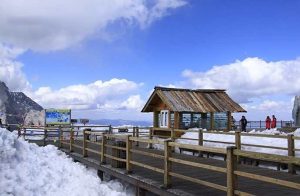
Walking to the pond side, I almost shouted—the reflection of Jade Dragon Snow Mountain was floating on the blue-green water surface. The snow on the mountain peak hadn’t melted, looking like a white hat on the tip, reflected in the water so clearly that even the texture of the snow was visible. I found a bluestone slab to sit on and took out my phone to adjust filters, framing the snow mountain, my own shadow, and the crooked willow tree nearby. A girl in Hanfu carrying an oil-paper umbrella passed by and stopped to ask: “You found a great angle; I want to take a photo too.” She helped me adjust my posture and took a photo of “Snow Mountain + Me + Willow Tree,” which I later posted on Moments. A friend commented: “It looks like a screenshot from ‘Meet Yourself’.”
At 5:30 PM, I returned to the hostel and sat in the common area organizing photos. The owner A’yi brought over hot milk, water droplets condensing on the cup: “Going back to Kunming tomorrow? I’ve checked He’ge’s carpool for you. It leaves at 7:30 AM and arrives at Kunming Station on time.” I packed my luggage—putting the handmade silver bracelet from Shuhe into a jewelry box, folding the wrapper from the old woman’s cured pork rib rice noodles into a small square (as a souvenir), and backing up the photos of Black Dragon Pool to my computer. The moon rose outside, shining on the black tiles of the ancient city. I remembered the coolness of touching the stream water at Qinglong Bridge today, the freshness of the old woman’s rice noodles, and the clarity of the snow mountain’s reflection. Even my packing movements slowed down.
Before bed, I found the tip written by A’yi; the pencil handwriting was wobbly: “Few people at Shuhe’s Qinglong Bridge in the morning, good for empty shots; photograph the snow mountain at Black Dragon Pool before 10 AM for soft light; the carpool back to Kunming is a bit bumpy, so remember to bring a bottle of mineral water.” I posted the tip inside my suitcase, touched the pencil marks, and slowly fell asleep—dreaming of eating the old woman’s cured pork rib rice noodles, the soup so fresh it was almost intoxicating.
“The stream water in Shuhe can be drunk directly, it’s very sweet; Black Dragon Pool’s willows bloom with small white flowers in spring, even more beautiful than now; the carpool back to Kunming is a bit bumpy, so remember to bring a bottle of mineral water.” — This note He’ge tucked in when dropping me off was placed in my notebook.
Daily Expense List
- Shuhe Carpool: 30 yuan, He’ge’s car, via Yuhe Corridor
- Old Woman’s Cured Pork Rib Rice Noodles: 12 yuan, small pot shared by two, very affordable
- Strawberries from Zhongyi Market: 10 yuan, fresh and sweet, stems with dew
- Black Dragon Pool Ticket: 5 yuan, half-price with student ID, reflection of snow mountain is stunning
- Yunqi Hostel Accommodation: 55 yuan, upper bunk, includes free laundry detergent
- Packing Bag: 2 yuan, bought at the hostel common area for local specialties
- Total: 104 yuan
Keep Reading
- Lijiang 5-Day Intangible Cultural Heritage Tour | Dongba Script + Naxi Ancient Music + Baisha Murals + Handmade Paper Making, Exclusive Route for Culture Enthusiasts
- Dali 6-Day Cultural Experience | Tie-Dye + Silverware + Bai Ethnic Three-Course Tea + Three Courtyards One Screen Wall, Deeply Feel Intangible Cultural Heritage
- Xishuangbanna 4-Day Dai Cuisine Guide | Gaozhuang Starlight Night Market + Man Ting Park + Dai Garden Water Splashing Festival, Tropical Food Map
- Yunnan 8-Day Self-Driving Route | Kunming-Dali-Lijiang-Lugu Lake, All Costs Including Highway Tolls + Fuel Fees + Parking Fees Calculated Clearly
- Yubeng 7-Day Hiking Guide | Sacred Waterfall Line + Ice Lake Line + Sacred Lake Line, Progressive Route from Novice to Experienced Trekkers
Kunming —: Numbers to Check
Tickets & Booking
- Dianchi cruise (luxury cruise/speedboat): About CNY 95 per person (speedboat); about CNY 145 per person (cruise)[src]
- Kunming tourist cableway (Dianchi Dam–Xishan): One way CNY 40, round trip CNY 70[src]
- Yunnan Ethnic Village: Daytime ticket about CNY 85–90; night ticket CNY 50[src]
Transport & Schedules
- Kunming South station → Jianshui station / Xishuangbanna station | High-speed rail: Kunming–Xishuangbanna high-speed rail about 3.5–4 h, second class about CNY 178–237, 30+ departures daily on average; Kunming South–Jianshui about 2 h, second class about CNY 56–75[src]
Where to Stay · Room Type · Nearby
- Near Kunming station | Reference price Budget hotel about CNY 101 per night (OTA) | Room tip: Suitable for a short stay and catching trains | Nearby add-ons: Yunnan Ethnic Village, toward Dianchi[src]
- Near Cuihu Park | Reference price Budget hotel about CNY 102 per night (OTA) | Room tip: Many characteristic guesthouses/hotels, near the old streets | Nearby add-ons: Cuihu, Yunnan Military Academy, Kunming Old Street[src]
Typical Climate & Packing (Past Years)
- January: 3 °C–17 °C °C, [Travel climate reference] Gull season
- February: 5 °C–19 °C °C
- March: 7 °C–22 °C °C
- April: 11 °C–25 °C °C
- May: 14 °C–26 °C °C
- June: 17 °C–26 °C °C, Rainy season






