



Use these three days for Heshun food stops, Rehai geothermal sightseeing and separately confirmed bathing facilities, with two nights of accommodation. Eat in designated dining areas, not while sitting in a hot spring. The original account names both a 200-yuan guesthouse and a 400-yuan hotel without explaining a move. Its travel date, personal conversations, shops, prices and hotel services still need supporting records; the retained narrative is not a verified booking offer.
Day 1: Landing in Tengchong, Fireworks of Flavor from Morning till Night
Finding Breakfast in the Lanes After Landing
Landing at Tengchong airport at 9:00 AM on Saturday, the terminal is as small as a community service center. At the exit, there are two rows of local aunties selling grilled Erkuai—I didn’t buy any. The account estimates 15 minutes by taxi to Heshun Ancient Town, but no dated route record supports a fixed transfer time. The driver was an uncle in a navy shirt with a box of jasmine tea on the passenger seat. He kept chatting with me all the way: “Morning, girl! Going to Heshun to eat Xidoufen (Pea Porridge)? Old Zhou’s stall is ten times more fragrant than those in the scenic areas.” The fare was 25 yuan, taking me directly to the ancient town’s parking lot. As I dragged my suitcase into the alley, a scent of ginger mixed with bean aroma wafted toward me. Looking up, I saw the blue plastic canopy of Old Zhou’s Xidoufen Stall. A string of dried chilies hung from the roof, and steam from the porridge carried its aroma toward me.
The owner was an auntie in a blue cloth apron, her hands never stopping: her copper ladle scooped up a portion of pea porridge, pouring it in circles along the edge of the bamboo bowl until the thickness just covered the bottom. Then she tossed in a freshly fried Youtiao (deep-fried dough stick)—the Youtiao was golden, with oil spots glistening in the sunlight. It was crisp with a loud “crunch.” Dipped in the porridge, the ginger’s spiciness was warming, and the bean aroma was pronounced; smell alone cannot identify the beans or prove how they were processed. It was 5 yuan a bowl, and the Youtiao was 1 yuan. I sat on a small bamboo stool in front of the stall; my bottom felt a bit stiff, but watching the aunties with vegetable baskets walk by the alley, I felt this was the true morning of Tengchong.
Wandering the Ancient Town: Looking at Old Houses and Lanes
Arrange luggage storage with your booked accommodation before walking the lanes. The original 9:00 AM landing, breakfast and 9:30 AM storage sequence leaves no clear allowance for leaving the aircraft and collecting bags. The claimed later stay at “Half Acre Field” for 200 yuan also conflicts with the evening hotel record; neither accommodation version has been confirmed. The observed dark stone walls do not establish that all old houses in Heshun use the same material. The walls are deep gray and feel as rough as an elder’s palm, with deep green moss growing in the crevices and small mushrooms popping up here and there. The scent of Ersi (rice noodles) being cooked drifted from someone’s home—not the smell of seasoning, but the aroma of bone broth simmered all night. Following the scent, I found a small shop with no sign. Huge jars of soaking Ersi stood at the door, and the owner was kneading Erkuai, his hands shiny with rice milk.
I stopped at the Laundry Pavilion to rest. The description of a six-pillared thatched pavilion and inscriptions dated 1985 and 2000 needs a specific location, photographs and heritage evidence. Do not use those details as established architectural history. The grandmother and washing memories remain part of the unverified travel account. The wind blew from the alley entrance carrying the scent of rice leaves. The grandmother’s silver hairpin swayed, and I suddenly understood what “the spirit of daily life” meant.
Da Jiu Jia: Eating the Freshly Fried Crispy Edges
At 12:00 PM sharp, I arrived at Old Tengchong Ersi—the sign was a wood-carved blackboard with “Old Tengchong Ersi” written in jagged letters, and red lanterns hung at the door. The owner was a stout uncle in a white apron. Seeing me looking at the menu, he shouted: “Eating Da Jiu Jia? We’ll stir-fry a tender one for you!” The kitchen was open-style. Through the glass, I could see the chef stir-frying Erkuai: the Erkuai were oval-shaped and sliced about 3 mm thick. They were first tossed into a scorching hot wok, sizzling as the edges curled into golden crispy bits. Then Xuanwei ham cubes (well-marbled and oily), local pickled vegetables (green, crisp, and ferment-sour), and scrambled eggs were added. The chef tossed the wok twice, coating the Erkuai in seasoning, and served it steaming hot.
I quickly took a bite—the first mouthful hit a crispy edge, fragrant and crunchy, followed by the soft rice aroma of the Erkuai. The savory ham flavor seeped into every grain of rice, the acidity of the pickled vegetables balanced the richness perfectly, and the egg bits added a silky tenderness. The uncle leaned over and smiled: “Our secret is not stir-frying it for too long to keep the rice aroma; it doesn’t taste good once it’s cold.” One portion was just right for two people (28 yuan). The account then adds Ersi for 10 yuan and mentions bone broth, although the described dish is stir-fried Erkuai. Whether soup was ordered separately needs a menu or receipt; stir-fry sauce should not be presented as bone broth.
Afternoon at Rehai: Separate Sightseeing from Bathing
Before leaving Heshun, confirm the Rehai entrance, transport, return trip and ticket type. The original 10-minute taxi, 10-yuan fare and 158-yuan ticket including bathing have no travel date and are not current quotes. The driver’s claim of a 1,000-meter source depth, the Lotus Pond directions and quieter afternoons also lack evidence. A sightseeing ticket does not automatically include bathing.
Mayugu Hot Spring is a separate destination, not a pool on a slope inside Rehai. Tengchong’s government locates Mayugu in Xinle Village, Beihai Township; visiting it needs a separate address, ticket, transport and time plan. [1] The Lotus Pond, banyan tree, volcano view, locker-room directions, hair-dryer brand and free towels or water have not been matched to a confirmed operator.
Check the actual water temperature and hygiene before bathing. Do not follow the original 43°C example: CDC says hot-tub water should not exceed 40°C. That is a ceiling, not a suitable target for everyone. Children under five should not use hot tubs; pregnant visitors should ask a healthcare provider first. Do not drink alcohol before or during use, and do not swallow the water. [2] A visitor’s suggestion to wait 20 minutes before getting out is not a safety rule. Leave the water and seek staff assistance if unwell; seek medical care for serious or continuing symptoms.
Do not enter Pearl Spring because someone recommends its bubbles. Official tourism information distinguishes the hot geothermal features from the designated Yugu and Beauty Pool bathing areas; the latter receives water after natural cooling. Use only formally open bathing facilities, stay away from hot vents and steam, and do not treat softness or sulfur odor as proof of safety or skin benefits. [5]
Evening Back at the Accommodation: Eat After Leaving the Pool
The account records a 7:30 PM return to “Heshun Hot Spring Resort Hotel” at 400 yuan a night, without explaining the morning guesthouse. The actual booking and the following facilities remain unconfirmed. In the retained description, the room was clean, and the balcony overlooked the rooftops of the ancient town. Use a confirmed public bathing area only if you feel well, and observe its capacity limit; a crowd is not a reason to choose a pool. The claimed in-room bath also needs hotel confirmation. The buffet snack station was right next to the bathing area, featuring grilled Erkuai, fried potatoes, watermelon, and cherry tomatoes. The grilled Erkuai were cooked over charcoal, charred on the outside and soft inside, dipped in sweet soy sauce—which is fermented from soybeans with a caramel-like hint. Leave the pool, dry off and wash your hands before eating in the permitted dining area. A feeling of relaxation is not evidence that bathing treats shoulder pain.
I added a skewer of grilled chives (5 yuan). The chives were very fresh with no raw taste, grilled just right. An auntie sitting nearby chatted with me: “You picked a good time; the water temperature is perfect these days. It gets hotter in the autumn.” The claim that pool temperatures rise in autumn and the recommendation of a rice-wine pool need the operator’s confirmation. Neither fragrance nor warmth establishes a health benefit or safe water temperature.
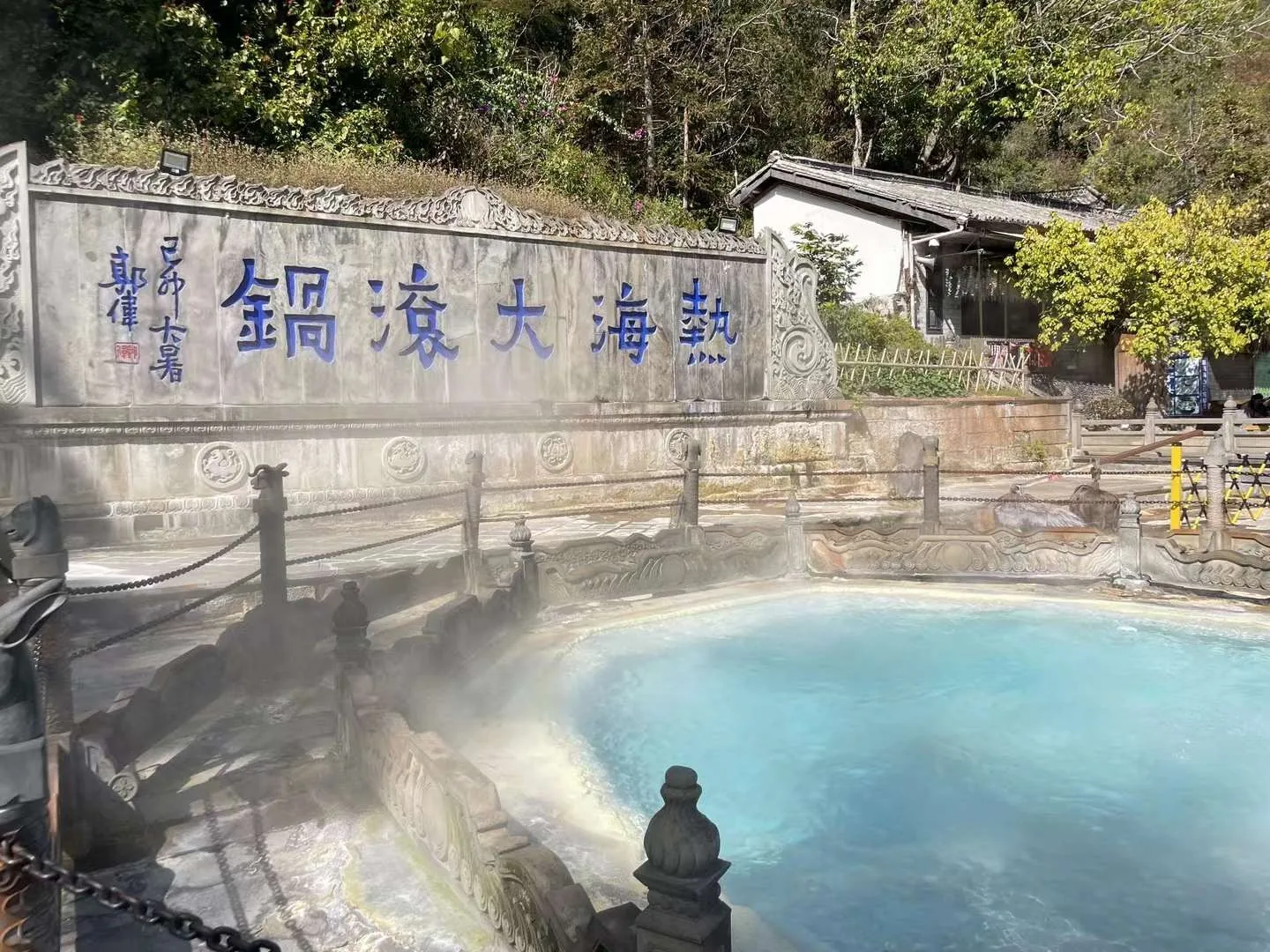
The pictured sign reads “Rehai Big Boiling Pot”: this is a geothermal sightseeing feature, not the hotel bathing pool described above. Do not enter it.
Day 2: Following the Scent of Tuguozi, Soaking and Authentic Eats
At 8:00 AM, I wandered to the breakfast area on the first floor of the hotel—a window seat at the hotel named in the account, whose identity and breakfast charges still need confirmation, where I could smell the sweet scent of osmanthus trees in the yard. I ordered a bowl of Soy Milk Mixian (rice noodles). The soy milk was served in a coarse ceramic bowl with a thin film of bean curd on the surface. Blowing it aside and taking a sip, it had the fresh scent of ground soybeans—not astringent, just like the taste my grandmother used to grind on a stone mill back home. The Mixian were hand-pressed and slipped smoothly into my mouth, paired with pickled radishes (with a sweet-spicy aftertaste) and freshly fried peanut crumbles (crispy to the last bit). At 8 yuan a bowl, I sat by the window eating slowly, watching the shadows of the osmanthus trees sway against the blue brick walls, finally feeling the initial unfamiliarity of Tengchong fade away.
At 10:00 AM, clutching the free bottled water from the hotel, I took a taxi to Mazhan Village. The driver was a middle-aged uncle in a navy T-shirt with an unopened box of jasmine tea on the passenger seat. He didn’t talk much, only mentioning “Mazhan is just ahead, the road is narrow, I’ll drive slowly” when he saw me looking at the tobacco fields. The recorded 20 minutes and 15-yuan fare have no date and are not fixed transfer terms. The arrival description mentions the wooden sign “Tuguozi Ancestral Home” hanging at the courtyard gate. Three large clay pots stood in the corner. Their claimed volcanic-clay material, 2 cm thickness and cement marks need evidence; a tapping sound cannot establish that cookware is food-safe. The owner, wearing a blue apron, was scooping old hen and bone broth from a large vat, adding crushed ginger and two grass fruits to the pot. The mountain spring water splashed as he poured it in, but turning white in less than three minutes cannot prove that chicken or broth is thoroughly cooked. Keep raw and cooked food separate, wash produce, cook thoroughly, store food at safe temperatures and use safe drinking water. [3]
Seeing me staring at the pot, he smiled and waved: “Come, check out the ingredients.” The account lists taro, yam, ham, egg rolls and pea tips. A safe preparation should use clean ingredients rather than the original muddy taro; the suggested layering is: the bottom layer was local small taro, washed, peeled and thickly sliced, with soil removed; the middle was iron-rod yam and Xuanwei ham slices (perfectly marbled and sliced so thin they were translucent); the top was freshly rolled egg rolls—egg skin wrapping minced meat, fried golden on both sides, and finally washed pea tips to be cooked through. The account says cooking would begin after arrival around 10:20 AM and take four hours, yet the next paragraph serves it at 12:30 PM—only two hours and ten minutes later. The author and restaurant need to clarify whether a different pot was prepared earlier or the times are wrong. Reserve a serving time for slow-cooked dishes rather than assuming they can be cooked from scratch on arrival.
The recorded 12:30 PM serving time remains unverified; the account describes bubbling soup. The first sip of soup was so fresh my eyebrows nearly flew off—it was the combination of the thick bone broth, savory ham, and the spice of ginger and grass fruit. It wasn’t too heavy or greasy, as if the entire aroma of the kitchen had been simmered into the soup.
Then I ate the taro: it had soaked up the broth, and biting into it was floury and soft, with the soup bursting in my mouth with the saltiness of the ham. Then the ham slices—the savory flavor complemented the taro, not tough at all. Finally, I scooped some pickled vegetables (pickled by the owner himself using local greens, refreshingly sour like three-day pickled radish greens), which perfectly balanced the ham. Two people ordering a pot base (38 yuan) plus taro, yam, ham, egg rolls, and pea tips cost a total of 60 yuan. I even finished half a bowl of soup, leaning back and laughing with a full stomach.
Heading back at 2:30 PM, I took a taxi to Tengyue Culture Square. The square is paved with flagstones that are a bit slippery. In the center stands an old archway, described in the account as having phoenix-and-peony carvings and an inscription dated to Guangxu’s 30th year. The monument’s identity, inscription and age need photographs or heritage records. I crouched by the archway to take photos. The 3:00 PM sunlight shone diagonally, casting a long shadow of the archway on the flagstones like a faded old painting. Camphor leaves drifted down onto my shoulders. A grandmother in a blue cloth shirt was doing Tai Chi with movements as slow as flowing water. I stood and watched for a while, finally understanding that “life only feels like life when it slows down.”
In the evening, use a confirmed bathing facility only if you feel well; 40°C is not a required or universally suitable temperature. The original account brings vacuum-packed Xidoufen bought in the morning into a pool and mixes it with warm water, relying on the seller’s two-day storage claim. It does not establish whether this is cooked food or dry mix, or how it was stored. Do not follow that example: vacuum packing does not make two days at room temperature safe. Follow the product’s storage and cooking instructions, use safe drinking water rather than pool water, and keep food in the designated dining area. Do not recommend an unverified preparation method to other bathers.
Day 3: Final Exploration and Packing a Taste of Tengchong
At 8:30 AM, I followed the roar of Dieshuihe River—just entering the alley, I heard the waterfall sounding like a giant drum. The bamboo stall of Yang’s Xidoufen was set up under an old pagoda tree. The bamboo tables and chairs had a vintage yellow tint, and ivy climbed over the roof. When the wind blew, the leaves brushed the table corners, carrying a damp, grassy scent.
- The owner was an auntie in a blue apron. Seeing me standing there, she shouted: “Want peanut crumbles and sesame? Just fried!”
- As the copper ladle scooped the porridge, it circled the bowl edge, the thickness just covering the bottom. Finally, she sprinkled golden-fried peanut crumbles (crisp enough to shatter) and finely ground black and white sesame. The bean aroma mixed with the toasted scent of the toppings.
- I sat on a bamboo stool eating; the mist from the waterfall drifted over, feeling cool, but the porridge was hot and warmed my throat—6 yuan a bowl, much more substantial than I imagined.
After eating, stay on formally open, protected paths and take care on wet surfaces; do not cross barriers or enter the water. In the retained account, the current crashed against the blue-gray stones, and the mist hit my face—the narrator recalls damp, cool clothes, not a guaranteed level of comfort in summer. Do not let children reach into waterfall water with a net. Check onward transport to Heshun rather than assuming the waterfall and ancient town are connected by a short alley walk.
At 10:30 AM, I wound deep into the ancient town alleys to find the “Tengchong Old Brand Food Shop”—the storefront was hidden behind two large banyan trees with a black wooden plaque. The characters were in gold paint, slightly peeling. The owner wore round glasses and was doing accounts behind the counter. The following are unverified purchase records, not a current must-buy list; confirm the shop, labels and prices before buying:
| Category | Recommended Product | Price | Check Before Buying |
|---|---|---|---|
| Staple Food | Vacuum-packed Da Jiu Jia | 25 yuan/box | Follow storage and heating labels; neither 3 days nor 10 minutes is a universal rule. |
| Seasoning | Xidoufen Dry Mix | 15 yuan/bag | Read the label for beans and how to cook; color is not a safety test. |
| Side Item | Local Dried Chrysanthemum | Ask shop | Ask if the flowers are for food and if free; do not brew unknown plants. |
The account returns to “Old Tengchong Ersi” at 12:30 PM, but Day 2’s clay-pot meal took place at a different restaurant in Mazhan. It cannot be described as returning to the same place for that dish. Confirm today’s menu, any complimentary potatoes and the actual bill; the texture description below remains part of the travel account.
- When the fried potatoes were served in a coarse ceramic bowl, the potato cubes were about the size of a thumbnail. The skin was fried to a charred brown, crisp enough to hear a “click,” while the inside was as soft as cotton with a hint of starchy sweetness.
- If ordering a fresh clay-pot meal here, use only safely handled soup served for this meal, not leftovers from another restaurant the previous day. The crispy skin and soft core, still hot as I bit in, made me nod in approval.
- The owner leaned in: “Our fried potatoes use local small potatoes; they have more starch, so they turn out crisp.” The additional Ersi, soup and bill need confirmation. Day 2 records 60 yuan for two people, or 30 each, not the same 60-yuan per-person rate. Today’s 38-yuan pot and 5-yuan potatoes total only 43 yuan; other items and diner numbers are missing, so this is not a verified 60-yuan set meal.
On departure day, follow the accommodation’s checkout rules, confirm luggage storage and collection, then work back from your flight or bus reporting time to arrange the transfer. The original noon checkout and 2:00 PM packing sequence does not explain late checkout or luggage storage. If you want to see a bridge, identify it first and check access. Longyang’s culture and tourism authority describes Shuanghong Bridge as crossing the Nu River and being rebuilt as an iron-chain bridge in the Qianlong period, not two joined stone arches. [4] This does not prove which bridge the author photographed. The claimed walk from Heshun, wreath, carved railings and volcano backdrop need location evidence; do not turn the Nu River crossing into a short ancient-town stroll before departure. Skip the stop if time is short.
Expense Check: Not a Complete Three-Day Budget
- Transport: the original 25+15+80=120 yuan has no breakdown for the 80 yuan. Whether the separate 10-yuan Rehai ride and departure transfer are included is unclear.
- Accommodation: 400 yuan × 2 nights = 800 yuan is only the original hotel assumption. Resolve the 200-yuan guesthouse conflict and establish whether room costs are shared.
- Dining: 6+8+28+60+6+25+15+60 equals 208 yuan, not 214. The 25+15 yuan purchases are also counted as souvenirs. Removing that duplicate 40 yuan leaves an arithmetic subtotal of 168 yuan, not a verified food bill; shared and per-person prices are still mixed.
- Souvenirs: the original 25+15=40 yuan must not also appear under dining. The separately stated 158-yuan hot-spring ticket is absent from the original total, and other tickets, meals and transfers need receipts.
The original 1,174-yuan total is not a complete trip quote. Without dates, diner numbers, accommodation records and missing expenses, a replacement total would be misleading. Prices here are original yuan records, not verified current offers.
Sitting in the car for the return trip, smelling the sulfur scent in my suitcase, I recalled the morning’s bowl of Xidoufen with peanut crumbles, the taro in the Tuguozi, and the crunch of fried potatoes dipped in soup—the taste of Tengchong isn’t heavy spice, it’s the freshness simmered at old stalls, the aroma of slow-cooked clay-pot food, and the sweetness tasted only when you slow down. Next time I come, I’ll still look for Old Zhou’s Xidoufen, still go to Mazhan Village for Tuguozi, and consider another bridge visit only after confirming its identity and access.
If you can allow an extra day for autumn leaves and wetlands, compare the four-day Tengchong hot-spring and ginkgo itinerary. It separates Rehai from Mayugu and discusses Jiangdong Ginkgo Village and Beihai Wetland. Do not squeeze that four-day route into these three days; check actual leaf color and open visitor areas. Its personal and commercial records also remain subject to confirmation.
Related Guides
- Yunnan 7-Day High-End Vacation Route | Aman Dali + Jinmao Resort Lijiang + Conrad Lugu Lake, Private Vacation Guide
- Yunnan 8-Day Food Route | Kunming Guoqiao Rice Noodles + Dali Rushan + Lijiang Cured Ribs + Xishuangbanna Barbecue, A Must-See for Foodies
- Winter Yuanyang Terraces + Jianshui Ancient Town 8-Day Tour | Witnessing Irrigation Period Light and Shadow + Enjoying Tofu Feast, Niche but Super Healing
- 6-Day Torch Festival Yi Ethnic Experience: Chuxiong + Weishan (Dali) + Nanjian — Bonfire Party, Tuotuo Meat & Stay in Yi Family Courtyard
- 7-Day March Street Festival Guide: Dali Bai Ethnic Celebration + Nearby Ancient Villages, One-Stop Folk Culture & Food Experience
Tengchong —: Numbers to Check
Tickets & Booking
- Beihai Wetland: About CNY 54.5–55; ticket + bamboo raft + touring cart package about CNY 140[src]
Transport & Schedules
- Tengchong bus station → Volcano Park | Dedicated bus line: Opposite the Tengchong bus station there is a volcano dedicated-line bus direct to the park[src]
- Tengchong → Mangshi | Scheduled bus: Fare about CNY 50–60, journey 1.5–2 h[src]
- Other places → Tengchong | High-speed rail + coach / flight: There is no direct high-speed rail to Tengchong; take high-speed rail to Baoshan station and transfer to a coach for Tengchong; Tengchong also has Tuofeng Airport[src]
Where to Stay · Room Type · Nearby
- Heshun Ancient Town | Reference price Mainly guesthouses (no authoritative range found) | Room tip: You can experience the old-town atmosphere, with morning mist and chimney smoke; guesthouses outside the old town are ch | Nearby add-ons: Heshun Library, Yeya Lake, Ai Siqi’s Former Residence, Western Yunnan Anti-Japanese War Memorial Hall[src]
- Along the Gaoligong Mountains | Room tip: Resort hotels are concentrated here, most with private hot-spring pools | Nearby add-ons: Rehai, Beihai Wetland[src]






