



Day 1: Arrive in Chuxiong, Stay in a Yi Family Courtyard, Visit Yi Ancient Town for the Torch Festival
The guesthouse I chose is located in an alley 50 meters west of the north entrance of Yi Ancient Town in Chuxiong, called “Yi Jia Xiao Zhu” (Yi Family Cottage). When I booked the room 10 days in advance, I repeatedly emphasized to the owner, Uncle Li, that I wanted a “room with an independent fire pit.” He patted his chest and said: “Don’t worry, I’ll save the innermost room for you; the fire pit was just rebuilt, and it burns very warmly.” I arrived at the door at 3:12 PM. Uncle Li was crouching in the corner of the yard tying torches, wearing a faded navy blue side-buttoned jacket, his trousers rolled up to his ankles with a bit of mud. Seeing me, he immediately stood up and wiped his hands on his pants: “You’re here? Come in quickly; the fire pit is simmering ‘Ganguan’ tea, it’s warm.”
The courtyard is a typical Yi family dwelling with blue brick flooring and several pots of Rhododendron delavayi at the base of the walls. In the center, in a terracotta fire pit, a copper pot sat over the fire bubbling away. At the bottom of the tea were a few walnut kernels and dried jasmine flowers. Uncle Li brought a bowl of tea, blew on it, and handed it to me: “I added wild honey from the mountain behind my house; it’s sweeter than what they sell outside.” I took a sip; the sweet tea carried a pine-smoke scent (I later learned it came from burning pine branches in the fire pit), sliding down my throat and warming my stomach. In the corner lay a pile of freshly made torches—the bamboo slats were freshly split bitter bamboo, flexible enough to bend into circles. The outer frame was wrapped with fresh pine branches smelling of resin, and then covered with red paper printed with small Rhododendron flowers. It felt a bit prickly but not uncomfortable to the touch. Uncle Li nudged a torch with his foot: “This is for the ‘Greeting the Torches.’ It won’t be lit until the town parade tonight. Tying them early lets the pine branches ‘wake up’ so they produce light smoke and the right scent when burning.”
At 5:58 PM, I stepped out clutching two roasted potatoes Uncle Li had stuffed into my hands—the skins were roasted crisp, and the inside was soft and mealy. Sprinkled with fine salt and dried chili powder, one bite was so hot I had to puff out air, yet I couldn’t bear to spit it out. A 10-minute walk led me to the Yi Ancient Town. Under the vermilion archway of the north entrance, three grandpas stood on ladders hanging lanterns. Beside the ladders was a pile of gauze lamps half a person high, with navy blue tassels hanging to their knees. The grandpas wore gloves, tying the lanterns to the crossbeams and looking up after each one, as if hanging them in their own homes.
The main street was already crowded. The iron spatulas at the roasted Erkuai stalls clinked. An old lady held a scalding piece of Erkuai to roast until small bubbles charred the surface, then spread peanut butter and sweet bean sauce, wrapped it around a fried dough stick (youtiao), and handed it over: “Young lady, eat it while it’s hot.” I bit into the Erkuai and walked further in, my nose filled with all sorts of scents—the sweetness of sugar paintings, the aroma of fried potatoes, and the mugwort scent drifting from herbal medicine stalls. At a torch-making stall, I crouched down to watch a master at work: a man in his sixties, his face full of wrinkles, veins popping on the back of his hands, and resin stuck in his fingernails. Seeing me approach, he beckoned: “Come, try wrapping the red cloth strips.” He handed me a pine branch, holding my hand to wrap the red cloth along the bamboo slats—it had to be tight, otherwise, it would fall apart when burning. “Look, wrap it three times like this, then tie a knot.” His hand over mine was as rough as old bark but very strong. I wrapped it crookedly, and he laughed while helping me adjust: “It’s fine, everyone is like this the first time. We learned this as kids, practicing with our fathers for three days.” Finally, he cut a strip of red cloth to tie to the top of the torch, then pulled a small bundle of torches from a cloth bag at his feet, wrapped it in old newspaper, and tucked it into my hand: “A gift for you. Take it back and hang it in the yard; you’ll smell the pine fragrance tonight.”
By 6:30 PM, all the lanterns on the main street were lit, casting vermilion light onto the flagstone road like scattered gold. The sound of a large drum came from afar—a “dong” sound that made the nearby lanterns sway, and the watching children laughed and clapped. Walking along the main street, I saw aunties wearing Charwa (Yi ethnic capes, black velvet with red borders) crouching by the road weaving straw ropes. The ropes were made of straw mixed with dragon beard grass. Their fingers flew, and soon they had woven small braids to hang on the stalls: “Ten yuan a piece, you can hang it on your door to ward off evil.” In front of a sugar painting stall, a group of children gathered. The master’s spoon dipped into the shining syrup, drawing phoenixes on the stone slab. Once cooled, he picked them up with small sticks, and the children ran off holding them, the syrup “sizzling” as it dripped onto the stone.
When I returned to the guesthouse at 7:15 PM, Uncle Li had set the dinner table in the yard: fried farm eggs (the eggs were from his own chickens, with orange-red yolks), cucumber salad (sprinkled with Yi-style Litsea cubeba oil), and a bowl of native chicken soup (with goji berries floating on top). The fire in the fire pit was still burning. I broke open the roasted potatoes I bought earlier and dipped them in the chicken soup. Uncle Li sat opposite me smoking a pipe and said: “There’s a parade in the ancient town tonight. You can go see it later. When the torches are raised, the whole street lights up.”
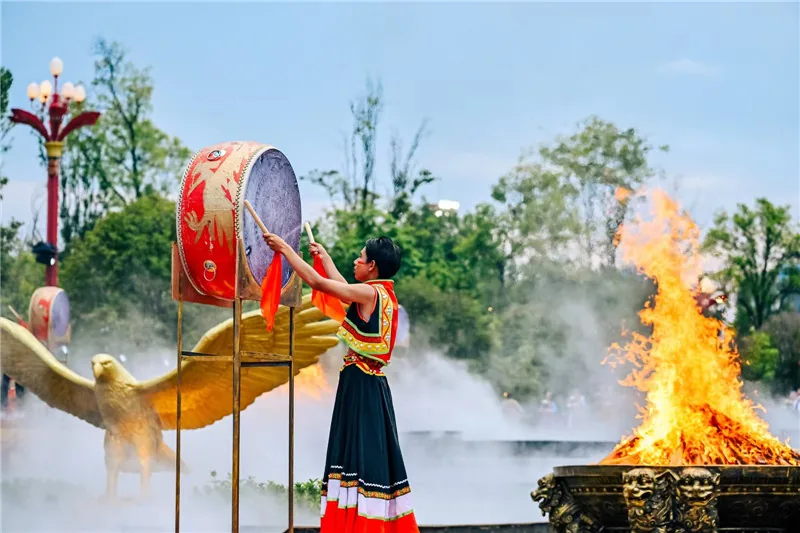
At 8:00 PM sharp, the town parade began. I stepped out of the guesthouse and saw a crowd on the main street holding torches, the firelight reddening everyone’s faces—there were girls in Yi ethnic clothing, grandpas carrying large drums, and children holding small torches. I followed the crowd for a bit, holding the small torch Uncle Li gave me. The smoke from the burning pine was light, carrying a resinous scent drifting in the wind. An auntie next to me pulled my hand: “Young lady, come and dance the Left Foot Dance!” I hesitated for a moment and then joined the crowd. As the music started, everyone formed a circle, stepping in with the left foot and back with the right, swinging hands. Laughter mixed with the drum beats, drifting far, far away.
It wasn’t until 9:30 PM that I reluctantly returned to the guesthouse. The fire in the yard was still burning. Uncle Li had already cleared the table and left a lamp on: “Tomorrow you are going to the Solar Calendar Culture Park. Get up early; I’ll cook Tuotuo meat for your breakfast.” I lay in bed, smelling the warm fragrance of the fire pit and listening to the insects outside, feeling that this day was more grounded than ever before.
Day 2: The Main Day of Chuxiong Torch Festival, Watching the Gala and Eating at the Long Street Banquet
At 8:40 AM, Uncle Li knocked on my door with a bowl of mutton soup pot—it was soup made by simmering mutton bones all night, with a few fresh mint leaves floating on top, paired with two roasted potatoes that were charred black and oily: “Eat quickly; it’s a 15-minute walk to the Solar Calendar Culture Park. If it gets cold, your stomach will hurt.” I sat under the Rhododendron tree in the corner of the yard to eat. The soup was so fresh I slurped it up, and the mealy fragrance of the potatoes wrapped in the coolness of the mint, warming me all the way to my chest.
At 9:00 AM sharp, I stepped out with my small canvas bag. Walking to the entrance of the Culture Park, I saw a Yi language plaque with gold characters on a black background. The security guard uncle checked my ID: “30 yuan, go right in.”
Solar Calendar Square
After a few steps, the blue flagstone patterns of the Ten-Month Solar Calendar Square hit my eyes—the ground was carved with dense concentric circles and squares, like a spread-out “map of time.”
An elder sister named Ayi, wearing a navy blue Charwa, was already waiting by the stone pillar, a silver hairpin in her bun and small embroidered Rhododendron flowers on her sleeves: “Just in time; I’m about to explain the calendar.” Her voice was like cotton thread soaked in resin, soft but substantial.
- She pointed to the circular stone formation in the center: “These 10 circles represent the 10 months of the ‘Ten-Month Solar Calendar.’ Each month corresponds to specific farm work—planting potatoes in the first month, raising buckwheat seedlings in the second, planting tobacco in the third… it even calculates which herbs should be dried on rainy days.”
- Then she moved to the outer square stone formation: “These 12 squares represent the ’12-month climate,’ such as ‘sun rising from the mountain’ for spring plowing and ‘sun setting over the slope’ for autumn harvest.”
- Finally, she stopped at a model of a fire pit in the center of the stone formation: “Our Yi ‘Kushi’ (New Year) is in these remaining 5 days—we slaughter New Year pigs, dance the Left Foot Dance, and offer three torches to our ancestors.”
Fire Sacrifice Ritual
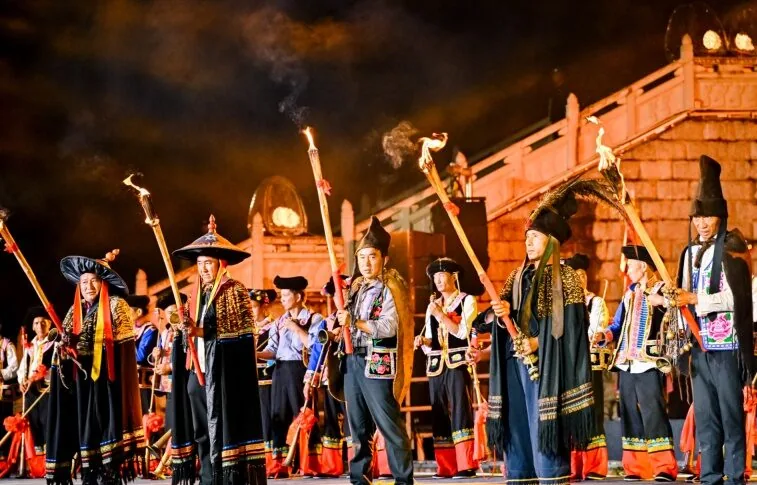
Next, I went to see the Fire Sacrifice Ritual. The venue was in a pine forest behind the square, with fresh pine needles half a foot thick on the ground. In the middle was a pile of pine branches and mugwort as high as a person. Several Bimo (priests) were wearing black wool ritual robes with white cloud patterns on the collars and ritual hats decorated with pheasant feathers. They held copper bells and yellowed scriptures.
At 9:40 AM, the ceremony began—the Bimo formed a circle, their copper bells “clinking,” chanting scriptures that sounded like singing. Assistants lit the pine branches, and smoke slowly drifted up with the scent of resin. Standing in the back, I saw sunlight filtering through the pine branches onto the Bimo’s robes, glowing with an old light. 20 minutes later, the Bimo suddenly shouted “O-huo!” in unison. The scent of cypress branches drifted in the smoke. The surrounding crowd burst into applause, and an old woman wiped her tears, saying: “This is the root of our Yi family.”
Tiger Dance (Laohu Sheng)
At 2:00 PM, I watched a dance performance at the Culture Park’s open-air stage. The first act was the finale—the “Tiger Dance.” Eight dancers wore tiger masks woven from bamboo slats with red glass beads for eyes and golden tiger patterns on their foreheads, wearing cloth skirts covered in leopard spots.
As the music started, they first crouched on the ground, hands on the floor like tigers just waking up, then slowly stood up, mimicking tigers pouncing and scratching. Their movements were as steady as being rooted to the ground, yet filled with wild energy. The audience was packed shoulder to shoulder. A little girl in a floral dress tugged at my sleeve: “Sister, do tigers eat people?” I laughed: “These are blessing tigers; they don’t bite.”
Bonfire Party + Long Street Banquet
By 7:30 PM, the main street of Yi Ancient Town began to “heat up.” I followed the flow of people and saw roasted milk fans (Rushan) “sizzling” on iron plates. An uncle selling bubble wine (Paoshui Jiu) held a ceramic jar and shouted “Have a free taste!” Girls in Charwa walked by holding torches, the firelight making their silver earrings sparkle.
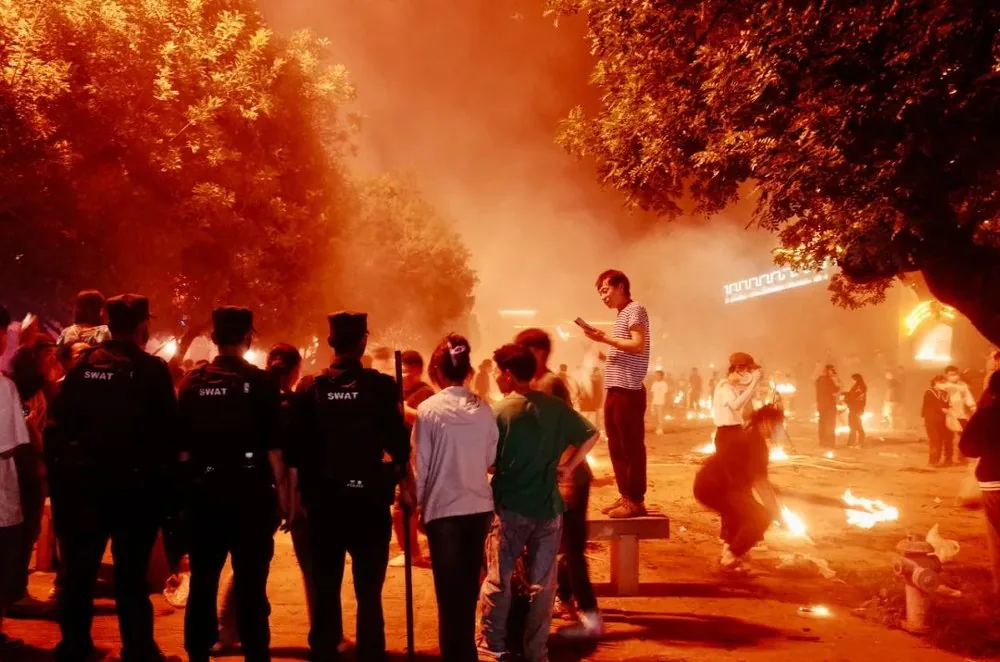
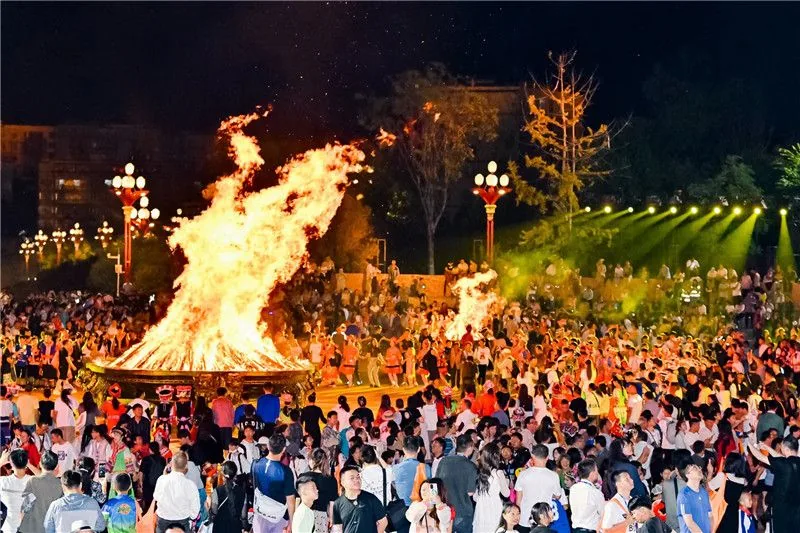
At 8:00 PM sharp, the Bonfire Party exploded—five large piles of pine wood were set in the center of the main street. Once lit, flames leapt 2 meters high, lighting up half the street in bright red. I squeezed to the front, and a man tapped my shoulder: “Come, dance the Left Foot Dance!” He wore a black side-buttoned jacket with trousers rolled up to his ankles, demonstrating at the front of the line: “Step in with the left, back with the right, swing your hands like you’re shooing mosquitoes, don’t be stiff!” I stepped on his foot the first time and my face turned red, but he just laughed: “I stepped on my father’s foot the first time too; it’s fine.” The music grew louder, more people joined, and the circle grew larger. The firelight reflected on everyone’s faces—elderly people in ethnic costumes, tourists recording with phones, and barefoot children. Laughter mixed with drum beats drifted far away.
After dancing, I was already hungry. I followed the crowd to eat at the Long Street Banquet—more than 200 red-clothed tables were set along the main street, forming a dragon hundreds of meters long. On the table were:
- Tuotuo meat (native pork stewed until very tender, chunks as large as fists)
- Pickled vegetable soup (made with homemade pickles, appetizingly sour)
- Roasted potatoes (charred skin cracked open to reveal a soft, mealy core)
The dipping sauce for the Tuotuo meat was crushed millet chili with Litsea cubeba powder and some coarse salt. One dip and it was so spicy I had to gasp, yet I couldn’t stop reaching for another piece. An auntie in a blue cloth shirt saw me eating with gusto and gave me the largest piece of Tuotuo meat: “Eat more, young lady. This is a black pig from the mountain behind my house; it was salted for 3 days after being slaughtered.” I smiled and said thank you, biting into the meat; even the skin was sweet.
Halfway through, a man at the next table brought over a bowl of bubble wine: “Taste this, it’s brewed from corn, low alcohol.” I took a sip; it was sweet with a grain aroma, without the harshness of strong liquor. The man patted my shoulder: “Every year for the Torch Festival, we set up the Long Street Banquet. Whether we know each other or not, we sit down and eat together. This is the ‘unity’ of the Yi family.”
It wasn’t until 10:30 PM that the Long Street Banquet ended. I walked back along the main street. the bonfires were not yet out, some people sat on the steps chatting, some walked with torches, and the scent of resin, roasted potatoes, and pickled vegetable soup drifted in the wind, along with the laughter of Yi girls. When I returned to the guesthouse, Uncle Li was sitting in the yard smoking his pipe. The fire in the fire pit was still burning. Seeing me, he said: “Tomorrow you are going to the Bimo residence deep in the Solar Calendar Culture Park. Get up early; I’ll cook Tuotuo meat for your breakfast.”
Day 3: Chuxiong → Weishan (1.5-hour drive), Visit the Ancient City and Stay in a Yi Village
At 8:40 AM, I walked toward the waiting room clutching a roasted Erkuai I just bought from a stall at the bus station entrance—the skin was charred crisp, and biting into it, the inside was so soft it could melt. The sesame aroma mixed with the wheat scent drifted into my nose. A green minibus was parked at the back of the parking lot, its body stained with a bit of mud from rice fields. The driver uncle poked his head out and shouted: “Those going to Weishan, hurry up, we’re leaving!” I gripped my ticket and found a window seat, watching the plane trees retreat and the cornfields swaying outside.
At 10:30 AM, the car stopped exactly at the south gate of Weishan. I rubbed my sleepy eyes and got off. The stone lions at the south gate had moss on their ears. Following the navigation into an alley for 200 meters, I saw the blue sign of “Lao Wang’s Paorou Ersi”—the corners were a bit curled, like the worn cover of an old book.
On the wooden table of Lao Wang’s Paorou Ersi were bamboo baskets piled with freshly cooked Ersi, emitting faint steam. The owner, Uncle Wang, wearing a faded blue apron, wiped his hands on it: “Young lady, sit inside, the soup just boiled.”
- Ersi: The milky white noodles are a circle thicker than ordinary rice noodles. Biting into them, they are soft yet resilient, having soaked up the density of the pork bone soup all night;
- Paorou (Shredded Meat): The pork leg meat is stewed until very tender, falling apart with a touch of a chopstick. The skin is saturated with soup, and the gelatinous texture wraps around a faint pepper aroma;
- Broth: Sweet and clear as if with a hint of rice fragrance. Add a spoonful of the owner’s homemade chili oil—bright red like amber, floating with sesame, fragrant but not harsh.
I drank all the soup, finally picking up the bowl to lick the oil stars from the corner of my mouth.
At 1:00 PM, I wandered into the Weishan Ancient City with my bag. Gongchen Tower stands in the center of the ancient city, its gray-blue brick walls showing the patina of time. I reached out and touched the wall bricks; a few stalks of foxtail grass grew in the cracks, feeling soft. The wind on the tower was very strong, making the copper bells on the eaves “clink.” Looking down, the alleys of the ancient city spread out like veins, and the flagstone road glistened.
Walking south along Nanzhao Ancient Street, the blue and white tie-dye banners at the corner shop were blown by the wind, looking like a flowing cloud. The landlady, Ah Zhen, is a Bai auntie. Her hair was pulled into a bun with a silver hairpin, and she had a smile on her face: “Young lady, which square scarf do you like? I’ll teach you tie-dyeing.”
She handed me a milky white cotton-linen square scarf, her fingertips stained with indigo dye: “Tie the ‘knots’ first. Tie them tight, otherwise, you won’t get the cloud patterns.”
I followed her and folded the scarf into small pieces, wrapping them with cotton thread into small knots until my hands were sore. Then she put the scarf into the dye vat—the liquid bubbled with a bitter botanical scent, like freshly cut mugwort. After soaking for 5 minutes, I took it out and untied the thread. White cloud-like patterns remained on the cloth, like the marks left by wind blowing over a rice field.
Ah Zhen hung the scarf on a bamboo pole to dry and said: “Come get it tomorrow, or I can mail it to you; write down your address.”
I pinched the corner of the freshly dyed scarf. The blue and white cloud pattern swayed in the wind, and my heart felt like it was holding a piece of cotton.
At 5:00 PM, I took a minibus from the ancient city entrance to Donglianhua Village. The driver was a man in a navy blue T-shirt, speaking with a bit of a local accent: “This village used to be a post station on the Ancient Tea Horse Road. Many old houses are still there. The Yi family courtyard you are staying in has an osmanthus tree in the yard; it’s very fragrant when it blooms.”
Rice fields passed by the car window. Dew on the rice leaves dampened the glass. Occasionally, I could see murals on the walls of Bai villages—depicting horse-riding merchants and women carrying loads. The colors were still bright, looking as if they were just painted. 10 minutes later, the car stopped at the village entrance. I smelled a hint of osmanthus. Following the scent, I saw the blue tiles and white walls of the guesthouse. An osmanthus tree two stories high stood in the yard, with bamboo chairs and a coarse ceramic teapot placed beneath it.
The owner, Ah Qiang, wearing a black side-buttoned jacket with trousers rolled up to his ankles, took my bag and led me inside: “The room is next to the courtyard, with a private bathroom. Rest for a bit; dinner will be in the courtyard.”
The room had two wooden beds, and a Yi ethnic embroidery hung on the wall—the Rhododendron pattern was a vivid red, the stitches a bit coarse but very strong. A few osmanthus petals fell in the courtyard. Ah Qiang pointed toward the threshing floor: “There’s Left Foot Dancing at 7:00 PM. Come after dinner; I’ll teach you the basic steps.”
Dinner was served on a bamboo table in the courtyard. Ah Qiang’s wife brought out:
- Fried farm eggs (the yolks were orange-red like small suns);
- Cucumber salad (sprinkled with some Yi-style Litsea cubeba powder, very refreshing);
- Native chicken soup (with a few goji berries floating on top).
I sat on the bamboo chair to eat, the scent of osmanthus in the wind and the sound of a dog barking in the distance. Ah Qiang smoked his pipe, the sparks in the bowl glowing and fading: “Tomorrow I’ll take you to the ancient tea garden behind the village. I’ll teach you how to pick tea leaves, and I’ll roast them for you at night; it’s more fragrant than what you buy.”
At 8:00 PM, I walked toward the threshing floor. The bonfire had already been lit, the flames reflecting on the villagers’ faces—aunties in Yi Charwa (black velvet with red borders), children with silver necklaces, and uncles carrying large drums formed a large circle.
Ah Qiang tapped my shoulder: “Come, follow my steps.” He stood at the front and demonstrated: “Step in with the left, back with the right, swing your hands like you’re shooing mosquitoes, don’t be stiff!” I stepped on his foot the first time and my face turned red, but he just laughed: “I stepped on my father’s foot the first time and he laughed at me for half a month; you’ll get used to it.” The music started, played on the Yi-style Yueqin and Hulusi. More and more people joined, the circle grew larger, and laughter mixed with drum beats drifted far away. A little girl in a floral cloth dress pulled my hand: “Sister, one more time!” I danced with her; it didn’t matter if I stepped wrong, everyone was laughing.
At 9:30 PM, I returned to the guesthouse. The osmanthus tree in the yard rustled. I lay on the bamboo chair, smelling the osmanthus, and felt the small tie-dye square scarf Ah Zhen had secretly stuffed into my hand (she cut a piece of leftover material, blue and white, like a small cloud).
I thought about today’s Paorou Ersi, the cloud patterns in the dye vat, and the bonfire on the threshing floor. I suddenly understood the “slowness” of Weishan—it’s not about wasting time, it’s about simmering life until it becomes long like Ersi soup, gentle like tie-dyeing, and slowly seeping into the heart like the scent of osmanthus.
I lay there until 10:00 PM. As the insects began to chirp, I wrapped myself in a thin blanket and heard the sound of osmanthus falling into the courtyard, softly, like an unspoken goodnight.
Day 4: Yi Family Life in Weishan, Eat Buckwheat Cakes and Visit Village Torches
At 8:00 AM sharp, the landlady’s loud voice drifted from the main hall—“Little girl, come and help me stir the buckwheat flour!” I dropped my notebook and ran to the kitchen. On the iron pot of the earthen stove, porridge was simmering. On the counter was a coarse ceramic basin filled with buckwheat flour ground by the landlady at 4:00 AM: the light gray powder was mixed with crushed buckwheat hulls, smelling like grass that had been in the sun.
“Add two farm eggs, then scoop half a ladle of well water.” The landlady, wearing a blue cloth apron, wiped her hands on it and handed me a wooden spoon. I held the spoon and stirred clockwise. The buckwheat batter slowly thickened, and small bubbles floated on the surface, looking like a handful of crushed pearls. The flat-bottomed pan was heating up. The landlady poured a spoonful of rapeseed oil, and the oil stars “sizzled”: “Don’t let the fire be too big, otherwise the outside will char and the inside will be raw.” She used a wooden spatula to spread the buckwheat batter into a round cake. The edges soon curled up, and the golden patterns looked like sunflower petals. When both sides were roasted crisp, she scooped up the buckwheat cake and handed it to me: “Blow on it before eating. The aroma of bitter buckwheat wrapped with the egg taste is more substantial than the cakes in the city.”
One bite and the crust was so crispy it crumbled, and the buckwheat inside was soft, with a faint bitter taste—not an unpalatable bitterness, but a refreshing one like drinking a cup of light tea. After swallowing, a sweetness remained in the throat. The landlady sat opposite me munching on corn, watching me eat with gusto: “This buckwheat is grown on the mountain behind my house; no pesticides are used. When grinding the flour, even the bran is kept; it’s very nutritious.”
At 9:30 AM, I walked toward the old ancestral hall in the village with the blue cloth scarf I dyed yesterday—the embroidery workshop was in a side room of the ancestral hall. A faded red cloth hung over the lintel, saying “Yi Embroidery Training Center.” I pushed open the door and saw several grandmas sitting in a circle on bamboo mats, their silver earrings casting fine light. In the center, a grandma in a navy blue side-buttoned jacket held an embroidery needle, with half a flame pattern trailing from the thread: “Little girl, want to learn how to embroider a flame waistband?”
I approached and saw that on the red silk in her hand, the curve of the flame pattern was just right, and the five petals of the Rhododendron flower were layered, the stitches as dense as rain. I picked up a needle but got stuck as soon as I tried to thread it—the thread was too fuzzy, and I only succeeded on the third try. Grandma laughed and held my hand: “Keep your wrist loose, like stroking a grandson’s head.” Her hand was as rough as old bark but as warm as a stone that had been in the sun all morning. I tried to embroider a small Rhododendron flower; the stitches were crooked. Grandma leaned over to look: “Not bad, better than what my grandson does.”
Before I left, I picked out two waistbands embroidered with flame patterns. Grandma wrapped them in old newspaper and tucked them into my hand: “Gifts for the guest, to keep you safe.” The newspaper still held her warmth, like carrying a hand warmer.
At 6:30 PM, I walked toward the threshing floor with the waistbands. Passing the old locust tree at the village entrance, I saw several grandpas splitting pine wood—tonight’s bonfire would use dry pine wood from the mountain behind the village. The split branches were piled like a small mountain, and the resin scent could be smelled from two li away. At 7:00 PM sharp, the bonfire on the threshing floor “whooshed” into flames, which leapt half a person high, reflecting on the red faces of the seated villagers.
The ladies brought out wooden trays containing Tuotuo meat: this time it was mountain goat meat, the chunks smaller than yesterday’s, stewed tender. The skin was wrinkled and saturated with soup. I picked up a piece and dipped it in some bubble wine on the table (brewed from corn, served in a coarse ceramic bowl, the alcohol content as low as a sweet drink)—there was almost no gamey smell, the meat was so tender it melted, and the sweetness of the wine wrapped around the meat fragrance. After swallowing, even my breath became fragrant.
An auntie next to me pulled me down to sit and taught me how to sing Yi songs: “The moon is hanging in the sky, Yi children dance the left foot…” I hummed along, but my tune was completely off. The auntie laughed so hard she slapped her thigh: “It’s fine, I was even worse the first time I sang!” Everyone around laughed, the laughter mixing with the crackling of the bonfire and drifting far away. A little girl in a floral cloth dress ran over holding a piece of roasted potato: “Sister, have mine!” I took the potato; it was charred on the outside and soft on the inside. Dipping it in her bubble wine, I squinted my eyes in sweetness.
The bonfire burned until 9:30 PM before slowly dying out. I walked back along the pebble path of the threshing floor, clutching the roasted potato given by the auntie and the waistband given by the grandma in my pocket. The scent of resin and mutton still drifted in the wind, and the sound of a grandpa snoring came from afar—so the village night is this warm.
Returning to the guesthouse, the owner Ah Qiang brought a bowl of sweet wine: “Tired today? Drink this to help you sleep.” The sweet wine was brewed from glutinous rice, as sweet as honey, and after drinking it, my whole body felt soft. I lay on the bamboo chair in the courtyard, feeling the waistband in my arms; the stitches of the flame pattern still held the grandma’s warmth. I suddenly understood—Yi family life is not scenery, it is the temperature kneaded into every bite of buckwheat cake, every bit of embroidery, and every bonfire, like a quilt that has been in the sun all day, covering the body and warming the heart.
Day 5: Weishan → Nanjian (2-hour drive), Visit the Tiaocai Village and Stay in a Mountain-View Yi Courtyard
At 7:30 AM, the osmanthus scent in the courtyard mixed with Ah Qiang’s shout drifted in—“Little girl, time to get up! The bus to Nanjian leaves in 10 minutes!” I rubbed my eyes and grabbed a thin jacket (the mountains are cold like well water in the morning and evening). On the bamboo chair in the courtyard lay the roasted potato the landlady gave me yesterday; the skin was charred crisp and the inside was soft. I took two sweet bites, grabbed my bag, and ran out the door.
The bus left on time at 8:30 AM, heading south along National Highway 215. The rice fields outside changed from a mix of green and yellow into golden waves, the heavy ears of rice bending the stalks into bows. Occasionally, I could see an old woman wearing a bamboo hat bending over to harvest rice, followed by a spotted dog chasing the rice leaves. The vegetation on the hills was a deep green like oiled jade, with occasional wild chrysanthemums that were startlingly yellow. The driver was playing Yi songs; the lyrics were like crushed wind, their tunes drifting into my ears. I stared out the window, watching dewdrops on rice leaves roll into ditches and splash.
At 10:30 AM, the bus stopped at the entrance of the old town area of Nanjian County. I followed the scent—under the blue cloth awning of Old Yang’s Fried Termite Mushroom (You Jicong) Mixed Noodles, bamboo trays were piled with freshly fried termite mushrooms, golden and translucent, so fragrant I breathed deeply. Old Yang, wearing an oily apron, was flipping alkaline noodles in a pot of oil, the oil “sizzling”: “Young lady, want a hot bowl?” The wooden table was placed under the phoenix tree outside. I sat down and he brought a bowl of noodles: the alkaline noodles were springy enough to bounce, topped with crispy fried termite mushrooms, a handful of toasted sesame seeds, and a drizzle of dark brown soy sauce. I picked up a mouthful; the termite mushrooms were so crispy they crumbled, each strand coated in sauce. Slurping the noodles, the savory taste mixed with the freshness of the termite mushrooms. I even drank half a bowl of the soup—it had the fragrance of termite mushrooms, sesame, and the richness of the soy sauce, warming my stomach.
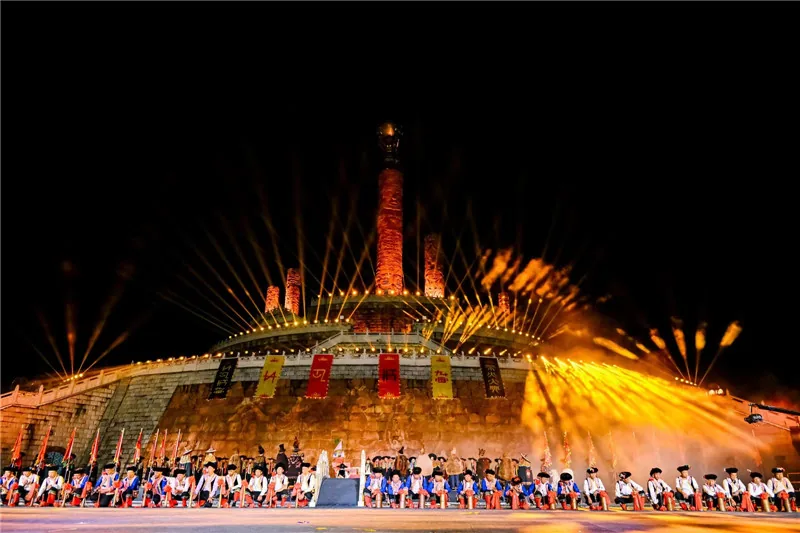
At 1:00 PM, I took a small village minibus to Tiaocai (Serving-while-dancing) Village. A 15-minute drive, with layered tea gardens and pine trees on both sides of the road. The wind carried the scent of tea and resin. In the square of Tiaocai Village, a temporary stage was set up, surrounded by people: elderly people in Yi Charwa, tourists with cameras, and barefoot children chasing butterflies. Even the grandpas smoking by the wall joined in. The Tiaocai Dance began—eight dancers wore black velvet Charwa and ritual hats decorated with pheasant feathers. Each carried a red lacquer tray on their head, containing blue and white porcelain bowls (filled with pickles) and small wine pots (shaking with bubble wine). As the music started, they began to dance to the drum beats: their steps were as fast as a machine gun, yet their bodies were as steady as being nailed to the ground. Not a bowl on the trays wobbled, and not a drop of wine from the pots spilled. A grandpa in a navy blue side-buttoned jacket slapped his thigh while explaining: “This is a provincial-level intangible cultural heritage! It used to be for serving dishes to the Tusi (local chieftain). You have to practice for three years before you dare to go on stage. Now it has become our Yi family’s blessing dance.” I stared at the hand of a young dancer; he wore a silver bracelet on his wrist that shook with the rhythm, as if touched by the wind.
After watching the dance, I followed the owner of Tiaocai Village to visit the Ancient Tea Garden. The owner wore a navy blue T-shirt, with tea dust on his trousers and knuckles as thick as old tree roots: “This tea garden was planted by my grandfather’s generation; it’s almost a hundred years old.” The tea trees were not tall, reaching my shoulder, and the leaves were so shiny they looked waxed. The owner picked two tender leaves and tucked them into my hand: “Chew them; they are very fresh.” I put them in my mouth; first a faint bitterness, then a sweetness emerged like a sip of freshly brewed spring tea with the clarity of mountain mist. The tea garden was very quiet, with only bird calls and the rustle of the wind blowing the tea leaves. I crouched down to touch the roots of the tea trees; the bark was rough like a grandma’s palm, holding the temperature of the years.
At 6:00 PM, I returned to the Mountain-View Yi Courtyard at the edge of the village. The yard was not large, with two cherry trees growing there, green fruits swaying on the branches. The room was on the second floor, with a window facing the mountain—the sunset dyed the mountain orange-red like a layer of honey, and after a while, stars came out, as dense as diamonds scattered on black velvet. The owner brought a bowl of wild mushroom soup, with termite mushrooms, porcini, and a bit of tender tofu floating in the ceramic bowl: “You are returning tomorrow; have a bowl of hot soup to nourish yourself.” The broth was so fresh my tongue almost melted; the fragrance of the termite mushrooms and the richness of the porcini mixed with the tenderness of the tofu. I drank two bowls, my whole body warming and trembling.
Lying in bed, listening to the insects outside and smelling the mountain grass, I felt the tea dust the owner had tucked into my pocket (he said, “This is this year’s new tea; it’s more fragrant when brewed than what you buy”). I suddenly understood—Nanjian is not a scenic spot; it is the vitality kneaded into every bite of mixed noodles, every dance, and every tea leaf. The mountains are awake, the tea is awake, and even the wind carries the laughter of the Yi family. I have to leave tomorrow, but this warmth will stay in my heart for a long, long time like the stars.
Day 6: Return from Nanjian, Ending with the Morning Market
At 7:00 AM, holding the thermos I had tucked into the side pocket of my bag last night, I stepped onto the flagstones of Nanjian County wet with dew and headed into the morning market—the branches of the old locust tree at the alley entrance still held last night’s mist, dripping by my feet and splashing. From afar, I could hear the calls of the stall owners clashing: “Fresh pickled vegetables!” “Handmade shawls, they don’t fade!” “Xidoufen (pea porridge) over youtiao, it’s hot!”
Yi-style Shawls at the Handicraft Stall
I first squeezed through to the busiest handicraft stall. The landlady was a small sister in a navy blue side-buttoned jacket, sitting on a small stool weaving a shawl with red and black wool. The wool wound through her fingers like a small flame that wouldn’t go out. “Young lady, want a shawl?” She looked up, with laughter hidden in the wrinkles at the corners of her eyes. “I wove it myself. Red and black are our Yi family’s lucky colors. I used madder from the mountain for the dye, soaking it for three days and three nights.” She handed me the semi-finished product; the texture of the wool was as rough as sun-dried grass, yet it held the warmth of the sun. I draped it over my shoulders; the red and black stripes made my skin look bright. The sister pulled a glass jar from a cloth bag at her feet: “Inside is dried madder; soak some when you want to wash it, and it will get brighter the more you wash.” I paid and carefully folded the shawl into my bag.
Pickled Vegetables in Glass Jars
The neighboring stall had a row of glass jars with hand-written white paper labels: “Yi Family Pickled Vegetables · Pickled for 30 Days.” The vegetables in the jar were soaking in a light brown liquid, the green leaves still with water droplets. It smelled so sour it shot into my nose, like the radishes my grandma used to pickle in my hometown. I picked two jars, and the owner wrapped them tightly in old newspaper: “Hold them steady, don’t drop them—put a handful in when you cook fish at home, it’s ten times fresher than MSG from the supermarket.” The newspaper still held the warmth of the owner’s palm, wrapped with the sour fragrance of the pickles, like carrying a handful of Nanjian wind.
The Warmth of the Xidoufen Stall
Further along, I squeezed through to the Xidoufen stall. The pea porridge in the bamboo tray was so thick it could cling to a spoon. The owner was using a copper ladle to scoop a spoonful, pouring it over freshly fried youtiao. “Young lady, want a set?” He handed me a youtiao, golden and crispy with sesame seeds on the skin. I took a bite of the youtiao dipped in pea porridge—it was savory with the sweetness of the beans. The youtiao soaked up the juice of the pea porridge, and it went “kacha” when I bit down; I couldn’t even bear to spit out a crumb. The owner said with a smile: “This pea porridge is made from soybeans ground this morning; no gypsum was added, it’s just about freshness.” I finished it while crouching by the stall with a paper bowl, drinking half a mouthful of the soup, warming my stomach.
At 12:00 PM, I packed my luggage and checked out. The guesthouse owner Ah Qiang stuffed a bag of wild walnuts into my hand: “Something for the road; Nanjian walnuts have thin shells and large kernels.” Holding my bag, I walked toward the bus station, passing Old Yang’s stall where I had the termite mushroom mixed noodles yesterday. He shouted to me: “Next time you come, I’ll save the freshest termite mushrooms for you!” I waved, and the bus was already stopped at the intersection.
The bus drove for two hours back to Kunming. I felt the glass jars in my bag; the sour fragrance of the pickles still drifted through the newspaper cracks, like a Nanjian morning. That night, lying in my bed at home, the sheets still smelled like the jasmine of my laundry detergent, but I could always smell it—I could smell the resin in the fire pit, the bitter fragrance of the buckwheat cake, and the wine fragrance of the Tiaocai dance. I still had the video of the Tiaocai dance on my phone, with the dancers’ trays swaying and the grandpa’s explanation still in my ears: “This is a dance for serving dishes to the Tusi. You have to practice for three years before you dare to go on stage…”
I realized the meaning of travel has never been about how many photos were taken. It’s the warmth of the shawl on my shoulders, the freshness of pickled vegetables in fish soup, the aroma of Xidoufen over youtiao, and this warmth hidden in the smoke and fire that has been kneaded into the days to come—even after a long time, as soon as I smell a similar scent, I can remember the morning market in Nanjian, the sister’s smile, and those slowed-down times.“`
Related Reading
- 7-Day March Street Festival Guide: Dali Bai Ethnic Celebration + Nearby Ancient Villages, One-Stop Folk Culture & Food Experience
- 9-Day Off-Peak Yunnan National Day Route: Skip the Crowds in Dali & Lijiang, Visit Shaxi, Lugu Lake & Yubeng for a More Relaxing Trip
- 7-Day Yunnan Lunar New Year Escape Guide: Xishuangbanna + Yuanyang Rice Terraces + Jianshui Ancient Town—Celebrate Without Crowds, Spend Less
- 8-Day Border Exploration of Yunnan: Ruili + Tengchong + Yingjiang + Mangshi, Exotic Scenery and Cuisine on the China–Myanmar Border
- 10-Day Meili Snow Mountain Circumambulation Trek: Yubeng + Sacred Waterfall + Ice Lake + Holy Lake, Pilgrimage of Tibetan Locals & Natural Wonders
Dali — — Practical Data
Tickets & Booking
- Xizhou Ancient Town: Free; Yan Family Residence about CNY 18, Yan Family Courtyard Museum about CNY 21–30; Xizhou wheat-field mini-train CNY 35; no booking required[src]
- Shuanglang Ancient Town: Free; Nanzhao Customs Island about CNY 50–56; no booking required[src]
- Erhai cruise: About CNY 142 per person (the Greater Shuanglang line one way and other ticket types)[src]
Transport & Schedules
- Dali station → Kunming South station | EMU: E.g., D8784/D8781: Dali departs 15:40–Kunming South terminates 18:22, 2 h 42 min total, 356 km; stops at Yunnanyi, Chuxiong, Guangtong North, Lufeng South, Kunming[src]
Where to Stay · Room Type · Nearby
- Dali Ancient Town | Reference price Moderate range (mostly OTA guesthouses) | Room tip: Convenient for food, lodging and transport, suitable for a first visit to Dali | Nearby add-ons: Chongsheng Temple Three Pagodas, Renmin Road night market, Cangshan Gantong cableway[src]
- Shuanglang Ancient Town | Reference price On the high side (lake-view guesthouses) | Room tip: Right by Erhai with a good view but relatively inconvenient transport | Nearby add-ons: Nanzhao Customs Island, Yuji Island[src]
Typical Climate & Packing (Past Years)
- January: 2 °C–16 °C °C, [Travel climate reference]
- February: 4 °C–18 °C °C
- March: 6 °C–21 °C °C
- April: 9 °C–24 °C °C
- May: 12 °C–25 °C °C
- June: 15 °C–25 °C °C, Rainy season






