



Day 1: Arrive in Dali · Head Straight to the Main Venue of the March Street Ethnic Festival
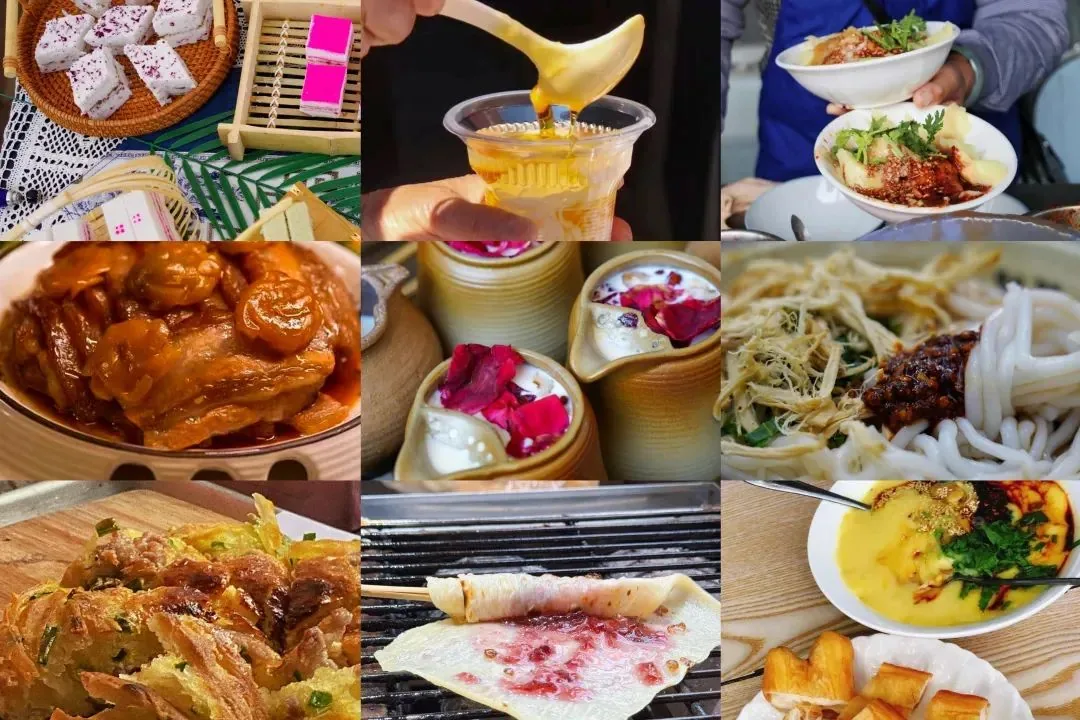
While taking the high-speed train from Kunming South to Dali North, I stared out the window as the scene shifted from a concrete jungle into the mountains of Yunnan—first, light green peaks touched by morning mist, then deep green slopes, occasionally passing wild cherry trees with white blossoms. On the train, an auntie wearing a Bai ethnic apron pushed a cart selling flower cakes. I bought a rose-filled one; the crust was so flaky it crumbled, and the rose jam was naturally sweet without the cloying taste of artificial sweeteners. 2 hours later, I arrived at Dali North Station. The wind outside the station was thick with the salty humidity of Erhai Lake. I hailed a ride, and the driver was a big brother wearing a silver bracelet. Hearing I was going to March Street, he immediately laughed: “Lucky girl! There is horse racing at the main venue today. I’ve driven many tourists; getting there early means you can grab a front-row spot without being blocked.” After a 20-minute drive, passing the March Street Ethnic Culture Square at the west gate of the Ancient City, I could hear the clamor of voices from afar, like the aroma of honey-soaked corn cakes drifting in the air.
10:00 AM Squeeze into the Racecourse
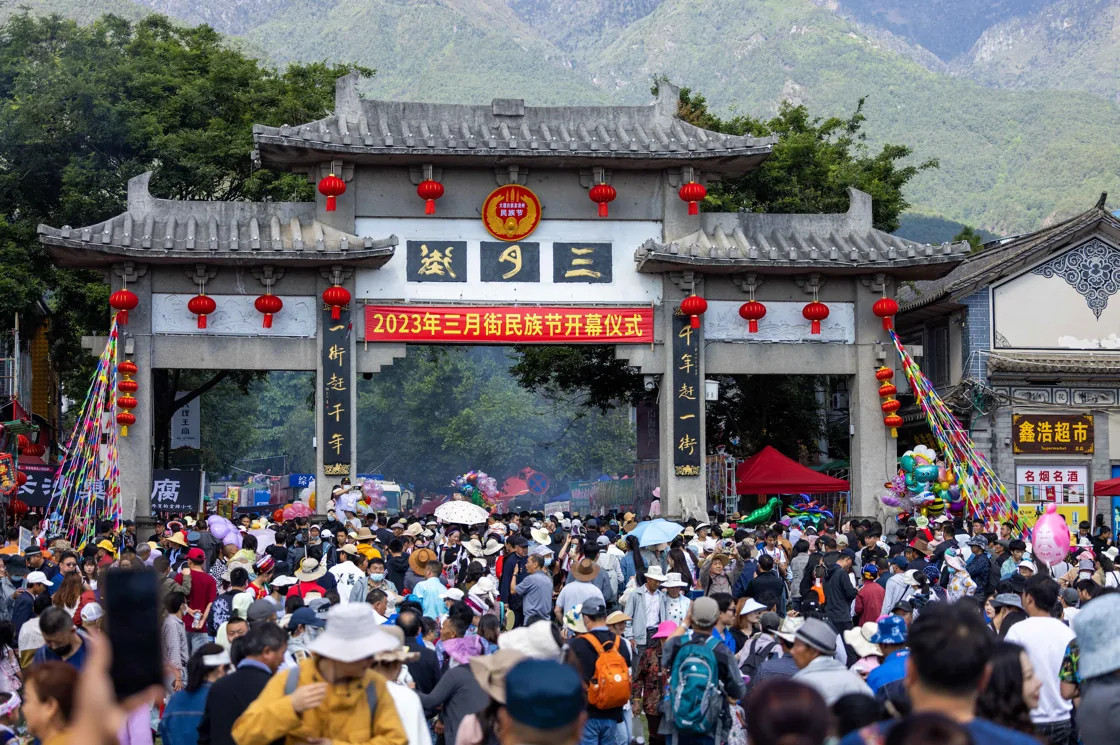
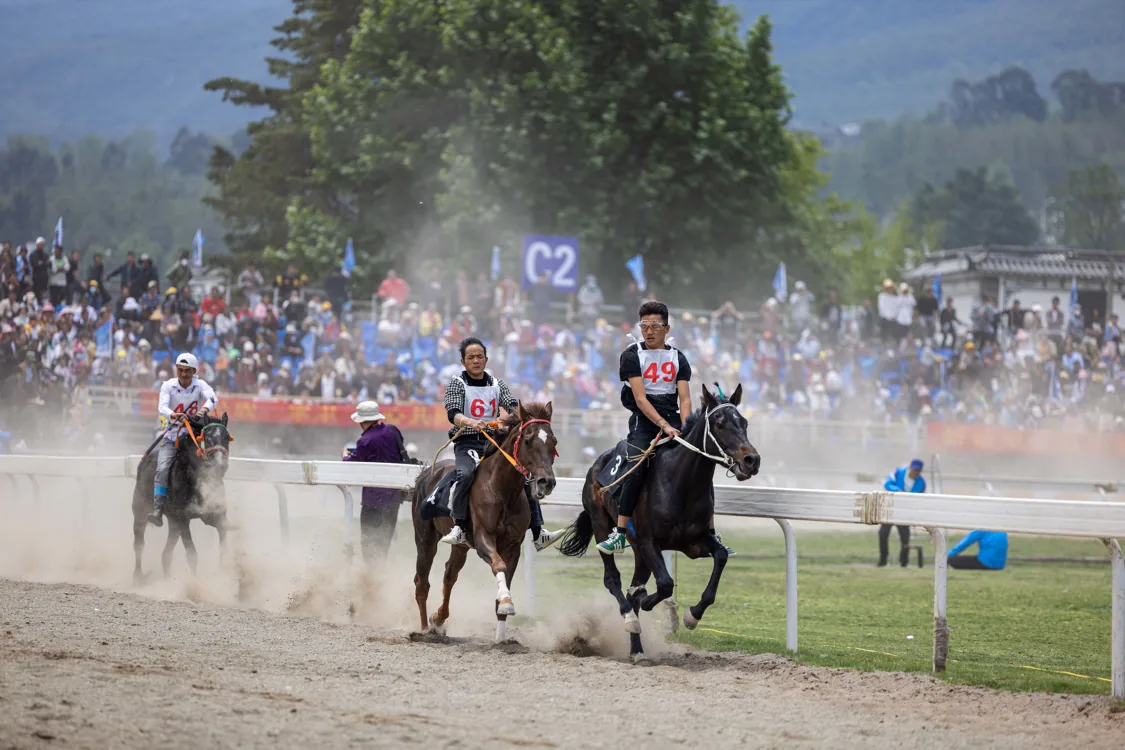
The venue entrance featured a bamboo-woven “March Street” archway. I gripped my phone and squeezed toward the front—dozens of floral plastic sheets were already spread on the ground, and aunties were holding insulated thermoses to claim their spots while young men stood on tiptoe with selfie sticks. At 10:00 AM sharp, the riders wearing red-tasseled hats lined up in a row, the copper bells on the horses’ necks clinking out a rhythm. “Ready—” As soon as the referee’s whistle blew, the horses “whooshed” out. The riders’ red-tasseled hats were blown back to their shoulders by the wind, and the manes whipped faster than the hooves, sending grass clippings fluttering onto the back of my hand. One rider’s hat fell off; he leaned down to pick it up, and the black horse behind almost collided with him, sending the whole crowd into a roar of laughter. The winning rider was a young man in a navy blue waistcoat, surrounded by tourists wanting to touch his shoulders. He held his certificate and smiled, sweat glistening on his face in the sunlight. I squeezed through the crowd to film a video; the audio was full of screams, ten times more exciting than horse racing on TV—it wasn’t special effects, my heart was truly jumping along with the sound of the hooves.
Afternoon Squatting at the Tie-dye Stalls
The tie-dye exhibition area next to the main venue was like a blue ocean, with each shed hanging fabrics of different patterns: some resembled the starry sky like “Cangshan Snow,” others were covered in vines like “Raosanling.” I crouched in front of the stall of an elder sister wearing a navy blue side-buttoned shirt. She was pinching a piece of cloth and threading a needle, her silver thimble flashing in the sun. “Sister, what does this butterfly pattern mean?” I asked, pointing to the design on the fabric. She looked up, her fingers tracing the stitches: “This is our Bai people’s ‘Butterfly Mother.’ Legend says she gave birth to humanity; wedding quilts and baby clothes must be embroidered with this.” She picked up a freshly dyed square scarf, a translucent blue, as if the sky of Cangshan had been crushed and soaked in Isatis root water: “Look at this color; it’s the result of soaking Isatis root for 3 days and drying it in full sun—the grayish fabrics sold in tourist spots are rushed out without being thoroughly dried.” I reached out to touch it; the fabric was a bit stiff but carried a faint herbal scent. She smiled: “Wait until it has seen 7 days of sun, it will be as soft as the cotton T-shirt you’re wearing.” She even taught me how to use cotton thread to tie a small knot. Although it was crooked, she stuffed the cloth into my hand: “Take it back to soak and dye; it will be uniquely yours.”
Evening Stay at Yunqi Guesthouse
I took a taxi to the west gate of the Ancient City. The two bougainvilleas at the alley entrance bloomed like a waterfall, petals falling on the wooden door of the guesthouse. The boss was an uncle wearing a tie-dye apron. He took my luggage and his first words were: “Hungry? I have cold chicken rice noodles warming on the stove.” The rice noodles were the thick, round type, springy to the bite. The chicken was shredded into thin silks, drizzled with sour papaya juice, millet chili, and two spoonfuls of pickled vegetables. I took a slurp; the sourness of the papaya wrapped around the fragrance of the chicken, and the millet chili brought heat with just one bite but didn’t burn the throat—it was like eating the spring of Dali. The uncle sat opposite me peeling peanuts: “If you want to wander the Ancient City tomorrow, we have tie-dye experience classes; my wife teaches them. You don’t need to buy those finished products at tourist spots; only things you make yourself have warmth.” The room was on the second floor, the window facing the phoenix trees at the alley entrance. When the wind blew, the leaves rustled, and a bag of dried jasmine was placed by the pillow, smelling like all the excitement of the day had been kneaded into fragrance.
Day 2: Slow Play in Dali Ancient City · Learn Tie-dye and Make Bai Pastries
At 8:50 AM, I headed out clutching a warm roasted Erkuai given to me by the guesthouse boss last night—the Erkuai was wrapped with sweet sauce and crushed peanuts, crispy on the outside and soft on the inside. Walking toward the middle section of Renmin Road, the wind carried the sweet and sour scent of tamarind juice and the bean fragrance of soy milk. An old lady selling Burmese gardenias at the alley entrance held a bamboo basket, dewdrops still on the petals. I bought a string to hang on my bag; it was so fragrant that even a passing kitten came over to sniff.
“Clumsy Hands” Class in the Tie-dye Workshop
The storefront of Lanxu Tie-dye Workshop was hidden under an old locust tree on Renmin Road. The wooden sign was engraved with gold-foiled “Lanxu.” Pushing the door open, the yard was full of the scent of Isatis root—large vats stood in the center of the courtyard, soaking deep green blue grass, with sunlight filtering through the grape trellis and casting flickering light on the vats. My teacher was Sister Li, who had her hair in braids. Her finger joints were as thick as old tree roots, yet she could twist fabric into a perfect braid: “Look, you have to wrap it three times like this, and the cotton thread must be tied tight, otherwise the pattern will blur when dyed.” I followed along, but my hands kept shaking, and the cotton thread was wrapped crookedly; in the end, my square scarf looked like a tangled mess. Sister Li smiled and said: “This is good; every piece of cloth has its own temper.” The indigo in the vat was dyed 3 times; when taken out, the cloth was as stiff as a brick. Li said, “Take it back and soak it for 3 days; it will be as soft as the cotton T-shirt you’re wearing.” I pinched that blue fabric with white lines, my fingertips rubbing against the texture of the cotton thread, smelling the sun-dried herbal scent. I couldn’t even bear to put it in my bag and draped it directly over my arm.
Climbing Wuhua Tower
By the time I left the tie-dye workshop, it was already 11:00 AM. I followed the cobblestone path toward Wuhua Tower—the stairs were old blue flagstones, each step making the soles of my feet ache, and the verdigris on the handrails made my palms itch. Halfway up, I met a grandma carrying a bamboo basket filled with freshly picked vegetables. Seeing me panting, she stopped and laughed: “Little girl, climb slowly, the wind is good up there.” When I stood atop Wuhua Tower, the wind carrying the clouds of Cangshan hit me. In the distance, the Three Pagodas looked like needles stuck in a green velvet carpet, and the alleys of the Ancient City looked like a chessboard, with the fragrance of tea from several teahouses drifting between the blue tiles and white walls.
I took out my phone to snap photos. While adjusting the angle, the shadow of Cangshan happened to fall on the roofs of the Ancient City. A friend replied instantly to my photo: “This is Dali, right? It looks like it was cut out from a painting!” The scent of Puer tea drifted from the tea stall below. I bought a cup of herbal tea and sat on the steps to drink half a cup. The wind blew my hair, and even my troubles seemed to drift away.
Broken Crispy Baba and Xidoufen
Walking down Renmin Road at noon, the sign for Yang Shunbao Broken Crispy Baba hung at the alley entrance. The red paint had peeled a bit, but it looked more flavorful than a new sign. The boss was kneading dough, flour on his hands. Seeing me, he handed over a freshly fried sweet Baba—the crust was so flaky it crumbled, and biting into it revealed scalding rose filling. The fragrance of fresh rose jam wrapped around the sugar, sweet but not greasy. The savory Baba was filled with ham and shiitake mushrooms; it felt like it would burst with juice when bitten. The ham was old Xuanwei ham, and the mushrooms were soaked and stewed soft. I paired it with a bowl of Xidoufen from the neighboring stall (5 yuan). The boss used a copper ladle to scoop the pea porridge, which was thick and creamy, added some peppercorn powder and sesame, and poured it over the Baba. The bean fragrance wrapped around the oiliness of the Baba. I ate two in a row, my stomach rounding out, yet I still wanted another.
A-Niang’s Rushan Sachima
It took some effort to find A-Niang’s Handmade Workshop in the afternoon. Finally, an auntie selling handmade cloth pointed to a small door in the alley: “Follow it to the end, the one with the blue-dyed curtain.” Lifting the curtain, an old lady sat at an altar table wearing reading glasses, a piece of Rushan (milk fan) in her hand: “You’re here? Sit, I’ll teach you how to make Sachima.” The Rushan was freshly roasted and crispy. The old lady taught me to cut it into thin strips, coat them in egg wash, and fry them in the oil pan—otherwise, they would absorb too much oil. Fry until golden and scoop out. The syrup was made with brown sugar, boiled until amber and bubbling before turning off the heat. I poured the fried Rushan in; I flipped them too quickly, and a few pieces were scorched. The old lady took over with a smile: “It’s fine, scorched ones are crispier.” She gave me a warm bowl; the Rushan Sachima was sweet but not greasy, incredibly crispy. I ate two pieces while she sat opposite me peeling an orange, saying: “Next time you come, I’ll teach you something even simpler that doesn’t require frying.”
Dongjing Music
In the evening, the guesthouse boss took me to listen to Dongjing Music at the Nanzhao State Music Hall. Red lanterns hung at the door, and rows of wooden chairs were arranged inside. The performers wore hand-embroidered Bai ethnic costumes with silver ornaments at the collars. When the music began, the sound of the Sanxian was like a tinkling spring, and the suona was as high-pitched as a mountain eagle. The scent of sandalwood drifted from backstage, wrapping around the music and entering my nose. I sat in the third row, staring at the performers’ hands—the strings of the Sanxian were plucked rapidly, and the suona player’s mouth was tight. The piece was “Water Dragon Chant.” As I listened, the surrounding noise vanished; there was only music and sandalwood. I felt myself sinking into a calm state, my breathing slowing down. The boss said: “This music was passed down by our ancestors. In the past, people only hired musicians to play for weddings. We are lucky to be able to hear it publicly now.”
When I walked out of the music hall, the Ancient City was lit up. The lanterns in the alleys reflected on the cobblestones with a warm red glow. I felt the tie-dye scarf in my bag and smelled the Rushan fragrance on my hands, remembering the old lady selling Burmese gardenias in the morning, the broken crispy Baba at noon, the old lady in the afternoon, and the Dongjing music in the evening—this day wasn’t spent rushing to sights or taking “check-in” photos, but just slowly doing handicrafts, eating delicious food, and listening to music, kneading the slowness of Dali into every cell.
On the way back to the guesthouse, the boss was waiting for me at the door and handed me a cup of hot milk: “Had a good time today?” I nodded, drinking the milk while looking at the moon, which was even rounder than yesterday. The scent of sweet osmanthus from the neighboring guesthouse drifted in the wind. I knew this was the life of Dali—unhurried, with a surprise hidden in every step.
Day 3: Xizhou Ancient Town · View Old Bai Houses and Eat Xizhou Baba
At 7:50 AM, I pinned the string of Burmese gardenias given by the guesthouse boss last night onto my bag strap—the petals still had last night’s dew, fragrant enough to wrap around my wrist three times. Walking toward the west gate of the Ancient City, the soy milk stall at the alley entrance was steaming. I bought a sugar-oil fruit to munch on while waiting for the minibus: a green minibus wobbled to a stop at the roadside. The driver wore a navy blue uniform; seeing me carrying a bag, he helped me put it in the trunk: “To Xizhou? Sit in the front, you can see the view.”
As the car started, the wind carrying the sweet scent of rapeseed flowers hit me—on the ridges on both sides of the road, golden waves of flowers reached the horizon, occasionally passing peas with purple blossoms. The driver said: “It’s March Street today, so there are more people in Xizhou than usual. Go to the Yan Family Compound first, then eat Baba, and don’t miss the Liangxia (cold shrimp) at noon.” 40 minutes later, the car stopped under the archway of Xizhou Sifang Street. I gripped my 10-yuan ticket and got off. Under my feet were cobblestones with moss in the cracks, a bit slippery to step on.
Yan Family Compound
The lintel of the Yan Family Compound was engraved with “Fortune, Prosperity, Longevity, and Happiness” brick carvings, with stone lions crouching on both sides, a bit of moss on their ears. Stepping over the threshold, the old sweet osmanthus tree in the courtyard cast spots of light on the cobblestones. The guide was a girl wearing a Bai tie-dye skirt, her fingers tracing the “Pine and Crane for Longevity” embroidery in the hall: “This stitch is ‘random stitch embroidery’; a Bai grandma needs 3 years of study to master it. Pine is for longevity, and crane is for luck. In the past, merchant families always hung this.”
She took me to wander the wing rooms, where an old spinning wheel stood by the window—the wooden axle was polished shiny from use, with half a strand of cotton thread still wrapped around it. “In the past, Xizhou women would sit here spinning thread, weaving it into cloth to sell on the street for salt and tea.” The girl pointed to a loom in the corner: “Look at this shuttle; it’s made of date wood and has been used for decades, still smooth.” I touched the wooden handle of the spinning wheel; it was rough to the touch, but I could imagine an old grandma sitting there, spinning thread while humming a Bai tune. The ticket was 30 yuan, and I felt it was worth it—it wasn’t just looking at an empty house, but touching the “living history” of the Bai merchant gangs.
Old Xizhou Baba Shop
Leaving the Yan Family Compound, the oily fragrance of Baba drifted to my nose—a long queue formed at the “Old Xizhou Baba Shop” at the entrance. The boss wore a blue cloth apron, his hands kneading dough on the counter, where two bowls of filling were placed: one with sesame sugar and one with scallion and meat.
“Sweet or savory?” the boss asked, his hands never stopping. I bought one of each: the crust of the sweet Baba was flaky and crunchy; the moment I bit into it, scalding sesame sugar flowed out, sweet but not cloying, with a toasted sesame aroma. The savory one was filled with ham and shiitake mushrooms; the scallions were fresh small fragrant scallions picked this morning, and the meat was finely minced. It was juicy and savory with a hint of freshness.
I paired it with a bowl of Xizhou Liangxia from the neighboring stall (5 yuan). The boss used a copper ladle to scoop up the “small shrimp” made of rice milk, which were slippery, and added a spoonful of brown sugar water—the rice fragrance wrapped around the sweetness of the brown sugar, cold and refreshing, perfectly cutting the greasiness of the Baba. A girl in Hanfu in the queue was taking photos of the Baba with her phone: “I want to show this to my friends back home; this is the real Dali breakfast!”
March Street Branch Venue
In the afternoon, I wandered over to the March Street branch venue at Xizhou Sifang Street, which felt more like a “locals’ market.” Bamboo baskets were placed on the cobblestones, and an auntie selling embroidery sat on a small stool with a blue cloth spread before her, displaying butterfly embroidery wallets: “I embroidered this until 10:00 PM last night. 20 yuan each. I dyed the threads myself; they don’t fade.” The auntie wore a silver bracelet, her fingers stained with embroidery thread. I bought one; the butterfly on the wallet was so vividly embroidered it looked like it was about to fly.
Next to her, a man selling wild mushrooms wore his straw hat low, holding Ganba mushrooms: “Picked on the mountain at 6:00 AM! Dried for 3 days, they can be kept for half a year! Use warm water when soaking, add a little salt, and they can be used for chicken soup—so fresh you’ll swallow your tongue.” There were grass clippings on his straw hat and a hole in his sleeve, but his smile was very sincere. I pinched a bit of the Ganba mushrooms and could smell the fishy sweetness of the forest.
Return Minibus
In the evening, I took the same minibus back to the Ancient City. An auntie wearing a bamboo hat carrying vegetables sat next to me. she struck up a conversation: “Young lady here for March Street? When I was young, going to the market meant walking 10 miles, carrying a basket to sell homegrown potatoes. It’s better now; the roads are finished, and we can enjoy the gathering.”
She counted on her fingers: “In the past, March Street was the ‘big fair before the farming season,’ for selling tools, exchanging seeds, and buying salt. Now it’s a ‘festival’ where everyone comes to play. My grandson followed the crowd dancing to Bai tunes yesterday, laughing his head off.” The car drove past a rapeseed field, and she pointed out the window: “Look, that field of flowers belongs to my family. When the flowers fade, we will plant garlic—life in Dali is like this, following the seasons.”
Returning to the Ancient City, the lanterns in the alleys were already lit. Feeling the embroidery wallet in my bag and smelling the Baba fragrance on my hands, I remembered the spinning wheel at the Yan Family Compound, the sweetness of the Liangxia, and the auntie’s bamboo hat—this day wasn’t spent checking in at any viral spots, but felt like walking into Bai life: old houses hidden with stories, Baba shops drifting with smoke, and the branch venue chatting about old times.
The guesthouse boss was waiting for me at the door and handed me a warm cup of milk: “How was the day?” I nodded, drinking the milk while looking at the moon, which was softer than yesterday. The scent of sweet osmanthus from the neighbor’s drifted in the wind. I knew this was the “slowness” of Dali—it’s not intentional, it’s just how life should be lived.

Day 4: Erhai East Line · View the Sea at Shuanglang and Drink the Three-course Tea
When the morning wind carrying the scent of grass drifted through the guesthouse window, I was crouching in the yard munching on roasted Rushan. The landlady came over with hot soy milk: “Going to Shuanglang? The electric scooter is fully charged at the North Gate; here are the keys.” The seat was covered in faded blue-dyed cloth. I hopped on and twisted the handle. In the morning light, my tie-dye scarf was blown up, like a flying cloud.
Cycling on Dali Road: Rapeseed Flower Sea Hits the Eyes
Out of the North Gate, the salty smell in the wind became stronger—it was the scent of Erhai. The scooter rolled over the asphalt road wet with dew, and the rapeseed flower fields on both sides suddenly surged over. Golden waves of flowers rushed before my eyes, petals with tiny dewdrops falling into the basket. I quickly squeezed the brakes to stop by the ridge and took out my phone to snap photos: in the lens, yellow flowers stretched to the horizon, with the pale blue Erhai behind and clouds drifting slowly. An auntie wearing a Bai tie-dye skirt carrying a hoe passed by, saying with a laugh: “Young lady, these flowers are blooming more vividly than last year!”
After 40 minutes of riding, the stone archway of Shuanglang finally appeared. The aerial roots of a giant banyan tree swept over the handlebars. I parked the scooter at the entrance to Yuji Island. The landlady was drying fish outside and shouted to me: “Follow the boardwalk to the end; that’s where the water is clearest!”
Yuji Island
The bamboo gate of Yuji Island creaked open, and the bougainvilleas were blooming crazily, purple petals covering the ground. The ticket was 25 yuan. The sister checking tickets wore a moon-white tie-dye top and pointed toward the sea: “Be careful, the boardwalk is slippery; don’t just focus on taking photos.”
The wooden boardwalk was warmed by the sun. I stepped on it with a creaking sound. The sea water was incredibly clear—I could see the pebbles under the water and a few gray-black small fish darting by. I crouched by the boardwalk and touched the surface; the coldness shot up through my fingertips, but I couldn’t help touching it a few more times. Rounding a corner, a rock jutted out over the sea. I stood on it and took out my phone: Cangshan was behind me with cotton-candy clouds at its peaks, and the sea was before me, waves gently lapping against the rock, the splashing water wetting my trouser legs.
The island features Yang Liping’s Sun Palace, but I didn’t head over. Under an old locust tree at the end of the boardwalk, several local grandmas sat weaving fishing nets, the thread spools spinning fast in their hands. One of them looked up and smiled: “Beautiful sea, isn’t it, young lady? We’ve watched it since we were children and still can’t get enough.”
Yuwuozi Diner
Walking back to Shuanglang Town from Yuji Island, I turned into the alley of Dajianpang Village. The red curtain of “Yuwuozi Diner” was fluttering in the wind. The boss was cleaning vegetables at the door; seeing me, he wiped his hands: “Sit outside! You can see the sea!”
When the sour and spicy fish was served, the clay pot was still bubbling. Bow-fish is a specialty of Erhai; the fish meat was so tender it melted in the mouth. The refreshing sourness of the papaya wrapped around the fragrance of the millet chili. With one sip of the broth, sweat immediately broke out on my forehead. I also ordered seaweed and taro soup—the seaweed was slippery, jumping in the mouth, and the taro was stewed soft. Only a bit of salt was added to the soup, so clear you could taste the sweetness of the ingredients.
An old man at the next table brought his bowl over: “Young lady, try this soup! It’s more effective than city health products!” I smiled and clinked bowls with him, watching him peel peanuts. Sunlight filtered through the bamboo curtain onto the table, overlapping our shadows.
Three-course Tea
In the afternoon, I wandered over to the Yuji Island Performance Hall, where the aroma of the Three-course Tea was already drifting out. The venue was converted from an old Bai house, with faded tie-dye fabrics hanging on the walls. The performers wore hand-embroidered side-buttoned shirts, their silver head ornaments making fine clinking sounds.
- The first course, Bitter Tea, was served in a small porcelain cup. The tea was amber, tasting slightly bitter at first like chewing on dried tea leaves, but with a toasted aroma. The performer said: “Eat bitter first to understand the sweetness that follows.”
- The second course, Sweet Tea, was served in a larger cup, with crushed walnuts, sesame, and honey swirling inside. One sip was richly sweet, the walnut fragrance wrapping around the sesame crunch—like swallowing the harvest of autumn.
- The third course, Aftertaste Tea, was the most ingenious—honey, peppercorn, and ginger surged in the tea, leaving the tongue numb at the end. The performer explained with a smile: “This numbness is to remind you that life should be savored slowly.”
When the performance ended, a performer gave me a small bag of tea: “Take it back to boil; this is the taste of Shuanglang.” The tea bag still held her body heat, and I carefully tucked it into my bag.
Night in Shuanglang
The guesthouse I stayed in at night was by the Shuanglang sea, a small room for 200 yuan a night with a balcony directly facing Erhai. Tie-dye sheets were hanging on the clothesline. When the wind blew, the blue cloth drifted like a swaying dream. I sat in a rattan chair, feeling the salty wind and listening to the waves lapping against the shore—the sound of the waves was very slow, like someone gently rocking a cradle.
The landlady brought hot milk: “Tired from riding today? Drink this and sleep early.” The milk was sweet. I held the cup and looked at the stars; the ripples of Erhai crushed the starlight and pieced it back together. The sweet scent of the roasted Rushan from the day remained by the pillow, mixing with the smell of the sea breeze, making even my dreams soft.
Lying down, I remembered the rapeseed flower field in the morning, the clear sea of Yuji Island, the sour and spicy fish soup, and the bitterness and sweetness of the Three-course Tea—this day wasn’t spent rushing to sights or taking “check-in” photos, but just following the wind on a scooter, finding food by scent, and listening to stories from the elderly.
I realized the most healing travel is putting yourself into the scenery—walking slowly, tasting slowly, waiting for a cloud to pass, for a bowl of soup to become warm, and for the waves to hit the shore for the eighth time.
Tomorrow I’ll see the country street of Shaxi, but for now, I just want to rest soundly to the sound of the waves.
Day 5: Erhai West Line · Shaxi Ancient Town Market and Folk Songs
I took the minibus to Xiaguan Bus Station. There weren’t many people, so I picked a window seat. Rapeseed flower fields outside rolled golden waves, occasionally passing Lake Jian, the water shimmering like scattered silver foil. An hour and a half later, Shaxi Bus Station was hidden at the end of an alley. The cobblestone path was so narrow only two people could walk side by side. Old houses on both sides were covered in ivy, and stalls selling roasted Erkuai were at the foot of the walls. An auntie shouted: “Sweet or savory?” I bought a sweet one; it was crispy on the outside and soft on the inside, the sweet sauce wrapping around the Erkuai fragrance—Shaxi’s first welcome to me.
Sideng Street
The archway of Sideng Street was right at the bus station exit. Half the red paint had peeled, but it had more layers of time than a new archway. The Old Stage stood behind the archway, the base half a person high, with thick moss looking like a green velvet carpet. Several Bai elders sat on the edge of the stage. An old man in a navy blue side-buttoned shirt held a Sanxian, the body polished shiny. When the strings sounded, it was like a melody from an old gramophone—I couldn’t understand the lyrics, but it was as soft as a stream flowing through stone gaps, wrapping around people.
The auntie selling roasted Erkuai came over: “This is ‘White Moon,’ singing about a girl waiting for her lover.” I crouched nearby to listen. The wind carried the sesame scent from the neighboring Erkuai stall, and the sound of the Sanxian mixed with the smell of mugwort (a cluster of mugwort grew by the stage), making me feel strangely at peace. I didn’t stand up reluctantly until the sun climbed overhead, the hem of my trousers wet from the moss.
Old Stage Restaurant
Walking further into Sideng Street, the blue cloth banner of “Old Stage Restaurant” was embroidered with a Bai peony. The boss was a bald man in an oily apron. Seeing me, he shouted: “The clay pot takes half an hour; eat roasted Erkuai first!” I sat on a small stool at the door, biting the roasted Erkuai he handed me—the crust was crispy and the inside soft, dipped in his sweet sauce, just sweet enough.
When the clay pot was served, the pot “hummed,” and the surface was covered in a golden layer of oil. The ribs were stewed until falling off the bone, the potatoes were as soft as mash, and the cabbage soaked up the freshness of the soup. Most wonderful was the dried pickled cabbage inside, translucently sour, the meat fragrance drifting to the nose. I devoured two bowls of rice. The boss laughed while wiping sweat: “This pot was cooked over a wood fire, ten times more fragrant than an induction cooker—if you come in winter, the soup can warm your toes.”
A-Po Roasted Milk Cake
The boss recommended the neighboring “A-Po Roasted Milk Cake” stall. Grandma wore blue cloth gloves and placed the goat milk cakes over the charcoal fire; the oil “sizzled” and the aroma immediately filled the street. The roasted milk cake was golden with a charred crust. Grandma handed it over: “Dip it in sugar; it’s more fragrant than cheese!”
I took a bite—the milky fragrance “exploded,” sweet and without any gaminess, like eating the sunshine of the grassland. Grandma said: “This milk cake is made from our own goats’ milk. I only make 5 catties a day, and when it’s sold out, it’s gone.” I quickly bought a piece, wrapped it in newspaper, and stuffed it into my bag for a night snack.
Country Street Fair
On lunar days ending in 2, 5, and 8, the Shaxi Country Street Fair opens in the clearing next to Sideng Street. Arriving at 2:00 PM, the stalls were lined up like a snake—a man selling wild mushrooms crouched on the ground, with piles of Ganba mushrooms and porcini before him. The Ganba mushrooms were deep brown with fine patterns on the caps, like old bark.
“Young lady, these were just picked this morning!” The man pinched a bit, “Take them back to fry with lard; the smell will make your neighbors knock on your door!” I bought a catty for 50 yuan. He wrapped it squarely in old newspaper: “Don’t let it get wet, or it will mold.” Next to him, an auntie selling handmade cloth had tie-dye aprons and tablecloths on her stall, blue and white patterns like clouds on Cangshan. She pulled at me: “I just dyed this last night, I spun the thread myself, it won’t fade!” I bought an apron for 15 yuan; the fabric felt rough but carried the scent of sun-dried fabric.
Old Stage Night Talk
In the evening, I brought a small stool and sat on the steps of the Old Stage. Folk artists had already set up their equipment—erhu, Sanxian, suona. The piece was “Playing Dragon Tune,” its rhythm as light as stepping on clouds. A nearby child followed along with a glow stick, the light swaying into small circles as they spun. I couldn’t help but clap along.
The artist smiled and handed me a cup of roasted tea—cooked in a pottery pot, the tea leaves toasted to a fragrance. It tasted a bit bitter but became warmer with every sip. An elder nearby said: “This tea is from the old tea trees of Sideng Street; only we locals can drink it.” I held the cup, watching the moon climb over the base of the stage. The moss gleamed green, and the mountain shadows were blurred in the distance. The wind carried the sweet scent of roasted milk cake, and even time slowed down.
I stayed at Shaxi Old Horse Inn. The boss was a Bai young man who took my luggage and said: “The room is on the second floor. The wooden stairs are a bit noisy, don’t mind it.” Climbing up, the wooden stairs “creaked” like they were singing an old song. The room had an old wooden bed covered in a tie-dye sheet, and the window was lattice-style, offering a view of the moon outside. Old photos hung on the wall—the horse inn during the Qing Dynasty, with workers leading horses and guests sitting on the threshold drinking tea. The young man said: “The house hasn’t been changed, just painted; the original appearance is preserved.”
I sat by the bed and felt the railing of the wooden bed—there was a faint notch, perhaps left by a previous guest or rubbed by a horse. The wind from Sideng Street drifted through the window, carrying the sweet scent of roasted milk cake. I held the milk cake I bought today and took a bite; the milky fragrance wrapped around the moonlight, making even my dreams soft.
Lying in bed, I remembered today’s Sideng Street, the thick soup of the clay pot, the aroma of the roasted milk cake, the mushrooms at the fair, and the folk songs at night—this day wasn’t spent at sights or taking photos, but just following the elderly in their tunes, following the boss in eating clay pot, and following children in dancing. I realized the slowness of Shaxi is turning days into poetry, with every bite of food, every tune, and every breeze hiding the warmth of life.
Day 6: Return to Dali · Focus on Food and Buying Souvenirs
The entrance to the vegetable market was like a hive, with each stall drifting with a different scent: on the left was the salty fishiness of the fish stall, on the right the sour fragrance of pickled vegetables, and at the far end, the roasted Erkuai stall was steaming. The auntie wore a blue cloth apron and had great strength, pressing the Erkuai over the charcoal fire to roast. The skin “sizzled” with oil. Seeing me, she handed over a Youtiao: “Add this, it’s crispy!” The sweet sauce was freshly made and wrapped with crushed peanuts. I took a bite—the crust was crispy, the Youtiao fragrance mixed with the thick sweet sauce, and the Erkuai was as soft as freshly steamed rice cake. 5 yuan, ten times cleaner than at tourist spots.
A grandma selling mushrooms came over: “Young lady, want some Ganba mushrooms? Just picked this morning!” I shook my head, but she stuffed a piece into my hand: “Take it back for soup, it’s very fresh!” Her hands were as rough as old bark, but she had cleaned the mushrooms thoroughly.
Fuxing Braised Chicken
Next to the North Gate Vegetable Market was Fuxing Braised Chicken. The storefront hung a red cloth curtain. The boss was shirtless and wearing an apron. Seeing me, he shouted: “Native chicken pot, want it spicy?” I nodded, and he lifted the clay pot lid—heat “whooshed” out. The chicken was stewed until falling off the bone, coated in bright red spicy oil, with mushrooms and potatoes floating on the surface. I took a piece of chicken; the spiciness was just right, and it was so tender it melted in the mouth. I wanted to suck every bone. With rice, I devoured three bowls. The boss laughed while wiping sweat: “This chicken was freshly slaughtered this morning. Spicy enough?” The rice was fragrant rice, with every grain distinct and soaking up the broth. I licked the oil stars from the edge of the bowl, sighing in satisfaction.
Weishan Shredded Meat Ersi
After eating the braised chicken, the aroma of Weishan Shredded Meat Ersi from next door drifted over. The boss brought a bowl; the Ersi was as smooth as silk, and the shredded meat was stewed soft. Biting it, the fat fragrance wrapped around the meat fragrance. The broth was clear and fresh without any gaminess. I took a sip of the soup; it was so fresh I almost swallowed my tongue. The boss said: “This soup was simmered for three hours using chicken carcasses and tube bones. The Ersi was transported from Weishan and is made fresh every day.” I held the bowl and drank most of the soup. The scallions at the bottom floated like scattered green stars.
Buying Souvenirs
In the afternoon, I wandered over to the Jiahua Flower Cake Shop. The freshly baked cakes were steaming. The clerk was a girl with a ponytail who handed me one: “Eat it while it’s hot!” Biting it, the rose jam flowed out, sweet but not cloying. The petals were fresh, and I could taste the rose fragrance. 10 yuan each, I bought two boxes. The girl reminded me: “They aren’t good once cold; put them in the microwave for 10 seconds when you get back.”
Next door was Pan Xiangji Carved Plum. The glass jars had hand-written labels. The plums were coated in icing sugar, sour and sweet. I popped one into my mouth; it was very refreshing. 25 yuan a jar, enough for half a month. Finally, I bought grass fruit powder, packed in a brown paper bag. It smelled spicy. The boss said: “Put a little when cooking fish; it adds freshness and fragrance, more useful than MSG.” 10 yuan a bag, I stuffed it into my suitcase, thinking of making sour and spicy fish at home.
Back at the guesthouse in the evening, I exported the photos from my camera—the elderly at Sideng Street singing, the thick soup of the clay pot, the oily shine of the roasted milk cake, and the smile of the auntie at the North Gate Vegetable Market. I edited a 1-minute short video, set it to Bai ethnic music, and sent it to my best friend. She replied instantly: “Seeing how you eat, I’m hungry!”
The guesthouse boss brought a cup of warm honey water: “Tired from wandering today? Want to go to Cangshan tomorrow?” I shook my head, feeling the flower cakes in my bag and smelling the grass fruit fragrance on my hands, remembering today’s spiciness, freshness, and sweetness. I realized the meaning of returning to Dali is putting the beauty of these days into the stomach, the camera, and the suitcase to take home.
Lying in bed, I flipped through the short video, remembering the wind on the minibus in the morning, the roasted Erkuai at the vegetable market, the spiciness of the braised chicken, and the sourness of the carved plum. I suddenly felt the meaning of travel is not checking in at how many sights, but eating a warm meal, meeting a passionate person, buying an honest souvenir, and keeping the temperature of life in every memory.
Day 7: Return · Take Away the Memories of March Street
When checking out, the guesthouse boss—the one who always wore a navy blue tie-dye apron—stood at the door holding a box of Rushan taken from the stove. Fine water droplets condensed on the plastic bag. He pinched it: “5 yuan, eat it on the way. Don’t stuff it in your bag; it’s only fragrant when hot.” The Rushan was still soft, with charred crispiness at the edges. When I received it, my fingertips touched the blue dye stains on his apron—that was rubbed on yesterday when he taught me tie-dyeing.
Taking the minibus to Dali Airport, the driver was an acquaintance who often took me around the Ancient City. Seeing me holding Rushan, he laughed: “Bringing food again? Last time you brought carved plums, my wife talked about them for three days.” Erhai outside the window was like a piece of crumpled blue velvet, with willows by the shore drooping into the water, their shadows flickering into fine gold. I took a bite of the Rushan; the sweet milky fragrance wrapped around the warmth, softer than the one I ate yesterday in Shaxi—it turns out Dali’s Rushan carries temperature even when leaving.
Arriving at the airport at 9:00 AM, I wandered over to the small stamp stall on the departure level. The stall was run by an old lady wearing a silver bracelet. A blue cloth was spread over the stall, displaying various commemorative stamps. Seeing me staring at the March Street-themed box, she reached out and pulled one out: “Young lady, take this! It shows horse racing, tie-dyeing, and our Bai girls. My grandson designed it; you can feel the texture.” The stamp was off-white paper with fine protrusions—the horse’s mane, the butterfly pattern of the tie-dye, and the silver ornaments on the girl’s head were all clear. 10 yuan a box, I held the box, my fingernail touching the edge of the stamp, feeling like I had touched the excitement of March Street.
As the plane took off, I leaned against the porthole and looked down. Dali slowly turned into a sapphire. The silhouette of Cangshan was like an ink brush soaked in water, the blue tiles and white walls of the Ancient City shrank into small dots, and even that Dali Road I rode the electric scooter on yesterday became a thread wrapping around a blue silk ribbon. I felt the Rushan in my bag—it was already cold but still held the milky fragrance; I felt the stamp box—the protruding texture remained, like sealing the sounds of horse racing at March Street, the herbal scent of the tie-dye workshop, and the sweetness of Xizhou Baba into the paper.
The days of these seven days suddenly surged up: Day 1 at March Street, squeezing into the crowd to film horse racing, with an elder sister teaching me to recognize tie-dye patterns; Day 2 learning tie-dyeing, with Li laughing at the cloth I tied like “tangled mess”; Day 3 eating Xizhou Baba, sweet with flowing sugar, with grandma saying “I’ll keep a hot one for you next time”; Day 4 riding the electric scooter to Shuanglang, the wind carrying the scent of rapeseed flowers, the sea water of Yuji Island clear enough to see stones; Day 5 listening to folk songs in Shaxi, with the elderly singing “White Moon” and me clapping along; Day 6 eating braised chicken, lips numb with spice, with the boss saying “this chicken was freshly slaughtered this morning”; Day 7 checking out, with the boss stuffing Rushan into my hand, saying “eat it on the way”…
These images were clearer than photos—not the scenery in the lens, but the temperature of the Rushan, the herbal scent of the tie-dye, the tune of the folk songs, the boss’s instructions, and the reality of every step into daily life.
When I got off the plane, a message popped up from the guesthouse boss: “Send me a WeChat when you get home, and eat the Rushan while it’s hot.” I held the stamp box, looking at the airport exit, remembering the wind of Dali—not the cold wind in an air-conditioned room, but the wind of March Street, carrying the dust of horse racing, the blue of tie-dye, and the sweetness of Rushan, blowing into my collar.
Small tips from my “painful lessons”:
- Dali is crowded during the March Street peak season (lunar March). I booked my guesthouse two weeks in advance, otherwise I could only have stayed in budget hotels outside the Ancient City;
- Don’t be too ambitious when riding an electric scooter around Erhai. I tried to ride to Xizhou on the first day, but got lost and only found the way after asking three locals;
- Always choose freshly made souvenirs—Jiahua flower cakes should be baked on the day, otherwise they become soft; Pan Xiangji carved plums with hand-written labels on the glass jars are more sour and sweet than beautifully packaged ones;
- When chatting with locals, call them “Elder Sister” or “Grandma.” I asked Grandma about the butterfly pattern of the tie-dye, and she told me the story of “Butterfly Mother” for half an hour and taught me how to tie the cloth so it wouldn’t blur.
Related Guides
- 9-Day Off-Peak Yunnan National Day Route: Skip the Crowds in Dali & Lijiang, Visit Shaxi, Lugu Lake & Yubeng for a More Relaxing Trip
- 7-Day Yunnan Lunar New Year Escape Guide: Xishuangbanna + Yuanyang Rice Terraces + Jianshui Ancient Town—Celebrate Without Crowds, Spend Less
- 8-Day Border Exploration of Yunnan: Ruili + Tengchong + Yingjiang + Mangshi, Exotic Scenery and Cuisine on the China–Myanmar Border
- 10-Day Meili Snow Mountain Circumambulation Trek: Yubeng + Sacred Waterfall + Ice Lake + Holy Lake, Pilgrimage of Tibetan Locals & Natural Wonders
- 9-Day Self-Drive on the Yunnan-Tibet Highway: Kunming → Dali → Lijiang → Shangri-La → Deqin → Markam, Snow Mountains & Tibetan Culture
Dali — — Key Facts
Tickets & Booking
- Xizhou Ancient Town: Free; Yan Family Residence about CNY 18, Yan Family Courtyard Museum about CNY 21–30; Xizhou wheat-field mini-train CNY 35; no booking required[src]
- Shuanglang Ancient Town: Free; Nanzhao Customs Island about CNY 50–56; no booking required[src]
- Erhai cruise: About CNY 142 per person (the Greater Shuanglang line one way and other ticket types)[src]
Transport & Schedules
- Dali station → Kunming South station | EMU: E.g., D8784/D8781: Dali departs 15:40–Kunming South terminates 18:22, 2 h 42 min total, 356 km; stops at Yunnanyi, Chuxiong, Guangtong North, Lufeng South, Kunming[src]
Where to Stay · Room Type · Nearby
- Dali Ancient Town | Reference price Moderate range (mostly OTA guesthouses) | Room tip: Convenient for food, lodging and transport, suitable for a first visit to Dali | Nearby add-ons: Chongsheng Temple Three Pagodas, Renmin Road night market, Cangshan Gantong cableway[src]
- Shuanglang Ancient Town | Reference price On the high side (lake-view guesthouses) | Room tip: Right by Erhai with a good view but relatively inconvenient transport | Nearby add-ons: Nanzhao Customs Island, Yuji Island[src]
Typical Climate & Packing (Past Years)
- January: 2 °C–16 °C °C, [Travel climate reference]
- February: 4 °C–18 °C °C
- March: 6 °C–21 °C °C
- April: 9 °C–24 °C °C
- May: 12 °C–25 °C °C
- June: 15 °C–25 °C °C, Rainy season






