



Day 1: Arriving in Shigatse, First Exploration of Tashilhunpo Monastery
Landed at Shigatse Peace Airport at 7:30 AM, the moment I pushed open the door, the plateau’s sunlight was like a handful of scattered broken gold, making one squint, the air was so dry that the nasal cavity felt tight, taking a breath carried a bit of grass and dust smell. Taxis at the airport exit were lined up neatly, I stopped a white Jetta, the driver master said in Tibetan-accented Mandarin: “Twenty minutes to the city area, fifty yuan without the meter, sit with peace of mind.” On the way he pointed out the window: “That is a tributary of the Yarlung Tsangpo River, in summer the water is very big.” When arriving at Phuntsok Kangsang Viewing Hotel (Old Town Branch), the front desk girl handed over a cup of warm water: “Just arrived, don’t drink fiercely, adapt slowly.” The room was on the fourth floor, pushing open the window one could see the white walls and grey tiles of the old town, standard room 320 yuan including breakfast, right by the bedside was an independent oxygen concentrator—it made a buzzing light sound when turned on, breathing for ten minutes, the shortness of breath from climbing stairs just now dissipated.
Putting down luggage and heading straight for the Old Brand Tibetan Noodle Shop on Tuanjie Road, at past eleven o’clock the shop was filled with locals. I asked for a bowl of signature Tibetan noodles, when served the noodles were piled like a small mountain, picked up by chopsticks they were trembling, biting down they were springy with wheat fragrance, the broth was dark brown yak bone soup, sprinkled with a handful of fried highland barley flour, drinking a mouthful it was thick but not greasy, the served pickled radishes were sliced thin as paper, crispy and fresh with a bit of fermentation’s micro-acidity, 25 yuan made the belly roundly full. The owner saw I was a tourist, smiled and said: “Next time come try adding a portion of beef, ten yuan more, enough to satisfy.”
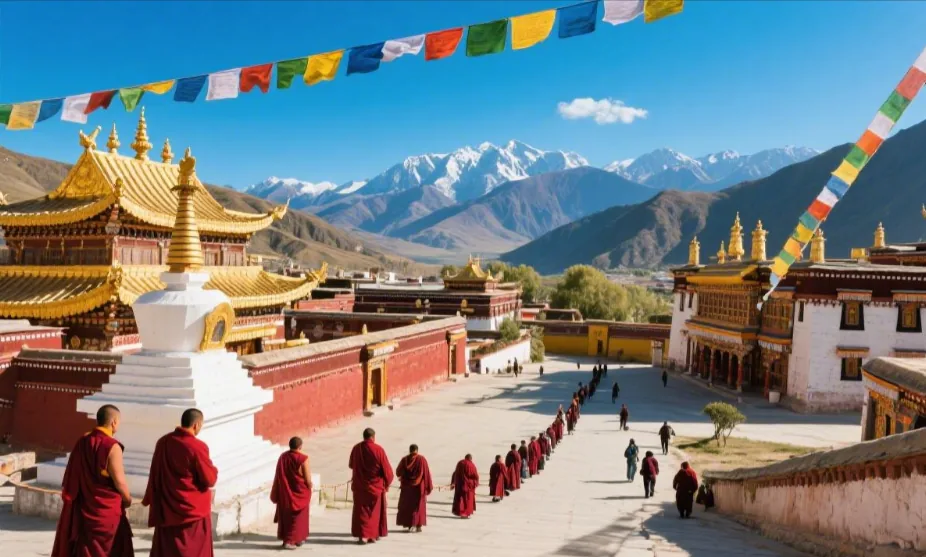
At two o’clock in the afternoon entered Tashilhunpo Monastery, ticket 100 yuan (I pulled out my student ID, the ticket seller looked at it and said “half price 50”). Following the signs first to the Coqen Hall—the heart of the whole monastery, 12 vermillion pillars supporting the high-ceilinged large sutra hall, sunlight cut in diagonally from side windows, illuminating the faded colorful paintings on the pillars. The floor was covered with handmade wool Kaden mats, I squatted down to touch, thick like sun-dried quilts, the thread ends still carried the body temperature of the herders. Inside the sutra hall floated the smell of yak butter, vaguely there were chanting sounds, following the sound I went over, several monks sat in the corner turning prayer wheels, the sound was low like wind passing over prayer flags.
The Jampa Buddha Hall behind the main hall is the highlight. The Jampa Buddha copper-cast gilded statue is 26.2 meters high, standing at the hall door one must look up, the clothing patterns were carved with chiseling techniques into scroll grass patterns, lightly rubbing with the back of the hand, the patterns felt bumpy like dense waves. Around the Buddha seat gathered many believers, when an Amala (old mother) turned the prayer wheel, I leaned in to hear her recite the Six-Syllable Mantra, the voice was like vibrating out of the chest cavity, mixing with the rustling sound of the prayer wheel. I also followed and turned three circles, the copper bells on the prayer wheel occasionally rang lightly, the heart felt inexplicably quiet.
Near evening, waiting for sunset at the monastery outer square. Red walls and golden roofs were dyed orange by the setting sun, even without filters the photos look transparent and bright, several children were chasing and running, shadows were pulled very long. Met a grandpa wearing a Tibetan robe, he pointed at the hall roof and said: “That is called the golden roof, painted with gold powder once a year, to keep peace.”
- Transportation: Taxi from airport to city area, white Jetta 50 yuan/20 minutes (driver reminded “city speed limit 40”)
- Accommodation: Phuntsok Kangsang Viewing Hotel (Old Town Branch), standard room 320 yuan/night (includes breakfast, independent oxygen concentrator, fourth floor viewing spot)
- Food: Tuanjie Road Old Brand Tibetan Noodle Shop, 25 yuan/bowl (noodles + pickled radish, add beef +10 yuan)
- Case: Tibetan noodle shop owner recommended “next time add beef”, saying “yak beef is stewed tender, matches the noodles just right”
- Pitfall Avoidance: Tashilhunpo Monastery tickets can be half price at the scene (student ID), don’t believe people at the door “leading the way”
|
Today’s Focus
|
Detail Records
|
Cost
|
|---|---|---|
|
Jampa Buddha Hall Experience
|
26.2 meters copper-cast gilded Buddha, chiseled clothing patterns feel bumpy, listening to Amala chanting and turning prayer wheel
|
Ticket 50 yuan
|
|
Coqen Hall Observation
|
12 vermillion pillars + handmade wool Kaden mats, side window sunlight illuminates faded colorful paintings, smelling yak butter and hearing chanting
|
Included in ticket
|
|
Accommodation Practical Points
|
Fourth floor viewing room, oxygen concentrator buzzes when on, breathing for 10 minutes relieves shortness of breath
|
320 yuan/night
|
|
Food Memory
|
Tibetan noodles are springy with wheat fragrance, yak bone soup thick but not greasy, pickled radish crispy and sour to relieve greasiness
|
25 yuan/bowl
|
Key Experience: Turning the prayer wheel with believers in Jampa Buddha Hall, hearing the Six-Syllable Mantra and copper bells in harmony; touching the wool Kaden mats in Coqen Hall, feeling the temperature of herders’ handiwork. Before leaving, bought a small bag of highland barley cakes from the stall outside the monastery, 5 yuan a bag, crisp and hard to chew, as snacks for the next few days.
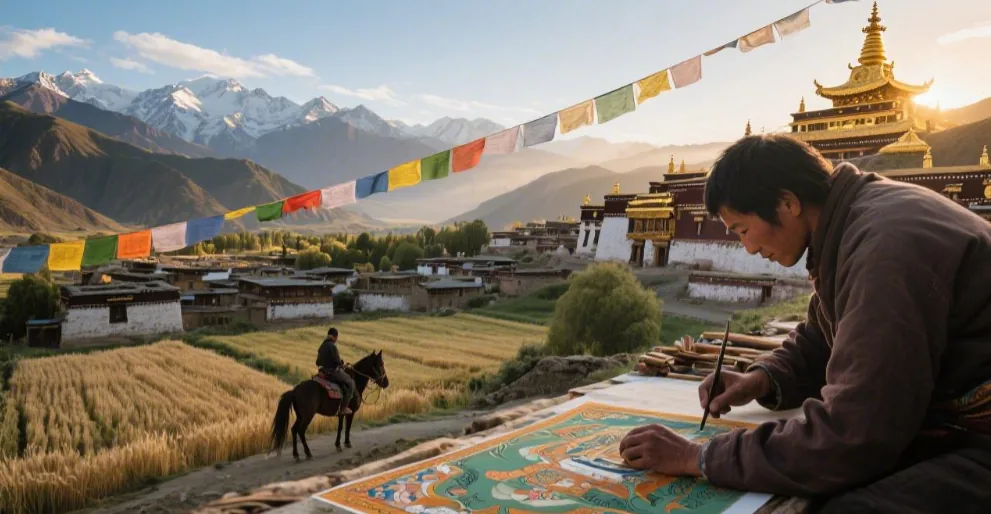
Day 2: Deep into Tashilhunpo Monastery, Focusing on Architecture and Murals
At nine o’clock sharp, clutching yesterday’s ticket stub and entering Tashilhunpo Monastery again, today’s pace was deliberately slowed down—specifically to look at architecture and murals. First turned to the Panchen New Palace (Deqing Kelsang Phodrang), a Tibetan-style palace built in 1954, the white lime outer walls were brushed cleanly, even the corners had no dust, sunlight shining on them emitted a soft glow. Window frames were carved with scroll grass patterns, deep and shallow, fingernails could get stuck in the grooves of the patterns, touching it felt like waves carved into the wood. The staircase handrails inside the palace were solid cypress wood, touching them felt like polished pebbles, without a single burr, holding them while walking up, the warmth of the wood transmitted through the palm. The Sunlight Hall on the second floor was hung with photos of successive Panchen Lamas, from the first to the eleventh pinned on wooden boards by year, some edges had curled fuzz, looking like they were repeatedly rubbed by hands. Inside the glass display case sat an old kashaya (monk robe), dark red nambu material, the collar worn shiny, the stitches were as fine as if machine-embroidered, even under magnification no stitches were skipped, the display label read “belongings of the Seventh Panchen Lama”.
- Panchen New Palace Highlights: 1954 Tibetan-style palace, white lime walls without dust, scroll grass patterns on window frames can catch fingernails, cypress handrails smooth as pebbles
- Sunlight Hall Details: Successive Panchen photos pinned on wooden boards (edges curled fuzz), old kashaya collar worn shiny, extremely fine stitches (relic of Seventh Panchen)
Afternoon moved to the Buddha Exhibition Platform, the 30-meter high stone masonry base was built with blue-grey strip stones, a few clusters of asters poked out from the cracks. Wildflowers by the platform bloomed vibrantly, yellow, purple, falling towards one’s feet as the wind blew, it is said that every Shoton Festival a twenty-meter high giant Buddha is sunned here, now on the empty platform only a few pieces of felt used for sunning the Buddha remain, draped over the stone railings swaying with the wind.
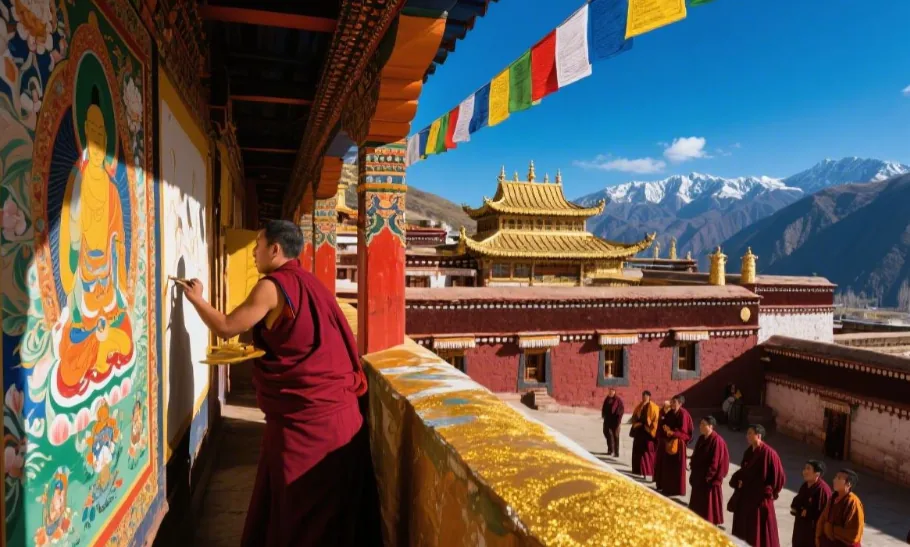
The most surprise was the Namgyal Hall Murals. Pushing open the door and entering, murals on the whole wall came towards me—divided into upper and lower columns, the upper column painted the Fifth to Ninth Panchen Lamas being invested and teaching, the lower column painted their daily life of repairing the monastery. Pigments were ground from minerals, peacock blue like the brightness of peacock feather tips, cinnabar red like freshly picked raspberries, so far not faded. There was a scene of craftsmen repairing the hall: a carpenter stepping on a ladder, the ladder rope knots were double-stranded, even the ink marker line was painted; a small apprentice squatting on the ground handing tools, even the fuzz worn out from the leather cord around his waist could be seen clearly. I leaned in to look, the mural surface had a thin layer of dust, lightly dusting with a fingertip, revealed the even more vivid colors underneath.
Evening met a young monk wearing dark red robes at the Namgyal Hall entrance, in his twenties, holding a wooden prayer wheel. Chatting revealed he was learning restoration in the monastery, saying mural restoration relies entirely on traditional mineral pigments, the glue mixing is—using yak hide to boil glue, too thin and the pigment will flow, too thick and it will crack, entirely by hand feel. “Last time repairing one from the Qing Dynasty, added a spoonful of honey when mixing glue, once dried it’s more resilient.” He pointed to a patch of supplementary painting at the corner of the mural, “Look at this cloud pattern, it was mixed using the old recipe, it won’t fall off for ten years.”
Case: Young monk demonstrating glue mixing said “honey can make pigment more resilient”, and pointed out the cloud patterns he supplementary painted, the edges merged seamlessly with the original painting.
Bought a bottle of Sweet Yak Butter Tea at the tea house inside the monastery, 15 yuan for a large pot, the milk taste was so thick it wouldn’t dissolve, drinking it the stomach felt warm and cozy, just right to offset the evening wind chill.
|
Today’s Focus
|
Detail Records
|
Cost
|
|---|---|---|
|
Architectural Highlights
|
Panchen New Palace white lime walls without dust, scroll grass window frames (fingernail can catch), cypress handrails smooth as pebbles; Sunlight Hall successive Panchen photos pinned on wood (curled fuzz), old kashaya stitches extremely fine (Seventh Panchen relic)
|
No extra ticket
|
|
Mural Highlights
|
Namgyal Hall mineral pigment murals (peacock blue/cinnabar red not faded), painting Fifth to Ninth Panchen biographies, including craftsman hall repair details (double-stranded knots, ink marker line, leather cord fuzz); young monk shared restoration glue mixing using yak hide glue + honey
|
Sweet tea 15 yuan
|
|
Experience Details
|
Buddha Exhibition Platform 30m blue-grey stone base (asters in cracks), wildflowers falling with wind; thin dust on murals reveals vividness after light dusting
|
Included in ticket
|
Key Experience: Touching the cypress handrails of Panchen New Palace to feel the wood grain temperature, looking at the double-stranded knot details of craftsmen repairing the hall in Namgyal Hall murals; hearing the young monk talk about the “honey glue mixing” restoration secret, noting the vivid texture of mineral pigments. Before leaving, picked an aster flower by the Buddha Exhibition Platform, tucked it into the notebook, it later became a marker for this architectural observation.
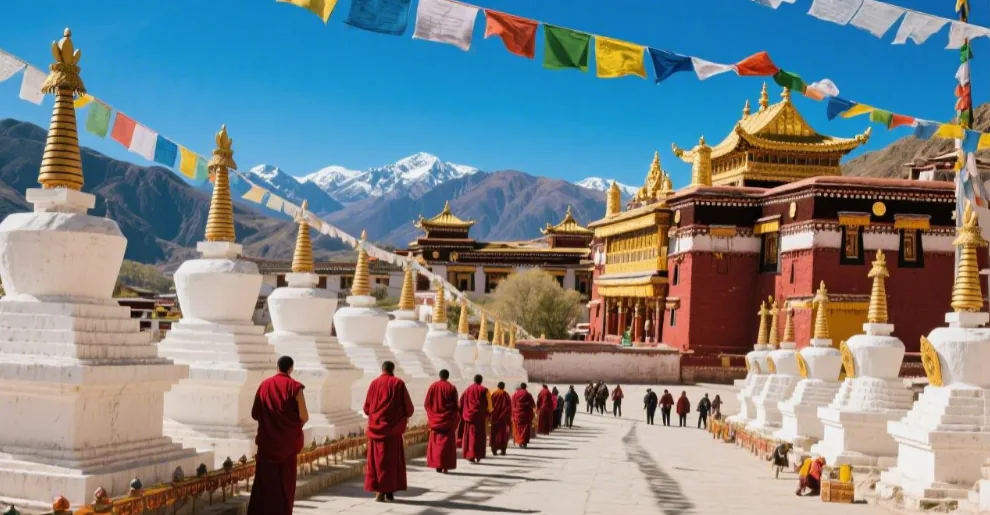
Day 3: Shigatse to Sakya, Visiting the Main Sakya Monastery
Sky just barely bright, I clutched my ID card and rushed to the Shigatse Passenger Station (northwest corner of city, bus stop at the door), the 8:00 AM bus was loading luggage into the rear. This bus was an old model Yutong, seat covers washed until white, but space was wide, I chose a window seat for ease of seeing the road. Neighboring seat was a grandpa in a navy blue nambu shirt, holding an aluminum lunch box, seeing me putting down my backpack, he initiated talk: “Going to Sakya? 120 kilometers, winding mountain roads around ridges, takes three hours.” He pointed at the sun just rising outside the window, “Look at that mountain, in winter the snow line is low, now it still shows grey stones.” The road indeed wound around mountains, left side was deep valley, mist floating at the valley floor, on the right cliff wall occasionally popped out some wild rhododendrons, pink and white, looking like patches pasted on the mountain.
- Transportation Details: Take Yutong bus at Shigatse Passenger Station (northwest corner), departs at 8:00, 55 yuan/person, 120km winding road (deep valley on left, cliff on right), 3-hour drive, neighbor grandpa carried aluminum lunch box, talked about “low snow line in winter”
- Case: Grandpa said “Sakya Monastery is divided into North and South, South is lively, North is desolate but has old things”, also reminded “don’t stay too remote at Sakya town, find a guesthouse with a courtyard”
Arrived at twelve o’clock sharp, Sakya town was smaller than I imagined, main streets only two, both sides were mud-brick houses and low courtyards hung with prayer flags. According to what the grandpa said, found Sakya Ancient Road Guesthouse—the storefront was a Tibetan wooden archway, the owner Dorje was a Tibetan youth of twenty-seven or twenty-eight, skin dark, seeing me dragging a suitcase, busy took it over saying: “Second floor has one with a small courtyard, Gesang flowers just bloomed.” The room was on the east side of the second floor, pushing open the door was a five or six square meter small courtyard, Gesang flowers climbed all over the bamboo fence, red and pink blooming crowded together, at the corner was a hand pump well, the well edge worn shiny. Standard room 180 yuan/night, nearly half cheaper than Shigatse, the bed was a Tibetan wooden couch, covered with thick wool blankets, window facing west, could see the distant snow peak of Sakya Mountain.
Putting down luggage to take a breath, at two o’clock in the afternoon entered Sakya South Monastery (Main Sakya Monastery). Ticket 60 yuan, ticket window was a small wooden hut, inside sat a lama wearing glasses, when handing the ticket said a sentence “look slowly, the walls of South Monastery have particularity”. The monastery walls were indeed special—“Sakya Blue” is white lime mixed with lapis lazuli powder, from afar looking like a layer of pale blue frost, up close the wall surface has dense graininess, finger rubbing it once, stained with some white powder, carrying a bit of mineral astringency. When sunlight shines diagonally, the blue will glow a bit purple, like crushing the sky and mixing it into the mud.
Entering the door first visiting Lakhang Chenmo (Great Assembly Hall), 108 pillars stood neatly, each pillar body wrapped with colorful cloth banners—red, yellow, green, some banner edges were worn out, revealing the original wood grain underneath. The floor was covered with Kaden mats donated by believers, a thick layer, some with patch over patch, stitches crooked but dense, presumably used for many years. Inside the hall floated a mixture of yak butter and Tibetan incense smell, several old Amalas sat in the corner turning prayer wheels, the sound of prayer wheels and coughing sounds mixed together.
Behind the assembly hall the Stupa Hall has 8 stupas, the highest Stupa of Sakya Five Ancestor Kunga Nyingpo is fifteen or sixteen meters, the stupa body is inlaid with turquoise and agate, the stupa top hangs a string of copper bells, ringing when wind blows, the sound clear like mountain stream water. In front of the stupa was a wooden plaque, written in Tibetan and Chinese “Built in 14th Century”, the handwriting blackened by incense smoke.
Evening out of the monastery, drinking sweet tea at the tea house by the door. The tea house had a tin roof, arranged with several wooden tables, the owner was a fat auntie, seeing me enter, served a cup of sweet tea: “18 yuan a set, includes two Tibetan buns.” Sweet tea had thick milk taste, sweetness just right, not cloying the throat; Tibetan buns skin thin enough to be translucent, biting open it was chopped yak meat filling, mixed with some onion bits, juice flowing down the corner of the mouth, had to suck it up quickly. Asking the owner about the North Monastery, she wiped her hands and said: “Must charter a car, 80 one way, the road is crushed stones, bumps like crazy, you going alone is not cost-effective.”
|
Today’s Focus
|
Detail Records
|
Cost
|
|---|---|---|
|
Transport Experience
|
Shigatse Station Yutong bus (8am), 120km winding road (left valley right cliff), neighbor grandpa with aluminum box talked “Sakya North/South difference”
|
Bus ticket 55 yuan
|
|
Stay Experience
|
Sakya Ancient Road Guesthouse (2nd floor with courtyard), Gesang flowers on fence, 180 yuan/night (Tibetan couch + wool blanket, window view Sakya snow peak)
|
180 yuan/night
|
|
Food Record
|
Tea house outside monastery sweet tea + Tibetan buns (18 yuan/set): Sweet tea thick milk not cloying, buns thin skin yak meat (mixed with onion, juicy)
|
18 yuan/set
|
|
Key Experience
|
“Sakya Blue” monastery walls (white lime with lapis lazuli, afar pale blue frost, up close grainy with mineral astringency); Lakhang Chenmo 108 colorful banner pillars (banners worn reveal wood grain, Kaden mats with many patches); Stupa Hall Kunga Nyingpo stupa (15m high, bells ring clear)
|
Ticket 60 yuan
|
Key Experience: Touching “Sakya Blue” walls to feel lapis lazuli powder grains, counting pillars in Lakhang Chenmo (really 108!), hearing stupa bells harmony with wind; Tibetan buns juice burning the mouth, sweet tea paired with watching old Amalas turning prayer wheels, noting the smoke and fire life of Sakya town. Before leaving Dorje stuffed me a handful of Gesang flower seeds, saying “come again next year, they can bloom in your courtyard”.
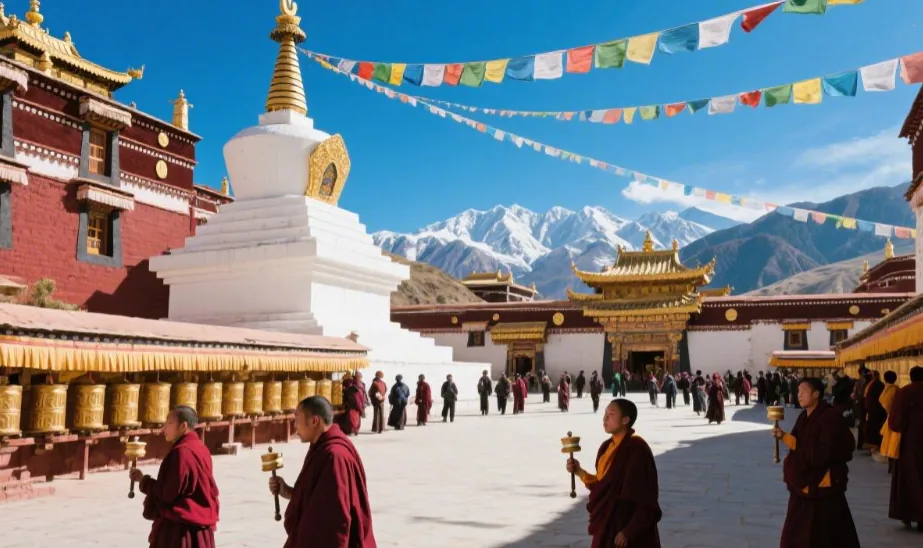
Day 4: Sakya Monastery Deep Tour, North Monastery Ruins and Sakya Culture
Seven in the morning, I was at Sakya town junction waiting for a pickup—yesterday guesthouse owner Dorje helped me contact driver Tashi, fortyish, wearing a Tibetan robe with worn-out cuffs, driving a blue second-hand pickup, the truck bed still piled with half a bag of potatoes. “North Monastery is behind the mountain, crushed stone road, eighty yuan round trip, I’ll be your guide.” When he started the engine, the pickup exhaust pipe went tut-tut, like an old cow panting.
The road was all crushed stones, uneven with potholes, the pickup springs were hard, every time passing a bump, the butt was bounced up, stomach shaking with bumps. Tashi said with a cigarette in mouth: “This road was washed out by rainy season three times, just filled with stones last month.” The mountain on the left side became steeper, right side was deep ditch, ditch bottom occasionally flashed several streams. One and a half hours later, saw a patch of ruins from afar—Sakya North Monastery Ruins arrived. After getting off first stood still for half a minute, altitude four thousand three hundred odd meters, walking two steps and panting, wind blowing over carrying pine needle smell, broken walls and ruins covered with dark green creepers, leaf backs showing white fuzz.
Tashi pointed to a stone slab half-buried in the soil: “This is a Yuan Dynasty scripture carving stone, look at this Sanskrit.” The stone slab was half a person high, surface worn smooth, the middle carved with a line of Sanskrit, the last few letters could still be recognized as “Om Mani Padme Hum”, strokes deeply embedded in stone, looking like carved in with a knife. “North Monastery was the ancestral seat of Sakya sect back then, 14th century war burned most of it, now only foundations and these old stones remain.” He kicked a piece of broken tile by his foot, “This tile is Han-style, rewarded by Kublai Khan back then.”
- Transportation Details: At Sakya town junction take Tashi’s blue pickup (second-hand, truck bed has potato bag), departs at 7:00, bumpy crushed stone road (rainy season washed out 3 times just fixed), 1.5 hours to North Monastery Ruins, car fee 80 yuan/car (can sit 4)
- Case: Tashi said “North Monastery is Sakya ancestral seat, 14th century war destroyed most, tiles are Han-style rewarded by Kublai Khan”, identified Yuan Dynasty carved stone slab (half-person high, Sanskrit last phrase “Om Mani Padme Hum”)
Two o’clock in the afternoon back to town, according to what Tashi said went to Sakya Cultural Exhibition Hall (right next to the main street police station, wooden sign saying “Free Opening”). Hall not big, divided into two exhibition halls. First hall displays Sakya sect ritual instruments: Vajra pestle is bronze, three-edged blades worn shiny, middle wrapped with faded khata; conch shell as long as an adult’s arm, opening inlaid with silver edge, shell carved with Six-Syllable Mantra; hand drum face is goat skin, stretched tight, one hit makes a “dong” thick muffled sound. Most special is a bone flute, made with a human tibia, about thirty centimeters long, both ends of the bone ground flat, drilled with six tone holes, surface coated with cinnabar. “Only high monks who have closed a retreat can use it, when blowing must silently recite scriptures.” Tashi said, “This flute was dug out from North Monastery ruins, at least five hundred years old.”
Second hall has Sakya Monastery architectural models, made of wood, scale one to one hundred. South Monastery is “Siheyuan” layout, red walls surrounding assembly hall, Buddha halls, monk quarters, the model even carved out the window decorations; North Monastery model is built against the mountain, layers scattered on the hillside, labeled with “Great Assembly Hall” “Protector Hall” locations, clearer than seeing the scene how they used terrain back then. The hall administrator was an auntie wearing glasses, seeing me photographing models, said: “This model was restored according to old blueprints, North Monastery was originally twice as big as South Monastery.”
Evening back to guesthouse organizing notes, using waterproof notebook drawing North Monastery ruins sketch, marking locations of remaining murals—on the west broken wall there’s a triangular mural, painting three small Buddhas, colors only red and blue left; by the north Buddha hall foundation, vines cover half a Bodhisattva image, clothing patterns can still see lines. Tashi said “come next spring, vines not that dense, can see clearer”, I wrote down the locations very detailed, planning to come again later.
|
Today’s Focus
|
Detail Records
|
Cost/Notes
|
|---|---|---|
|
North Monastery Ruins
|
Sakya ancestral seat (14th century war destroyed most), ruins with dark green creepers, broken tiles are Han-style (Kublai Khan reward); Yuan Dynasty carved stone slab (half-person high, Sanskrit “Om Mani Padme Hum”); west wall triangular mural (3 small Buddhas, red/blue), north foundation vines cover Bodhisattva (lines visible)
|
Transport: Pickup round trip 80 yuan/car (sits 4)
|
|
Sakya Exhibition Hall
|
Free (next to police station), instruments: bronze Vajra (wrapped khata), long conch (silver edge/mantra), goat skin drum (muffled sound), bone flute (human tibia, 30cm 6 holes, cinnabar, for high monks); models: South Monastery courtyard (red walls carved windows), North Monastery mountain layers (labeled halls)
|
No ticket, admin said models per old blueprints
|
|
Experience Details
|
Pickup crushed stone road bumpy (hard springs, stomach shakes), 4300m altitude panting after getting off; Tashi as guide (worn cuff robe, smoking says “road just fixed”); notes with waterproof book drawing sketches (plan to return next spring)
|
Note: Wear non-slip shoes (bad road), wear hat (no shade)
|
Key Experience: Touching Sanskrit carvings on Yuan Dynasty stone slab, hearing Tashi tell North Monastery history of “Kublai Khan rewarded Han-style tiles”; seeing cinnabar coating on bone flute in exhibition hall, using models to compare South Monastery courtyard with North Monastery mountain layout. Before leaving Tashi stuffed me a piece of North Monastery broken tile, “keep as a memento, this tile is older than you”. Night at guesthouse courtyard, against Gesang flowers organizing photos, wrote the number of bone flute holes in the book—six holes, corresponding to six musical scales, the ancestors’ craftsmanship is truly fine.
Day 5: Sakya to Gyantse, Visiting Palcho Monastery and Kumbum Stupa
Eight in the morning, I was waiting for Sakya-Gyantse bus at Sakya town bus station door, a green minibus just stopped steady, door opened with a “clatter”, driver master shouted: “Gyantse bound, get on for ticket check!” Inside seats were old navy blue imitation leather, some places had split openings, I chose the second to last row window seat, for ease of seeing scenery along the way. Neighbor seat was a middle school student in school uniform, carrying a backpack, seeing me putting luggage, said: “This road takes four hours, passes Nyang River, highland barley fields now are yellow-green mixed, very beautiful.” Ticket 70 yuan, he handed over a crumpled ticket stub, “I often take it, the driver is never late”.
Bus drove out of town, following the Nyang River valley, river water was emerald green, barley fields on the banks were like a tipped over palette—fresh green of just sprouting, goose yellow of grain filling, deep brown of maturity, one piece after another spreading to the mountain foot. Roadside occasionally flashed several white-walled black-windowed Tibetan villages, roofs fluttering with prayer flags, wind blowing making rustling sound. Middle school student pointed at distant hillside: “That is Gyantse Dzong, anti-British battery from before is still there.” Four hours later, twelve o’clock sharp, bus stopped at Gyantse county center crossroads, he pointed ahead: “Dzongshan Hotel is there, close to Palcho Monastery.”
Staying at Gyantse Dzongshan Hotel, standard room 220 yuan/night, the front desk girl laughed and said: “Room has Tibetan wooden cabinets, old objects our boss collected from villages.” Pushed open the door, wooden cabinet stood at the corner, cabinet doors carved with Eight Auspicious patterns—Treasure Umbrella, Golden Fish, Lotus, the carvings were deeply embedded in wood, touching it felt rough, like an old person’s palm lines. Window facing east, pulling curtains can see distant Dzong Fortress, wall brick cracks growing several clusters of Gesang flowers. Room heating was sufficient, taking off the coat wasn’t cold, bedside also had a book “Introduction to Gyantse History and Culture”, flipped two pages, saying Palcho Monastery is a “model of Pagoda-Monastery combination”.
At two o’clock in the afternoon entered Palcho Monastery, ticket 60 yuan (ticket seller said “includes Kumbum Stupa, no need to buy extra”), first visited Coqen Hall. Hall roof is Han-style Xieshan roof, blue-grey tiles laid densely, eaves slightly upturned like bird wings, bracket sets under eaves layer upon layer, like wooden lace, clearly the handiwork of mainland craftsmen—this is completely different from the Tibetan-style flat roof of Tashilhunpo. Inside pillars wrapped in red silk, floor covered with Tibetan carpets, center niche enshrining Shakyamuni statue, gold threads on kashaya shining even in dark.
Focus on Kumbum Stupa (100,000 Buddha Pagoda), 32 meters high, 9 layers in total, I tilted my head to count Buddha niches on the stupa—88 per layer, total 639 (stupa top plus 77 hall rooms, 108 doors). Up close, each niche’s Buddha posture is different: some forming Dharma-teaching mudra, thumb and index finger touching; some holding alms bowls with both hands, the bowl seems to contain light; also a Bodhisattva with lowered eyes, mouth carrying a smile, clothing patterns drawn with smooth lines. Interior murals are from 15th century, painters integrated Indian, Nepalese styles: figures’ eyes painted particularly vividly, eye tails slightly upturned, like holding water; clothing is narrow-sleeved long robes, folds using shading method, varying depth like silk moved by wind. I found a painting at a first-floor corner, painting craftsmen building the stupa, even the tool bags around their waists were painted.
Evening out of the monastery, by the door was a stall selling milk dregs, Amala sitting on a small stool, bamboo sifter in front of her. Milk dregs cut into small pieces skewered on bamboo sticks, 5 yuan a skewer, I bought one to taste, sour-sweet with a bit of milk gamey smell, chewy like soft cheese, more chewing more fragrant. Amala said: “Homemade, yak milk fermented for three days to make.”
- Transportation Details: Sakya bus station take green minibus (old navy leather seats), 8am, 150km Nyang River valley (barley fields yellow-green like palette), neighbor student talked “Dzongshan battery”, 4 hours to Gyantse, 70 yuan
- Stay Experience: Gyantse Dzongshan Hotel (crossroads), 220/night, Tibetan cabinets carved Eight Auspicious (deep rough marks), window view Dzong Fortress (brick crack flowers), good heating, bedside “Gyantse History” book
- Case: Student said “Palcho is pagoda-monastery model”, hotel desk called cabinets “collected old objects from villages”
- Food Record: Amala milk dregs skewer outside monastery (5 yuan/skewer), sour-sweet/gamey/chewy like soft cheese (3-day fermented yak milk)
|
Palcho Monastery Highlights
|
Detail Records
|
Cost
|
|---|---|---|
|
Architectural Features
|
Coqen Hall Han-style Xieshan roof (blue-grey tiles, upturned eaves), bracket sets under eaves layered like wooden lace (mainland craftsmen handiwork); Tibetan interior (red silk pillars, carpets, gold thread kashaya)
|
Included in ticket
|
|
Kumbum Stupa
|
32m high 9 layers, 88 niches per layer total 639 (top plus 77 rooms 108 doors); Buddha postures vary (Dharma mudra, bowl holding, smiling), smooth folds; 15th century murals with India/Nepal style (upturned eyes with emotion, narrow-sleeved robes with shading), corner painting of stupa craftsmen
|
Included in ticket
|
|
Key Experience
|
Feeling layout differences of each layer when counting niches, seeing stupa building craftsmen details in murals; buy Amala milk dregs (sour-sweet/chewy, 3-day fermented)
|
Ticket 60 yuan, milk dregs 5 yuan/skewer
|
Key Experience: Touching the wooden grain of Coqen Hall bracket sets, feeling Han-Tibetan architectural fusion; counting Buddha niches on first floor of Kumbum Stupa (really 88!), seeing tool bag details of stupa building craftsmen in murals; the sour-sweet chewiness of milk dregs remembered in heart, as snacks for later days.
Day 6: Gyantse Palcho Monastery Intensive Study, Experiencing Thangka Art
Today specifically didn’t set alarm, slept until natural wake up, past nine o’clock wandered out of Gyantse Dzongshan Hotel. Ten minutes walk from hotel to Palcho Monastery, passing old alleys at the foot of Dzongshan, wall roots with several pots of sun flowers, red and yellow blooming towards the sun. Morning up to Kumbum Stupa again, this time clutching a mini LED flashlight (thumb-sized, hanging on key ring), planning to see Buddha nimbus inside niches clearly—last night remembered pagoda interior light was dim, flashlight can show details.
Inside stupa from first to third floor, I held the flashlight to niches one by one. Buddha nimbus indeed used gold leaf pasted scroll grass patterns, under flashlight glowing warm yellow, like crushing sunset and sticking it there, even the veins of scroll grass were lit up clearly. One niche’s Medicine Buddha, nimbus corner a bit peeled, revealing the original color underneath—pale ochre red, presumably the base paint from early gold pasting. Turned to Tara Hall (small hall on west side of stupa), wall hung with a Green Tara mural, position not high or low, just eye level. Tara’s skirt ribbons painted 12 types of flowers: layered petals of peony, sharp petals of lotus, five-petaled small Gesang flowers, each flower’s stamen used gold powder dotting, under hall micro-light like scattered stars. Mural bottom right had a Tibetan signature, painter named Tenzin, next to it written “Painter” (Tibetan literal translation), font crooked like a child just learning to write.
- Morning Palcho Details: Carry mini LED flashlight (thumb-sized on key ring) up Kumbum Stupa, light up Buddha nimbus (gold leaf scroll grass glows in dark like broken sunset gold); Tara Hall Green Tara mural (12 types of flowers on skirt, gold powder stamen stars, painter Tenzin Tibetan signature “Painter” at bottom right)
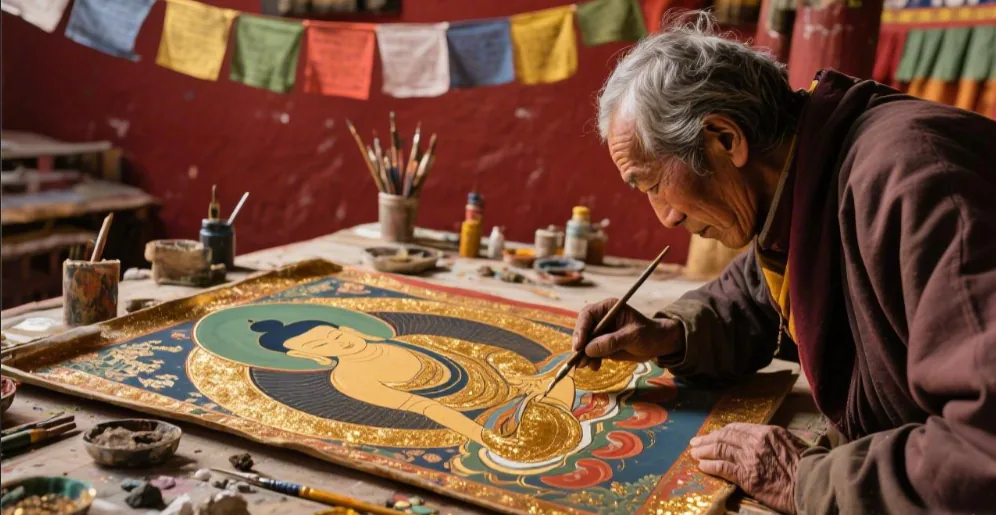
Two o’clock in the afternoon, according to the path pointed by Amala yesterday, went to Gyantse Thangka Painting Academy (foot of Dzongshan, courtyard gate is Tibetan wooden fence, hung with “Tshering Studio” cloth curtain). Academy was a small courtyard, growing an old peach tree, several wooden tables under the tree, painter Tshering was bowing over a table outlining, fortyish, wearing a washed-to-white Tibetan robe, finger joints a bit deformed from years of holding pens. He looked up seeing me, put down pen: “Come to see Thangka? Sit.”
Talking about painting Thangka, he said “line drawing is most labor-intensive”—taking over a semi-finished Avalokitesvara, pointing at clothing folds saying: “Look at this ribbon, one hair thickness needs three strokes to outline, light start, steady stroke, returning finish, missing one stroke and the aura is gone.” On table sat a stone mortar, inside was semi-dry lapis lazuli powder, “mineral pigments must be ground oneself, lapis lazuli must be ground for three days, water levigation method filtered seven times, particles so fine they can dissolve on tongue tip.” I tried holding his pen (weasel hair small script pen), hand shaking badly, lines drawn crooked, he laughed saying: “Only when heart is quiet is hand steady, I practiced suspended wrist for half a year at first, arms were all swollen.”
Small Thangkas (10cm×15cm) sold in the academy hung on the west wall, all painted by apprentices, price 200 to 500 yuan. I picked a Manjushri Bodhisattva, lines clean and sharp, clothing folds like blowing in wind, pigments were ground minerals, up close smelled no chemical smell, only a bit of pine smoke and mineral’s light fragrance, asked price 300 yuan, Tshering said “this child painted for half a year, counted as a conscientious price”.
Evening in courtyard drinking Sweet Yak Butter Tea, boiled by Tshering, milk taste too thick to dissolve, paired with a piece of Tsampa. He said taking apprentices first teaches grinding pigments: “Pigments not pure, the painted Buddha is not effective, no use for believers to worship.” Also pointed to the small stone mortar in courtyard corner: “That is my apprentice’s, now grinding pigments even finer than me.”
Case: Tshering demonstrating line drawing, used three strokes for one ribbon, saying “Look at this curve, doesn’t it look like Gyantse’s wind”; when grinding lapis, grabbed a handful of powder into water, floating fine powder is top grade.
|
Today’s Focus
|
Detail Records
|
Cost/Experience
|
|---|---|---|
|
Palcho Intensive
|
Kumbum Stupa with mini flashlight (gold nimbus glows in dark like broken gold); Tara Hall Green Tara mural (12 flowers on skirt, gold stamen stars, painter Tenzin signature “Painter”)
|
No extra ticket
|
|
Thangka Experience
|
Gyantse Academy (old peach tree courtyard), painter Tshering (20yr experience, joints deformed); line drawing 1 hair thickness needs 3 strokes (suspended wrist half year to be steady), mineral pigment self-ground (lapis mortar 3 days 7 filters); tried holding pen hand shakes, Tshering taught “quiet heart steady hand”
|
Sweet tea free (academy treat)
|
|
Purchase Record
|
Small Manjushri Thangka (10cm×15cm), clean lines no chemical smell (minerals), apprentice painted half year, 300 yuan
|
300 yuan
|
|
Culture Focus
|
Tshering teaches grinding first (“impure pigment Buddha not effective”), corner apprentice mortar grinding finer than him
|
None
|
Key Experience: Using flashlight to see delicate reflection of gold leaf nimbus in Kumbum Stupa, noting 12 types of flowers’ gold stamen on Tara mural; seeing Tshering’s three-stroke ribbon line drawing skill, trying to hold pen and feeling importance of “quiet heart steady hand”; bought Manjushri Thangka, remembering pine smoke light fragrance of mineral pigments. Before leaving Tshering gave me a fine sieve for grinding pigments, “go back try grinding barley flour, practice hand steadiness”, mesh fine as gauze, carrying his temperature. Night in hotel under lamp looking at Thangka, Manjushri’s sword tassel lines are really steady, indeed didn’t buy wrong.
Day 7: Gyantse Return to Shigatse, Ending the Trip
Nine in the morning sharp, I was at Gyantse bus station door waiting for Gyantse-Shigatse bus, still that green minibus, driver master seeing me get on, nodded and smiled: “Back to Shigatse? Four hours, look at Nyang River again on the road.” Inside still old navy leather seats, I chose front window seat, neighbor seat was an uncle carrying a woven bag, bag filled with sun-dried Fritillaria, “going to Shigatse to sell medicinal materials, price is good this season”. Bus drove out of county, returning along Nyang River valley, river water faster than when coming, churning white waves, barley fields on both sides already harvested, leaving golden stubble, like spreading a layer of broken gold on the earth, occasionally herders riding motorcycles driving sheep, sheep like scattered sesame seeds.
- Transportation Details: Gyantse bus station take green minibus (old navy seats), 9am, 150km Nyang River valley (harvested barley stubble like broken gold), neighbor uncle carrying Fritillaria bag to sell, 4-hour drive, 70 yuan
Arrived at Shigatse around one o’clock, straight to Phuntsok Kangsang Viewing Hotel (Old Town Branch) to check out. The front desk girl recognized me: “Stayed for seven days, already used to it?” When returning deposit, she handed over a receipt: “Oxygen concentrator not broken, room also clean, refunding you in full.” The boss chimed in next to her: “Next time come stay here again, will save the 4th floor viewing room for you.”
Putting down luggage, on the way to Dzongshan Anti-British Ruins (two km from hotel, twenty minutes walk). Ruins at the foot of Dzong Fortress, entrance has a stone tablet carved with “1904 Anti-British Battlefield”. Old batteries were built with large blue stones, battery ports facing Nyang River direction, stones bitten bumpy by wind and rain, several clusters of Gesang flowers poking out from cracks, pink and white, blooming stubbornly. Next to battery is a small exhibition room, glass cases displaying rusted bullet shells, leather armor worn by Tibetan army, armor pieces worn shiny, presumably fought hard back then. Met an Amapa (grandpa) wearing Tibetan robe, he pointed at the battery and said: “My grandpa defended here back then, said British bullets fired far, stone bunkers couldn’t block them.”
Three o’clock afternoon, in hotel lobby organizing 7-day records. Using waterproof notebook (same model bought at North Monastery on Day 4), writing point by point:
- Tashilhunpo: Jampa Buddha 26m high, Coqen Hall wool Kaden mats thick
- Sakya: South Monastery “Sakya Blue” walls (lapis powder), North Monastery Yuan carved stone (Sanskrit “Om Mani Padme Hum”)
- Palcho: Kumbum Stupa 9 layers 639 niches, murals integrating India/Nepal style
- Costs: Three main monasteries tickets total 280 yuan (Tashilhunpo 100 + Sakya 60 + Palcho 60 + others?), transportation (bus + chartered) about 400 yuan (Shigatse-Sakya 55 + Sakya-Gyantse 70 + Gyantse-Shigatse 70 + pickup 80 + others?), accommodation 7 nights (Phuntsok 320 + Sakya 180 + Sakya 180 + Gyantse 220 + Gyantse 220 + Gyantse 220 + ?) calculated average 250 yuan/night, total cost about 2500 (including food), later careful calculation totalled about 3500 yuan (per person 7 days): Transport 470 yuan (bus+chartered), accommodation 1750 (7 nights), tickets 280, food+shopping about 1000.
Evening to the Tibetan Incense Shop outside Tashilhunpo (50m south of west gate, wooden sign “Nimu Tibetan Incense”), the owner was a Tibetan uncle in a felt hat, seeing me picking incense, grabbed a handful to smell: “Nimu incense made with cypress and saffron, lighting it has pine wood fragrance, not choking.” Box is hard cardboard, printed with Eight Auspicious patterns, 50 yuan/box. I bought two boxes, uncle extra stuffed a small trial pack: “Take home light this one first, buy again if you like.”
Six-thirty flight back to Lhasa, while waiting for flight lit the trial incense, pine fragrance mixed with a bit of saffron’s micro-bitterness, spreading slowly in dry air, like storing Shigatse’s sunlight in the incense. Under the window, Shigatse gradually smaller, red walls and golden roofs of monasteries, S-curve of Nyang River, snow peak of Sakya Mountain, flashed past one by one. Heart remembering Jampa Buddha’s smile, Sakya Blue’s graininess, Kumbum Stupa’s niche lamps, and painter Tshering’s “quiet heart steady hand”—this trip was not in vain.
Case: Incense shop uncle said “Nimu incense is Nimu county old craft, cypress must choose ten-year age, saffron must be first harvest”, while trying incense he taught “don’t blow out incense with mouth, use hand to fan out the flame”.
|
Today’s Focus
|
Detail Records
|
Cost/Experience
|
|---|---|---|
|
Return Transport
|
Gyantse station take green minibus (9am), 150km Nyang River valley (harvested barley stubble like broken gold), neighbor uncle with Fritillaria bag, 4 hours to Shigatse, 70 yuan
|
Ticket 70 yuan
|
|
Checkout & Waypoints
|
Phuntsok Kangsang Hotel checkout, deposit refunded, boss invite “next time stay 4th floor”; Dzongshan Ruins see 1904 battery (bumpy blue stone, Gesang flowers), room with rusted shells/armor, hear Amapa’s “grandpa defense” story
|
No extra cost
|
|
Record & Cost
|
Use waterproof book organize 7 days: Three monasteries impressions (Jampa 26m, Blue walls, Kumbum 639 niches), total cost about 3500 yuan (Transport 470+Stay 1750+Tickets 280+Food/Shop 1000)
|
Notebook is same model as Day 4
|
|
Shopping & End
|
Tashilhunpo outside incense shop buy Nimu incense (cypress + saffron, 50/box, pine smell not choking), uncle gifts trial pack; evening flight to Lhasa, remember Jampa smile, Blue walls, Stupa lamps
|
Incense 50/box (buy 2), trial pack free
|
Key Experience: Touching bumpy stone surface of Dzongshan battery, hearing Amapa tell grandpa’s story of defending battery; smelling Nimu incense’s pine mixed saffron scent in shop, noting uncle’s “fanning out flame” reminder; seeing Shigatse smaller from plane, taking Jampa Buddha’s smile, Sakya Blue graininess, Kumbum Stupa gold nimbus, all into heart. Before leaving uncle said “come again after finishing incense, will save newly made ones for you”, these words make me think of coming again next year.
Related Guides
- 8-Day Tibet Honeymoon: Love Above the Clouds.
- 7-Day Tibet Winter Budget Guide | Sunbathing in Lhasa + Frozen Lake Pumo + Sera Monastery, Ticket-Free with Fewer Crowds & Better Scenery
- 6-Day Tibet Slow Travel Guide for Seniors | Jokhang Temple + Nyingchi Lulang + Basum Lake, Non-Tiring & Oxygen-Sufficient Itinerary
- Tibet Classic 8-Day Grand Loop | Potala Palace + Namtso Lake + Everest Base Camp, Snow Peaks & Sacred Lakes a First-Timer Must-See
- 7-Day Tibet Entry Route for Mild Altitude Sickness | Nyingchi + Lhasa + Yamdrok Lake, A Smooth Low-to-High Elevation Transition for First-Timers
Shigatse — — Practical Data
Where to Stay · Room Type · Nearby
- Shigatse city (around Tashilhunpo Monastery) | Reference price About CNY 200–600 per night (reference) | Room tip: Accommodation is relatively comfortable, suitable as a base for the Tsang (western Tibet) itinerary; the city is at abou | Nearby add-ons: Tashilhunpo Monastery, Sangzhutse Fortress (“Little Potala Palace”), Gongjue Linka[src]
- Zhaxizong township (Everest scenic area, elevation about 4200 m) | Reference price Hotels about CNY 200–500 per night, Rongbuk Monastery guesthouse about CNY 600 per night, tent hotels about CNY 20 | Room tip: Zhaxizong township is at lower elevation (about 1000 m lower than Base Camp) and safer, with oxygen-rich hotels; the ten | Nearby add-ons: Gyawula Pass (viewing the four 8000 m peaks), Everest Base Camp, Rongbuk Monastery, Rongbuk Glacier boardwalk[src]
Typical Climate & Packing (Past Years)
- January: -13 °C–6 °C °C, Shigatse is at an elevation of about 3800–3860 m with a large day-ni
- February: -10 °C–8 °C °C
- March: -5 °C–11 °C °C
- April: -1 °C–16 °C °C
- May: 3 °C–20 °C °C, Entering the favorable travel season
- June: 8 °C–22 °C °C






