



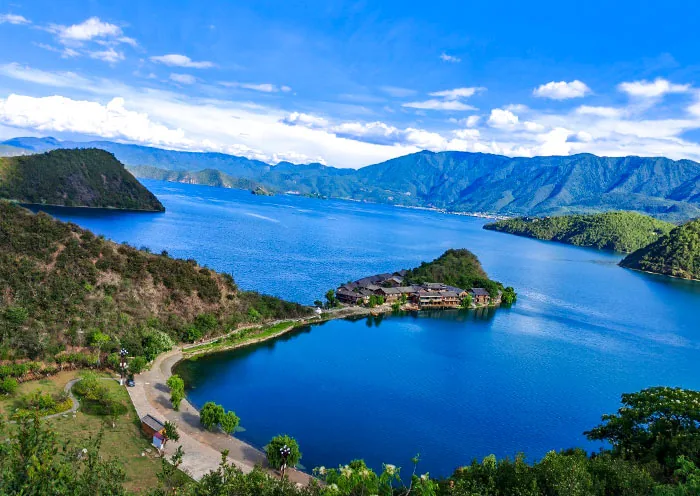
Day 1: First Impressions of Dali · Aman Stay · Slow Tour Around Erhai Lake
Landing at Dali Airport at 8:50 AM, after collecting my luggage and walking toward the exit, I spotted a driver in a navy blue uniform from a distance, holding a sign that read “Aman Dali Reception”—he was also clutching a box of warm flower cakes, which he handed over as soon as he saw me: “You must be Ms. Li? This is a welcome gift from the hotel, freshly baked with rose filling.” Chatting along the way, he mentioned he had been an Aman driver for 3 years, driving this route every day. “The clouds on Cangshan Mountain are different every day; you’ll see them when we reach the hotel—they look like marshmallows floating halfway up the mountain.” The 40-minute drive didn’t feel tedious at all; we passed through Bai ethnic villages with walls painted in blue-and-white tie-dye patterns, and dahlia flowers in the courtyards grew taller than people.
Arriving at the hotel at 10:30 AM, the main entrance consisted of two tung-oiled wooden doors carved with interlocking lotus patterns. Upon pushing them open, I was greeted by the scent of pine needles mixed with wood. The receptionist, wearing a Bai ethnic tie-dye apron, said while handing over the room card: “Your room is in Building 3, featuring a private terrace with a view of Erhai Lake. Your butler will escort you there shortly.”
The room was more spacious than I imagined. At the foot of the bed sat an old elm tea table with natural cracks on its surface. The butler stood at the door and introduced: “This tea table is an antique collected from Jianchuan; you can brew your own tea here.”
At 2:30 PM, I changed into white sneakers and grabbed a rattan bag borrowed from the hotel (stuffed with a bottle of mineral water and mosquito repellent), then walked 10 minutes to the entrance of the Ecological Corridor. The corridor floor was paved with bluestone slabs, with clover growing in the crevices and occasional lines of small ants marching along. Reaching the S-bend first, there were wooden signs in the grass reading “Please do not step on the lawn.” An auntie sitting on a nearby wooden bench was holding her phone to photograph the lake. I crouched down to find an angle, but the wind kept blowing my hair into the lens. Just as I was about to fix it, the auntie smiled and said, “Young lady, shall I help you take one without the hair in the way?” She stood to the side, waited for me to pose, and pressed the shutter: “There we go, look—” On the screen, the curve of Erhai Lake was behind me, my hair was neat, and the water reflected Cangshan Mountain.
Walking 1 km from the S-bend to the Longkan Wharf wetlands, the reed beds were half a person tall, rustling in the wind. Walking along the wooden boardwalk, I saw two wild ducks chasing each other, splashing water. A nearby child shouted, “Mom, look! The ducks are kissing,” making everyone laugh. At the end of the boardwalk was a small pavilion where an auntie selling iced drinks asked: “Would you like some tamarind juice? It’s freshly squeezed with a bit of honey.” I took the cup, the ice crystals crunched in my mouth, and the tamarind flavor was very refreshing.
Walking back at 4:30 PM, the sun began to set, and the water of Erhai Lake turned orange-red, looking like a handful of crushed gold had been scattered over it. I took off my shoes and stepped onto the wooden planks; they were slightly hot but comfortable, and I could feel the temperature of the wood on my soles. Back at the hotel, the butler had already set the tea table on the terrace—a ceramic teapot was brewing small-grain Pu’er tea, with two pieces of osmanthus cake on the side. He said: “This tea should be brewed with 85-degree water; the first steep washes the leaves, and the second is the most fragrant.” I followed his instructions and poured a cup. It tasted of honey nectar. Watching the sunset dye the ripples of Erhai Lake into gold leaf, there were no other tourists—only the rustling of wind through the willows and the sound of distant birds.
Lying on the rattan chair on the room’s terrace in the evening, the scent of osmanthus from the neighboring courtyard drifted in the wind. The butler brought hot milk and said: “If you want to head out tonight, there is a bicycle at the hotel entrance that you can ride to nearby villages where they sell rushan (milk fans).” I didn’t go; I just sat there scrolling through photos on my camera—the wind at the S-bend, the ducks at Longkan, the tea on the terrace—every image carried the warmth of Erhai Lake.
Small Details Reminder: There is a free luggage storage area at the entrance of the Ecological Corridor if you get tired; the wooden boardwalk at Longkan Wharf occasionally has puddles, so non-slip shoes are more stable; don’t waste the welcome tea provided by the hotel—the Pu’er and osmanthus cake balance sweetness and bitterness perfectly.
Day 2: Aman Dali Immersion · Exploring Xizhou Ancient Town
At 9:30 AM, clutching the linen square towel placed in the rattan basket in my room, I followed the butler to the tie-dye workshop in the hotel’s back courtyard. Teacher Zhang, the instructor, wore a faded blue apron with hands stained with indigo dye. She handed me a pair of cotton gloves as I arrived: “Wash your hands first; the dye will stain your skin blue, though it washes off after three days.” She taught me to choose a butterfly-in-flight pattern template, laid the towel on a wooden board, and used cotton thread to tightly wind around the butterfly’s wings: “You must wind it tight, or the outline will be blurry—like braiding a butterfly’s hair, it has to be secure.” My hands grew sore and the thread kept loosening, so Teacher Zhang smiled and adjusted it with a toothpick: “Look, this is how it should be.” Then, she dipped the towel into the dye vat. The indigo water immediately enveloped the fabric as she stirred it with her wrist, the cloth unfurling in the water like a sinking cloud. “It needs to soak for 15 minutes, with two flips in between.” She pointed to a small wooden stool by the vat, “Sit here and wait. Smell this—it’s fermented Isatis root; it’s a bit bitter, but the dyed cloth will have a clean scent.”
Shortly after 11:00 AM, I took out the soaked cloth; the indigo had seeped into the fibers, and it felt a bit stiff to the touch. Teacher Zhang helped me hang the cloth on a line in the courtyard. As the wind blew, the wet cloth swayed, as blue as the shadow of Erhai Lake. She handed me a small paper packet: “This is dried Isatis root; you can brew it as tea when you get home to reduce internal heat.” I held the packet, watching the cloth dry in the wind, thinking about spreading it on my desk at home—it would certainly have more soul than a store-bought tablecloth.
At 1:30 PM, I took the hotel’s private car to Xizhou. The driver, wearing a light blue shirt, knew I was headed to the ancient town and took a scenic detour: “Taking the road through the rice paddies is much more pleasant than the main road.” Outside the window, the rice had just begun to ear, a vibrant green that shimmered like a sea in the wind. 40 minutes later, I arrived in Xizhou and headed straight for the Yan Family Mansion. Four gilded characters reading “Hundred Patients Legacy” were carved on the vermilion lintel. The guide was an auntie in a tie-dye top, her fingers brushing over the wood carvings of the gatehouse: “This is the ancestral home of the Yang family, who made their fortune in the tea trade. ‘Hundred Patients’ was their family rule—be patient in character and steady in action.” Entering the courtyard, ink orchids were arranged in a circle, their long leaves bearing pale purple flowers. The auntie leaned in and said, “The old master waters these every morning at 6:00, saying the fragrance of orchids can calm the mind.” The wood-carved doors and windows were even more exquisite; the magpie-and-plum patterns were so detailed you could count every feather on the magpies. I touched them; the wood had been polished to a shine, bearing all the marks of time.
Leaving the Yan Family Mansion, I followed the flagstone path to the Corner Building—a three-story wooden structure where the stairs creaked underfoot. Several bougainvilleas in front were blooming wildly, their pink-purple petals dusted with a bit of dirt, looking as if they had just been through a fine drizzle. I sat on a bluestone bench in front of the building, the sour and spicy aroma drifting from a nearby Liangji (Cold Chicken) Rice Noodle stall. The owner, in a white tank top, saw me staring and shouted with a smile: “Young lady, want a bowl? Our chickens were freshly prepared this morning.” I ordered a mildly spicy bowl. When it arrived steaming hot, the broth was a bright red, sprinkled with sesame and golden-brown crushed peanuts. The rice noodles were slippery; a sip of the broth was refreshingly sour and satisfyingly spicy. The chicken strips were finely shredded and tossed with peanuts, getting more flavorful with every chew. The owner stood nearby and said: “The broth for this cold chicken rice noodle is simmered for three hours with chicken bones, give it a try—” I picked up a piece of chicken; it was indeed tender enough to burst with juice, and I ended up drinking half the broth.
Returning to Aman at 6:30 PM, I changed into a light gray knit sweater and walked along the lakeside path. The wind carried the salty scent of Erhai Lake and the bitter freshness of the grass on the shore. My neighbor, Ms. Lin from Beijing, an internet company product manager, saw me and waved: “You’re in luck! I didn’t see any squirrels here yesterday, but there’s one today!” I followed her finger—under a streetlight sat a small gray squirrel, its tail arched like an umbrella, gnawing on a pine cone. The “ka-ta ka-ta” sound was remarkably clear in the night. I stood there for five minutes; it looked up at me once and continued eating, not afraid of humans at all. We just stood there, listening to the water of Erhai Lake lapping against the shore and watching the lights of distant fishing boats flicker. The wind blew my hair, carrying the scent of grass; it was incredibly comfortable.
Note: Teacher Zhang from the tie-dye workshop later dried my square towel, wrapped it in newspaper, and gave it to me. When unfolded, the blue was even and the butterfly’s wings were sharp. I spread it on the hotel desk; as sunlight filtered through, the fabric showed fine indigo ripples, just like the waves of Erhai Lake. I actually went back for the Xizhou Cold Chicken Rice Noodles the next day. The owner remembered me and said with a smile, “Double peanut crumbles for you.”
Day 3: Dali → Lijiang · Jinmao Stay · Gazing at the Snow Mountain
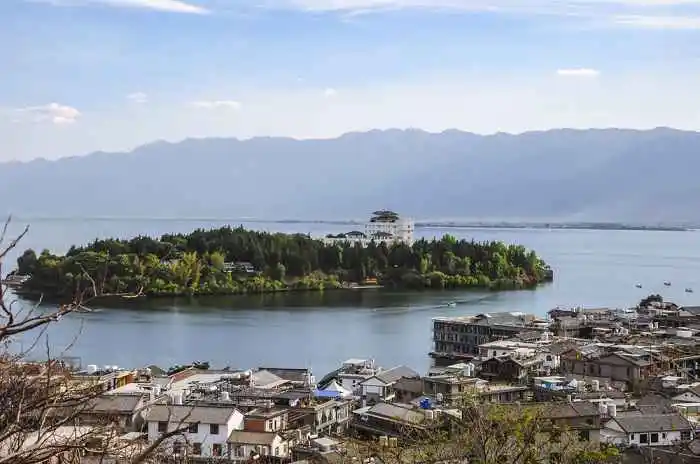
At 7:50 AM, I headed downstairs nibbling on a rose flower cake given by the hotel. Flaky crust fell onto my suit pants, so I brushed it off quickly. The driver was already leaning against the black sedan, smiling: “Morning, Ms. Li. The dew on Cangshan is heavy; sit in the back, I’ve laid out a wool blanket for you.” As the car left Aman, the morning mist hadn’t dissipated yet; the outline of Cangshan Mountain looked as if it were soaked in milk, and the bougainvillea by the road were covered in dewdrops, a translucent red.
Lashi Lake soon came into view. The water was pale green, like a piece of crumpled jade, with several egrets standing on floating islands, tucking their heads into their wings. Occasionally, one would flutter up, its wingtips skimming the water, sending up splashes that shimmered in the morning light. The driver glanced at me through the rearview mirror: “Black-necked cranes come here in winter; they’re a bit rounder than egrets. They stand in the shallows looking for snails, looking like little old men squatting by the river smoking.” I leaned toward the window and indeed saw several gray cranes with extraordinarily long legs and necks retracted into S-shapes, pacing slowly.
Arriving at the Heqing Service Area at 10:30 AM, my stomach was growling, so I squeezed into a restaurant with the queueing aunties. I ordered a bowl of “Zhuangyuan Crossing-the-Bridge Rice Noodles.” The broth was clear chicken soup with a thin layer of oil, smelling fresh but tasting a bit plain. The noodles were thin round ones, served with paper-thin meat slices, two quail eggs, and a few wilted green vegetables. The meat was a bit dry, not as hearty as what I had in Dali’s ancient city. I took a few bites, swallowed them with some pickled radish, and bought a bottle of iced mineral water—it was cloyingly sweet, not as good as the warm water at the hotel.
At 2:10 PM, the car turned into the parking lot of the Jinmao Lijiang. The doorman in a dark gray uniform bowed as he opened the door, his fingertips carrying a bit of the snow mountain’s chill: “You must be Ms. Li? Your room is on the 12th floor; the porter has already taken your luggage up. This way, please.” The hotel lobby was high enough to see the crystal chandeliers on the ceiling. The entire roof was made of floor-to-ceiling glass, and the peak of Jade Dragon Snow Mountain was framed within it, looking as if someone had broken off a piece of the mountain and placed it there. The elevator had a pine and citrus fragrance that wasn’t overpowering. I watched the numbers climb; the moment the 12th floor opened, the butler was already standing there in a light blue shirt, holding a gold-embossed card: “Sir, your room has a view of the snow mountain. There are freshly warmed towels on the balcony. The sunlight on the top-floor observation deck is softest at 3:00 PM; the binoculars are there if you’d like to take a look later.”
The room was pale beige, looking as if it were wrapped in sunlight. At the foot of the bed was a rattan basket stuffed with mineral water and dark chocolate. I walked over and drew the curtains—the snow on Jade Dragon Snow Mountain was still frozen at the peak, a blinding white. Sunlight hit the snowline, casting a pale golden glow. The windowsill was a bit cool; I touched it, my fingertips catching the crisp scent of the snow mountain, like taking a bite of a peppermint. The butler placed a tea tray on the table: “The Pu’er is pressed by the hotel itself; if you want to brew it, the teapot is in the kitchen.” I nodded and pressed a hot towel to my face—it smelled of lavender, easing the fatigue of the journey.
At 3:00 PM sharp, I took the binoculars to the top-floor observation deck. There was a rattan chair on the balcony, warmed by the sun. I adjusted the focus of the binoculars and could clearly see the rock textures on the snow mountain and the unthawed snow, looking like a white fur hat on the mountain. The wind was a bit strong, blowing my bangs across my face. I pulled them back and just stood there, watching a cloud drift over, covering a corner of the mountain before slowly dispersing to reveal the blue sky behind. The butler’s voice came from behind me: “Sir, would you like a cup of ginger tea? It was simmered in the kitchen downstairs to ward off the cold.” I shook my head and continued watching the mountain—it turns out “watching the snow mountain” isn’t just about the scenery; it’s about watching it change slowly, or not move at all, as if time had stopped.
At 6:30 PM, I went to the Chinese restaurant “Xuelu Ge” for dinner. At the next table were two aunties from Chengdu in floral shirts and pearl necklaces, chatting animatedly: “We come to Jinmao every year! Just for this cured pork ribs (La Paigu); restaurants outside just don’t have this flavor!” I ordered the cured pork rib hotpot. The base was simmered for 4 hours with pork bones and cured ribs; the broth was thick and white with a faint smoky aroma. When the ribs were served, the brownish meat pieces were piled on the plate. I picked one up; it was salty and fragrant with a hint of sweetness. The meat was firm but grew more flavorful with every chew—I even wanted to suck the marrow out of the bones. For a side, I ordered potato noodles—the noodles were thin and had soaked up the broth, sliding into my mouth full of cured rib flavor, much chewier than the thin noodles I have at home. I drank two bowls of soup in a row, feeling my stomach warm up and even a bit of sweat on the tip of my nose.
Seeing how much I enjoyed the meal, the auntie from the next table leaned over with a smile: “Young man, eat up! These ribs are cured by the hotel itself; they have to be aired for half a month and then slow-cooked with bones. You can’t get this taste anywhere else.” The other auntie picked up some potato noodles: “Look at these noodles, they hold the sauce so well! Even better than the thin noodles you get in Chengdu!” Hearing this, I added another bowl of soup and tipped my bowl toward them: “It really is delicious, I want to come back tomorrow!” The aunties burst into laughter, and one even pressed a piece of pickled radish into my hand: “Take some back for your porridge; we made it ourselves, very crunchy!”
Back in my room at night, I stood by the window looking at the snow mountain. Moonlight spilled over the peak, casting a silver-white glow like a veil over the mountain. The butler brought hot milk with condensation on the glass: “Sir, would you like to visit Shuhe Ancient Town tomorrow? I can arrange a horse carriage for a slow tour.” I shook my head: “No need, I want to sleep in tomorrow, then just wander through the alleys of the ancient town.” The butler smiled and placed a box of flower cakes on the table: “Then we’ll keep a warm batch for you tomorrow morning to have with your milk. They are made in-house with rose filling.”
Lying in bed, I smelled the faint pine scent on the pillow and listened to the wind outside. Today’s egrets at Lashi Lake, the snow on Jade Dragon Snow Mountain, the salty fragrance of the cured ribs, and the pickled radish from the Chengdu aunties—there was no rush to follow an itinerary, no panic to take “check-in” photos. It felt like sitting in my own living room, so comfortable it made me want to sigh with contentment.
Note: The driver at Lashi Lake told me later that in summer, the lake is full of lotuses—pink and white, ten times more lively than now; the sunlight on the hotel’s top-floor observation deck is softest at 3:00 PM, perfect for photos without filters; the potato noodles in the hotpot should be eaten while hot, as they clump when cold, but reheating them in the soup restores the flavor perfectly.
Day 4: Jinmao Lijiang Leisure · Slow Wander Through Shuhe Ancient Town
At 8:30 AM, I headed to the hotel’s heated indoor pool with my folded swimsuit. The scent of spicy ginger tea wafted through the hallway. A staff member pointed toward the end of the corridor: “The pool is by the floor-to-ceiling windows with a view of the snow mountain. Take your time.” The pool bottom was lined with pale blue mosaics, and the water shimmered with a soft blue light. The temperature wrapped perfectly around my skin; entering the water felt like a slight contraction followed by an unfolding, as if soaking in a quilt that had been sunned all morning. I swam laps; every time I looked at the window, the peak of Jade Dragon Snow Mountain peeked out from the clouds—as white as freshly kneaded glutinous rice flour, the snow’s glare soft on the eyes. By the 15th lap, I rested by the edge, my fingertips touching the warm pool wall, suddenly recalling the feeling of soaking in a hot spring in my hometown as a child; even my breathing slowed down.
The rattan lounge chair was warmed by the sun. When the butler brought a coarse ceramic tray, the steam from the ginger tea reached my nose just in time. The ginger tea had two red dates in it, spicy with a hint of sweetness, and the cookies were freshly baked, butter and wheat aromas combining into a crisp bite. He pushed the cup closer to my hand: “Sir, don’t catch a chill after swimming; have some of this first.” I held the cup, watching the snow mountain slowly get wrapped in clouds, like a thin blanket being pulled over it.
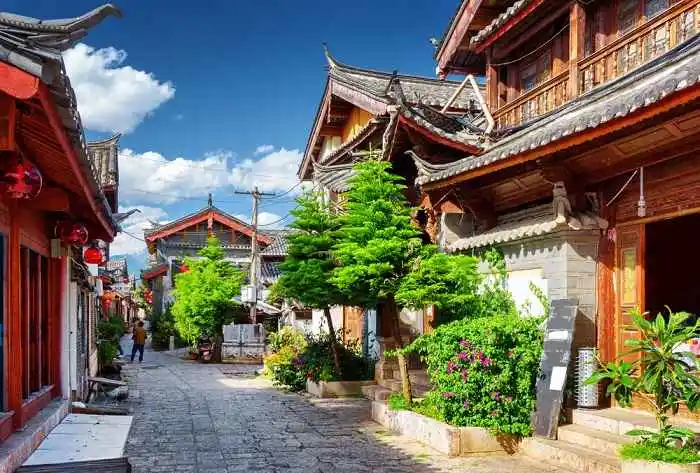
At 2:30 PM, I caught a light blue BYD taxi at the hotel entrance. The driver in a plaid shirt smiled and tapped the steering wheel when he heard I was going to Shuhe: “That place is quieter than Dayan. The flagstones are slippery, so I hope you’re wearing non-slip shoes.” 20 minutes later, the ancient town’s stone archway came into view—the red paint had chipped in places, revealing the original wood underneath, like wrinkles on an old man’s face, carved with the marks of time.
I walked to the Qinglong Bridge first. The bluestone bridge deck was polished to a shine by a thousand years of footsteps. Every crack held the green of moss, and the carved lotus patterns on the railings were sometimes whole, sometimes chipped, like cookies nibbled by time. An auntie selling handmade silver jewelry stood by the bridge wearing a navy tie-dye apron, the silver bracelets in her bamboo basket glowing softly. I crouched down and picked up a pair of bracelets carved with cloud patterns—the silver was heavy in my hand, the surface polished smooth, and the cloud lines looked like clouds kneaded by the wind. “Can you engrave these?” I asked. The auntie looked up, her reading glasses sliding to the tip of her nose: “I can. What do you want?” I thought for a moment: ” ‘Cloud’, to match the snow mountain I saw today.” She took the bracelet, sat on a small stool, and tapped a chisel with a small hammer—the “ding-ding dang-dang” sound was like rain falling on silver. In less than five minutes, the character for “Cloud” was finished: the strokes were thin but deep, as if the shape of a cloud had been carved into the silver. I held it up to the light; even the chisel marks were clear. The auntie wiped the bracelet and handed it to me: “Take care, don’t hit it against sharp objects.”
At 6:00 PM, I found my way along the flagstone path to the Ancient Tea Horse Road Museum. The vermilion paint on the door was peeling; when I pushed it open, the door hinges made an ancient creak, like the long whinny of an old horse. The museum was quiet, and the artifacts in the display cases glowed with an old light: the brass horse lamp had over a dozen scratches, like the wrinkles of an old horse; the edges of the leather saddle were polished bright, still holding a faint salty scent of horse sweat; the ropes braided from horsehair were thick and tied in dead knots, like the marks left by a swishing horse tail. There was a bit of dust on the glass case; I wiped it with my sleeve and read the description: “This horse lamp followed a caravan for 30,000 miles during the Republic of China era, from Lijiang to Lhasa, with the lamp oil replaced 80 times.” My reflection was mirrored on the glass as I stared at it, and I suddenly understood what “the accumulation of years” meant.
Leaving the museum, a sour fragrance hit my nose—under an old pagoda tree at the alley entrance was a stall selling Jidou (Chickpea) Liangfen. The owner in a white T-shirt was scraping the jelly with a wooden spoon; the jelly was grayish-black like solidified ink, slippery as he scraped it. I ordered a bowl, and when he served it, the chili oil was perfectly drizzled: bright red but not choking. The jelly was springy to the bite, stretching into fine strands; the sour fragrance combined with the chili’s heat and the crunch of peanuts felt like a small party in my mouth. The owner handed me a free cup of Pu’er: “We brewed it ourselves to cut through the richness.” The tea was a bit bitter but perfectly washed away the sourness of the jelly. I sat on a stone bench to eat, listening to the cries of a flower vendor nearby and watching the shadow of the pagoda tree slowly crawl across the stone table.
At 8:00 PM, I walked back along the flagstone paths. The streetlamps looked like old kerosene lamps, their light soft, making the stone paths glow with warmth. Clutching the silver bracelet engraved with “Cloud” in my hand and carrying the leftover Jidou Liangfen in my pocket, with the sound of distant flowing water in my ears—this wasn’t “checking in” at a tourist spot; it was slowly kneeding the time of the ancient town into my own life.

Day 5: Lijiang → Lugu Lake · Conrad Stay · First Tour of the Plateau Lake
8:40 Departure from Hotel
While crouching in the lobby by the floor-to-ceiling windows to tie my cashmere scarf, the peak of Jade Dragon Snow Mountain was still touched by morning mist, looking like an unmade white duvet. The driver, Zhaxi, holding a thermos printed with Mosuo weaving patterns, was waiting at the door: “Ms. Li, my wife brewed this butter tea; drink it on the road to stay warm.” Unscrewing the lid, a salty aroma mixed with milk hit me; it was so thick it stuck to my tongue but was warm enough to make my throat tingle.
10:00 On the Way to Ninglang
The car headed northwest, the mountain roads winding in circles. The Yunnan pines along the road were twisted and gnarled, their needles covering the ground and crunching underfoot. Zhaxi said: “Another half hour to Ninglang, the ‘Matriarchal Home’ of the Mosuo people—no fathers in the house, uncles look after the children, and the old grandmother is the boss.” On the mountain road, a black dog sat on a rock, staring at the car with a drooping tail, as if wondering, “What are these people doing going to the lake?”
11:30 Ninglang Native Chicken Hotpot
Zhaxi led me into an old wooden house in a bluestone alley, with faded Mosuo brocade hanging over the lintel and jars of pickled vegetables in the corner. When the chicken hotpot was served, the clay pot was bubbling: the meat was falling off the bone, the broth was milky white, and a few wild mushrooms floated on top—their caps still dusted with pine needles, as if they had just run down from the mountain. I took a bite of a drumstick; it was so tender it burst with juice. A sip of the soup was so fresh it made my spirits soar—a sweetness of matsutake mixed with goji berries, without any artificial MSG taste. Zhaxi rubbed his head and smiled: “The mushrooms were picked by my wife at 6:00 this morning; we only trust things from the mountains.”
13:00 Checking into Conrad Lugu Lake
The car stopped in front of the hotel’s wooden archway. The architecture followed the traditional Mosuo log-cabin style, with stacked log walls, green tile roofs, and copper door knockers carved with lotus patterns. The doorman in a navy uniform opened the door and bowed: “Your room is in Building 3, with a full lake-view floor-to-ceiling window. The butler reserved the one closest to the water for you.”
Room Details
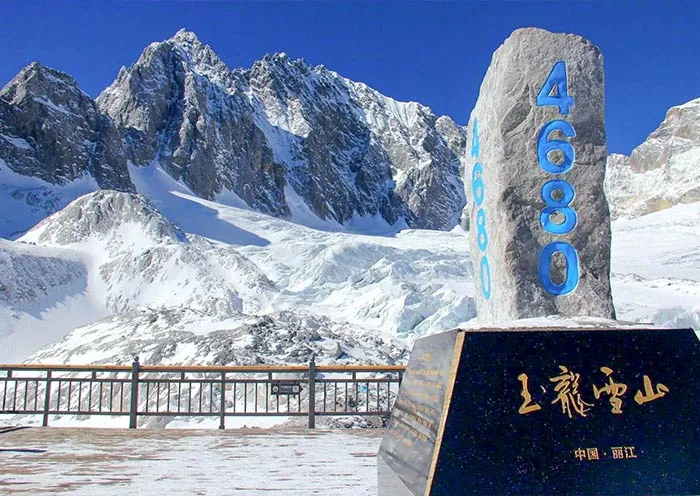
The scent of pine needles drifted in as I pushed the door open. The light oak floors creaked slightly underfoot, like an old house saying hello. Drawing the curtains—the blue of Lugu Lake flooded in, looking like a crushed sky soaked in water. The surface was a pale blue, and the distant Lige Peninsula looked like a small foot tucked into the lake. A rattan basket at the foot of the bed held mineral water and a handmade shawl, navy blue with a white diamond pattern, very soft.
14:00 Lake Tour to See Ottelia acuminata (Water Nymphs)
I changed into a light blue linen dress and grabbed my wide-brimmed straw hat. The wooden boat at the pier was dark brown, the oars made of fresh bamboo. The boatman, A-Hei, wore a Mosuo cross-collar top and a white turban, with wrinkles at the corners of his smiling eyes: “Ms. Li, I’ll take you to see the Water Nymphs—they only bloom from May to October; they are very precious.”
As the boat cut through the water, a chill climbed up from my ankles. The wind carried the bitter freshness of the lake water, like freshly brewed Kuding tea. A-Hei paddled and said: “In Mosuo language, we call them ‘flowers that only grow in clean water’.” Just as he finished, a layer of white “stars” appeared on the surface—the Water Nymphs were floating there, their petals snow-white and centers pale yellow, like shredded marshmallows scattered on the lake. I reached out to touch one; the petals were as soft as a baby’s cheek. A-Hei quickly warned: “Be gentle, they are shy.” Close up, the stems were thin, yet they rooted in the mud and held the flowers high, as if greeting the sun.
15:00 Rest on the Lakeside Terrace
Back at the hotel, I sat on a rattan chair on the lakeside terrace to soak up the sun. Strings of dried corn hung from the railings, the golden kernels swaying like little bells. A nearby stall sold handmade silver bracelets. An old lady in a Mosuo embroidered top asked: “Young lady, these bracelets were made by my son from pure silver. Shall I engrave ‘Lugu’ for you?” I chose a slender one; the engraving was deep, as if the wind of Lugu Lake had been carved into the silver.
18:00 Dinner at the Lake View Restaurant
The outdoor restaurant tables were set by the lake, the white tablecloths fluttering in the wind. I could see the light shimmering under the water. The roasted lake fish arrived, crucian carp grilled to a golden brown and sprinkled with salt and Sichuan peppercorns—crispy on the outside and tender inside. The fish aroma mixed with the pepper fragrance; I even wanted to gnaw on the bones. The Sulima wine was served in a coarse ceramic cup, a pale pink color like peach blossom juice. It tasted sweet with a hint of alcohol; half a cup in, my face felt warm and my ears turned as red as the Lugu Lake sunset.
A young couple from Chengdu sat at the next table: the girl was taking photos of the lake, and the boy leaned in: “The stars on the water are moving!” The girl laughed: “Those are Water Nymphs!” Listening to their conversation and watching the water, I suddenly felt time slowing down like the waves of Lugu Lake—I could hear them hitting the shore, see the shadows of the stars, and even the wind felt gentle.
20:30 Stroll by the Lake
Walking along the shore, the sound of the waves grew louder. The wind carried the scent of cooking fire from Mosuo homes, and soft singing drifted from afar like ripples on the water. Clutching the silver bracelet and with the dried wild mushrooms from A-Hei in my pocket, I looked up at the moon—it looked like a freshly toasted glutinous rice cake, its light falling on the lake and dyeing the water silver-white.
Note: Drink Zhaxi’s butter tea while it’s hot; it gets fishy when cold. The Ninglang chicken hotpot must have wild mushrooms added—it’s the soul of the dish. Choose a Mosuo boatman for the lake tour to hear the lake’s stories. Water Nymphs bloom from May to October; go early to see them. Sulima wine has a low alcohol content; a slight buzz is just right.
Day 6: Lugu Lake Depth · Mosuo Culture and Lake Views
8:30 Taking a Business Van to the Mosuo Village
The hotel sent a business van decorated with Mosuo weaving pattern stickers. The driver, Zhaxi, was humming a Mosuo tune. As the window rolled down, a scent of pine needles and wild chrysanthemums drifted in. We passed a slope of knee-high Gesang flowers, the pink and purple blossoms swaying like moving clouds. I couldn’t help but reach out; my fingertips touched the petals, catching a bit of fine pollen. 20 minutes later, we reached the village entrance. An old pagoda tree, three people wide, stood in the middle of the road, its hollow filled with colorful prayer flags fluttering in the wind like someone whispering.
9:00 By the Old Grandmother’s Hearth: Butter Tea and Matriarchal Stories
The host’s home was a small log cabin with embroidered shoes on the threshold and dried highland barley piled in the corner. The 70-year-old grandmother was wrapped in a navy brocade shawl, her silver hairpin dangling with small silver bells that jingled like wind chimes when she moved. She sat by the hearth where pine branches crackled in the fire, and the milk tea simmering above emitted a rich aroma. Seeing me, she patted the straw mat beside her: “Sit, I’ll tell you our family stories.”
“There are over 20 people in my family. No fathers; the uncles look after the children,” she said, stirring the butter tea with a bamboo ladle as bubbles swirled in the tube. “I was 18 when I married into this family. My mother-in-law woke me up at 4:00 AM to brew tea—the butter must be from goat’s milk, the tea leaves should be the small-leaf variety from Yunnan, and just a tiny bit of salt, otherwise it gets bitter.” She held my hand, teaching me how to shake the bamboo tube: “Do it like you’re soothing a baby, light then heavy.” I tried to copy her, but my wrist lacked the strength, and the butter splashed onto my arm, feeling sticky. The grandmother laughed and wiped it with her sleeve: “Little girl, you need to use clever strength.” The resulting butter tea was salty and fragrant, with the bitterness of the tea underneath. It was so warm it made my chest tingle, like holding a sun-warmed stone.
12:30 Back to the Hotel for a Mosuo Lunch
The hotel lunch was served on the terrace. On the wooden table were golden roasted potatoes, cold-tossed wild leeks, and a bowl of mutton soup—the broth was boiled white with a few sprigs of cilantro. One sip and the gaminess vanished, leaving only the freshness of the mutton. I sat in a rattan chair eating, as the wind brought the bitter freshness of the lake. The distant Lige Peninsula looked like a small foot tucked into the lake, its outline soft and gentle.
14:00 Hotel Private Beach: Fine White Sand and Lakeside E-Scooters
The hotel’s private beach was hidden behind a pine forest. The sand was fine white coral sand, feeling as soft as stepping on freshly sunned cotton. Several willows stood nearby, their branches dipping into the water. When the wind blew, the willow leaves brushed my arm, making me giggle. I lay on a lounge chair looking at the clouds—some looked like the waves of Lugu Lake, some like the grandmother’s silver hairpin, drifting so slowly I could count their textures.
Later, I borrowed an e-scooter from the front desk. The staff member smiled while handing over the key: “The battery lasts for 30 km, don’t go too deep into the mountains.” The seat was a bit hot, so I cushioned it with the hotel’s thin jacket. Riding along the lakeside road, I passed a shallow bank where the water was so clear I could see the pebbles at the bottom and small fish darting away, their tails sending up tiny splashes. Reaching the Lige Peninsula Observation Deck, I propped my phone in a rock crevice.
15:30 Picking Pebbles on the Shallows
I crouched by the shallows and picked up a few round pebbles—some were pale green like the water of Lugu Lake; others were gray like the grandmother’s shawl. With these stones in my pocket, the wind blew my dress against my legs, feeling cool and refreshing.
17:30 Back to the Room to Change
The room had a scent of pine needles mixed with butter. I changed into a white linen dress and sat by the window watching the lake. The wind blew the curtains against my face, soft and gentle. On the table was a small gift from the grandmother: a packet of dried butter tea powder and a string of silver bells—the bells were tiny, and when shaken, they jingled like the waves of Lugu Lake.
19:30 Bonfire Party: Dancing with the Grandmother
The hotel’s bonfire party was by the lake. By the time I arrived, the fire was burning bright, flames licking the night sky and warming the air until it felt hot. The Mosuo people, wearing brocade cross-collar tops and red pleated skirts with silver jewelry on their heads, came over and pulled my hand: “Come, let’s dance!” I twisted and turned with them, my arms swinging awkwardly. The grandmother sat on a nearby stone bench, shouting with a laugh: “Little girl, you dance even more energetically than my grandson!”
The firelight reflected on everyone’s smiling faces. Someone handed me a cup of Sulima wine, pale pink like peach blossom juice. I took a sip; it was sweet with a hint of alcohol. My face felt warm, but I was very happy. The air smelled of roasted mutton mixed with pine needles, the scent of a Lugu Lake night.
21:30 Walking Back to the Room
The lakeside path was very dark, but the moonlight on the water looked like a layer of silver. I clutched the bells from the grandmother, shaking them to hear the “ding-dong” sound as if someone was following me. The room still held the warmth of the bonfire. I lay in bed, listening to the waves outside, and soon fell asleep—my dreams were filled with the grandmother’s hearth, the blue of Lugu Lake, and that string of jingling silver bells.
Note:
- During a Mosuo home visit, sit close to the grandmother; she will naturally take your hand and tell family stories;
- Don’t rush when learning to make butter tea; your wrist must follow the rhythm of the bamboo tube, or the butter will splash everywhere;
- Borrow the hotel e-scooter 1 hour in advance; otherwise, it might be booked by someone else;
- Don’t be shy at the bonfire party; the Mosuo people are very hospitable, just follow their moves—no one will laugh at you;
- You can prop your phone in the rock crevices at the Lige Peninsula Observation Deck to take photos without a tripod.

Day 7: Lugu Lake Departure · Ending the Private Vacation
6:30 Natural Wake-up: Sunrise on the Terrace with a Hot Drink
Awoken by the call of turtle doves outside, I threw on the hotel’s cashmere sweater in the dark—no lights were on, yet the lake outside shimmered with a pale blue light like silk soaked in morning dew. Walking barefoot to the terrace, the rattan chair still held a trace of last night’s warmth. The butler had already set out hot milk in a coarse ceramic cup, the walls beaded with fine condensation: “Ms. Li, going to see the sunrise? There’s a new wooden boardwalk by the lake that goes out to the shallows.”
I carried the milk toward the boardwalk. The wind was a mix of the lake’s bitter freshness and the sweet scent of wild roses. The wooden planks creaked underfoot; with every step, I could feel the temperature of the wood, like stepping on the spine of an old house. At the end of the boardwalk, the sky had turned from ink-blue to a pale pink, looking like crushed cherry blossoms scattered across the heavens. The surface of Lugu Lake was the first to catch the morning light, turning from pale pink to orange-red, and finally looking like a gentle fire had been lit—the sun climbed from behind Gemu Goddess Mountain, dyeing the peak a golden-red and gilding the Gesang flower slopes. I stood on the boardwalk, sipping hot milk and watching the sun rise. The ripples of the lake were full of dancing light, as if someone had crushed the stars and scattered them inside.
8:30 Back in the Room: Lingering Pine Scent and Small Gifts
Returning to the room, sunlight had already covered the light oak floors. As I packed my bags, I saw the butter tea powder the grandmother had given me yesterday in the drawer. The rough brown wrapping paper had Chinese characters scribbled on it: “Little girl, come back often to drink the tea I brew.” In the rattan basket at the foot of the bed, the butler had quietly placed a box of freshly baked rose flower cakes—still warm, their fragrance drifting out mixed with the scent of pine needles. The biggest surprise was under the pillow—a small horse charm braided from horsehair, feeling soft to the touch. It was handmade by Mosuo people, and the butler said: “This is a small token from our hotel, carrying the wind of Lugu Lake.”
10:00 Check-out: Butler’s Blessing and a Last Look at Lugu Lake
The butler stood at the door in his navy uniform, holding my suitcase: “Ms. Li, the car is waiting downstairs. Shall I help you with your coat? The wind by the lake is strong in the morning.” The car was a black business van provided by the hotel. The driver, Zhaxi, poked his head out and smiled: “Ms. Li, I’m taking you to Lijiang Airport today. I’ll play some Mosuo tunes for you along the way.”
I stood at the hotel entrance for one last look at Lugu Lake—the water was still that blue, like an untouched emerald, and the distant Lige Peninsula looked like a small foot tucked into the lake, soaking quietly. The butler handed me a cup of freshly brewed ginger tea: “Drink this on the road to ward off the morning chill.”
11:00 On the Road: Fading Blue
As the car drove toward Lijiang Airport, we passed that slope of Gesang flowers again. The pink and purple blossoms were still swaying in the wind as if waving goodbye. Zhaxi turned on the stereo, playing a Mosuo song; the tune was soft, like the ripples of the lake. I watched Lugu Lake grow smaller out the window, turning from a vast blue to a single dot, until it finally disappeared behind the mountains.
12:30 Arrival at Airport: Packing Lugu Lake into My Luggage
By the time we reached Lijiang Airport, sunlight was streaming through the terminal’s floor-to-ceiling windows. I sat in the departure area with the flower cakes from the butler, watching the planes take off. Clutching the silver bells, I recalled my arrival at Lugu Lake: Zhaxi’s butter tea, the grandmother’s hearth, the Water Nymphs on the lake, and the dance steps at the bonfire party. Although the vacation was over, those details were like seeds planted in my heart.
Note:
- Wear a windbreaker for the sunrise; the terrace chairs are quite cold in the morning;
- Remember to say “thank you” to the butler when checking out; you’ll often receive a small gift (flower cakes/Mosuo charms/butter tea powder);
- The drive to Lijiang Airport takes about 4 hours; prepare some snacks (the hotel’s flower cakes are perfect);
- Holding onto the grandmother’s gift will remind you of many warm details on the way home—that is the meaning of travel: turning other people’s stories into your own memories.
Related Reading
- Yunnan 8-Day Food Route | Kunming Guoqiao Rice Noodles + Dali Rushan + Lijiang Cured Ribs + Xishuangbanna Barbecue, A Must-See for Foodies
- Winter Yuanyang Terraces + Jianshui Ancient Town 8-Day Tour | Witnessing Irrigation Period Light and Shadow + Enjoying Tofu Feast, Niche but Super Healing
- 6-Day Torch Festival Yi Ethnic Experience: Chuxiong + Weishan (Dali) + Nanjian — Bonfire Party, Tuotuo Meat & Stay in Yi Family Courtyard
- 7-Day March Street Festival Guide: Dali Bai Ethnic Celebration + Nearby Ancient Villages, One-Stop Folk Culture & Food Experience
- 9-Day Off-Peak Yunnan National Day Route: Skip the Crowds in Dali & Lijiang, Visit Shaxi, Lugu Lake & Yubeng for a More Relaxing Trip
Dali — — Key Facts
Tickets & Booking
- Xizhou Ancient Town: Free; Yan Family Residence about CNY 18, Yan Family Courtyard Museum about CNY 21–30; Xizhou wheat-field mini-train CNY 35; no booking required[src]
- Shuanglang Ancient Town: Free; Nanzhao Customs Island about CNY 50–56; no booking required[src]
- Erhai cruise: About CNY 142 per person (the Greater Shuanglang line one way and other ticket types)[src]
Transport & Schedules
- Dali station → Kunming South station | EMU: E.g., D8784/D8781: Dali departs 15:40–Kunming South terminates 18:22, 2 h 42 min total, 356 km; stops at Yunnanyi, Chuxiong, Guangtong North, Lufeng South, Kunming[src]
Where to Stay · Room Type · Nearby
- Dali Ancient Town | Reference price Moderate range (mostly OTA guesthouses) | Room tip: Convenient for food, lodging and transport, suitable for a first visit to Dali | Nearby add-ons: Chongsheng Temple Three Pagodas, Renmin Road night market, Cangshan Gantong cableway[src]
- Shuanglang Ancient Town | Reference price On the high side (lake-view guesthouses) | Room tip: Right by Erhai with a good view but relatively inconvenient transport | Nearby add-ons: Nanzhao Customs Island, Yuji Island[src]
Typical Climate & Packing (Past Years)
- January: 2 °C–16 °C °C, [Travel climate reference]
- February: 4 °C–18 °C °C
- March: 6 °C–21 °C °C
- April: 9 °C–24 °C °C
- May: 12 °C–25 °C °C
- June: 15 °C–25 °C °C, Rainy season






